He was first buried at Classis, the ancient port of Ravenna, which is now filled with sand. In 549, his relics were moved to a vault under a church dedicated to him at Classis. Venantius Fortunatus (who died around 600) encourages the faithful to make pilgrimages to his tomb, and Pope Gregory the Great (who died in 604) ordered that oaths in uncertain lawsuits be taken before the tomb of S. Apollinaris. Pope Honorius built a church in his name in Rome. The apocryphal Acts are as dull as they are lacking in historical value.
The body of S. Apollinaris is still at Classis. It has been examined multiple times, and all the bones are present. However, a head of the saint is displayed in the church of S. Apollinare Nuovo in Ravenna, which is four miles away; another head is in Cisoin, near Lille, in France; one of the arms is in the church of S. Martin des Pres in Paris; another arm is at Floreffe, near Namur; several relics are at Fulda; others are at S. Apollinaris, above Andernach, on the Rhine; more are in Bologna, in the churches of S. Peter and S. John in Monte; others are in Catania in Sicily; a part of the thigh and another head are in Cologne; and other relics are in Dijon, Brindisi, and so on. However, since there were five or six other saints with the same name, it is likely that some of these skulls and arms belong to them but have been mistaken for those of the more well-known Apollinaris of Ravenna.
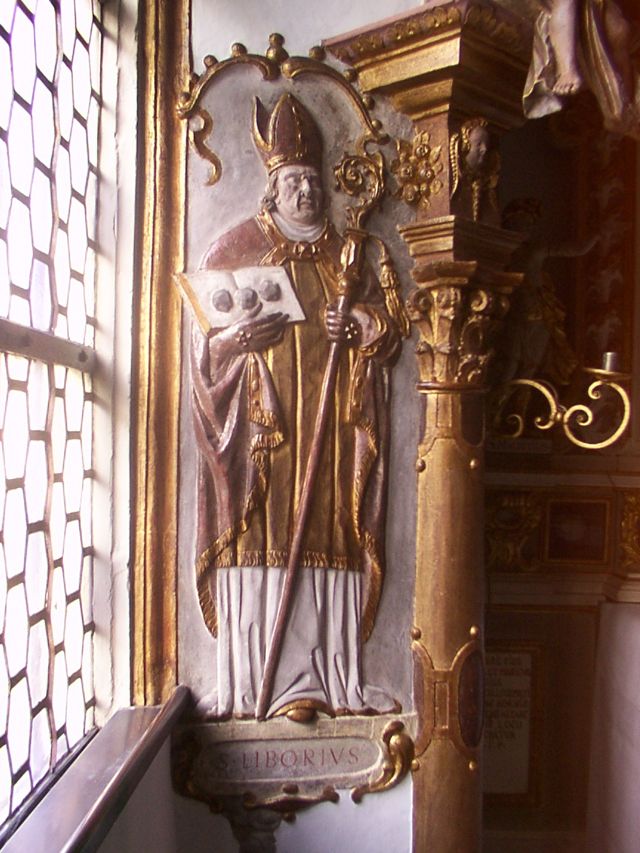
According to Nieremberg, on the feast of S. Apollinaris, such large numbers of ravens arrive at Ravenna that the inhabitants kill and throw out a horse to feed these black pilgrims. However, this story likely originated in Germany, as the name Ravenna resembles the word Raben, which means raven. S. Apollinaris is usually depicted as a bishop, holding a sword or a club; and in Germany, he is shown with a raven at his side.
Footnotes
- Venantius Fortunatus (d. c. 600)
- Pope Gregory the Great (d. 604)
Baring-Gould’s own footnotes, in modern English.
Read the original 1870s text
Baring-Gould’s sources: Roman Martyrology, and almost all Latin Martyrolpgies.] B AINT APOLLINARIS was the first bishop of Ravenna, sent there, according to the apocryphal Acts, by S. Peter. From a very early period S. Apollinaris has been reverenced at Ravenna. S. Peter Chrysologus, in a sermon on his festival, styles him a martyr, not because he died for Christ, but because on several occasions he was called to shed some of his blood in testimony of his faith.
He was first burried at Classis, the ancient port of Ravenna, now choked with sand. In 549 his relics [the bodily remains of a saint, or objects they used, kept with honor] were translated to a vault under a church dedicated to him at Classis. Venantius Fortunatus (d. c. 600) exhorts the faithful to make pilgrimages to his tomb, and S. Gregory the Great (d. 604) ordered oaths in doubtful lawsuits to be taken before the tomb of S. Apollinaris Pope Honorius built a church under his name in Rome The apocryphal Acts are as dull as they are devoid of historical value.
J See lulv q, r. an The body of S. Apollinaris is still at Classis. It has been repeatedly examined, and all the bones are there. Nevertheless a head of the saint is shown in the church of S. Apollinare Nuovo at Ravenna, four miles off; another head at Cisoin, near Lisle, in France; one of the arms in the church of S. Martin [St. Martin of Tours (d. 397), soldier turned bishop] des Pres at Paris; an arm at Floreffe, near Namur; several relics at Fulda; others at S. Apollinaris, above Andernach, on the Rhine; others at Bologna, in the churches of S. Peter and S. John “ in Monte others at Catania in Sicily, a part of the thigh and of another head at Cologne. Other relics at Dijon, Brindisi, &c. But as there were some five or six other saints of the same name, it is probable that some of these skulls and arms belong to them, but have been mistaken for those of the better known Apollinaris of Ravenna.
According to Nieremberg, 1 on the feast of S. Apollinaris, such swarms of ravens arrive at Ravenna, that the inhabitants kill and throw out a horse to feed these black pilgrims. But the story, no doubt, arose in Germany, from the name Ravenna bearing some resemblance to the word Raben, a raven. S. Apollinaris is usually represented as a bishop, holding a sword or a club; and in Germany, with a raven at his side. •S’. John Cassian.