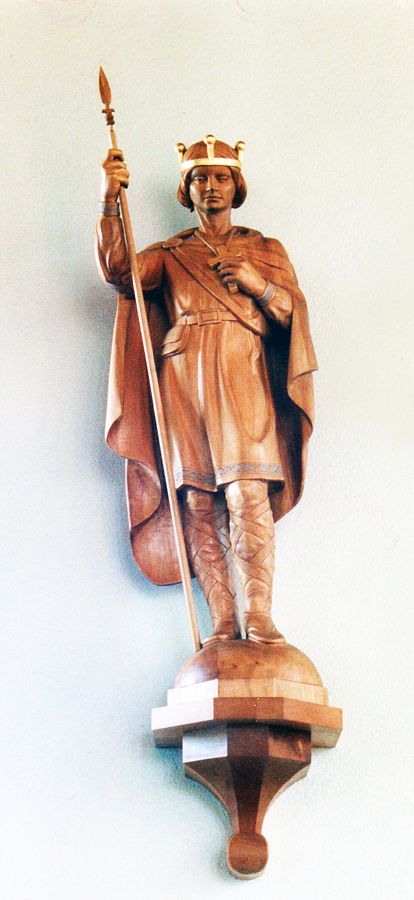
…out, for it was written in English. Finally, an Englishman was found, and he read the letter. It stated that Kenelm, the young king of the Mercians, had been cruelly murdered, and his body hidden in a thicket.
So the pope wrote letters to the kings of England, informing them of the evil deed that had been done in their land. Men then went out to search for the body of Kenelm the young king. As they searched, they saw a pillar of light shining over the thicket, and in the thicket, they found the body of Kenelm. They then carried the body to Winchelcombe, in Gloucestershire, and buried it there. Over the place where they found his body, they built a chapel, which is called S. Kenelm’s chapel to this day. It is near Halesowen, in Shropshire.
It is difficult to determine the basis for this story. The Anglo-Saxon Chronicle does not mention Kenelm. However, it is not unlikely that the son of Kenwulf was killed, as such occurrences were not rare in Anglo-Saxon history.
Footnotes
- The Anglo-Saxon Chronicle is a collection of annals in Old English chronicling the history of the Anglo-Saxons.
Baring-Gould’s own footnotes, in modern English.
Read the original 1870s text
Baring-Gould’s sources: Sarum Breviary of 1499; Anglican Martyrologies, the Arburthnott, and the Hyrdmanistoun Kalendar, Nova Farina Kalendar, Greven in his German Martyrology, and Ferrarius in his Catalogue of the Saints. Authorities William of Malmesbury and Florence of Worcester, and John of Brompton.] This is the legend of Kenelm. King Kenwulf of Wessex died in 819, and left two daughters, Cwendrida and Burgenilda, and a son, a child of seven years old, named Kenelm. Cwendrida envied her little brother, and thought that if he were killed, she might reign as queen. She therefore spake to Askbert, his guardian, and gave him money, and said, “ Slay me my brother, that I may reign.” But Burgenilda was not privy to this wicked device, for she loved her little brother. Then Askbert took Kenelm into a wood, under pretence of hunting,* and the child, tired with the heat, lay down under a tree and went to sleep. Askbert began to dig a grave; but the boy woke and said, “ It is in vain that you think to. kill me here. I shall be slain in another spot. In token whereof see this rod blossom.” And he stuck a stick into the ground, which instantly took root and began to flower. And it grew in after days to be a great ash tree, which was called S. KeneWs ash. Then Askbert took the little king to another spot, and the child began to sing the “Te Deum,” and when he came to the verse, u Thee, the white-robed army of martyrs praise,” the assassin smote off his head; and then he buried him in the thicket. Now at the same time, lo ! a white dove flew into the church of S. Peter at Rome, with a letter in its beak, which it deposited on the high altar. And men took the letter and tried to read, but they could not make it [Jnijr 17.
…out, for it was written in English. At last an Englishman was found, and he read the letter. And it stated that Kenelm, the little king of the Mercians, had been cruelly murdered, and his body hidden in a thicket.
So the pope wrote letters to the kings of the English, and told them what an evil deed had been done in their land. So men went forth to seek for the body of Kenelm the little king. And as they went, they saw a pillar of light shining over the thicket, and in the thicket they found the body of Kenelm. Then they carried the body to Winchelcombe, in Gloucestershire, and there buried it. But over the place where they found his body, they built a chapel, and it is called S. Kenelm’s chapel to this day. It is near Halesowen, in Shropshire.
It is hard to say what foundation there is for the story. The Anglo-Saxon Chronicle does not mention Kenelm. Yet it is not improbable that the son of Kenwulf was killed, such occurrences were r.ot rare in Anglo-Saxon history.