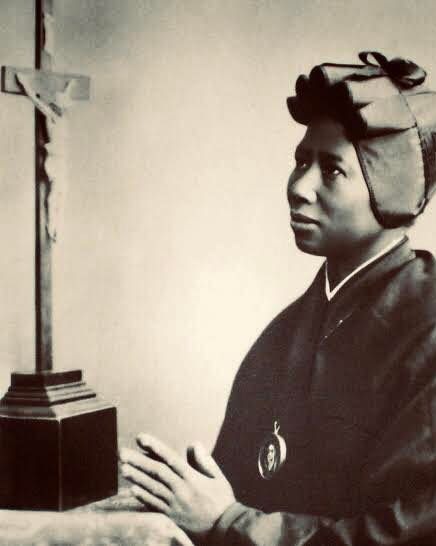
St. Josephine Bakhita

Josephine Bakhita, a former slave from Sudan, is celebrated for her remarkable journey to freedom and her lifelong dedication to God as a Canossian sister. Josephine Margaret Bakhita was born around 1869 in Olgossa, Sudan, into a loving family of the Daju people.

Read the story →
February 8 · Religious, Nun, Foundress

St. Josephine Bakhita

Feast

February 8
Verified · General Roman Calendar

Status

Saint
Canonized 1 October 2000 by Pope John Paul II

Represents

Religious
Nun
Foundress

Feast days

Feast: February 8

This Saint’s Story

Written for this site from Wikipedia and The Holy See (vatican.va)

Josephine Margaret Bakhita was born about 1869 at Olgossa in Darfur (now western Sudan), among the Daju people. She remembered a happy childhood with brothers and sisters until Arab slave traders seized her at about seven or eight—after they had already taken an elder sister. Sold several times over some twelve years, she forgot her birth name. Captors called her Bakhita, Arabic for "fortunate" or "lucky." She later described whip wounds and a scarring of 114 patterns cut into her skin and packed with salt.

In 1883, in Khartoum, the Italian vice consul Callisto Legnani bought her and treated her without beatings. When he left for Italy she begged to go with him. In Genoa she was given into the care of the Michieli family and became nanny to their daughter Mimmina at Zianigo near Venice. In late 1888, while the Michielis arranged a move back to Sudan, Bakhita and Mimmina were placed with the Canossian Sisters in Venice. There she first learned who the God was whom she had already sensed in the beauty of the world.

When Mrs. Michieli returned to reclaim her, Bakhita refused to leave. On November 29, 1889, an Italian court ruled that she had never been a legal slave under British Sudanese and Italian law. Free at last, she chose the Canossians. On January 9, 1890, Cardinal Giuseppe Sarto (later Pope Pius X) baptized her Josephine Margaret Fortunata, confirmed her, and gave her First Communion. She entered the novitiate in 1893 and made vows on December 8, 1896.

From 1902 she lived mainly at the Canossian house in Schio (Vicenza), as cook, sacristan, and doorkeeper. Townspeople called her Madre Moretta—"Black Mother." In later illness she answered how she was with "As the Master desires." She died at Schio on February 8, 1947. Pope John Paul II beatified (declared 'Blessed', the step before sainthood) her on May 17, 1992, and canonized (officially declared a saint by the pope) her on October 1, 2000. Her feast is February 8. She is remembered especially with Sudan and with those who suffer human trafficking.
What she represents

How she teaches us to live

Drawn from their life story

Embrace your identity in Christ. Bakhita's journey from slavery to freedom in Christ shows the transformative power of faith.

Respond to suffering with love. Her ability to forgive those who harmed her exemplifies profound compassion and grace.

Live joyfully in service. Despite her past, Bakhita dedicated her life to serving others, reflecting her deep love for God.

More about St. Josephine Bakhita

Checked against at least two sources, in our own words

  • She was kidnapped at a young age and endured years of slavery before finding freedom. · Wikipedia Franciscan Media
  • Bakhita was baptized and confirmed in 1890, marking a new beginning in her life. · Wikipedia Vatican

Help us add to this saint's story

Everything is read by a person before anything appears. Facts are checked against trusted sources first.

Facts are welcome; a source link helps (optional).With your permission we may share it on this page.

Nine days · Free

Pray the novena
with us.

One short email a day for nine days. The day's prayer, a line from St. Josephine Bakhita's story, and a nudge to keep going.

Also on February 8
St. Juventius

St. Juventius

February 8 · Bishop, Confessor
D

Sts. Dionysius

February 8 · Martyrs
P

St. Paul of Verdun

February 8 · Bishop
← All 1970 saints in the library
Sources & notes

Feast-day sources

Story sources

Sources

Credits

Image: Photograph of Saint Josephine Bakhita (c. 1910).jpg · Photograph of St. Josephine Bakhita, c. 1910, photographer unknown. Cropped to a portrait that keeps the crucifix. The Commons file is tagged CC0 as the uploader’s own work; that claim is not reliable (the photograph predates the uploader). Basis used here: an anonymous Italian photograph made around 1910. Under the Italian term for simple photographs (20 years from creation) it was in the public domain in Italy long before 1 January 1996, so it was not restored in the United States under the URAA (PD-1996). · Public domain, via Wikimedia Commons