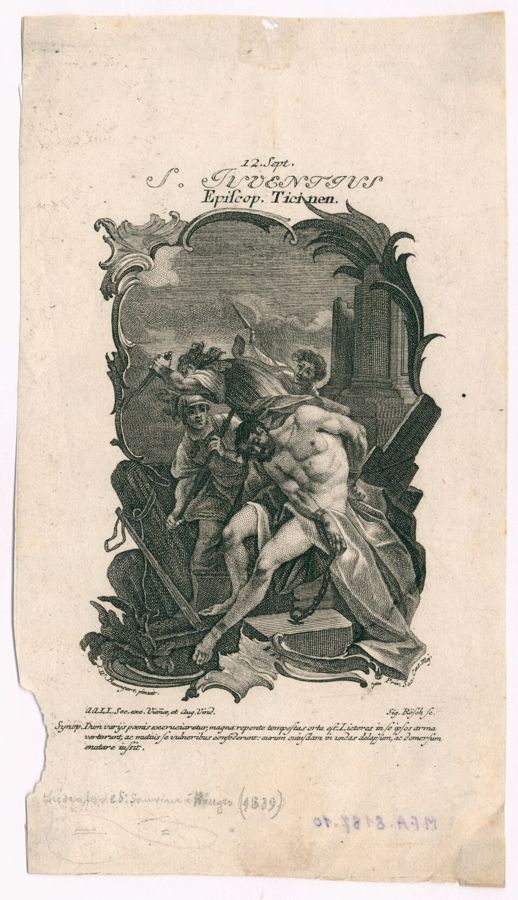
Hermagoras, the disciple of Saint Peter the Apostle and Saint Mark the Evangelist, who was also the Bishop of Aquileia, sent Syrus and Juventius to preach the Gospel in Ticinum, or Pavia. When it became known that Saints Celsus and Nazarius had been martyred for their faith in Milan, and that Saints Gervase and Protasius were imprisoned, Syrus sent Juventius to Milan to comfort the church there and encourage the Confessors. Upon his return, he was ordained by Saint Syrus, who had received episcopal consecration from Saint Hermagoras. He succeeded Syrus, his mentor, as the bishop of Pavia. However, few traditions from his time as bishop have been passed down to us. Perhaps the most interesting one is this: A tax collector, while crossing the river, nearly drowned and lost the money for which he was responsible. In great distress, the man hurried to the bishop, who, feeling compassion for his trouble, went with him to the banks of the Ticino River and cried out, "I say to you, O water, on which Christ the Lord walked, in His name restore the money for which this man is distressed!" Immediately, the bag of coins was washed up to their feet.
Porphyrius, the prefect of Rome, after traveling through the region, arrived in Pavia to investigate the Christians and others considered to be disturbing the peace of the Commonwealth. Juventius was brought before him, and Porphyrius was so impressed by his gentleness and innocence that he let him go, with a warning to refrain from preaching the doctrine of Christ to the people. To avoid persecution, the bishop decided to stop public speeches and discussions and limited himself to private teachings of the truth.
Footnotes
- Porphyrius was the prefect of Rome, a high-ranking official responsible for maintaining order.
Baring-Gould’s own footnotes, in modern English.
Read the original 1870s text
Baring-Gould’s sources: Roman Mart., and that of Usuardus. Juventius is sometimes called Eventius, but it seems that Eventius, B. of Pavia, was a later prelate, and ought not to be confounded with Juventius. The Acts are late, written by Paulus Diaconus, or at all events re-written by him in what was regarded as a more polished style. These Acts belong to S. Syrus, see December 9th; but contain much concerning S. Juventius.
HERMAGORAS, the disciple of S. Peter the Apostle, and S. Mark the Evangelist, who was also Bishop of Aquileia, sent Syrus and Juventius to preach the Gospel in Ticinum, or Pavia. When it was known that SS. Celsus and Nazarius had shed their blood for the faith at Milan, and that SS. Gervase and Protasius were in bonds, Syrus sent Juventius to Milan, to comfort the church there, and to animate the Confessors. On his return he was ordained by S. Syrus, who had received episcopal consecration from S. Hermagoras. He succeeded Syrus, his master, in the see of Pavia [a bishop’s “see” is his diocese, named from his seat (Latin sedes)]. But few traditions of his episcopate have been wafted down to us. Perhaps the most interesting is this. A collector of taxes in crossing the river was nearly drowned, and lost the money for which he was held responsible. In great tribulation, the man hastened to the bishop, who, commiserating his trouble, advanced with him to the banks of the Ticino, and cried, "I say unto thee, O water, on which Christ the Lord walked, in His name restore the money for which this man is distressed!" Immediately the bag of coins was washed to their feet.
Porphyrius, præfect of Rome, having made the circuit of the country, came to Pavia, holding inquisition upon the Christians and other reputed disturbers of the Commonwealth. Juventius was brought before him, and Porphyrius was so won by his gentleness and innocence that he let him go, with an admonition to abstain from preaching the doctrine of Christ to the people; and the bishop, to prevent a persecution, abandoned public orations and discussions, and confined himself to private expositions of the truth.