St. John Chrysostom

St. John Chrysostom (c. 347–407), archbishop of Constantinople, was such a great preacher he was nicknamed 'golden-mouthed.' He is a Doctor of the Church; his feast is now September 13.

Read the essentials →
Feast September 13 · Bishop, Deacon

St. John Chrysostom

Current feast

September 13
Verified · General Roman Calendar

Traditional feast

January 27
1914 / pre-1969 calendar, per Baring-Gould (1914)

Represents

Bishop
Deacon

Feast days

Feast: September 13
Traditional: January 27

This Saint’s Story

John Chrysostom—the Doctor of the Church (a title the pope gives to a saint whose teaching is of special value to the whole Church) treated in the Catholic Encyclopedia article “St. John Chrysostom”—was born at Antioch about 347 and died at Comana in Pontus on 14 September 407. The surname “Chrysostom” (“golden-mouthed”) was given for his eloquence; the Encyclopedia notes it first appears in writing only in 553, and calls him the greatest preacher ever heard in a Christian pulpit. His father Secundus, a high-ranking officer, died soon after his birth, and his mother Anthusa, widowed at twenty, raised him and sent him to the best schools, including the lectures of the pagan orator Libanius. Baring-Gould records the tradition that Libanius, asked to name a successor, answered that John would be fittest “if the Christians had not stolen him.”

Drawn by Bishop Meletius, he was baptized and made lector, lived among ascetics under Diodorus, and then spent two years as a hermit in a cave until fasting and cold ruined his health. Made deacon about 381 and priest by Flavian in 386, he preached for twelve years at Antioch; in the Lent of 387, after riots had thrown down the emperor’s statues, his sermons “On the Statues” steadied the terrified city until pardon came. His consecutive homilies on Scripture date largely from these years.

In 397 he was carried off secretly to Constantinople and consecrated bishop on 26 February 398 by Theophilus of Alexandria, who resented the choice. He cut household expenses, applied the savings to hospitals, and rebuked clergy and court alike, offending the Empress Eudoxia. In 403 Theophilus and his allies deposed him at the Synod of the Oak (a hostile gathering of bishops near Chalcedon); recalled almost at once, he was exiled again on 24 June 404, first to Cucusus in Armenia. Forced on toward Pityus, he collapsed and died at Comana with the words, “Glory be to God for all things.” His body was brought back to Constantinople on 27 January 438. The Encyclopedia names no patronage.

What he represents

How he teaches us to live

Drawn from themes in the original account

Stay faithful when it costs you. Holding firm under pressure is part of this story.

Share your faith, in words and by example. Preaching and conversion are part of this story.

Give to people in need. The account records care for the poor.

Take one thing from this life into your own. He told the rich and powerful the truth and paid for it with exile.

The full story

Baring-Gould’s account retold in modern English

Read the full story · 4,175 words · about 18 min

John Chrysostom was the son of Secundus, a military officer. He was born around 347 in Antioch. After his father's death, which occurred soon after his birth, he received careful and Christian training from his devout mother, Anthusa. He studied rhetoric under the skilled pagan teacher Libanius. When Libanius was later asked to name his successor, he replied, "John would be the fittest, if the Christians had not stolen him."

He was baptized by Meletius, the patriarch of Antioch. His closest friend was S. Basil, and Anthusa had to earnestly plead with him to counter Basil's suggestion that they both retire into monastic life. Chrysostom, as we may conveniently call him, could not resist his mother's appeal. He continued to live at home while practicing monastic asceticism and diligently reading Scripture. He studied theology under Diodore, who was a companion of Flavian. They had both been champions of orthodoxy against Arianism, first as laymen and later as priests in Antioch. Meletius, who baptized John Chrysostom, was himself a confessor. It was likely around 372-374 that Chrysostom and Basil were considered likely candidates for bishoprics. Chrysostom, through a clever maneuver—whose justification is the least appealing part of his treatise "On the Priesthood"—managed to secure Basil's consecration while avoiding the burden himself.

For several years, he followed the plan he had abandoned during his mother's lifetime. He lived first in cenobitic "tabernacles" and later as a hermit in a cave. However, his health, which was never strong, deteriorated, and he was forced to return to Antioch, where he entered the ministry.

In early 387, a rise in taxes led the people of Antioch to revolt. They destroyed the bronze statues of Emperor Theodosius and his deceased wife, the pious and charitable Flacilla. Flavian, who had been elected and consecrated patriarch after Meletius's death, set out shortly before Lent to appease the emperor. He encountered the imperial officers sent from court to punish the insult. His absence was effectively covered by Chrysostom, who had recently been ordained as a priest. Chrysostom began to address this crisis with a series of "Sermons on the Statues." In these sermons, he tried to calm the people's fears and convince them of their persistent sins, with swearing being the most significant. He succeeded to such an extent that the churches were filled all day. The people of Antioch were eventually pardoned by the emperor at the intercession of the patriarch.

Chrysostom had been a deacon for five years and a priest for twelve years when Nectarius, the bishop of Constantinople, died in 397. Nectarius had led a time during which the general conduct of the clergy had become more relaxed. "Then," says the biographer of Chrysostom, "some who were not wanted came together, unworthy priests besieging the palace gates, resorting to bribery, and even falling on their knees before the people." Disgusted by this scandalous eagerness for an office that saints typically feared, the faithful urged Arcadius, the Emperor, to find someone who could fulfill the role with dignity.

Eutropius, the emperor's chamberlain, had come to admire Chrysostom's character during a visit to Antioch. He persuaded Arcadius to write to the military commander in Antioch, asking him to send the priest John to Constantinople without causing any public disturbance. The commander sent a message to Chrysostom, asking him to meet him "at the Church of the Martyrs, near the Roman Gate." Chrysostom agreed, was placed in a public carriage, and was quickly taken away from the place of his early life and priestly work.

Several bishops were called for the consecration. Theophilus of Alexandria had come to Constantinople to seek the appointment for his priest Isidore. He was required to consecrate Chrysostom but tried to withdraw, reading the determination and seriousness of Chrysostom in his face. He disliked Chrysostom because he was a completely worldly and self-serving bishop. However, Eutropius showed him some documents, saying, "Choose between consecrating John and facing a trial on the charges made against you in these papers." Theophilus had no response. He consecrated Chrysostom on February 26, 398, but he never forgave him for causing this significant embarrassment.

In a city where intrigue and flattery were the common paths to honor, John Chrysostom, straightforward and outspoken, was appointed as patriarch. He became the chief shepherd over a clergy that had become complacent and sycophantic, flattering the rich and powerful, fawning over the emperor for positions, and neglecting their responsibility to the poor.

Chrysostom immediately began his work as a reformer of abuses. He forbade the clergy from attending the banquets of wealthy individuals. He fought against the practice of entertaining "spiritual sisters." Several clergy members were removed from their positions, which earned Chrysostom the intense dislike of many within the clergy. He examined the financial accounts of the church stewards, eliminated unnecessary expenses, and ordered the savings to be used for maintaining hospitals. He scrutinized the lives of the widows receiving pensions from the Church. He earnestly requested contributions to a fund for the poor. He urged the faithful to attend the nighttime services but advised them to leave their wives at home with the children. He reprimanded the wealthy for their pride and selfishness. The charm of his "golden-tongued" eloquence, along with the unmistakable nobility and sincerity of his character, led to "the city putting on a new aspect of piety." As a result, the worship of the Catholics became more genuine, and their lives more earnest and pure.

Among the higher classes in Constantinople who were offended by the uncompromising nature of their new archbishop was Eutropius, the chamberlain, who had elevated him to the position. Eutropius wanted the Church to be respectable and obedient, with the patriarch being pious and submissive to the state. In his view, the Church was part of the state organization, and the clergy served as moral enforcers, always under the crown's direction. However, under Chrysostom's leadership, the Church was becoming unmanageable and independent. To limit its freedoms, Eutropius secured a law to revoke the right of asylum in churches, a right that had developed over the past century. But he was soon forced, due to a change in the emperor's decisions, to cling to the altar as a means of protecting his life. Chrysostom defied the new law in defense of its author. While Eutropius hid in the sanctuary, Chrysostom instructed the people to take home this new lesson on the futility of earthly power. "The altar," he said, "is more awe-inspiring than ever, now that it holds the lion chained." He called on his listeners to plead for the emperor's mercy, or rather, to ask the God of mercy to save Eutropius from impending death and help him repent for his many crimes. He bravely stood against the court in the name of Christian humanity, but Eutropius himself left the church and was sentenced to exile.

At this time, the Origenist controversy was intense and filled with hostility. It is hard to form a clear opinion about it. Origen had certainly published some heretical views, but some opinions attributed to him were not actually his. Theophilus of Alexandria had strongly supported the Origenists, but he was not a principled man; he chose the views that suited his interests at the moment. When he found it more beneficial to oppose Origenism, he condemned it in his Paschal letters in 401.

The monks and hermits of Egypt were viewed negatively by pagans, Arians, and insincere Christians. All the educated, philosophers, and literati among the pagans were eager to protest against them. The passionate efforts of the monks against idolatry, and their increasingly successful attempts to eradicate it from the hearts of the rural population, naturally angered the last defenders of the idols. The Arians were even more relentless than the pagans. These enemies of the Divinity of Christ sought to abuse, degrade, and suppress the spirit of Christianity in every way. How could the monastic life, which was its most glorious expression, escape their wrath? The conflict between them and the monks was therefore long and brutal.

The persecution that paganism barely had time to ignite under Julian was merciless under the Arian Constantius, and more cunning, though not more effective, under the Arian Valens. During Constantius's reign, entire monasteries, along with the monks inside them, were burned in Egypt. In the horrific persecution led by the Arian patriarch Lucius in Alexandria, a group of imperial soldiers ravaged the solitude of Nitria and massacred its inhabitants. Lucius was then succeeded by the worldly, ambitious, and completely unspiritual Theophilus, who despised the poor monks of the desert as a living reminder of his own self-serving nature and his goal to adapt Christianity to worldly desires.

He soon had a falling out with S. Isidore the hospitaller, who had suffered under the Arian Lucius, and whom he now expelled from Alexandria. He hated Isidore, as those who cling to wealth often hate those who cling to Christ. Isidore fled to Nitria. Theophilus accused the monks there of Origenism. The main Nitrian monks were Dioscorus, Bishop of Nitria, Ammonius, Eusebius, and Euthymius; they were known as the "Tall Brothers." Theophilus ordered their expulsion. When they came to protest, his eyes flashed, his face turned pale, he threw his episcopal pallium (a type of cloak) around Ammonius's neck, struck him in the face with an open hand and a clenched fist, and shouted, "Heretic, anathematize Origen!"

They returned to Nitria, but the patriarch condemned them without hearing their case in a synod and then attacked their monasteries at night, leading a drunken mob. Dioscorus was dragged from his throne; the cells of the other three were burned, along with copies of both Testaments and even the reserved portions of the Holy Eucharist. It was reported that a boy died in the flames. The brothers, along with many of their companions, fled to Scythopolis in Palestine, hoping to support themselves by weaving palm-baskets in a place known for its palm trees. The enmity of Theophilus drove them out of this refuge; they reached Constantinople and fell at Chrysostom's feet. "Who is it," he asked with tears, "that has harmed you?" They replied, "Pope Theophilus; please, father, persuade him to allow us to live in Egypt, for we have never done anything against him or against our Saviour's law."

He housed them in the church called Anastasia. He allowed them to attend the service, but wisely, to avoid a conflict with their persecutor, he barred them from communion. They had been condemned by their own patriarch, and it was not his place to admit them to communion without a proper investigation and official clearance. He wrote to Theophilus, addressing him as a "son and brother," asking him to reconcile with the fugitives. However, Theophilus, who denied his right to interfere, slandered them as sorcerers and heretics. The Tall Brothers then appealed to the emperor and empress, who ordered Theophilus to be summoned and the accusations he made against the brothers to be examined. The accusations were quickly shown to be baseless. Theophilus, who openly stated he was "going to court in order to depose John," arrived in Constantinople in June 402, bringing gifts for the emperor, the empress, and the court from Egypt and India. He immediately adopted a tone of contemptuous hostility towards S. Chrysostom. He refused to visit or speak to him and even avoided entering the church.

While Chrysostom chose not to hear the complaints of the Tall Brothers in a judicial manner, Theophilus was plotting his deposition. All the courtiers among the bishops and the worldly clergy wanted this, as they resented his godly discipline, and his example of self-denial was a constant challenge to their self-indulgence. Acacius, Bishop of Berrhœa, had been given such a simple lodging by Chrysostom that he joined the dissenters, expressing his frustration with the odd threat, "I will cook a dish for him!" Eudoxia, the empress, who had heard of a sermon in which Chrysostom criticized the pride of women, sided with his enemies, who decided to hold a council in a suburb of Chalcedon called "The Oak." Thirty-six bishops attended. Twenty-nine charges were brought against the patriarch. Some were of outright violence; he had beaten and chained a monk, struck a man in church so that he drew blood, and then offered the sacrifice. Others were accusations of slander; he had said his clergy "were not worth three-pence" and had accused three deacons of stealing his pallium. He was also charged with misconduct in his office; he sold church furniture, was careless in granting orders, was unsociable, gave women private meetings, was irreverent in church, and ate wafers while sitting on his throne. Some of these charges were gross exaggerations of his straightforward severity, which showed no favoritism. Others were more or less malicious fabrications. One of the most despicable charges was regarding the disposal of church ornaments. Like other saints, he had done this for the sake of the suffering poor.

While these charges were being read at the Oak, he sat in his palace with forty bishops and comforted them by quoting texts from Scripture. "I am now ready to be offered. Do not weep and break my heart! To live is Christ, and to die is gain."

Then, two young bishops from the council at the Oak entered, citing "John" to appear, along with other clergy. The forty bishops sent a delegation to protest to Theophilus. Chrysostom, for himself, sent word that he objected to Theophilus and three others as unfit to be his judges due to their open hostility. A bishop named Isaac presented a new list of charges, three of which were particularly notable. He had used strong language about the fervor of rapturous devotion. He had been emphatic in his assurances of God's long-suffering. This was condemned as encouraging sinners in their sins, but it was overlooked that he had warned people against presuming on that long-suffering. "He had eaten before administering baptism," referring to the Paschal baptism that was immediately followed by a celebration of the Holy Eucharist, which implied that the sacrifice was performed without fasting; and "he had given the Eucharist to people who were not fasting," two charges that he strongly denied. "If I have done this, may my name be removed from the list of bishops," he said. The council declared him contumacious (disobedient) and deposed him, asking the emperor, Arcadius, to also punish him for his insolence towards Eudoxia. This occurred in 403.

Chrysostom, appealing in vain to a more just tribunal, was dragged from his church and hurried by night into Bithynia. That night, an earthquake shook the palace; Eudoxia, frightened by the omen, wrote to the exile, begging him to return. He was escorted back to the city by a joyful crowd, carrying candles and singing psalms, who forced him, despite the irregularity of such an action, to ascend his throne before the council's sentence from the Oak could be overturned. This was, however, quickly done by a synod of sixty bishops; the hostile assembly could not maintain its position, and Theophilus, after shamefully forcing the two surviving brothers, on the basis of their monastic obedience, to ask for his pardon, sought safety by fleeing to Alexandria.

New troubles soon began. In September of the same year, 403, a silver statue of Empress Eudoxia was erected near the cathedral. The Manichean governor of the city encouraged wild and pagan dancing in its honor, which interrupted the church service. Chrysostom spoke strongly about this issue and was said to have begun a sermon with the words, "Again Herodias rages, again she demands the head of John." His enemies seized the opportunity. His old enemy Theophilus sent three bishops to Constantinople. The weak Emperor Arcadius was persuaded to order that Chrysostom should be denied the use of the churches.

Easter-eve came on April 16. Arcadius said to the chief adversaries of Chrysostom, "Make sure that you are not giving me bad advice." They replied, "Let the deposition of John be on our heads!" One of the forty faithful bishops urged the proud empress to fear God and have compassion for her own children. As the churches were closed to S. John Chrysostom, he held the solemn services of the day in the Baths of Constantine. The people flocked there, abandoning the churches. The courtier bishops complained, and it was decided to break up this gathering. A group of soldiers was sent along with four hundred barbarian recruits to clear the bath around 9 p.m.

They pushed forward to the baptismal font, scattering the catechumens, as it was customary to baptize many on that day. They struck the priests on the head until their blood mixed with the baptismal water. They rushed up to the altar where the sacred Body and Blood were reserved for the newly baptized and overturned them. As S. Chrysostom says in his letter to Pope Innocent of Rome, "the most holy Blood of Christ, as might be expected in such a great tumult, was spilled on the clothes of the soldiers." Thus, the Arian horrors were renewed.

On Easter day, Arcadius, riding out of the city, saw about three thousand newly baptized in their white robes. "Who are those people?" he asked. "They are heretics," was the answer, and a new attack was made against them. During the paschal season, those who refused to disown S. Chrysostom were thrown into prison. Instead of the joyful worship of the season within the churches, the sounds of torture were heard, along with the terrible oaths by which men were forced to anathematize the archbishop. His life was attempted twice; his people guarded his house. He wrote an account of what had happened to the Bishops of Rome, Milan, and Aquileia. Pope Innocent, who had already heard Theophilus' version of the story, continued to offer communion to both parties for the time being, but summoned Theophilus to attend a council.

Towards the end of Whitsun week, Arcadius was persuaded to send another message to Chrysostom: "Commend your affairs to God, and depart." Chrysostom was convinced to leave secretly; he gathered his friends for prayer, kissed them, said goodbye to the deaconesses in the baptistry, and asked them to accept a new bishop if one was ordained without his request. "The Church cannot be without a bishop." While the people waited for him to mount his horse at the great western door, he exited through the eastern door, repeating to himself the words of Job, "Naked came I out of my mother's womb, and naked I return thither!"

This was his final expulsion on June 20th, 404. He crossed over to Bithynia, while a fire broke out that consumed the cathedral and the palace of the senate. Some blamed it on arsonists; others considered it a sign of divine wrath. Several of Chrysostom's friends, known as the "Joannites," were cruelly treated as if they were responsible for the fire.

His place of exile was Cucusus, in Armenia. After a journey that was only made bearable by signs of sympathy and respect, he arrived in the middle of September. The bishop of Cucusus offered to resign his position in his favor, and Dioscorus, a man of rank, asked him as a favor to stay in his house, which he furnished for the exile's comfort with such generosity that Chrysostom remarked, "I am continually exclaiming." Soon after he reached Cucusus, Empress Eudoxia gave birth to a stillborn child and died.

Pope Innocent wrote to the exile, encouraging him to be patient by citing examples from Scripture. "A good man can be tested, but he cannot be defeated, while the Divine Scriptures strengthen his mind. Venerable brother, let your conscience comfort you." He also wrote to the clergy and laity of Constantinople, announcing his intention to hold a General Council to resolve these unfortunate disputes.

The saintly exile in Cucusus, while suffering from illness and extreme cold, and in constant danger from bandits, continued to fulfill the role of a good shepherd. He wrote letter after letter to the faithful lady Olympias in Constantinople, urging her to remember that the only truly terrible trial was sin. He lamented that faithful bishops were suffering for remaining loyal to his communion; he encouraged them and their clergy to be courageous. His pastoral concern extended well beyond a general care for his brethren's welfare. He rebuked two priests of Constantinople, one of whom had only preached five times between his expulsion and October, while the other had not preached at all; he initiated a mission to the pagans of Phoenicia; he was eager to have a good bishop consecrated for the Goths; he strengthened the old ties that connected him to the clergy of Antioch; and he used part of his friends' contributions to redeem captives and help the poor.

Pope Innocent now boldly supported his cause, as that of a confessor for righteousness' sake. He gathered a synod and persuaded Honorius, Emperor of the West, who had already protested to Arcadius, Emperor of the East, to write in a more forceful tone. Honorius demanded a council at Thessalonica and pointed out Theophilus of Alexandria as the supposed author of the current troubles.

Towards the end of the year, the violent attacks by the Isaurian robbers, which filled the country with plunder and bloodshed, forced S. Chrysostom to take refuge in the castle of Arabiscus. The winter was once again a time of discomfort; he could not obtain enough medicines, and the snowdrifts prevented him from receiving letters from his friends. Around this time, the western delegates sent from Rome, along with four eastern bishops who had gone there to advocate for Chrysostom, were intercepted on their way to Constantinople and imprisoned in a fortress. Their credentials were violently taken from them, and instead of being allowed to see Arcadius, the western delegates were sent back to Italy while the eastern bishops were banished to the borders of the empire. On their journey, they were cruelly mistreated, robbed of their money, exhausted by long days of travel, and forced to stay in the most disreputable places. One of them comforted his companions by noting that their presence reminded the wretched women of God, which might lead to their salvation and His glory. The fact that the persecution was largely a calculated revenge against Chrysostom as a representative of strict clerical standards is shown by the incident where a respected man named Hilary was whipped, not by a judge, but by the clergy. Chrysostom wrote to thank his western friends for their support and sent a second letter to Pope Innocent, assuring him that "in the third year of exile, amid famine, disease, war, sieges, indescribable solitude, and daily danger from Isaurian swords, he was greatly consoled and delighted by Innocent's genuine, steadfast, and abundant charity."

The winter of 406-407 was severe, but Chrysostom maintained his health by staying inside a warm and well-heated room. In the summer, his enemies, fearing his influence on the people of Antioch who came to visit him, arranged for his removal to Pityus, located on the shores of the Black Sea, which was the last fortress of the empire. His guards were instructed to wear him down with long journeys. He was hurried along through scorching heat and heavy rains, and he was never allowed the comfort of a bath; only one of the guards showed him any secret kindness. This painful journey lasted for three months; finally, they stopped at the Church of S. Basiliscus, which was a short distance from Comana in Pontus. That night, the suffering man had a premonition that his release was near. The martyr Basiliscus appeared to him and said, "Courage, brother John, tomorrow we shall be together."

In the morning, on September 14, 407, he requested to stay in the church until eleven o'clock in the morning. This was not permitted; he was forced to continue, but after traveling about four miles, it was clear that he was dying, so they returned to the church. There, he asked for white garments and changed out of the ones he was wearing. He was still fasting; he received Holy Communion, likely from the priest of the church, offered his last prayer, and added his usual thanksgiving, "Glory to God for all things," sealing it with a final, Amen. Then he stretched out his feet, which had run so beautifully for the salvation of the penitent and the rebuke of habitual sinners, and calmly passed away, at about sixty years of age and in the tenth year of his episcopate. He was buried beside the martyr Basiliscus, and his funeral was attended by a crowd of virgins and monks from Syria, Cilicia, Pontus, and Armenia. No commentary on his glorious life could be as expressive as the doxology with which it concluded, which, bringing together all its contrasts, recognized the gracious presence of a never-changing Love in both success and honor, as well as in cruel outrage and homeless desolation.

Footnotes

  1. Flavian was the patriarch of Antioch after Meletius.
  2. Arianism is a theological belief that denies the full divinity of Jesus.
  3. Cenobitic refers to a monastic life lived in community.
  4. Theophilus of Alexandria was a bishop known for his worldly ambitions.
  5. Eutropius was a high-ranking official in the Byzantine Empire.
  6. Theophilus of Alexandria was a bishop known for his opposition to the monks.
  7. S. Isidore the hospitaller was a monk who cared for the sick and poor.
  8. The pallium is a woolen cloak worn by bishops.
  9. Scythopolis is a city in modern-day Israel.
  10. Theophilus: a prominent bishop of Alexandria.
  11. Eudoxia: the empress of the Eastern Roman Empire.
  12. Chalcedon: a city in Asia Minor, known for the Council of Chalcedon.
  13. pallium: a woolen vestment worn by bishops.
  14. Theophilus was a bishop of Alexandria.
  15. The "Joannites" were followers of Chrysostom, named after him.
  16. Phoenicia was an ancient region located in the eastern Mediterranean.
  17. Theophilus of Alexandria was a bishop known for his role in early church controversies.
  18. Isaurian robbers were a group known for raiding and plundering in the region.
  19. Hilary was a respected figure who faced punishment from the clergy.
  20. Basiliscus: a Christian martyr.

Baring-Gould’s own footnotes, in modern English.

Read the original 1870s text

Baring-Gould’s sources: Authorities: Socrates, Sozomen, life by Palladius, and his own writings, &c.

John Chrysostom was the son of Secundus, a military officer, born about 347, at Antioch, and on his father's death, soon afterwards, he became indebted for a careful and Christian training to his pious mother, Anthusa. He studied rhetoric under the accomplished pagan teacher Libanius, who afterwards, on being asked to name his own successor, replied, "John would be the fittest, if the Christians had not stolen him."

He was baptized by Meletius, patriarch [the title of the bishops of the great ancient sees: Rome, Constantinople, Alexandria, Antioch, Jerusalem] of Antioch; his chief friend was S. Basil, and Anthusa's earnest pleadings were required to counteract Basil's proposal that they should both retire into monastic life. Chrysostom, as we may most conveniently call him, could not resist his mother's appeal; he continued to live at home, but in the practice of monastic asceticism and the diligent reading of Scripture. He studied theology under Diodore, the companion of Flavian, who had been the champions of orthodoxy against Arianism [followers of Arius, who taught that the Son is a created being, not fully God], first as laymen, and afterwards as priests, in Antioch. Meletius, who had baptized John Chrysostom, was himself a confessor [in old usage, a saint who was not martyred, or who suffered for the faith without being killed]. It was probably about 372-374 that Chrysostom and Basil were spoken of as likely to be made bishops; and Chrysostom, by a singular artifice—the justification of which forms the least pleasing portion of his treatise "On the Priesthood,"—procured Basil's consecration while evading the burden himself.

For several years he carried out the plan which, during his mother's lifetime he had abandoned, living first in cenobitic "tabernacles," and afterwards as a hermit in a cave, until his health, never robust, gave way, and he was obliged to return to Antioch, where he entered the ministry.

Early in 387, an increase of taxes provoked the people of Antioch to sedition. They threw down the brazen statues of the Emperor Theodosius [name of Roman emperors; Theodosius I (379–395) made Christianity the state religion], and his deceased wife, the pious and charitable Flacilla. Flavian, who had been elected and consecrated patriarch, on the death of Meletius, set forth a little before Lent [the forty days of fasting before Easter], to appease the emperor, and met the officers of the empire, sent from court to avenge the insult. His absence was well supplied by Chrysostom, who had recently received priest's orders [ordination; “orders” means the sacrament by which deacons, priests and bishops are ordained], and who began to turn this trouble to account by a course of "Sermons on the Statues," as they are called. In these he endeavoured to allay the people's terror, and to convince them of their besetting sins—of which swearing was the chief—and so far succeeded, that the churches were thronged all day. The people of Antioch were pardoned by the emperor at the intercession of the patriarch.

S. Chrysostom [St. John Chrysostom, archbishop of Constantinople (d. 407)] had been five years deacon, and twelve years priest, when Nectarius, bishop of Constantinople died, in 397, after an episcopate which had relaxed the general tone of the clergy. "Then," says the biographer of S. Chrysostom, "there came together some who were not wanted, priests unworthy of the priesthood, besetting the palace gates, resorting to bribery, falling on their knees even, before the people." Disgusted by this scandalous eagerness for an office which saints were wont to dread, the faithful entreated Arcadius, the Emperor, to look out for one who could administer it worthily. Eutropius, the emperor's chamberlain, had learned by visiting Antioch to admire the character of Chrysostom. He made Arcadius write to the military commander at Antioch, desiring him to send the priest John to Constantinople, without causing any public excitement. The commander sent a message to Chrysostom, asking him to meet him "at the Church of the Martyrs, near the Roman Gate." Chrysostom complied; was placed in a public conveyance, and hurried away from the scene of his early life and priestly labours. Several bishops were summoned for the consecration. Theophilus of Alexandria had come to Constantinople to solicit the appointment for his priest Isidore. He was required to consecrate Chrysostom, but endeavoured to withdraw, reading the decision and earnestness of Chrysostom in his face, and disliking him, for he was a thoroughly worldly, self-seeking prelate. Eutropius showed him some papers, however, saying, "Choose between consecrating John, and undergoing a trial on the charges made against you in these documents." Theophilus could make no reply. He consecrated Chrysostom on Feb. 26th, a.d. 398; but he never forgave him for having been the cause of this severe mortification.

Over a city in which intrigue and adulation were practised as the royal road to honour, John Chrysostom, straight forward and outspoken, was set as patriarch. He came to be chief shepherd over a clergy given up to ease and sycophancy, flattering the rich and powerful, fawning on the emperor for place, and betraying their charge, the poor.

Chrysostom set to work at once as a reformer of abuses. He forbad the clergy frequenting the banquets of great men; he struggled against the practice of entertaining "spiritual sisters." Several clergy were deprived; Chrysostom drew upon himself the bitter dislike of many members of their body. He examined the accounts of the church-stewards, cut off superfluous expenses, and ordered the sum thus saved to be applied to the maintenance of hospitals. He scrutinized the lives of the widows receiving pension from the Church; he earnestly besought contributions to a fund for the poor; he exhorted the faithful to attend the nocturnal services, but to leave their wives at home with the children. He rebuked the rich for their pride and selfishness. So great was the charm of his "golden tongued" eloquence, and of the unmistakeable nobleness and sincerity of his character, that "the city put on a new aspect of piety;" and the worship of the Catholics became more real, and their lives more earnest and pure.

Among those of the higher classes in Constantinople who were offended by the uncompromising character of their new archbishop, was Eutropius, the chamberlain, who had raised him to the see. He desired to see the Church respectable and subservient, the patriarch pious and obedient, to the state. The Church, in his view, was a portion of the state organization, the clergy the moral police, always to be under the direction of the crown. But under Chrysostom's government it was becoming unmanageable and independent. To curtail its liberties, he procured a law to annul the right of asylum in the churches, which had been growing up during the century. But he was soon driven himself, by a revolution in the emperor's counsels, to clasp the altar as the safeguard of his life. Chrysostom violated the new law in defence of its author; and while Eutropius lay cowering in the sanctuary, bade the people take home this new lesson on the vanity of vanities. "The altar," said he, "is more awful than ever, now that it holds the lion chained." He called on his hearers to beg the emperor's clemency, or rather, to ask the God of mercy to save Eutropius from threatened death, and enable him to put away his many crimes. He bravely withstood the court in the cause of Christian humanity; but Eutropius himself quitted the church, and was condemned to exile.

At this time the Origenist controversy was raging with great acrimony. It is difficult to pronounce an opinion upon it. Origen had unquestionably published some heretical opinions, but some were also attributed to him which he did not hold. Theophilus of Alexandria had leaned strongly towards the Origenists, but he was not a man of principle, and he adopted that view which suited his purposes at the time. Finding it would answer his ends better to oppose Origenism, he denounced it in his Paschal letters, in 401. The monks and hermits of Egypt had been regarded with an evil eye by heathens, Arians, and insincere Christians. All the learned, the philosophers, and men of letters, among the pagans, were emulous in their protest. The impassioned activity of the monks against idolatry, their efforts, more and more successful, to extirpate it from the heart of the rural population, naturally exasperated the last defenders of the idols. The Arians were still more implacable than the Pagans. The tendency of these enemies of the Divinity of Christ was in everything to abuse, degrade, and restrain the spirit of Christianity. How should the monastic life, which was its most magnificent development escape their fury? The war between them and the monks was therefore long and cruel. The persecution which Paganism had scarcely time to light up to its own advantage under Julian, was pitiless under the Arian Constantius, and more skilful, without being more successful, under the Arian Valens. In the time of Constantius, entire monasteries, with the monks they contained, were burnt in Egypt, and in the frightful persecution under the Arian patriarch Lucius, raised in Alexandria, a troop of imperial soldiers ravaged the solitude of Nitria [a desert monastic settlement west of the Nile Delta], and massacred its inhabitants. And now Lucius was succeeded by the worldly, ambitious, and utterly unspiritual Theophilus, who hated the poor monks of the desert as a living reproach upon his own self-seeking, and his aim to accommodate Christianity to worldliness. He soon quarrelled with S. Isidore the hospitaller, who had suffered under the Arian Lucius, and whom he now drove from Alexandria, hating him, as those holding to mammon always will hate those who hold to Christ. Isidore fled to Nitria. Theophilus brought the charge of Origenism against the monks there. The chief Nitrian monks were Dioscorus, Bishop of Nitria, Ammonius, Eusebius, and Euthymius; they were known as the "Tall Brothers." Theophilus ordered them to be expelled; when they came to remonstrate, his eyes flashed, his face became livid, he threw his episcopal pall round the neck of Ammonius, struck him on the face with open palm and clenched fist, and cried, "Heretic, anathematize Origen!" They returned to Nitria; the patriarch, in a synod, condemned them unheard, and proceeded by night to attack their monasteries, at the head of a drunken band. Dioscorus was dragged from his throne; the cells of the other three were burned, together with copies of both Testaments, and even the reserved portions of the Holy Eucharist. It was said that a boy perished in the flames. The brothers, with many of their companions, fled to Scythopolis in Palestine, hoping to support themselves in a place famous for palms, by their occupation of weaving palm-baskets. The enmity of Theophilus hunted them out of this refuge; they reached Constantinople, and fell at Chrysostom's feet, "Who is it," asked he with tears, "that has injured you?" They answered, "Pope Theophilus; prevail upon him, father, to let us live in Egypt, for we have never done aught against him or against our Saviour's law."

He lodged them in the church called Anastasia; allowed them to attend the service, but prudently, to avoid, if possible, a breach with their persecutor, debarred them from the communion. They had been condemned by their own patriarch, and it was not for him to admit them to communion without a fair investigation and authoritative exculpation. He wrote to Theophilus, in the tone of a "son and brother," praying him to be reconciled to the fugitives; but Theophilus, who disclaimed his right to interfere, defamed them as sorcerers and heretics. The Tall Brothers now appealed to the emperor and empress, who ordered Theophilus to be summoned, and the accusations against the brothers made by him to be examined. The accusations were soon proved to be groundless. Theophilus, who openly said he was "going to court in order to depose John," arrived in Constantinople in June, 402, with a load of gifts for the emperor, the empress, and the court, from Egypt and India. He at once assumed a tone of contumelious hostility towards S. Chrysostom. He would not visit or speak to him; he even abstained from entering the church.

While Chrysostom declined to hear judicially the complaints of the Tall Brothers, Theophilus was concocting a scheme for his deposition. All the courtiers among the bishops, and the worldly among the clergy desired it, for their tempers rebelled against godly discipline, and the example of his own self-denial was a standing protest against their self-indulgence. Acacius, Bishop of Berrhœa, had been provided with so homely a lodging by Chrysostom that he joined the malcontents, venting his spleen in the curious menace, "I will cook a dish for him!" Eudoxia, the empress, who had heard of a sermon in which Chrysostom had lashed the pride of women, took the side of his enemies, who determined to hold a council at a suburb of Chalcedon, called "The Oak." The bishops who attended were thirty-six. Twenty-nine charges were advanced against the patriarch. Some were of open violence; that he had beaten and chained a monk, had struck a man in church so as to draw blood, and then had offered the sacrifice. Others were of evil speaking; he had said his clergy "were not worth three-pence;" he had accused three deacons of having stolen his pall. He was also charged with misconduct in his office; he sold church furniture, had been careless in conferring orders; he was unsociable, gave women private interviews, was irreverent in church, and ate wafers while sitting on his throne. Some of these charges were gross exaggerations of that plain-spoken severity which knew no respect of persons. Others were inventions more or less malignant. One of the basest was the charge about disposing of church ornaments. Like other saints, he had done so for the sake of the suffering poor.

While these charges were being read at the Oak, he sat in his palace with forty bishops, and consoled them by quoting texts of Scripture. "I am now ready to be offered. Do not weep and break my heart! To me to live is Christ, and to die is gain."

Now entered two young bishops from the council at the Oak citing "John" to appear, with other clergy. The forty bishops sent a deputation to remonstrate with Theophilus. Chrysostom, for himself, sent word that he objected to Theophilus and three others as disqualified, by avowed hostility, to be his judges. A bishop, named Isaac, produced a new list of charges, three of which were remarkable. He had used strong language about fervour of rapturous devotion. He had been emphatic in his assurances of Divine long-suffering. This was denounced as an encouragement of sinners in their sins; but it was forgotten that he had warned men against presuming thereon. "He had eaten before administering baptism," that is the Paschal baptism which was followed immediately by a celebration of the Holy Eucharist, and which therefore implied non-fasting performance of the sacrifice; and "he had given the Eucharist to persons who were not fasting;" two charges which he vehemently denied. "If I have done this, may my name be effaced from the roll of bishops," he said. The council pronounced him contumacious, and deposed him, requesting the emperor, Arcadius, also to punish him for insolence towards Eudoxia. This was in 403.

Appealing in vain to a more just tribunal, Chrysostom was dragged from his church, and hurried by night into Bithynia. That night an earthquake shook the palace; Eudoxia, frightened at the omen, wrote to the exile, entreating him to return. He was escorted to the city by a joyous multitude, bearing tapers and chanting psalms, who forced him, in spite of the irregularity of such a proceeding, to ascend his throne, before the sentence of the council of the Oak could be annulled. This was, however, speedily done by a synod of sixty bishops; the hostile assembly could not stand its ground, and Theophilus, after meanly forcing the two surviving brothers, on the ground of their monastic obedience, to ask his pardon, consulted his safety by flight to Alexandria.

New troubles soon began. In September of the same year 403, a silver statue of the Empress Eudoxia was erected near the cathedral, and the Manichean governor of the city encouraged wild and heathenish dancing in its honour, which interrupted the church service. Chrysostom spoke strongly on the subject, and was said to have begun a sermon with the words, "Again Herodias rages, again she demands the head of John." The foes of the archbishop seized the opportunity. His old enemy Theophilus sent three bishops to Constantinople. The feeble Emperor Arcadius was persuaded to order that Chrysostom should be refused the use of the churches. Easter-eve came, April 16. Arcadius said to the chief adversaries of Chrysostom, "See to it, that you are not giving me wrong counsel." "On our heads," they answered, "be the deposition of John!" One of the forty faithful bishops bade the haughty empress fear God, and have pity on her own children. As the churches were closed to S. John Chrysostom, he held the solemn services of the day in the Baths of Constantine. Thither the people thronged, abandoning the churches. The courtier bishops complained, and it was resolved to break up this assembly. A band of soldiers was sent together with four hundred barbarian recruits to clear the bath, about 9 p.m. They pressed onwards to the font, dispersed the catechumens, for on that day it was customary to baptize great numbers, struck the priests on the head until their blood was mingled with the baptismal water, rushed up to the altar where the sacred Body and Blood were reserved for communicating the newly baptized, and overthrew them, so that as S. Chrysostom says in his letter to Pope Innocent of Rome, "the most holy Blood of Christ, as might be expected in so great a tumult, was spilled on the clothes of the soldiers." Thus were the Arian horrors renewed. On Easter-day, Arcadius, riding out of the city, saw some three thousand newly baptized in their white robes. "Who are those persons?" he asked. "They are heretics," was the answer; and a new onslaught was made upon them. During the paschal season, those who would not disown S. Chrysostom were cast into prison. Within the churches, instead of the joyful worship of the season, were heard the sounds of torture, and the terrible oaths by which men were commanded to anathematize the archbishop. His life was twice attempted; his people guarded his house; he wrote an account of what had happened to the Bishops of Rome, Milan and Aquileia. Pope Innocent, who had already heard Theophilus' version of the story, continued his communion for the present to both parties, but summoned Theophilus to attend a council.

Towards the end of Whitsun-week, Arcadius was prevailed upon to send another mandate to Chrysostom—"Commend your affairs to God, and depart." Chrysostom was persuaded to depart secretly; he called his friends to prayer; kissed them, bade farewell in the baptistry to the deaconesses, and desired them to submit to a new bishop, if he were ordained without having solicited the see. "The Church cannot be without a bishop." Whilst the people waited for him to mount his horse at the great western door, he went out at the eastern; repeating to himself the words of Job, "Naked came I out of my mother's womb, and naked I return thither!"

This was his final expulsion, June 20th, 404; he crossed over to Bithynia, while a fire broke out which consumed the cathedral and the palace of the senate. Some ascribed it to incendiaries; others called it a sign of divine wrath. Several of Chrysostom's friends, the "Joannites," as they were called, were cruelly treated, as if guilty of the fire. [126]

The place of his exile was Cucusus, in Armenia; and there, after a journey, the pain of which was only alleviated by marks of sympathy and reverence, he arrived in the middle of September. The bishop of Cucusus offered to resign his see in his favour; and Dioscorus, a man of rank, entreated him as a favour to occupy his own house, which he fitted up for the exile's convenience, with a liberality against which Chrysostom writes, "I am continually exclaiming." Very soon after he reached Cucusus, the Empress Eudoxia bore a dead child and expired.

Pope Innocent wrote to the exile, exhorting him to patience by Scriptural examples. "A good man can be exercised, but he cannot be overcome, while the Divine Scriptures fortify his mind. Venerable brother, let your conscience comfort you." He also wrote to the clergy and laity of Constantinople, declaring his intention of holding a General Council for the composing of these miserable quarrels.

The saintly exile in Cucusus, while suffering from illness and intense cold, and in constant peril from freebooters, continued to discharge the office of a good shepherd. He wrote letter after letter to the faithful lady Olympias in Constantinople, exhorting her to remember that the only trial really terrible was sin. He lamented that faithful bishops were suffering for adherence to his communion; he exhorted them and their clergy to be of good courage. His pastoral thoughtfulness extended far beyond a merely general care for his brethren's welfare. We find him rebuking two priests of Constantinople, one of whom had only preached five times between his expulsion and October, while the other had not preached once; setting on foot a mission to the pagans of Phœnicia; anxious to have a good bishop consecrated for the Goths [Germanic peoples who invaded the Roman Empire, many of them Arian Christians]; drawing tighter the old ties which bound him to the clergy of Antioch, and employing part of his friend's contributions in the redemption of captives, and the relief of the poor.

Pope Innocent now boldly espoused his cause, as that of a confessor for righteousness' sake. He assembled a synod, and persuaded Honorius, Emperor of the West, who had already remonstrated with Arcadius, Emperor of the East, to write in a more peremptory tone, demanding a council at Thessalonica, and pointing out Theophilus of Alexandria as the reputed author of the present evils.

Towards the end of the year, the furious incursions of the Isaurian robbers, filling the country with rapine and bloodshed, compelled S. Chrysostom to take shelter in the castle of Arabiscus. The winter was again a time of discomfort; he could not obtain a sufficiency of medicines; and the snow-drifts prevented him from receiving his friend's letters. About this time the western delegates sent from Rome with four eastern bishops who had gone thither to plead the cause of Chrysostom, were intercepted on their way to Constantinople, and confined in a fortress, their credentials were violently wrung from them, and instead of being allowed to see Arcadius, the westerns were sent back to Italy, the easterns banished to the frontiers of the empire. On their way they were cruelly harassed, robbed of their money, wearied by prolonged days' journeys, and compelled to lodge in the lowest haunts of profligacy. One of them consoled his brethren by observing that their presence recalled the wretched women to thoughts of God, which might result in their salvation, and His glory. That the persecution was in great measure a systematic revenge on Chrysostom as the representative of clerical strictness, is evidenced by such a fact as that a venerable man named Hilary was scourged, not by a judge, but by the clergy. Chrysostom wrote to thank his western friends for their sympathy, and sent a second letter to Pope Innocent, assuring him that "in the third year of exile, amid famine, pestilence, war, sieges, indescribable solitude, and daily peril from Isaurian swords, he was greatly consoled and delighted by Innocent's genuine, stedfast, and abundant charity."

The winter of 406-7 was severe, but Chrysostom preserved his health by never stirring out of a close and well-warmed chamber. In the summer his enemies, dreading his influence on the people of Antioch, who went to visit him, procured an order for his removal to Pityus on the shores of the Black Sea, the last fortress of the empire. His guards were ordered to exhaust him by long journeys. Through scorching heat and drenching rains, he was hurried on, and never allowed the refreshment of the bath; one only of the guards being disposed to show him furtive kindnesses. For three months this painful journey lasted; at length they halted at the Church of S. Basiliscus, a short distance from Comana, in Pontus [a region on the Black Sea coast of Turkey]. That night, the sufferer had a foreboding that his release was at hand. The martyr Basiliscus appeared to him and said, "Courage, brother John, tomorrow we shall be together." In the morning, Sept 14, 407, he begged to be allowed to stay in the church until eleven o'clock in the forenoon. It could not be; he was forced to proceed, but after travelling about four miles, he was so evidently dying, that they returned to the church. There he asked for white garments, and exchanged for them those which he wore. He was still fasting; he received the Holy Communion, doubtless from the priest of the church, offered up his last prayer, added his usual thanksgiving, "Glory to God for all things," and sealed it with a final, Amen. "Then he stretched out his feet, which had run so beauteously for the salvation of the penitent, and the rebuke of the habitual sinners," and calmly expired, in about the sixtieth year of his age, and in the tenth of his episcopate. He was buried beside the martyr Basiliscus, the funeral being attended by a throng of virgins and monks from Syria, Cilicia, Pontus, and Armenia. No comment on his glorious life could be so expressive as the doxology with which it closed, and which, gathering into one view all its contrasts, recognised not only in success and honour, but in cruel outrage, and homeless desolation, the gracious presence of a never-changing Love. [127]
In This Saint’s Own Words

One quotation that sums them up, checked word for word against its source.

Homilies on First Timothy, John Chrysostom · See on Wikiquote →

“Nothing is so apt to draw men under teaching, as to love, and be loved.”

— Homily 6

More of their words & lives →

More about St. John Chrysostom

Checked against at least two sources, in our own words

Learn more about this saint →Their full life, teachings, every verified quotation in their own words, legacy, and free public-domain reading.

Help us add to this saint's story

Everything is read by a person before anything appears. Facts are checked against trusted sources first.

Facts are welcome; a source link helps (optional).With your permission we may share it on this page.

Nine days · Free

Pray the novena
with us.

One short email a day for nine days. The day's prayer, a line from St. John Chrysostom's story, and a nudge to keep going.

Also on January 27
J

St. Julian of Mans

January 27 · Bishop
D

St. Devota in Corsica

January 27 · Virgin, Martyr
L

St. Lupus of Chalons

January 27 · Bishop
← All 1970 saints in the library
Sources & notes

Feast-day sources

Story sources

Sources

Credits

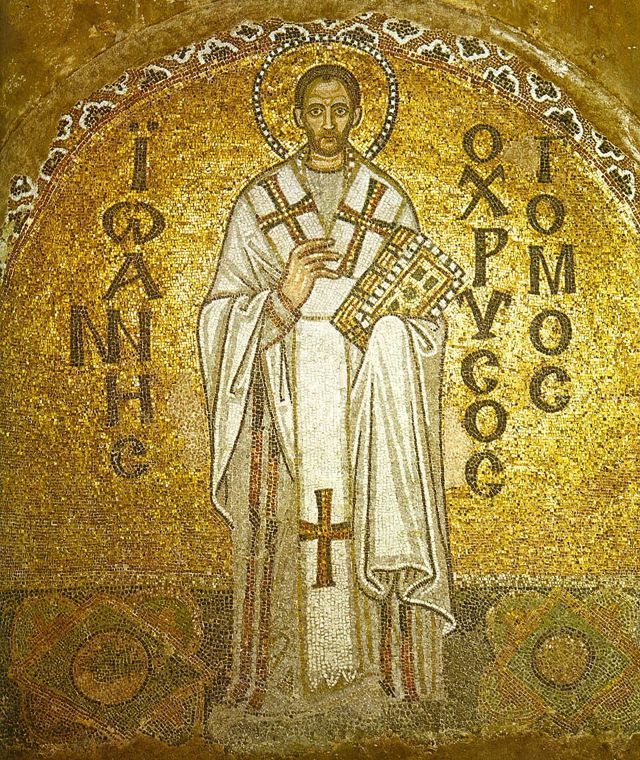
Image: Johnchrysostom.jpg · Unknown · Public domain, via Wikimedia Commons

Image: Unknown, Wikimedia Commons (Public domain)

Retold in plain modern English from Baring-Gould’s public-domain text, sentence by sentence, keeping the same facts and order. Short explanations in parentheses are ours.

From Sabine Baring-Gould, The Lives of the Saints, new and revised edition (Edinburgh: John Grant, 1914; first edition 1872). Public domain in the United States. Reproduced unedited, except for short bracketed notes in grey that we added to explain names and terms (“S.” is the old abbreviation for Saint). Some history and judgments reflect 19th-century scholarship.

Notes

Story retold in our own words from the cited sources.