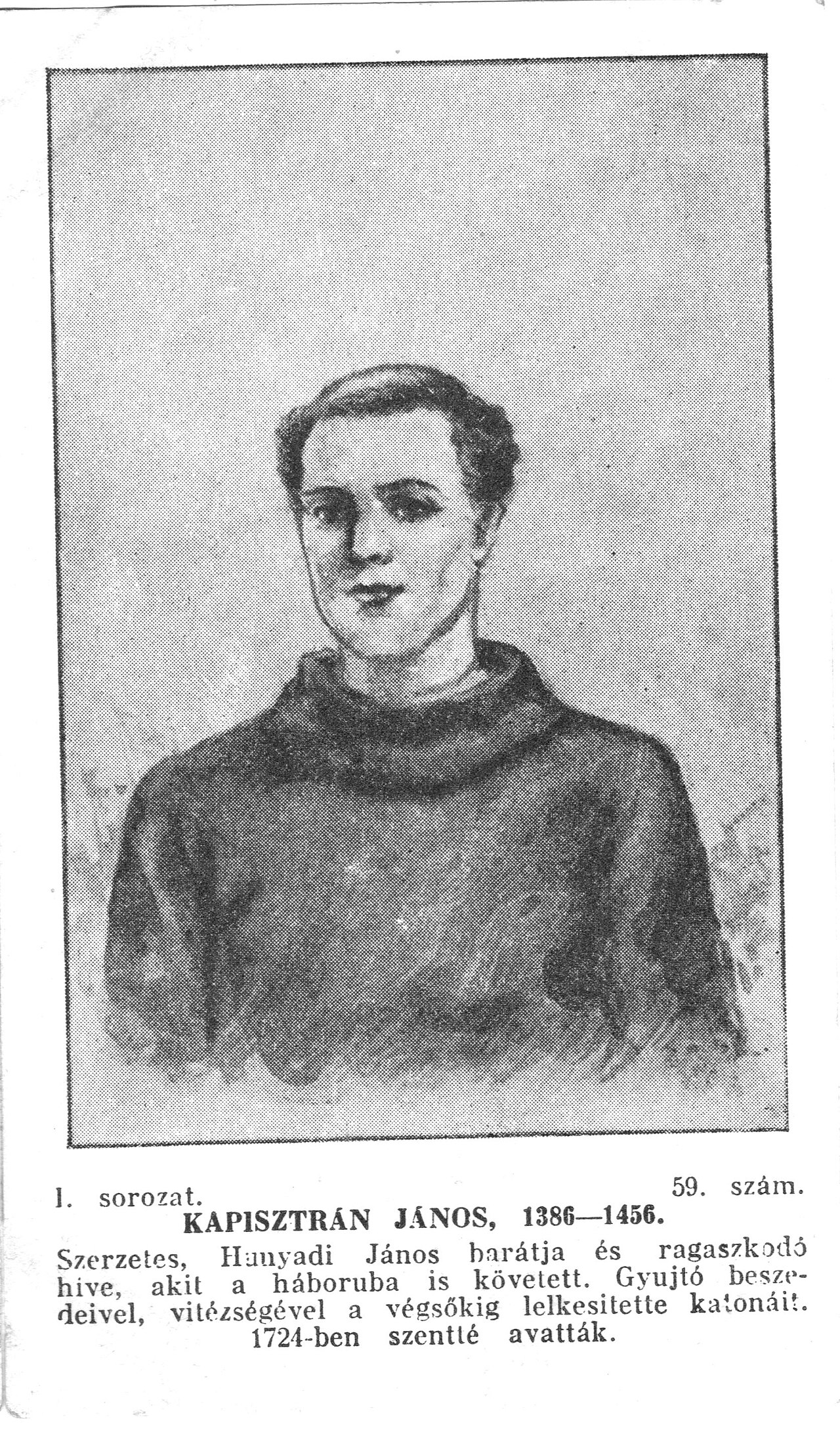
The details of the conflict are unclear. It became public in 1413, and the Pope fled Rome before the advancing armies of the King of Naples.
Around this time, a riot broke out in Perugia, and John Capistran, serving the king, was captured by the opposing faction and imprisoned. He waited there, hoping that Ladislas would pay for his release. However, the king did not concern himself with his fate, and John remained in prison, consumed by anger, disgust, and despair. One night, he tied a rope to his window and climbed down a distance, but the rope broke, causing him to fall and break his leg. He was taken back to prison, shackled with a chain, and thrown into a filthy dungeon, where the water reached halfway up his legs. In this miserable state, he thought he saw the figure of St. Francis appear before him, and he resolved that if he were released, he would join the Minorite Order.
The king showed no signs of interest in John Capistran or any willingness to pay the heavy ransom asked for him — four hundred ducats. John was forced to pay the sum himself from his own savings and the sale of his books. After his release, he visited his wife and informed her of his intention to leave the world and enter a Minorite convent. She was heartbroken, threw her arms around him, and sobbed as she implored him not to desert her. He made her promise not to marry again, and then, having restored her dower, he went back to Perugia. There, he fashioned a large paper fool's cap, inscribed on it with all the sins he had committed. He mounted an ass, facing its tail, and paraded through the town in this manner, pursued by boys who pelted him with mud. The women looking out of the windows said, “Poor fellow, he has gone utterly crazed!”
In this guise, with his clothes and fool's cap covered in mud and holding the donkey's tail in his hand, he cantered up to the door of the Minorite convent and asked to be admitted as a novice. The guardian, thinking he was out of his senses, rejected him. Then John jumped off the ass, threw himself at the guardian's feet, and vowed he would not leave the spot until he had been admitted. The guardian's reluctance was quickly overcome, and John of Capistran was admitted among the probationers. His wife, or betrothed, however she was, soon consoled herself with another husband, and after his death, with a third. She ultimately died of leprosy.
When his novitiate was completed, Saint John Capistran had Saint Bernardine of Siena as his master and was ordained as a deacon. He was soon admitted to the priesthood, and in 1425, he was granted faculties for giving absolution in cases usually reserved for bishops. He was already famous as a preacher, attracting crowds wherever he went. He labored for several years in Siena, Ancona, Verona, and Ferrara. A curious and interesting account of his preaching in Brescia is given by an eyewitness, Christopher de Soldo. It is too long to be quoted in full here, but it can be summarized as follows:
“On February 9, 1451, a certain brother, John of Capistran, of the Observant Order of Saint Francis, came to this city. On that day, three hundred of the rulers of the city and women on foot went to meet him. He came by the road of Saint Euphemia, and when he reached Saint Salvator’s, there was quite an army on foot and on horseback, for his fame had spread from Padua, Vicenza, and Verona. The city magistrates, expecting a large crowd, had collected a significant supply of food. They immediately ordered the closing of all the taverns so that everyone who had come to hear him could be fed at public expense. An assembly was scheduled to be held in the market-place on February 10, and three hours before sunrise, ten thousand people had gathered there. It can be imagined how large the crowd was later. The magistrates escorted the preacher from the convent of Saint Apollonius, where he was staying, to the agreed-upon location. Forty attendants were appointed, four of whom were knights with gold spurs, to prevent the crowd from crushing the preacher, as everyone was trying to touch him and tear off a piece of his clothing. It was with great difficulty that he was brought to the meeting place.
After the sermon, he refused to preach again in the market-place, which he found inconvenient. It was decided that he would preach the rest of his series in the hall of merchandise, and there he preached for the next three days: Thursday, Friday, and Saturday. About two thousand people came to him to be healed, and he made the sign of the cross on their foreheads in the name of the Trinity, invoking Saint Bernardine, whose little hat he held in his hand. With that hat, he performed wonders. During his preaching over those three days, he announced to the people that on the following Lord’s Day, he would show them Saint Bernardine’s hat. Partly to see the hat and partly due to the rumors of his miracles, the entire neighborhood poured into Brescia, with crowds coming even from Bergamo, Cremona, Mantua, and some even from Germany. By Sunday, not only the hall but every place from which a glimpse of him and the hat could be seen was crowded. A platform was raised for the magistrates to occupy. I thought I had found a convenient spot, but I would have been crushed to death had I not, with the help of my friends, been lifted up and walked away over the heads of that dense throng. When he solemnly displayed the hat of Saint Bernardine, the people shouted so loudly that it seemed to rend the skies. After the sermon, he invested fifty knights whom he had converted in Brescia with the habit of Saint Francis.”
Saint John Capistran was appointed, along with Saint Laurence Justiniani, Patriarch of Venice, to investigate the morals and doctrine of the Order of Jesuates, founded by Saint John Columbini. Some scandal had arisen from the conduct of certain members of the Order, and it was suspected that the entire society needed reformation or abolition. John Capistran and his fellow inquisitor found the Order in general to be pure and undeserving of the disrepute into which it had fallen.
In 1440, John Capistran was sent by Pope Eugenius IV on a mission to Philip Visconti, Duke of Milan. His goal was to secure Philip's support against Amadeus of Savoy, who had been elected pope by the Council of Basel under the title of Felix V. He was later sent for the same purpose to Philip the Good, Duke of Burgundy. In 1444, he was in Sicily, likely to persuade Alphonso of Aragon to abandon support for the antipope.
Eugenius died, and his successor, Nicolas V, in 1447 appointed Capistran as inquisitor against the Jews in Sicily. This was to enforce the repeated orders of previous popes, which sternly forbade Christians from receiving medicines from Jews or from entering and washing in the same baths that had touched their filthy and accursed bodies. He had already held the same position in Naples in 1427, at the command of Joanna, Queen of Naples. It is possible that this was when he first encountered issues related to the conduct of some individuals in the religious community, which seemed to involve dishonorable behavior and inappropriate familiarity under the guise of religion and spirituality with certain devout women, leading to scandals.
acquired a thirst for heretical and Jewish blood that seemed to have consumed him throughout his life. “He blazed with rage,” says his enthusiastic biographer, Christopher Varisio, “against three types of people — namely, Jews, heretics, and schismatics, striving either to convert them to the faith, or to subject them to the laws, or to completely eradicate them. Considering that those most perverse Jews, in addition to other crimes and hardness of heart, continually blaspheme the name of Christ and of the Blessed Virgin, he would, if possible, have expelled them from Christendom. However, thinking that they served as a testimony to the death of Christ, and remembering our Lord's word that this generation would not pass away until all was fulfilled, and seeing that the Church was obliged to endure their presence, he worked by every means in his power to enforce the ecclesiastical statutes published against them throughout the world. He also obtained many other injunctions against them in favor of Christians, in decrees and bulls.
In all the cities he visited, if he noticed that these decrees were not being enforced, and that the Jews enjoyed privileges due to the leniency of princes, prelates, or municipalities, he did not regard individuals but was filled with zeal for the Christian people. He preached against the authorities and denounced their laxity. If public preaching was not enough, he personally approached princes and magistrates, and with tears in his eyes, pleaded with them not to allow Christians to be harmed by infidel Jews. Thus, in many parts of Christendom, he was able to rescue many from the hands of the Jews, who troubled them with their usury, and he secured the abolition of the evil privileges granted to the Jews.” These evil privileges were — toleration.
By obtaining permission for Christians to repudiate their debts to the Jews, the outcome of these fervent appeals to the crowd, many of whom were burdened with debt and eager to loot the wealthy homes of non-believers, can be imagined. Imaginary crimes of the most absurd nature were attributed to the unfortunate Israelites, and they were plundered, tortured, and burned based on these fabricated accusations. Some, fearing for their lives and property, accepted Christianity and underwent baptism. “The rest,” as his biographer tells us, “who did not follow the laws, or troubled Christians, he persecuted with intense fervor, and was able to drive them completely out of some cities, or otherwise punish them.”
We will soon discuss a terrible example of judicial murder based on a false accusation, which Capistran oversaw for the glory of God. It is no surprise that "the Jews everywhere were filled with terror at the mere mention of his name; and some, fearing for their lives, offered him gifts, but he, smiling, refused to accept these bribes and turned them down." One might think that his anger towards Jews was excessive, but we are told that his fury against heretics was even greater.
"But he persecuted heretics even more fiercely than Jews because he knew they harmed the Church of God more. He did not tire of hunting down heretics in every region where he traveled; some he warned, some he arrested, some he ensnared, some he drove away, and he imposed various punishments on others. The popes Martin V., Eugenius IV., Nicolas V., and Callixtus III., seeing this, encouraged him further in his zeal for the faith, hoping that he might help eliminate all heretics. They appointed him General Inquisitor of Heretics throughout the world and granted him the necessary privileges. He skillfully carried out this role, and although he persecuted all heresies, three in particular were prevalent at that time."
aroused his liveliest zeal—that of the Fraticelli, that of the Bohemians, and that of the Greeks. The rivalry and division between the Conventuals and the Observants in the Society of St. Francis had been brewing since 1368. Although the Council of Constance in 1415 had removed the Observants from the authority of the General of the Minorites, the Conventuals were constantly and actively trying to regain their control over the convents that had adopted the reformed rule.
The strictness and asceticism of the Observants led the Conventuals to classify them with the Fraticelli, another offshoot from the Society of St. Francis, which had unfortunately fallen into heresy. The Observants faced suspicion, and St. Bernardine of Siena had to defend himself before a commission from the apostolic throne. No suspicion of heresy could be attached to the zealous persecutor, Capistran, who belonged to the reformed order. When the Conventuals attempted, with Pope Eugenius IV, to reunite the divided branches, John Capistran strongly defended the independence of the Observants. As a result, he was able to establish the reform on an independent basis and was elected Vicar-General of the Observants.
The Fraticelli “degli Opinione” were remnants of the old Manichaean-Paulician heresy, which had concealed itself under the cowl of St. Francis, hoping to avoid persecution. The schism had arisen in a similar manner to that of the Observants. The Spiritualists, as they called themselves, opposed the relaxations that had become widespread throughout the Order of St. Francis. They condemned the practices that had developed.
His biographer, Christopher Varisio, devotes three chapters to his achievements in persecution: De Judaeorum persecutione; De persecution haereticorum; De persecutione schismaticorum.
The soft texture of the tunic, the delicate diet, the magnificent convents, and the gold and silver vessels at the altars belonged to those who had committed themselves to extreme poverty. They engaged in prophecy, condemned the luxury and wealth of the church leaders, and developed a doctrine of “two churches: one carnal, burdened with possessions, overflowing with wealth, tainted with wickedness, ruled by the Roman pontiff and the lesser bishops; the other spiritual, simple, free from impurity, admirable for its virtue, clothed in poverty, consisting only of the Spirituals and their followers, and governed by men of spiritual life alone.”
The Fraticelli were too closely aligned with the Observants to avoid the jealousy and hostility of John Capistran. “These Fraticelli,” his biographer states, “he vigorously persecuted; wherever he heard that they were staying, he rushed there. He destroyed many of the places where they lived, drove many away, converted many to the true faith, and burned many of those who were stubborn and refused to convert. And although some powerful individuals were influenced by this heresy, he spared no one. Thus, a certain noblewoman from the Colonna family near Rome was boldly imprisoned by him, and he forced her to recant.” His biographer continues to describe how the hatred and frustration with his harshness grew to such an extent that many plotted his death.
One night, some heretics encountered him in a secluded area and asked if John Capistran was passing through. “I am he,” the saint replied. Although he was alone, they did not harm him, but suspecting they intended to do so, he had them arrested and executed. “He did not cease,” his biographer enthusiastically states, “from persecuting this dangerous sect until very few of them remained.”
John Capistran certainly had plenty of encouragement to pursue this work. By a papal bull from Martin V., dated June 6, 1426, he was given special authority to root out these heretics. A little later, Saint James de Maschia was appointed to work with him as an inquisitor of the Fraticelli (a group of heretical Franciscans). His mission against them was renewed by Eugenius IV in 1432, by Nicolas V in 1447, and by Callixtus III in 1451. At the request of Emperor Frederic III, he came to Vienna in preparation for an expedition against the Hussites of Bohemia.
Eneas Sylvius, who saw him there, described him as a withered old man, full of energy, with skin stretched so tightly over his bony frame that it revealed every bone and muscle. He preached in Nuremberg, Magdeburg, Meissen, Leipzig, Halberstadt, and Augsburg, accompanied by an interpreter, Dr. Christian, from his Order. During his preaching, playing cards, dice, board games, women's veils, and pouches were thrown into the fire.
Achilles Gassarius, a German writer of the time in Augsburg, noted that John Capistran, an Italian Minorite, was unable to convert or bring back any of the old Waldenses or new Hussites among the citizens to the Roman Catholic Church. To avoid appearing ineffective, he dramatically burned on a public pyre, in the courtyard of the episcopal palace, little painted carriages, dice boxes, chess boards, dice—amounting to fifteen hundred—and playing cards.
Wherever he went, crowds gathered to hear his preaching. With relics of Saint Bernardine, he performed miracles and stirred the people's devotion for this great saint of the Observants. Many disabled individuals, believing they had been cured, hung their crutches before the images of Saint Bernardine. However, Matthias Doering, the Provincial of the Franciscans in Saxony at the time, remarked that it was commonly reported that many of those who were supposedly cured had to ask for their crutches back again.
This Franciscan Provincial had a low opinion of the saint. He says that Capistran was unhappy unless he was welcomed everywhere with processions, and a lot of fuss was made about him. He adds that although the saint displayed his disdain for the world, he still expected to be provided with exquisite dishes and the very best wines. According to Doering, his great success in attracting crowds was due to clever advertising; before visiting a town, he sent messengers ahead to stir up wonder and curiosity among the people by recounting his miracles. The same writer notes that Capistran would not tolerate anyone expressing an opinion that differed from his own. It should be noted that Matthias Doering belonged to the Conventuals, and was therefore envious of the Observants.
At this time, Bohemia was almost entirely caught up in the Utraquist schism, which insisted on Four Articles that had been presented by the Bohemians to Emperor Sigismund, and to which they strictly adhered: “I. That the word of God be preached without impediment throughout the kingdom; II. That communion under both kinds be administered to the people, according to the institution of Christ; III. That ecclesiastics shall be prevented from holding lands and lordships, and that they be made to reform their morals on the model of the apostolic life; IV. That all mortal sins, especially public and scandalous crimes, shall be tried and punished by the magistrates, whether the criminals are lay or clerical.”
The Church in Bohemia, founded by Saint Methodius, had inherited a Slavic liturgy and had used, without rebuke, communion under both kinds. The vernacular liturgy had been permitted to the Bohemians in 977 by Pope Benedict VII; however, Gregory VII, in a brief dated 1079, had ordered the exclusive use of the Latin liturgy. The first Archbishop of Prague, Ernest von Pardubitz (1344-64), tried to introduce communion under one kind, acting on the advice of foreign professors and students at the University. He succeeded to a limited extent, but faced much opposition in various places. Boniface IX, in 1490, allowed the chalice to be given to the Kuttembeigers. In 1396, the chalice was withdrawn from the laity in Prague Cathedral and in all the churches of Bohemia. Jacobel von Mies, a professor at the University of Prague, refused to comply and continued to administer communion to the people under both kinds. John Huss arose and proclaimed the right of the laity to receive the chalice. He also denounced the corruption that was spreading everywhere among the clergy and the religious. A large portion of the land in Bohemia was owned by ecclesiastics, who were extremely wealthy and morally lax. There were no means to bring them to justice for their crimes, as they could only be tried before ecclesiastical tribunals, which acquitted them or dealt so leniently with their misdemeanors that it encouraged the prevailing laxity among them.
The burning of Huss at Constance ignited the flames of religious war in Bohemia. The Bohemians rose up, almost entirely, to avenge his murder. The University of Prague published a declaration in favor of communion under both species (bread and wine); the clergy who refused to administer the chalice were expelled from Prague and the major cities of Bohemia. The suffragan (assistant bishop) of the archbishop sympathized with the popular party and was inhibited. War with the emperor followed; fanatical sects, such as the Taborites, emerged and swept across the country like bandits. The armies of the Imperialists faced repeated and crushing defeats. A crusade launched against the Bohemian Hussites by Pope Martin V met with disgraceful failure. After the death of Archbishop Conrad in 1431, Rockyzan, a man of great administrative skill, was elected to replace him, confirmed by Emperor Sigismund, and consecrated at Iglau. However, the Pope refused to approve the appointment, and Rockyzan became the leader of the Utraquist or Calixtin party, which consisted of those who supported communion with the cup.
The Council of Basle reached an agreement with the Bohemians, acknowledged their orthodoxy, and approved the use of the chalice; but Eugenius IV and his successors refused to recognize the council and rejected its compromises.
Saint John Capistran lingered around the borders of Bohemia, eager to confront the Utraquists, but he could not reach them without risking his life. Attempts were made to arrange a meeting between him and Rockyzan, but these efforts failed. In Brunn and other towns on the borders, where he was supported by Imperial forces, he preached and achieved considerable success, bringing many who had joined the Utraquists back into union with the Roman see.
The "Compact" with the Utraquists, formulated by the Council of Basle, infuriated Capistran to the utmost. He attacked it with both his writing and his speech. Rockyzan wrote against him, and Capistran responded with an angry pamphlet: "O Rockyzan, most unfortunate of men! You call me, who am known to all, a runaway seducer of the people and an antichrist. Rockyzan believes he is more insightful than the entire Catholic community and all the universities I have mentioned. He thinks he is more knowledgeable than the universities of Rome, Naples, Siena, Perugia, Florence, Ferrara, Bologna, Padua, and Pavia, where I have taught and where my teachings were praised and approved! O foolish brute, to call me a seducer of the people! Listen to this: I will tell you about what has happened, not from afar, but right here. I, a stranger who does not speak German, was welcomed by the famous city of Vienna with the utmost honor, by its most distinguished doctors and masters. My teachings preached there for forty days were not considered heretical but were highly praised. Such crowds gathered to hear me that had not been seen or heard of in modern times. O foolish brute! Do you not feel ashamed to call me a runaway and a wizard? Even though I was a stranger and unknown in the city of Olomuz, on a certain Sunday, as many as a hundred thousand people gathered to hear me preach. O brute with a venomous tongue! Do you call me a runaway? If so, how was it that I was received with such honor, which had not been offered to any other religious man in our times, by all the people of Austria, Olomuz, Brunn, Znaim, and the magistrates of Padua, Ratisbon, Egren, and by the most distinguished princes, Louis of Bavaria, Albert and John, Margraves of Brandenburg, Prince Frederick, Duke of Saxony, and all the cities and their princes through which I passed? O cursed tongue! Do you call me a runaway and seducer, who am sixty-six years old?"
The response received by S. John was sharp and to the point. It is recorded by Cochlaeus in his history of the Hussites. The letter was from George Podjebrad, Regent, and later King of Bohemia.
“An epistle has been presented to us from you, which is more like a pamphlet than a letter. It does not reflect the character of a religious man. It consists of a series of venomous sentences that are hardly different from the insults of a stage actor. Certainly, if you claim apostolic authority to justify this, you show something very different from paternal charity. Even if we were to accept that the venerable John Rockyzan has somewhat exceeded the limits of discretion, which we do not believe, it would surely be better, in our opinion, to approach a religious man with caution and not with aggression, knowing that harsh words provoke conflict. We assure you, our ears tingle from the loud and dramatic style you adopt, John Capistran, against our most faithful doctors, cruelly linking it with slander.”
In 1453, he went into Silesia and was received with the utmost respect and favor by the citizens of Breslau, who had refused to acknowledge George Podjebrad. There, if we may trust Wadding, he performed a notable miracle, not of healing, but of killing. Some Hussites, in jest, placed a young man on a bier and brought it past where Capistran was standing in the market-place. They stopped the bier and said, “Pray that the youth be restored to life.” “Rather,” answered the saint grimly, “let him have his portion for eternity with the dead.” When the shroud was removed, the young man was found to be dead. His contemporary biographers knew nothing of this miracle, which is first recorded by Wadding (1628-1654).
At Breslau, he was able to resume his old pursuit of tormenting Jews, and at the same time repay the citizens for the honor they showed him by indulging them with a large auto-da-fé (a public act of penance).
“A certain peasant,” says Wadding, “had sold nine consecrated hosts to Jews, and they, having placed them on a piece of linen, beat them with rods, repeating, ‘This is the God of the Christians!’ And that it was so, He showed, for blood flowed forth and stained the linen. This being S. John Capistran.”
John Capistran, acting as an inquisitor, had many people arrested and tortured. When they confessed to their crimes, he cast them into the flames. While this was happening, a woman who had converted from Judaism approached and said that she had seen a sacred host thrown into the fire by other Hebrews. She claimed it jumped out three times without being burned. When an old woman witnessed this and converted, reverently adoring God and confessing Him, they killed her and buried her in a dark corner.
She also said that they had kidnapped a Christian boy, fattened him up with rich foods, and then enclosed him in a barrel filled with spikes, which they rolled until he died. Then, she continued, they sacrificed his blood and sent it to neighboring synagogues. They hid his body in a secret place in the house. Capistran ordered the bodies to be taken from their hiding places, gave them to the mob to be venerated as the relics of martyrs, and burned forty-one of the unfortunate Jews on this accusation. He hunted down the rest of the Jews, not only from Breslau but also from the lands of King Ladislas. He took away all their children aged seven and under, had them baptized, and gave them to Christians to be raised in the Catholic faith.
The chief rabbi, in despair, hanged himself in prison and urged the other Jews to do the same to escape the cruelty of their persecutors. “The king, Ladislas,” says Nicolas de Fara, who was with Capistran at the time, “took all the possessions of the Jews for himself, following the example of his father Albert, King of the Romans, who, for a similar crime in the province of Austria, confined two thousand Jews in one house and burned them all in a single day.” The same eyewitness informs us that the evidence used to burn these forty-one poor souls was the uncorroborated statement of an old woman about what she had seen when she was a child under six years old.
Nicolas de Fara recounts an incident from S. John’s time in the German Empire that does not seem surprising after this mass execution. Six men were hanged, and the magistrate ordered them to be taken down and buried. However, they were so decayed that no one was willing to perform the task. Then S. John eagerly approached, wrapped his arms around one of the corpses, threw the body over him, with his head resting on the stomach of the corpse, and declared that the smell of hanged criminals was a delightful fragrance to him.
From Silesia, John Capistran entered Poland and was pleased to capture Paul of Prague, a doctor of medicine sent into Poland by Rockyzan to advocate for the cause of the Utraquists. He had the unfortunate man imprisoned in Cracow and wrote urgent letters to encourage the bishop and his guards there to keep a close watch to prevent his escape before he was dealt with, using his authority as inquisitor, during his upcoming visit to Cracow. He promised that he would not listen to any pleas on Paul’s behalf. He is accused, not without reason, of having incited King Casimir of Poland to attack the Teutonic Knights and take their lands, but the Bollandists strongly deny this accusation.
His attention was now directed by Sbigneus, Cardinal Archbishop of Cracow, and by Æneas Sylvius, to the dangers that the Turks posed to the empire. They urged him to try to reconcile the rival princes in Germany and unite them against this common enemy.
Saint John readily accepted these suggestions. He wrote letters to rally the Duke of Burgundy and hurried to attend a diet (assembly) at Frankfort to advocate for a war against the Turks. His efforts were unsuccessful, and finding the German princes indifferent, he went into Hungary to proclaim a crusade. In 1455, he participated in the diet of Neustadt, and through his passionate speeches, he inspired the princes and the people to take up arms against the Turks. However, the war was delayed by the death of Nicolas V., who had been very insistent in urging Christians to take action. Under Callixtus III., his successor, who vowed to dedicate all his efforts and, if necessary, give his last drop of blood for the recovery of Constantinople, Ladislas, King of Hungary, and John Hunniades, the voivode (military leader) of Transylvania, urged John Capistran to join them in person in the midst of this army. After receiving permission from the Pope, he joined the Christian forces at Buda. He received the cross from the papal legate, the Cardinal of Saint Angelo, and rushed to the aid of Belgrade, which was then under siege by Mahomet II.
The crusader army consisted of more than forty thousand men, including French, Italians, Germans, Bohemians, Poles, and Hungarians. He inspired them with great enthusiasm and predicted their victory over the infidels. He entered Belgrade and, in surprise attacks, harassed and ultimately defeated the Turks. John Capistran was present in every battle, but despite being in the thick of the fighting, he was not wounded. The infidels retreated from the assault and withdrew from Hungary, reportedly leaving forty thousand dead on the battlefield. Shortly after this victory, Saint John Capistran fell ill with a fever. Realizing that his end was near, he had himself moved to the convent of the Observance at Villach. The king, the queen, and many nobles came to visit him. He made his last confession and received the viaticum (the Eucharist given to someone near death) at the age of seventy-one.
Eneas Sylvius, who later became Pope Pius II, wrote about the victory over the Turks, saying: “Three Johns were responsible for this victory: the legate Cardinal (John de Carvajal), who initiated the war, and Hunniades and Capistran, who fought in the battle. However, Capistran does not mention the role played by Hunniades, nor does Hunniades refer to Capistran in the letters they wrote to their friends or to the Roman pontiff. The human mind is very eager for honor; it can give up kingdoms and wealth rather than glory. Capistran was able to disregard his family fortune, reject sensual pleasures, and control his passions, but he could not overcome pride.”
In his Bohemian History, he expresses the same idea: “Hunniades and Capistran were present in this war, and each wrote about his own success, but neither mentions the other; each claims the sole glory of the event for himself. Glory is indeed sweet; it is easier to dismiss it in words than to truly reject it. Capistran turned away from worldly honors, avoided its pleasures, trampled on greed, controlled lust, but he could not rid himself of vanity.”
The relics of Saint John Capistran were kept in Villach. In 1526, the town was captured by the Turks, and the body was then moved to Szatmarien, in Transylvania, and later to Nagyszolos. When Calvinism spread in Transylvania, the body was thrown into a well, and the convent where it had been kept was destroyed. Nothing more is known about the body of Saint John; it probably still lies in the well where it was discarded.
Footnotes
- St. Francis refers to Saint Francis of Assisi, founder of the Franciscan Order.
- Equivalent in modern English money to £6,400.
- There is some doubt whether they were married or only betrothed.
- Muratori, Script. Ital. i. xxi. col. 867.
- “It is possible that some mortifications were previously made in that community, which seemed to have dishonor, and familiarity was had under the pretense of religion and spirituality with some devout women, from which... scandals arose.” — Letter of John, Bishop of Ferrara, to John Capistran, provided by Wadding. This John was himself a member of the Order of Jesuates.
- The result of these vehement appeals was obtaining permission for Christians to repudiate their debts to the Jews.
- His biographer, Christopher Varisio, devotes three chapters to his achievements in persecution: De Judaeorum persecutione; De persecution haereticorum; De persecutione schismaticorum.
- The Roman pontiff refers to the Pope, the leader of the Catholic Church.
- Eneas Sylvius was a contemporary observer and later became Pope Pius II.
- Achilles Gassarius was a German writer who documented Capistran's activities.
- Mencken, iii. fol. 19.
- He was afterwards drowned in a fishpond by order of Zisca, the Taborite leader, because he had desisted from his functions when inhibited by the archbishop.
- Cochlaeus: a historian known for his writings on the Hussite movement.
- Wadding (1628-1654) is the first to record the miracle.
- Auto-da-fé is a public act of penance.
- Nicolas de Fara was an eyewitness to the events described.
- The Utraquists were a group advocating for communion in both kinds (bread and wine).
- The Bollandists were a group of Jesuit scholars who compiled the "Acta Sanctorum," a collection of saints' lives.
- The diet was an assembly of princes and representatives in the Holy Roman Empire.
- The voivode was a military leader or governor in certain Slavic countries.
- The viaticum is the Eucharist given to someone who is dying.
- The human mind is most greedy of honour; it can surrender kingdom and wealth rather than glory.
- Sweet indeed is glory, easier is it in word to despise it than to despise it in fact.
Baring-Gould’s own footnotes, in modern English.
Read the original 1870s text
Baring-Gould’s sources: Beatified by Leo IX. Canonized by Benedict XIII. in 1724. Roman and Franciscan Martyrologies. Authorities: — A Life by his companion Nicolas de Fara; another by Hieronimo de Utino; a third by another companion, Christopher it Varisio. Other contemporary writers containing notices of him are quoted by the Bollandists.] The saint was bom in 1386 at Capistrano in the Abruzzi, and was educated for the law. He practised in Perugia, where he married a beautiful heiress. Mixing himself up with the party strifes then raging, he took the side of Ladislas, King of Naples, against the Pope and Louis of Anjou. John XXIII. had no sooner been elected to the throne of S. Peter than he fulminated his sentence of excommunication against Ladislas, and pronounced his deposition from the throne of Naples. His ally, Louis, marched against the king, and defeated him in the battle of Rocca Secca, May 17, 1411. But Louis knew not how to profit by his victory; and, retiring from Italy, he left the Pope to his fate. John published a crusade against the Christian king of Naples, but few were disposed to assume the cross in such a cause, and Pope John was forced to come to terms with Ladislas. Ladislas was acknowledged king of Naples and Sicily, and the Pope promised to pay him 120,000 florins of gold. He surrendered as security the cities of Ascoli, Viterbo, Perugia, and Benevento. Ladislas then appointed John Capistran judge in Perugia. The peace did not, however, last long. The causes of S. John Capistran.
…the breach are obscure; it became open in 1413, and the Pope fled Rome before the advancing armies of the King of Naples.
About this time a tumult broke out in Perugia, and John Capistran, as a servant of the king, was seized by the opposite faction and thrown into prison. There he waited, expecting that Ladislas would ransom him. But the king did not trouble himself about his judge, and John remained in prison, a prey to anger, disgust, and despair. One night he passed a rope out of his window, and descended by it some distance, but the cord gave way, and he fell and broke his leg. He was taken back into prison, bound by a chain, and thrown into a loathsome dungeon, where the water was halfway up his legs. When in this miserable condition he thought he saw the form of S. Francis appear before him; and he resolved, should he obtain his release, that he would join the Minorite Order.
The king showing no signs of interest in him nor willingness to pay the heavy ransom asked for him — foui hundred ducats1 — John Capistran was forced to pay the sum himself out of his own savings and the sale of his books. On his release he visited his wife,2 and informed her of his intention to leave the world and enter a Minorite convent. She was heartbroken, threw her arms round him, and sobbing implored him not to desert her. He made her promise not to marry again, and then, having restored her dower, went back to Perugia, and having fashioned himself a great paper fool'scap, inscribed on it all the sins he had committed, and mounting an ass, with his face to the tail, he careered through the town in this fashion, pursued by the boys, who pelted him with mud. The women looking out of the 1 Equivalent in modern English money to £6,400. I* There is some doubt whether they were married or only betrothed. He calls her himself “ sponsa jurats,” but the dower had been paid over to him and he returned it. Dowers are not usually paid till the marriage has taken place. windows said, “ Poor fellow, he is gone utterly crazed ! ” 1 In this guise, his clothes and fool’s-cap plastered with mud, and holding the donkey’s tail in his hand, he cantered up to the door of the Minorite convent, and asked to be admitted as a novice. The guardian, thinking him out of his senses, rejected him. Then John, jumping off the ass, threw himself at his feet, and vowed he would not leave the spot till he had been admitted. The reluctance of the guardian was speedily overcome, and John of Capistran was admitted among the probationers. His wife, or betrothed, whichever she was, speedily consoled herself with another husband, and on his death with a third. She finally died of leprosy. When his novitiate was ended, S. John Capistran had S. Bemardine of Siena as his master, and was ordained deacon. He was soon after admitted to the priesthood, and, in 1425, was granted faculties for giving absolution in cases usually reserved to bishops. He was already famous as a preacher, attracting crowds wherever he went He laboured for some years in Siena, Ansani, Verona, and Ferrara. A curious and interesting account of his preaching in Brescia is given by an eye-witness, Christopher de Soldo. It is too long to be here quoted entire, but shall be given in a condensed form: — “ On February 9, 1451, there came to this city a certain brother, John of Capistran, of the Observant Order of S. Francis, and on that day there went to meet him three hundred of the rulers of the city, and women on foot. He came by the road of S. Euphemia, and when he reached S. Salvator’s there was quite an army on foot and on horse, for his fame had spread from Padua, Vicenza, and Verona. The city magistrates, expecting a crowd, had collected a large supply of food. At once they ordered the closing of 1 “ Mulicres ad fenestras • • • flebiles voces dabant, Amens effect us est, sensu caret." — Nicol. dt Fora* S. John CapistratL all the taverns, so that all those who had come to hear him might be regaled at the public expense. An assembly was appointed to be held in the market-place on February 10; and three hours before sunrise there were ten thousand persons collected there, it may be imagined therefore what the crowd was later. The magistrates conducted the preacher from the convent of S. Apollonius, where he was lodged, to the place agreed upon; forty apparitors were appointed, four of whom were knights with gold spurs; and their duty was to prevent the preacher from being crushed by the crowd; for every one was trying to touch him and tear off a bit of his garb. It was with the greatest difficulty that he was got to the place of meeting. When the sermon was over, he refused to preach again in the market-place, which he felt was inconvenient, and it was decided that he should preach the rest of his course in the hall of merchandize; and there he preached on the three following days, Thursday, Friday, and Saturday. Some two thousand came to him to be healed, and he made the sign of the cross on their brows, in the name of the Trinity, and invoking S. Bernardine, whose little hat he held in his hand; and with that hat he did wonders. And in his preaching during those three days he announced to the people that on the following Lord’s Day he would show them S. Bemardine’s hat. And partly in order to see the hat and partly on account of the rumours of his miracles, the whole neighbourhood poured into Brescia, crowds coming even from Bergamo, Cremona, Mantua, and some even out of Germany, so that on the Sunday, not the hall only, but every place was crowded from which a glimpse of him and the hat was obtainable. A platform was raised for the magistrates to occupy. As for me, I thought I had got a convenient place, but I should have been squeezed to death, had I not, by the assistance of my friends, been lifted up, and walked away over the heads of that dense throng. And when he solemnly exposed the hat of S. Bemardine the people gave a shout which rent the skies, and after the sermon, he invested with the habit of S. Francis fifty knights whom he had converted in Brescia.”1 S. John Capistran was appointed along with S. Laurence Justiniani, Patriarch of Venice, to inquire into the morals and doctrine of the Order of Jesuates, founded by S. John Columbini (31 July). Some scandal had been given by the conduct of certain members of the Order,2 and it was suspected that the whole society needed reformation or abolition. John Capistran and his fellow inquisitor found the Order in general pure, and undeserving of the disrepute into which it had fallen.
In 1440, John Capistran was sent by Pope Eugenius IV. on a mission to Philip Visconti, Duke of Milan, to secure his adhesion against Amadeus of Savoy, whom the Council of Basle had elected pope in his room, under the title of Felix V. He was sent afterwards for the same object to Philip the Good, Duke of Burgundy. In 1444 he was in Sicily, probably to detach Alphonso of Aragon from the cause of the antipope.
Eugenius died, and his successor, Nicolas V., in 1447 constituted Capistran inquisitor against the Jews in Sicily, to put in force the repeated mandates of previous popes, sternly forbidding Christians to receive medicines at the hands of Jews or to enter and wash in the same baths which had laved their filthy and accursed bodies. He had already exercised the same office in Naples in 1427, at the command of Joanna, Queen of Naples; and had perhaps then first 1 Muratori, Script. ItaL i. xxi. col. 867. 3 “ Fortasse aliquae mortificationes fuerunt alias facts in sodetate ilia, quae videbantur habere inhonestatem, et familiaritas habita fuit sub obtentu religionis et spiritualitatis cum nonnullis et devotis mulieribus, ex qua... exorta fuisse scandala.”— Letter of John, B. of Ferrara, to John Capistran, given by Wadding. This John was himself a member of the Order of Jesuates. John Capistran.
acquired that thirst for heretical and Jewish blood which seems to have fevered him through life. “ He blazed with rage,” says his enthusiastic biographer, Christopher k Varisio, “ against three species of men — to wit, Jews, heretics, and schismatics, endeavouring either to convert them to the faith, or to subject them to the laws, or to wholly eradicate them. Considering that those most perverse Jews, besides other crimes and hardness of heart, continually blaspheme the name of Christ and of the Blessed Virgin, he would, if possible, have expelled them from Christendom; but thinking that they served as a testimony of the death of Christ, and remembering our Lord's word that this generation should not pass away till all was fulfilled, and seeing that the Church was obliged to endure their presence, he laboured by every means in his power to enforce against them the ecclesiastical statutes published against them, throughout the world... and he obtained in addition many other injunctions against them in favour of Christians, in decrees and bulls. And in all the cities through which he passed, if he observed that these decrees were not put in force, and that the Jews enjoyed privileges through the indulgence of princes, or of prelates, or municipalities, not regarding persons, but burning with zeal for the Christian people, he preached against the authorities and denounced their laxity. And if public preaching were not sufficient, he went in person before princes and magistrates, and with tears in his eyes besought them not to allow Christians to be molested by infidel Jews. Thus, in many parts of Christendom, he was able to deliver many from the hands of the Jews, who vexed them by their usury,1 and obtained the abolition of the diabolical privileges accorded in favour of the Jews.” These diabolical privileges were — toleration.
1 ia, by obtaining leave for the Christians to repudiate their debts to the Jews. The result of these vehement appeals to the mob, many of whom were oppressed with debt, all eager to pillage the rich houses of unbelievers, may be conjectured. Imaginary crimes of the most preposterous nature were laid to the charge of the unfortunate Israelites, and they were plundered, tortured, and burnt on these trumped-up accusations. Some, fearing for their lives and property, accepted Christianity, and endured baptism. “ The rest,” as his biographer tells us, “ who did not observe the laws, or vexed Christians, he persecuted with inexpressible fervour, and was able to drive them wholly out of some cities, or otherwise to punish them.”
We shall come presently to a horrible instance of judicial murder on a false charge, at which Capistran presided to the glory of God. No wonder that “ the Jews everywhere were filled with terror at the bare mention of his name; and some in fear of their lives offered him presents, but he smiling (!) refused to receive these bribes, and rejected them.” One would have supposed that his fury against Jews was excessive, but his rage against heretics we are assured was even more exceeding.
“ But he persecuted heretics even more vehemently than Jews, because that he knew they hurt the Church of God more. He did not flag in hunting out heretics in every province where he was; some he admonished, some he arrested, some he caught by artifice, some he put to flight, and to others he dealt various punishments. The sovereign pontiffs Martin V., Eugenius IV., Nicolas V., and Callixtus III., seeing this, to urge him further in his zeal for the faith, and in hopes that he might be the means of extirpating all heretics, constituted him General Inquisitor of Heretics throughout the world, and furnished him with the requisite privileges. He skilfully executed this office, and though he persecuted all heresies, three especially then prevailing •S'. John Capistran.
aroused his liveliest zeal,— -that of the Fraticelli, that of the Bohemians, and that of the Greeks.” 1 The rivalry and schism between the Conventuals and the Observants in the Society of S. Francis had been fermenting since 1368, and though the Council of Constance in 1415 had withdrawn the Observants from the authority of the General of the Minorites, the Conventuals were incessantly and actively engaged in attempts to recover their authority over the convents which had adopted the reformed rule. The strictness and asceticism of the Observants allowed them to be classed by the Conventuals with the Fraticelli, another offshoot from the Society of S. Francis, which, however, had fallen into heresy. The Observants incurred suspicion, and S. Bemardine of Siena was obliged to clear himself before a commission from the apostolic throne. No suspicion of heresy could attach to the fiery persecutor, Capistran, who belonfged to the reformed order, and when the Conventuals made an attempt with Pope Eugenius IV. to re-unite the severed branches, John Capistran so vigorously maintained the independence of the Observants, that he was able to establish the reform on an independent footing; and he was elected Vicar-General of the Observants The Fraticelli “ degli Opinione” were survivals of the old Manichaean-Paulician heresy, which had hidden itself under the cowl of S. Francis, hoping thereby to escape the faggot The schism had arisen much in the same way as had that of the Observants. The Spiritualists, as they called themselves, resented the relaxations which had become general throughout the Order of S. Francis. They denounced the 1 His biographer, Christopher h Varisio, devotes three chapters to his achievements in persecution V. De Judaeorum persecutione; VI. De persecution haereticorum; VII. De persecutione schismaticorum.
soft texture of the tunic, the dainty diet, the splendid convents, the gold and silver vessels at the altars, of those who had vowed themselves to abject beggary. They took up with prophecy, they denounced the luxury and wealth of the hierarchy, they formulated a doctrine of “ two churches, one carnal, overburdened with possessions, overflowing with wealth, polluted with wickedness, over which ruled the Roman pontiff* and the inferior bishops; one spiritual, frugal, without uncleanness, admirable for its virtue, with poverty for its raiment, containing the Spirituals and their associates only, and ruled by men of spiritual life alone.”1 The Fraticelli were too dangerously near to the Observants not to incur the jealousy and antipathy of Capistran. “These Fraticelli,” says his biographer, “he vigorously persecuted; wherever he heard that they tarried thither he posted. He destroyed many of the places where they dwelt, he put many to flight, many he converted to the true faith, and many of those who were obstinate and would not be converted he burnt with fire. And although some men in power were infected with this heresy, he spared none. Thus a certain great lady of the house of Colonna near Rome he fearlessly flung into prison, and forced to recant.” His biographer goes on to relate how hatred and exasperation at his severity grew to such a pass that many schemed his death.
One night some heretics met him in a lonely place and asked him if John Capistran was coming that way. “I am he,” answered the saint. Though he was alone they did not maltreat him, but as he suspected that they had intended to hurt him he had them arrested and executed. “ He did not cease,” says his biographer in a burst of enthusiasm, “ from persecuting this pestiferous sect till very few of them remained.”
S. John Capistran* He had certainly plenty of encouragement to prosecute this work, for by bull of Martin V., dated 6th Kalends of June, 1426, he was specially invested with authority to extirpate these heretics; somewhat later S. James de Maschia was associated with him as inquisitor of the Fraticelli. His mission against them was renewed by Eugenius IV. in 1432, by Nicolas V. in 1447, and by Callixtus III. In 1451, at the request of the emperor Frederic III., he came to Vienna preliminary to an excursion against the Hussites of Bohemia. ^Eneas Sylvius, who saw him there, speaks of him as a withered old man, full of vehemence, with skin drawn so tight over his fleshless frame as to show every bone and muscle. “ He went preaching in Nuremberg, Magdeburg, Meissen, Leipsic, Halberstadt, and Augsburg, with an interpreter, Dr. Christian, of his Order, at his side. And at his preaching, playing-cards, dice, draughts, women’s veils and pouches, were cast into the fire.” 1 Achilles Gassarius, a German writer of the time at Augsburg, says, “ John Capistran, an Italian Minorite, when he was unable to convert and lead back any of the old Waldenses or new Hussites among our citizens into the bosom of the Roman see, lest he should seem to have produced no effects worthy of penitence, with more than histrionic gravity burnt on a public pyre, in the court of the episcopal palace, little painted carriages, dice-boxes, chess-boards, dice, to the number of fifteen hundred, and playing cards.” Wherever he went crowds attended his preaching, and with relics [the bodily remains of a saint, or objects they used, kept with honor] of S. Bernardine he performed miracles and fanned to enthusiasm the devotion of the people for this great saint of the Observants. Many cripples, thinking themselves cured, in the excitement of the moment hung up their crutches before the images of S. Bemardine. “ But,” says Matthias Doering, Provincial of the Franciscans at the time in Saxony, “ it is commonly reported that many of those cured were constrained to ask for their crutches back again.”
This Franciscan Provincial formed a low opinion of the saint. He says that Capistran was dissatisfied unless he were received everywhere with processions, and a great stir was made about him. And he adds that though the Saint made parade of his contempt of the world, yet he expected to be provided with exquisite dishes and the very best wines. His great success in drawing crowds, Doering says, was due to skilful advertisement; for before visiting a town he sent messengers to it to excite the wonder and curiosity of the people by relating his miracles.1 The same writer remarks, that Capistran would not endure to have any one express an opinion different from his own. It must be remembered that Matthias Doering belonged to the Conventuals, and was therefore jealous of the Observants. At this time Bohemia was almost entirely involved in the Utraquist schism, insisting on Four Articles, which had been presented by the Bohemians to the Emperor Sigismund, and to which they rigidly adhered: — “ I. That the word of God be preached without impediment throughout the kingdom; II. That communion under both kinds be administered to the people, according to the institution of Christ; III. That ecclesiastics shall be prevented from holding lands and lordships, and that they be made to reform their morals on the model of the apostolic life; IV. That all mortal sins, especially public and scandalous crimes, shall be tried and punished by the magistrates, be the criminals lay or clerical.,, The Church in Bohemia, founded by S. Methodius, had inherited a Sclavonic liturgy, and had used, unrebuked, communion under both kinds. The vernacular liturgy had 1 Mencken, iii. fol. 19.
o«. »3.) S.John Capistran. 593 been permitted the Bohemians in 977, by Pope Benedict VII.; but Gregory VII., in a brief dated 1079, had ordered the exclusive use of the Latin liturgy. The first Archbishop of Prague, Ernest von Pardubitz (1344-64), endeavoured to introduce communion under one kind, acting under the advice of foreign professors and students at the University. To a limited extent he succeeded, but much opposition manifested itself in different places, and Boniface IX., in 1490, permitted the chalice to be given to the Kuttembeigers. In 1396 the chalice was withdrawn from the laity in Prague Cathedral and in all the churches of Bohemia. Jacobel von Mies, professor at the University of Prague, refused obedience, and continued communicating the people under both kinds. John Huss rose and proclaimed the right of the laity to the chalice. He denounced also the corruption which was spreading everywhere amongst the clergy and the religious. A large portion of the land in Bohemia was possessed by ecclesiastics, they were enormously wealthy, and morally relaxed. No means existed for bringing them to justice for their crimes, as they could only be cited before ecclesiastical tribunals, which acquitted them, or dealt so leniently with their misdemeanours as to encourage the prevailing license among them.
The burning of Huss at Constance kindled in Bohemia the flames of religious war. The Bohemians rose, almost to a man, to revenge his murder. The University of Prague published a declaration in favour of communion under both species; the clergy who refused to administer the chalice were expelled Prague and the great cities of Bohemia. The suffragan [a bishop under the authority of an archbishop] of the archbishop sympathized with the populai party and was inhibited.1 War with the emperor ensued; fanatical sects, as the 1 He was afterwards drowned in a fishpond by order of Zisca, the Taborite leader, because he had desisted lrom his functions when inhibited by the archbishop. Taborites, sprang up, and swept over the country like bandits. The armies of the Imperialists met again and again with crushing overthrow. A crusade launched against the Bohemian Hussites by Pope Martin V. met with ignominious disaster. On the death of Archbishop Conrad, in 1431, Rockyzan, a man of great administrative ability, was elected in his room, confirmed by the Emperor Sigismund, and consecrated at Iglau. But the Pope refused to ratify the appointment, and Rockyzan became leader of the Utraquist or Calixtin party, as those were called who adhered to communion with the cup.
The Council of Basle had come to terms with the Bohemians, acknowledged their orthodoxy, and sanctioned the use of the chalice; but Eugenius IV. and his successors refused recognition of the council, and rejected its compromises.
S. John Capistran hovered about the outskirts of Bohemia, desirous of confounding the Utraquists, but unable to reach them without risking his life. Attempts were made to bring about a meeting between him and Rockyzan, but they failed. At Brunn, and other towns on the confines, where supported by Imperial arms, he preached, and obtained considerable successes, receiving back into union with the Roman see many who had joined the Utraquists.
The “Compact” with the Utraquists formulated by the Council of Basle exasperated Capistran to the last degree; he attacked it with pen and tongue. Rockyzan wrote against him, and Capistran flung back an indignant pamphlet: “ O Rockyzan, most unhappy of men ! you call me, who am known to all men — a runaway seducer of the people, and an antichrist Rockyzan is, forsooth, clearer-sighted than the whole Catholic people, and all the undernamed universities. He thinks himself more learned than the universities of Rome, Naples, Siena, Perugia, Florence, S. John Capistran. 595 Ferrara, Bologna, Padua, Pavia, in which I have taught, and where my doctrine was praised and approved ! O insensate brute, to call me a seducer of the people ! Hear this now: I will tell you of what has taken place, not at a distance, but close at hand. I, a stranger, ignorant of German, was received by the famous city of Vienna with the greatest honour, and by its most illustrious doctors and masters. My doctrine preached there through forty days was not thought heretical, but was most highly commended. And such crowds assembled to hear me as had not been seen or heard of in modem days. O insensate brute ! do you not blush to call me a runagate and wizard ? Though I was a stranger, and unknown by face in the city of Olomuz, on a certain Sunday as many as a hundred thousand persons assembled to hear me preach. O brute and viper-tongued ! Do you call me a runagate ? If so, how was it that I was received with such honour as was not known to have been offered to any other religious man in our times, by all the people of Austria, Olomuz, Brunn, Znaim, and the magistrates of Padua, Ratisbon [Regensburg in Bavaria], Egren, and by the most illustrious and excellent princes, Louis of Bavaria, Albert and John, Margraves of Brandenburg, Prince Frederick, Duke of Saxony, and all and every city and their princes through which I passed ? O cursed tongue ! Do you call me a runagate and seducer, who am sixty-six years old?”
The answer received by S. John was sharp and to the purpose. It is given by Cochlaeus in his history of the Hussites.1 The letter was from George Podjebrad, Regent, and afterwards King of Bohemia.
“An epistle has been presented to us from you, a pamphlet rather than a letter, which does not bear the flavour of a religious man; it consists of a string of venomous sentences, scarcely differing from the abuse of a stage-player. Certainly if you claim apostolic authority for sanctioning this, you exhibit something very different from paternal charity. For even if it be granted that the venerable John Rockyzan has somewhat exceeded the bounds of discretion, which, however, we do not believe and admit, it were surely, in our opinion, better to approach a religious man with prudence, and not with turbulence; knowing that harsh words stir up strife. Our ears, we assure you, tingle with the bellowing and mouthing in tragic actor's style which you affect, John Capistran, against our most faithful doctors, coupling it right cruelly with detraction.”
In 1453 he went into Silesia, and was received with the utmost respect and favour by the citizens of Breslau, which had refused to acknowledge George Podjebrad. There, if we may trust Wadding, he wrought a notable miracle, not of healing, but of killing. Some Hussites, in frolic, put a young man on a bier, and brought it past where Capistran was standing in the market-place. They stayed the bier, and said, “ Pray that the youth be restored to life.” “ Rather,” answered the saint, grimly, " let him have his portion for eternity with the dead.” And when the shroud was removed, the young man was discovered to be dead. His contemporary biographers knew nothing of this miracle, which is first recorded by Wadding (1628-54).
At Breslau he was able to revive his old pursuit of tormenting Jews, and at the same time to repay the citizens for the honour they did him, by indulging them with a wholesale auto-da-ff.
“ A certain peasant,” says Wadding, " had sold nine consecrated hosts to Jews, and they, having placed them on a piece of linen, beat them with rods, repeating, ‘This is the God of the Christians !’ And that it was so, He showed, for blood flowed forth and stained the linen. This being S. John Capistran.
reported, John Capistran, acting as inquisitor, had many arrested, put to the torture, and on their confessing their crime, he cast them to the flames. Whilst this was going on, a woman converted from Judaism came up, and said that she had seen a sacred host cast by other Hebrews into the fire, jump thrice out unconsumed, and when an old woman was converted at the sight and adored God reverently, confessing Him, the indignant Jews killed and buried her in a dark comer. She said, moreover, that they had stolen a Christian boy, had fatted him up on rich meats, and then had enclosed him in a barrel filled with spikes, which they rolled over and over till he was dead. Then, she continued, they sacrificed the blood, and sent it to neighbouring synagogues. The body they hid in a secret place in the house.,, Capistran sent and had the bodies extracted from their hidingplaces, gave them over to the rabble to be venerated as the relics of martyrs, and burned forty-one of the unfortunate Jews on this charge. All the rest of the Jews he hunted not only from Breslau, but from the dominions of King Ladislas. He took away from them all their children of seven years old and under, and had them baptized and given to Christians to be educated in the Catholic religion. The chief rabbi, in despair, strangled himself in prison, and urged the rest of the Jews to do the same, and thus defeat the cruelty of their persecutors. “The king, Ladislas,” says Nicolas de Fara, who was with Capistran at the time, “ took all the goods of the Jews to himself, imitating therein the example of his father Albert, King of the Romans, who, for a similar crime in the province of Austria, enclosed two thousand Jews in one house, and in one day burnt them all.” The same candid eye-witness informs us that the evidence on which these forty-one poor wretches were burned was the unsupported statement of an old woman of what she had seen when a child under six years oldl Nicolas de Fara tells us an incident of S. John’s sojourn in the German empire which does not seem marvellous after this wholesale execution. There were six men hung, whom the magistrate ordered to be taken down from the gallows and buried; but they were so advanced in corruption that none offered to perform the task. Then S. John eagerly approached, and casting his arms round one of the corpses flung the body over him, his head resting on the stomach of the corpse, and declared that the odour of hung criminals was to him delectable fragrance.
From Silesia John Capistran entered Poland, and had the satisfaction of capturing Paul of Prague, a doctor of medicine sent into Poland by Rockyzan to uige on the cause of the Utraquists. He had the unfortunate man imprisoned at Cracow, and wrote urgent letters to exhort the bishop and his keepers there to watch well lest he should escape before being dealt with, by virtue of his authority as inquisitor, on his approaching visit to Cracow; and promising that he would give ear to no intercessions in his behalf. He is accused, not without cause, of having stirred up King Casimir of Poland to attack the Teutonic Knights and annex their possessions, but the Bollandists [Jesuit scholars who since the 1600s have critically studied the lives of the saints] indignantly reject the charge.
His attention was now directed by Sbigneus, Cardinal Archbishop of Cracow, and by ^Eneas Sylvius, to the dangers which threatened the empire from the Turks, and he was urged to endeavour to reconcile the rival princes in Germany, and unite them against the common foe.
S. John readily adopted the suggestions. He wrote letters to excite the Duke of Burgundy, and he hastened to attend a diet at Frankfort to urge a war against the Turks. His attempts were unsuccessful, and finding the German princes lukewarm, he went into Hungary to pro5*. John Capistran. 599 claim a crusade. In 1455 he assisted at the diet of Neustadt, and by his addresses, full of fire, animated the princes and people to take up arms against the Turks. The war was, however, postponed by the death of Nicolas V., who had been most urgent in inciting the Christians to it. Under Callixtus III., his successor, who vowed to use all his energies, and spend, if necessary, the last drop of his blood for the recovery of Constantinople, Ladislas, King of Hungary, and John Hunniades, voyvode of Transylvania, urged John Capistran to assist in person in the midst of this army. Having obtained permission from the Pope, he joined the Christian host at Buda, and having received the cross from the hands of the papal legate [an official representative sent by the pope], the Cardinal of S. Angelo, he hastened to the relief of Belgrade, then besieged by Mahomet II. There were in the host of crusaders more than forty thousand men, French, Italians, Germans, Bohemians, Poles, and Hungarians. He inspired them with the utmost enthusiasm, and predicted their success over the infidels. He threw himself into Belgrade, and in sallies harassed, and finally routed the Turks. In every engagement John Capistran was present, but though he was in the heat of the fray he was unwounded. The infidels retired from the assault, and withdrew from Hungary, leaving, it is said, forty thousand on the field. Shortly after this victory, S. John Capistran fell ill with fever, and finding his end approaching, he had himself removed to the convent of the Observance at Villach. The king, the queen, and many of the nobles visited him. He made his last confession, and received the viaticum lying of seventy-one.
iEneas Sylvius, afterwards Pope Pius II., writing of the victory over the Turks, says: “ Three Johns were authors of this victory: the legate Cardinal (John de Carvajal), by [OcL a> whom the war was undertaken, Hunniades and Capistran, who were in the battle. But neither does Capistran make any mention of the part played by Hunniades, nor does Hunniades allude to Capistran, in the letters written by them either to their friends or to the Roman pontiff The human mind is most greedy of honour; it can surrender kingdom and wealth rather than glory. Capistran was able to despise his paternal fortune, trample sensual pleasures under foot, control his passions, but he could not resist pride.”1 In his Bohemian History he says the same: “ Hunniades and Capistran were present in this war, and each wrote about his success, but neither mentions the other; each ascribing to himself the sole glory of the affair. Sweet indeed is glory, easier is it in word to despise it than to despise it in fact. Capistran rejected the pomps of the world, fled its pleasures, trampled on avarice, controlled lust, but he could not shake off vainglory.”2 The relics of S. John Capistran were preserved at Villach. In 1526 the town was taken by the Turks, and the body was then removed to Szatmarien, in Transylvania, and afterwards to Nagyszolos. When Calvinism invaded Transylvania, the body was thrown into a well, and the convent in which it had been preserved was destroyed. Nothing further is known of the body of S. John, it probably lies still in the well where it was flung.