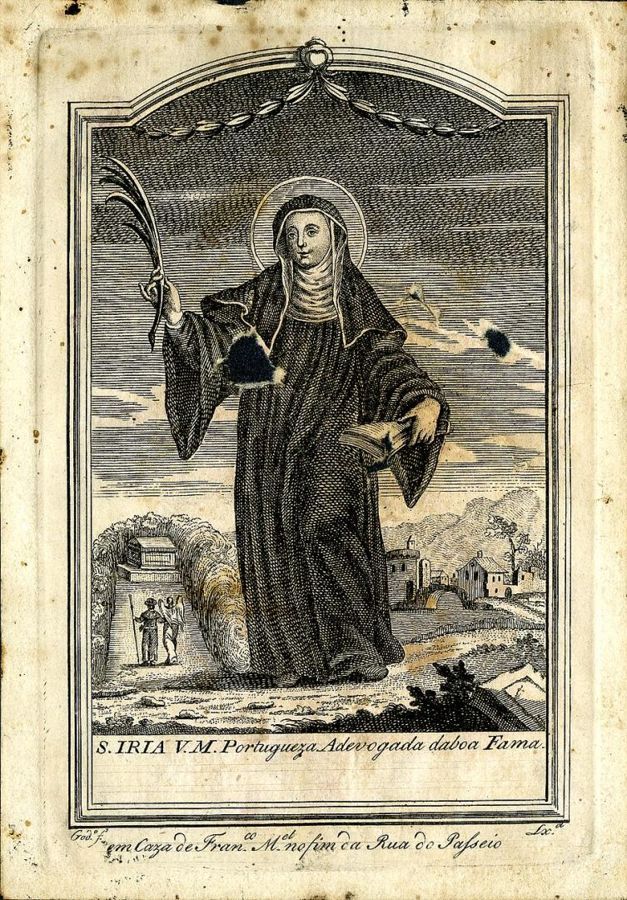
Two years passed, and Britald’s heart was still sore, aching for the sweet young face that haunted him night and day. Now it happened that Irene had a monk for her instructor, named Remigius, a monk "most learned and most religious," as the Breviary is pleased to call him, who also fell passionately in love with his pupil and apparently took advantage of his position. This caused considerable scandal in the neighborhood, as Irene showed clear signs of being on her way to becoming a mother. Britald, driven mad by his love, sent a servant to ambush her at night and kill her. The man found her near the river Nabana, cut her throat, and threw her into the stream, which carried her into the Zezare River, and the Zezare washed her into the Tagus River. She was then taken to Scalabis, which later took her name, now shortened to Santarem. Remigius went to Rome, confessed his sin, and did appropriate penance.
The title “Virgin,” given to this disreputable nun, is certainly a bit inappropriate. Numerous miracles have been performed by her relics and are attributed to her intercession.
She is depicted in art as a pregnant Benedictine nun with a sword through her throat. The Evora Breviary states that Remigius "gave her a potion made from a harmful herb, which caused the virgin, who was incorrupt, to gradually swell up, resembling a pregnant woman, and she did not escape infamy." This is an inventive way of getting her out of a difficult situation. The Auctuarium Mart. Rom. for Portugal ignores Remigius and the little scandal altogether. Guerin and Giry say nothing about the damaging appearance of the young woman and merely state that Remigius, when she would not listen to his advances, "spread the rumor that she had conceived," which shows a certain boldness in handling original documents. Alban Butler has forgotten the blessed Irene. She is only mentioned here in the hope of drawing attention to the need for a new revision of the Roman Martyrology, so that she and some other unworthy figures who have crept in may be removed.
Footnotes
- The Evora Breviary states that Remigius gave her a potion made from a harmful herb, which caused the virgin, who was incorrupt, to gradually swell up, resembling a pregnant woman, and she did not escape infamy.
- This is an inventive way of getting her out of a difficult situation.
- The Auctuarium Mart. Rom. for Portugal ignores Remigius and the little scandal altogether.
- Guerin and Giry say nothing about the damaging appearance of the young woman and merely state that Remigius, when she would not listen to his advances, spread the rumor that she had conceived.
- Alban Butler has forgotten the blessed Irene.
Baring-Gould’s own footnotes, in modern English.
Read the original 1870s text
Baring-Gould’s sources: Modem Roman Martyrology, Spanish and Portuguese Martyrologies. Authority: — The account in the Breviary of Evora.] A nobleman, named Castenald, lived at Thomar, on a confluent of the Zezare, in Portugal, in the beginning of the seventh century; he was ruler of the district He had a son named Britald, a young man of good disposition. At the same time there lived in a convent near Thomar, a beautiful young nun, named Irene, daughter of a gentleman of the neighbourhood. Her uncle was Abbot Selius of S. Mary’s on the Effona, at no great distance. The youth Britald met and fell in love with Irene; his hopeless passion consumed him, and he became ill. The parents in vain procured the best doctors; he sought the church where Irene went to pray, and it was his only consolation to see her. Irene, ascertaining by Divine inspiration, says the Breviary, what was the matter with the young man — girls generally detect this sort of thing by a very natural instinct — went to him, and assured him that it was much better he should not see her. “ Irene,” he answered, “ I can bear it that you are dedicated to God, and love no man; but if I thought you had given your heart to any human being, I would not endure it” She laid her hands on him and departed.
Two years passed, and Britald’s heart was still sore, aching for the sweet young face that haunted him night and day. Now it happened that Irene had a monk for her instructor, named Remigius, a monk u doctissimus et religiosissimus,” as the Breviary is pleased to designate him, who also fell passionately in love with his pupil, and apparently took advantage of his position; for Irene, to the no small scandal of the neighbourhood, gave visible token of being in a fair way to become a mother.1 Britald, his love turned to madness, sent a servant to waylay her at night, and kill her. The man arrested her near the river Nabana, cut her throat, and flung her into the stream, which carried her into the Zezare, and the Zezare washed her into the Tagus, and she was borne to Scalabis, which afterwards bore her name, now contracted into Santarem. Remigius went to Rome, confessed his sin, and did suitable penance.
The title “Virgin,” attributed to this disreputable nun, is certainly a little unsuitable.2 Numerous miracles have been wrought by her relics [the bodily remains of a saint, or objects they used, kept with honor], and are attributed to her intercession.
She is represented in art as a pregnant Benedictine [monks following the Rule of St. Benedict] nun with a sword through her throat. 1 The Evora Breviary says that Remigius ** malefic* herb* succum ills clam in potum dedit. Qua potione virgo incorrupta paulatim, praegnanti similis, intumuit, et infamise nota non caruit; ” an ingenious manner of extricating her from the scrape. The Auctuarium Mart. Rom. for Portugal ignores Remigius and the little scandal altogether. Guerin and Giry say nothing of the damaging appearance of the damsel, and say merely that Remigius, when she would not listen to his suit, “ repandit le bruit qu elle avait con^u,” which shows a certain audacity in dealing with original documents. Alban Butler dropped the blessed Irene into oblivion. She is only introduced here in the hope that attention may be called to the necessity of malring a new revision of the Roman Martyrology, when she and some other unworthy personages who have crept in may be expunged. illibitas designandas pertinet: de conjugatis enim et viduis, corruptisque virginibus seque adhibetur ac de vere virginibus." — Acta Sanct. Oct. T. ix. p. 143. S. Acca.