St. Artemius

Artemius was duke, or military commander, of Egypt under Constantius.

Read the essentials →
Feast October 20 · Martyr

St. Artemius

Current feast

October 20 (also listed: September 19)
Secondary source · Wikipedia infobox

Traditional feast

October 20
1914 / pre-1969 calendar, per Baring-Gould (1897)

Represents

Martyr

Feast days

Feast: October 20

This Saint’s Story

Adapted in modern English from Alban Butler's Lives of the Saints · Baring-Gould original below · little is known

Butler admits that in some commissions he acted against St. Athanasius, but says he helped him escape and never accepted Arianism (followers of Arius's teaching that the Son is a created being, not fully God).

Under Julian the Apostate (emperor 361–363, raised Christian, who tried to restore paganism), pagans in Egypt accused him of destroying their temples and idols. Julian summoned him to Antioch and had him beheaded there about June. Butler's sources include Theodoret (5th-century bishop and church historian).

Butler gives 362; Baring-Gould, the text on this page, gives 363. The sources differ.

What he represents

How he teaches us to live

Drawn from themes in the original account

Stay faithful when it costs you. Holding firm under pressure is part of this story.

Celebrate this saint’s feast day. Remember him on October 20 with a short prayer, and ask for his help.

The full story

Baring-Gould’s account retold in modern English

Read the full story · 494 words · about 2 min

Ammon, an Egyptian bishop, lived during the time of Theophilus and wrote about the history of E during the reign of Constantius. He speaks of Sebastian and his successor Artemius as being fierce in their persecutions against bishops, monks, virgins, and other Catholics.

“When the blessed Bishop Athanasius was pursued under Constantius by the Arians, the holy monks, virgins, and most devout laypeople in Egypt and Alexandria faced many hardships. They were sent away with wounds and blows, and the bishops throughout all of Egypt were exiled. Sebastian was the governor at that time, having succeeded Syrianus, who commanded that many virgins, devoted to God by their chastity, were killed by the wicked in the church of Bishop Theonas. Many holy bishops died from torments under Artemius, who succeeded Sebastian, and all the holy Western bishops were driven into exile. Indescribable miseries were widespread, with the Arians prevailing under their cruel leader, George.” However, if Artemius persecuted the Catholics, he also troubled the pagans by plundering their temples and knocking off the heads of their idols.

When Julian came to power, the anger of the pagans was unleashed, and Artemius was executed after accusations were brought against him.

Ammianus Marcellinus states, “At this time, Artemius, who had been the duke of Egypt, was put to death due to a large number of serious accusations brought against him by the citizens of Alexandria.”

According to Ammianus, George, the Arian bishop, often accused many residents of Alexandria to Constantius, opposing his authority. Artemius, who seemed to be closely associated with this infamous man, likely executed them.

Theodoret says, “Artemius, who held the position of military commander in Egypt, destroyed some idols during the reign of Constantius. As a result, he was not only stripped of all his property but was also beheaded.” The monk John, who wrote his Passion, compiled it from Philostorgius, unaware that he was quoting an Arian historian, who naturally praised a martyr of his own belief, one who did not believe in the eternal Godhead of Christ. The Paschal chronicle states, “Artemius, duke of the province of Egypt, during the time of the blessed Constantius, while enjoying this position, significantly affected the Churches. His possessions were confiscated, and his head was cut off in Alexandria due to the great hatred Julian had for him.” This statement comes from an Arian source, as the only Churches Artemius affected were those that did not worship the Consubstantial.

The actions of Artemius were elaborated into a lengthy story by a monk named John, who some believe to be John Malala and others think is John of Damascus. He completely ignores the Arianism of his subject and does not mention his persecution of Catholics and of Saint Athanasius. The Greek Church, relying on these Acts and likely without thoroughly examining the situation, has included Artemius in its sacred calendar. Baronius later transferred him from the Greek Menology (a collection of saints' lives) into the Roman Martyrology.

Footnotes

  1. Theodoret says, "Artemius, who held the office of military commander in Egypt, having, during the reign of Constantius, destroyed some idols, was, in consequence, not only deprived of all his property, but was also beheaded."
  2. The monk John, who wrote his Passion, compiled it from Philostorgius, unconscious that he was quoting an Arian historian, who naturally glorified a martyr of his own persuasion, one who disbelieved in the eternal Godhead of Christ.
  3. The Paschal chronicle says, “Artemius, duke of the province of Egypt, in the times of Constantius of blessed memory, whilst enjoying this dignity, singularly affected the Churches; his goods were confiscated, and his head was struck off at Alexandria, through the great hatred borne him by Julian.”

Baring-Gould’s own footnotes, in modern English.

Read the original 1870s text

Baring-Gould’s sources: Roman Martyrology, inserted by Baronius, from the Greek Menaea. Authorities: — Theodoret; mention in the Chron. Paschale, and the Acts written by John the Monk, probably John Malala, of little value.] Artemius was sent by the Arian Emperor Constantius to Patras and Thebes in Bceotia, to translate the bodies of S. Andrew and S. Luke to Constantinople, as they were exposed to the danger of being lost on account of the incursions of the Barbarians. He accomplished this task, and in addition to it that of translating S. Timothy from Ephesus, with such success, that Constantius rewarded him by elevating him to the prefectship of Egypt. Artemius was as zealous in persecuting Catholics at the bidding of his Arian master as he had been in translating Apostolic relics. The infamous George had been elevated to the patriarchal throne of Alexandria in the room of S. Athanasius, who was hiding. Artemius not only sent his soldiers, but went himself with them to hunt down that zealous champion of the true faith. At Tabenna he asked the monks to join with him in divine worship, but they indignantly refused communion with an Arian who had an Arian bishop in his suite. In the life of S. Pachomius we read that on this occasion, when Artemius was striving to hunt out the great Athanasius, and was searching the cells of Tabenna, he woke one morning to find that his nose had been bleeding during the night, and was so scared, that the Benedictine editor of the Life of S. Athanasius trusts his bloody nose was the means of his conversion to orthodoxy.

Ammon, an Egyptian bishop, who flourished in the days of Theophilus, and who wrote concerning the history of E in the reign of Constantius, speaks of Sebastian and his successor Artemius as raging in persecutions against bishops, monks, virgins, and other Catholics.

“ When the blessed Bishop Athanasius was pursued under Constantius by the Arians [followers of Arius, who taught that the Son is a created being, not fully God], the holy monks and virgins and most religious laity in Egypt and Alexandria endured many hardships, and were despatched with wounds and blows, and the bishops throughout the whole of Egypt were sent away, Sebastian being the governor, having succeeded Syrianus, by whose command many virgins, devoted by chastity to God, were killed by the weapons of the wicked in the church of the Bishop S. Theonas; and when of the holy bishops many expired through torments under Artemius, who succeeded Sebastian, and all the holy Western bishops were driven into exile, and indescribable miseries were general, the Arians prevailing under their most cruel leader, George, &c.” But if S. Artemius persecuted the Catholics, he a\sr worried the infidels by plundering their temples and knoc ing off the heads of the idols.

On the accession of Julian the exasperation of the heathen was relieved from restraint, and on accusation brought against him, Artemius was put to death.

Ammianus Marcellinus says, “ At this time, Artemius, who had been duke of Egypt, and against whom the citizens of Alexandria brought a great mass of heavy accusations, was put to death.”

George, the Arian bishop, according to the statement of Ammianus, was in the habit of accusing numbers of the inhabitants of Alexandria to Constantius, as opposed to his authority, and probably Artemius, who seems to have been hand and glove with this infamous man, executed them.

Theodoret says, " Artemius, who held the office of military commander in Egypt, having, during the reign of Lives of the Skints.

Constantius, destroyed some idols, was, in consequence, not only deprived of all his property, but was also beheaded.”1 The monk John, who wrote his Passion, compiled it from Philostorgius, unconscious that he was quoting an Arian historian, who naturally glorified a martyr of his own persuasion, one who disbelieved in the eternal Godhead of Christ. The Paschal chronicle says, “ Artemius, duke of the province of Egypt, in the times of Constantius of blessed memory, whilst enjoying this dignity, singularly affected the Churches; his goods were confiscated, and his head was struck off at Alexandria, through the great hatred borne him by Julian.” This is a statement by an Arian hand, for the only Churches Artemius affected were those in which the Consubstantial was not adored.

The acts of Artemius were expanded into a prolix narrative by a certain monk John, supposed by some to be John Malala, and by others John of Damascus. He throws completely over the Arianism of his hero, and says not a word about his persecution of the Catholics and of S. Athanasius [bishop of Alexandria (d. 373), great defender of the Nicene faith]. The Greek Church, relying on these Acts, and probably without critically investigating the case, has adopted Artemius into its sacred Kalendar, and Baronius [Cardinal Baronius (d. 1607), church historian who edited the Roman Martyrology] drafted him from the Greek Mensea into the Roman Martyrology.
Help us add to this saint's story

Everything is read by a person before anything appears. Facts are checked against trusted sources first.

Facts are welcome; a source link helps (optional).With your permission we may share it on this page.

Nine days · Free

Pray the novena
with us.

One short email a day for nine days. The day's prayer, a line from St. Artemius's story, and a nudge to keep going.

Also on October 20
C

Sts. Caprasius and…

October 20 · Martyrs
St. Irene

St. Irene

October 20 · Virgin, Martyr
← All 1970 saints in the library
Sources & notes

Feast-day sources

Story sources

Sources

Credits

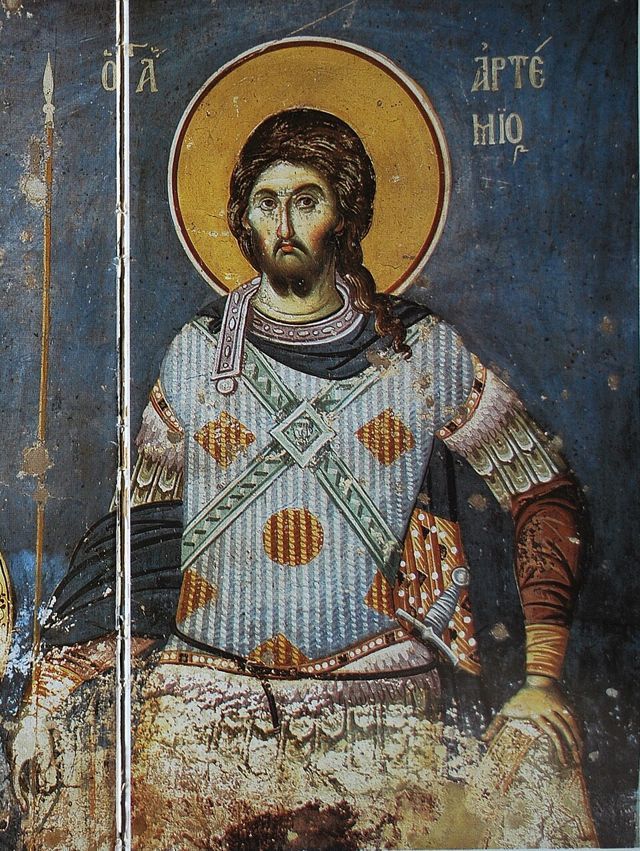
Image: Sant Artèmi.jpg · Manuel Panselinos · Public domain, via Wikimedia Commons

Image: Manuel Panselinos, Wikimedia Commons (Public domain)

Retold in plain modern English from Baring-Gould’s public-domain text, sentence by sentence, keeping the same facts and order. Short explanations in parentheses are ours.

From Sabine Baring-Gould, The Lives of the Saints, new edition in 16 vols. (London: John C. Nimmo, 1897–98); text from the Internet Archive scan (OCR, lightly cleaned; errors possible). Public domain in the United States. Reproduced unedited, except for short bracketed notes in grey that we added to explain names and terms (“S.” is the old abbreviation for Saint). Some history and judgments reflect 19th-century scholarship.