St. Ildefonsus of Toledo

Ildephonsus (Ildefonsus), Archbishop of Toledo, died on 23 January 667.

Read the essentials →
Feast January 23 · Bishop

St. Ildefonsus of Toledo

Current feast

January 23
Secondary source · Wikipedia infobox

Traditional feast

December 26
1914 / pre-1969 calendar, per Baring-Gould (1897)

Represents

Bishop

Feast days

Feast: January 23
Traditional: December 26

This Saint’s Story

Born of a distinguished family and nephew of St. Eugenius, his predecessor in that see, he entered the monastery of Agli near Toledo despite his father’s opposition. While still a simple monk he founded and endowed a monastery of nuns at Deibiensi villula. About 630 Helladius, once his abbot and later archbishop, ordained him deacon. As Abbot of Agli he signed the Eighth and Ninth Councils of Toledo in 653 and 655. Toward the end of 657 King Reccesvinth called him to the archiepiscopal throne; he governed Toledo a little more than nine years and was buried in the Basilica of Saint Leocadia. These scanty facts, the Catholic Encyclopedia notes, rest on Ildephonsus himself and on a short notice by his immediate successor Julianus.

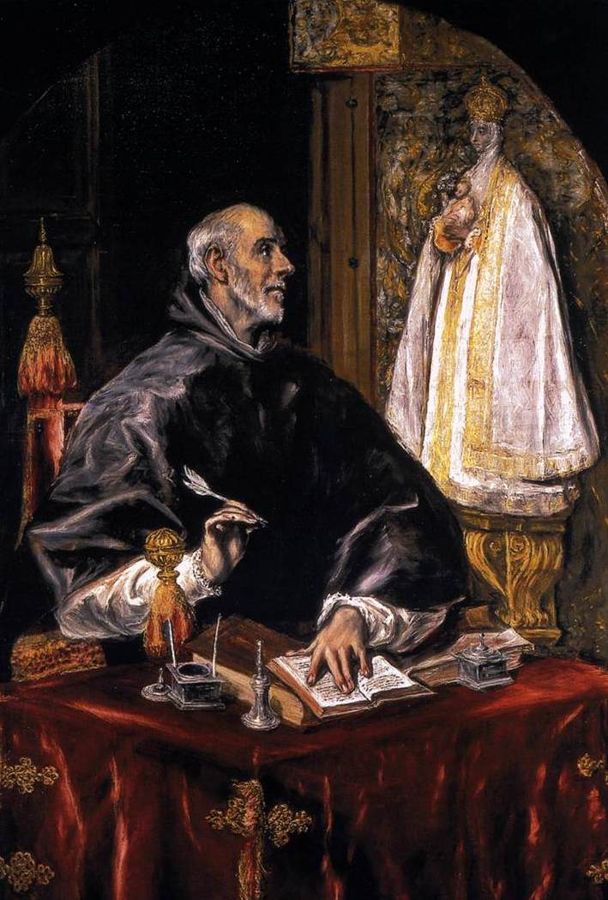
Later writers added doubtful or legendary anecdotes. At the end of the eighth century Archbishop Cixila related that Ildephonsus had been a disciple of Isidore of Seville, and told two marvellous stories long entwined with his memory: that Saint Leocadia rose from her tomb to thank him for devotion to the Mother of God, and that the Blessed Virgin appeared and gave him a priestly vestment. The Catholic Encyclopedia treats these as later embellishment rather than as the authentic core of his life.

His literary work earned him a high place among Spanish ecclesiastical writers. Of six treatises in his first division, two survive: the ardent De virginitate perpetua sanctae Mariae against three unbelievers, and the baptismal Annotationes with the Liber de itinere deserti (the first largely an earlier work with his additions). Correspondence with Quiricus of Barcelona, masses, hymns, sermons, and epitaphs filled other parts; the authentic De viris illustribus supplements Isidore while glorifying the Church of Toledo. His feast is 23 January.

Short entry · the summary here is 51 words; Baring-Gould’s fuller original text and its sources are below. We have not filled any gap with invented detail.

What he represents

How he teaches us to live

Drawn from themes in the original account

Celebrate this saint’s feast day. Remember him on January 23 with a short prayer, and ask for his help.

The full story

Baring-Gould’s account retold in modern English

Read the full story · 50 words · about 1 min

He wrote epitaphs and epigrams, and continued the list of notable men created by Saint Isidore of Seville. A second treatise on the virginity of the Virgin Mary, along with some sermons attributed to him, has been dismissed by scholars as not being his work.

Relics are located in Toledo.

Read the original 1870s text

Baring-Gould’s sources: Roman Martyrology Jan. 23; his Life having been omitted on dial day, is given here.] S. Ildefonsus, or Hildephonsus, was abbot of Agali, in Spain. He embraced the religious life at an early age, and founded a convent for virgins with his patrimony. On the death of Eugenius II., bishop of Toledo, he was compulsorily elevated to that see, a.d. 658, and occupied it during nine years and two months. He died on January 23, 667, and was buried in the church of S. Leocadia, at the feet of his predecessor. He left several works, but of them only one, on the virginity of our Lady, has been preserved. This was written in opposition to those who taught that the B. Virgin was the real wife of S. Joseph, and bore him children after the birth of our Lord. An absurd legend is told of him in reference to this treatise, given already in this volume.

He wrote epitaphs and epigrams, and continued the catalogue of illustrious men made by S. Isidore of Seville. A second treatise on the virginity of the Virgin Mary, and some sermons attributed to him, have been rejected by scholars, as not his.

Relics at Toledo. ft ft S. John the Divine.

From the Catholic Encyclopedia

1913 · 764 words

Archbishop of Toledo; died 23 January, 667. He was born of a distinguished family and was a nephew of St. Eugenius, his predecessor in the See of Toledo. At an early age, despite the determined opposition of his father, he embraced the monastic life in the monastery of Agli, near Toledo. While he was still a simple monk, he founded and endowed a monastery of nuns in Deibiensi villula. We learn from his writings that he was ordained a deacon (about 630) by Helladius, who had been his abbot and was afterwards elected Archbishop of Toledo. Ildephonsus himself became Abbot of Agli, and in this capacity was one of the signatories, in 653 and 655, at the Eighth and Ninth Councils of Toledo. Called by King Reccesvinth, towards the end of 657, to fill the archiepiscopal throne, he governed the Church of Toledo for a little more than nine years and was buried in the Basilica of Saint Leocadia. To these scanty but authentic details of his life (they are attested by Ildephonsus himself, or by his immediate successor, Archbishop Julianus, in a short biographical notice which he added to the "De viris illustribus" of Ildephonsus) some doubtful or even legendary anecdotes were added later. At the end of the eighth century Cixila, Archbishop of Toledo, embellished the biography of his predecessor. He relates that Ildephonsus was the disciple of Isidore of Seville, and recalls in particular two marvellous stories, of which the second, a favourite theme of hagiographers, poets, and artists, has been for ages entwined with the memory of the saint. Ildephonsus, it is said, was one day praying before the relics [the bodily remains of a saint, or objects they used, kept with honor] of Saint Leocadia, when the martyr arose from her tomb and thanked the saint for the devotion he showed towards the Mother of God. It was related, further, that on another occasion the Blessed Virgin appeared to him in person and presented him with a priestly vestment, to reward him for his zeal in honouring her.

The literary work of Ildephonsus is better known than the details of his life, and merits for him a distinguished place in the roll of Spanish writers. His successor, Julianus of Toledo, in the notice already referred to, informs us that the saint himself divided his works into four parts. The first and principal division contained six treatises, of which two only have been preserved: "De virginitate perpetuâ sanctae Mariae adversus tres infideles" (these three unbelievers are Jovinianus, Helvidius, and "a Jew"), a bombastic work which displays however a spirit of ardent piety, and assures Ildephonsus a place of honour among the devoted servants of the Blessed Virgin; also a treatise in two books: (1) "Annotationes de cognitione baptismi", and (2) "Liber de itinere deserti, quo itur post baptismum". Recent researches have proved that the first book is only a new edition of a very important treatise compiled, at the latest, in the sixth century, Ildephonsus having contributed to it only a few additions (Helfferich, "Der westgothische Arianismus [followers of Arius, who taught that the Son is a created being, not fully God]", 1860, 41-49). The second part of his works contained the saint's correspondence; of this portion, there are still preserved two letters of Quiricus, Bishop of Barcelona, with the replies of Ildephonsus. The third part comprised masses, hymns, and sermons; and the fourth, opuscula in prose and verse, especially epitaphs. The editions of the complete works of Ildephonsus contain a certain number of writings, several of which may be placed in either of the last two divisions; but some of them are of doubtful authenticity, while the remainder are certainly the work of another author. Moreover, Julianus states that Ildephonsus began a good number of other works, but his many cares would not permit of his finishing them. On the other hand, he makes no mention of a little work which is certainly authentic, the "De viris illustribus". It may be considered as a supplement to the "De viris illustribus" of Isidore of Seville, and is not so much a literary historical work as a writing intended to glorify the Church of Toledo and defend the rights of the metropolitan [the archbishop who heads a group of dioceses] see.

ANTONIUS, Bibliotheca Hispana vetus, I (1696), 286-302; FLOREZ, Espana sagrada, V (1750), 275-91; 470-525; cf. XXIX (1775), 439-43; GAMS, Kirchengeschichte Spaniens, II (1874), i, 135-38; VON DZIALOWSKI, Isidor und Ildefons als Litterarhistoriker (Munster, 1898), 125-60; — for ancient biographies, see Bibl. Hagiogr. Lat., nos. 3917-26; — for modern works, see CHEVALIER, Repertoire des sources historiques du moyen age: Bio-Bibl. (Paris, 1905), s.v. Ildephonse. The principal edition of the saint's works is that of LORENZANA, SS. PP. Toletanorum opera, I (1782), 94-451, reprinted in P.L., XCVI, 1-330.
Help us add to this saint's story

Everything is read by a person before anything appears. Facts are checked against trusted sources first.

Facts are welcome; a source link helps (optional).With your permission we may share it on this page.

Nine days · Free

Pray the novena
with us.

One short email a day for nine days. The day's prayer, a line from St. Ildefonsus of Toledo's story, and a nudge to keep going.

Also on December 26
S

St. Stephen the…

December 26 · Deacon, Martyr
St. Dionysius, Pope

St. Dionysius

December 26 · Feast
M

St. Marinus (December 26)

December 26 · Martyr
← All 1970 saints in the library
Sources & notes

Feast-day sources

Story sources

Sources

Credits

Image: Ildefonso de Toledo (cropped).jpg · El Greco · Public domain, via Wikimedia Commons

Image: El Greco, Wikimedia Commons (Public domain)

From “Catholic Encyclopedia (1913)/St. Ildephonsus,” The Catholic Encyclopedia (New York: Robert Appleton Company, 1907–1914), via Wikisource. Public domain. Matched by name and feast date; text unedited except for our bracketed notes in grey.

Retold in plain modern English from Baring-Gould’s public-domain text, sentence by sentence, keeping the same facts and order. Short explanations in parentheses are ours.

From Sabine Baring-Gould, The Lives of the Saints, new edition in 16 vols. (London: John C. Nimmo, 1897–98); text from the Internet Archive scan (OCR, lightly cleaned; errors possible). Public domain in the United States. Reproduced unedited, except for short bracketed notes in grey that we added to explain names and terms (“S.” is the old abbreviation for Saint). Some history and judgments reflect 19th-century scholarship.

Notes

Story retold in our own words from the cited sources.