St. Gregory Vii., Pope

Hildebrand, who became Pope Gregory VII, was born between 1020 and 1025 at Soana in Tuscany.

Read the essentials →
Feast May 25 · —

St. Gregory Vii., Pope

Current feast

May 25
Verified · General Roman Calendar

Traditional feast

May 25
1914 / pre-1969 calendar, per Baring-Gould (1897)

Represents

Feast

Feast days

Feast: May 25

This Saint’s Story

He came from humble stock. He was educated in Rome at Santa Maria on the Aventine, where his uncle was abbot, and made his profession as a Benedictine (monks following the Rule of St. Benedict) monk in Rome, not at Cluny (the great Burgundian abbey, head of a vast network of monasteries). He served Gregory VI as chaplain, followed him into exile at Cologne in 1046.

In 1049 he returned to Rome with Leo IX, who made him a cardinal-subdeacon and put him in charge of the Patrimony of St. Peter. Over the next twenty years he was the leading figure in Rome. He helped secure the decree that gave the election of popes to the cardinals and the Norman alliance of 1059. When Alexander II died on 21 April 1073, the crowd at the funeral cried out, “Let Hildebrand be pope!” He was elected that same day.

Gregory took on two great evils, simony (buying or selling church offices) and clerical incontinence. His Lenten synod of 1074 removed from ministry clergy who had bought their office or would not live chastely. In 1075 he forbade lay investiture (the right to appoint and install bishops). Henry IV of Germany answered at Worms by declaring him deposed, and Gregory excommunicated the king. In January 1077 Henry came as a penitent to Canossa, waited three days in the snow, and on 28 January was absolved. The quarrel broke out again: Henry set up the antipope Guibert (Clement III) and in 1084 took Rome. Robert Guiscard’s Normans freed the pope, but their excesses turned the people against him, and he withdrew to Monte Cassino and then Salerno. He died there on 25 May 1085, saying, “I have loved justice and hated iniquity, therefore I die in exile.” Baring-Gould admits that some of his acts were harsh, while defending his aims. He was beatified (declared 'Blessed', the step before sainthood) in 1584 and canonized (officially declared a saint by the pope) by Benedict XIII in 1728. The Encyclopedia names no patronage.

What he represents

How he teaches us to live

Drawn from themes in the original account

Stay faithful when it costs you. Holding firm under pressure is part of this story.

Share your faith, in words and by example. Preaching and conversion are part of this story.

Practise small acts of self-denial. Fasting and penance are part of this story. Skipping a snack or setting your phone aside for an hour is a start.

The full story

Baring-Gould’s account retold in modern English

Read the full story · 9,060 words · about 39 min

Gregory was a man whom many modern historians have misunderstood. He has been portrayed as a monster of ambition and priestly arrogance, which has led to widespread detestation. It is hard to dispute that his actions sometimes showed harshness and that he made serious mistakes on more than one occasion. However, we misinterpret his character if we attribute his actions to low motives like ambition or arrogance. From beginning to end, Hildebrand was driven by a zeal for the glory of God and the purification of the Church. To him, the only way to achieve his goals was to completely free the Church from the harmful subservience it had fallen into due to the well-intentioned but dangerous precedents set by Emperor Henry III. This was during a time when the papacy had sunk to its lowest point, and only the intervention of secular power could restore its glory.

Upon the death of John XVIII in 1033, his brother, the Count of Tusculum, who held significant power in Rome, showed so little regard for appearances that he arranged for the election and consecration of his son, Theophylact, a boy around ten or twelve years old, to the chair of St. Peter. The unfortunate youth was consecrated under the name Benedict IX and quickly demonstrated the unfitness of this choice through his reckless and hasty descent into various forms of debauchery and crime as soon as he was old enough. Eventually, in a bid to outrage public sentiment to the fullest, he foolishly considered marrying his first cousin. The girl's father refused to allow the marriage unless Benedict resigned the papacy. In response, the young pope sold the papacy to the archpriest John Gratian and personally consecrated him as his successor, under the name Gregory VI.

Another faction in Rome immediately elected and consecrated a rival pope, Sylvester III. When Benedict found that his intended bride was still unavailable and felt no obligation to honor his agreement with Gratian, he returned to Rome after three months. He claimed his former position. Although he managed to occupy the Lateran palace, he could not completely drive either of his rivals out of the city. Thus, the world witnessed the disgraceful sight of three popes opposing each other, each residing in different palaces and officiating at different altars in the papal city.

Although the Romans were usually and naturally opposed to German control, the name of the young and energetic Henry III, who now occupied the imperial throne, became well-known among them as that of a desired and expected savior. In a rhythmic saying that circulated widely, he was implored to come and, as the representative of the Almighty, rescue the Church of Rome from the peak of degradation it had reached.

Henry III entered Italy in 1046 and called a Council to meet at Sutri to address the issues within the Church. The Council deposed all three popes. To prevent the scandals that had plagued the election of the popes for a long time, Henry demanded that the Romans place the elections entirely under his control. He insisted that no one should dare to nominate a pastor to the Apostolic see without prior approval from the imperial authority.

Afterward, Henry donned the green mantle, the golden circlet, and the ring that signified the dignity of Patrician of Rome. He took the hand of Suidger, the bishop of Bamberg, led him to the papal chair, and required the Church to recognize him as the new pope, taking the name Clement II. This esteemed pontiff died, almost certainly by poison, in 1047. Hardly had he taken his last breath when the Tusculan faction rose again in arms. They summoned their unfortunate puppet, Benedict IX, from his exile and placed the miserable man back on the throne of St. Peter. With the support of his followers, he managed to hold his position for several months, while the evils and disorders that Henry believed he had effectively stopped began to resurface.

Consequently, many who had previously protested vehemently against the complete subjugation of the Church to an imperial master found themselves, due to their unfortunate circumstances, once again pleading with that master to determine the Church's fate. Henry, genuinely eager to make a wise choice, selected Poppo, the bishop of Brixen, who was installed under the name of Damasus II. However, Damasus ended his earthly life within just three or four weeks after formally taking on the responsibilities of his office. The quick succession of these events could not help but reinforce the suspicions already circulating regarding the death of Clement, as well as raise similar doubts about the current situation.

found among his German bishops a general reluctance to accept a position that, while prestigious, was filled with danger. He therefore appointed Bruno, the bishop of Toul, who was a relative, and he took the Apostolic throne under the name of Leo IX. This overview shows that the emperor had set a dangerous precedent, compelled by the needs of the time; however, the full extent of this danger soon became apparent. He had turned the Church into a part of the state. The Pope was now a creation of the emperor, just as he had previously been a creation of the faction that had elevated him.

There was a growing faction in Rome that feared for the Church, as they observed the imperial power overshadowing it. This faction wanted to free the Church from imperial control. It was not just the Papacy that, due to the zeal of Henry III, had become subordinate to the State; throughout the empire, the entire Church was more or less under State control and was used as a political tool rather than a religious one. In Germany and Italy, bishoprics and abbeys were gifts from the crown, and the emperor awarded these church positions to his friends or, if they were in need, sold them to the highest bidder. The bishops, to recover the costs of purchasing their sees, sold the benefices they controlled, leading to simony infecting the entire German and Italian Church. It is clear that in such a situation, the moral authority of the Church weakened, and to restore discipline and reform abuses, the monarch's right to invest bishops must be abolished. The princes claimed the right to confer bishoprics through the outward symbols of the ring and staff, and the people would quickly come to believe that spiritual authority originated from the crown.

The history of Gregory VII is the story of his struggle against the encroachment of imperial power on spiritual matters. It was not ambition to elevate himself that drove the great pope into conflict with the emperor; it was his zeal for the Church of God, over which he had been appointed overseer. We may regret the way in which the conflict was conducted, but we must respect the motive that compelled the pope to engage in it.

Another of the goals that motivated Hildebrand was the abolition of clerical marriage and the improvement of the moral standards of the clergy. Several of his predecessors had spoken out against it, but their words had fallen on deaf ears, and neither the bishops nor the princes had been willing to enforce their commands. The struggle that needed to be fought was one of purity against impurity, of holiness against corruption. The clergy in the West who were married knew that they had violated the decrees of popes and church councils. The priests who had become accustomed to ignoring one commandment that bore the authority of the Church had crossed a significant moral line that separates those who are systematically, though imperfectly, dutiful from those who are habitually godless and profane. Their character had been compromised, and their descent into the worst excesses of vice may have been easier than their initial bold step from obedience to disobedience. The reforming pope had two options: either to remove the married priest from his association with all classes of the licentious and profane by adopting the less strict rules of the Greek Church, or to combat clerical immorality by force. Using the means available to him, Gregory VII chose the latter approach and set out to achieve, and did achieve, a significant reform.

To accurately assess the character of this great pope, we must recognize the extent of the opposition he faced. It is a mistake to overlook this opposition; instead, we should acknowledge its intensity and its widespread nature. Only then can we understand the remarkable determination of that one man to confront and overcome it. Hildebrand, even if not born in Rome, was educated as a Roman. He came from humble beginnings. His father was a carpenter in Saona, a small town on the southern border of Tuscany. His name suggests a Teutonic ancestry. He spent his youth in a monastic house in Rome, specifically S. Mary on the Aventine, where his uncle served as abbot. Hildebrand's personality was well-suited to his education. He had been a monk since childhood. The practice of self-denial in even the smallest matters taught him the self-control and discipline that he would later impose on others. If he was strict with others, he was even harsher on himself. Rome was not an ideal environment for monastic perfection; however, the city's blatant and shocking immorality, along with the problems within the monastic system, may have strengthened his resolve. Upon reaching adulthood, he decided to seek a better environment for his deep devotion and to find a cloister that offered more protection from temptation to help control the rebellious passions of his youth. Despite the general decline of monastic institutions, there were still some that were renowned for their holiness. At no time were there a lack of individuals who adhered strictly to the rules of Benedict or Columban. Among these was Odilo, the abbot of Cluny in Burgundy. With him, Hildebrand found a suitable refuge, and he was strongly tempted to spend his days in the peaceful surroundings of Cluny. However, a life of holy seclusion was not the calling of his dynamic spirit. Hildebrand returned to Rome, where he became associated with one of the three rival popes, whose cause was most likely to resonate with a devout person committed to canonical order. When Gregory VI, forced to resign from the papacy, retreated to Germany, Hildebrand re-emerged as the advisor to Leo IX, then to Nicholas II, and later to Alexander II. For a long time in the history of the papacy, Hildebrand appeared to be the only constant figure. Pope after pope came and went; Hildebrand remained steadfast. One by one, they fell away: Clement, Damasus, Leo, Victor, and Nicolas. The only pope who ruled for ten years was Alexander II.

While Hildebrand was rising to the height of power and becoming more and more involved in the affairs of the world that he was soon to govern, Saint Peter Damiani, his older colleague under the reforming Pope Leo IX (see April 19th), watched his progress with amazement and regret. The similarities and differences between these two men are notable. Damiani was still a monk at heart, and he had struggled with restless impatience against the burden of the episcopate (the office of a bishop) placed upon him by Pope Stephen. Damiani saw the monk in Hildebrand fading away as he became a statesman, and he feared for Hildebrand's salvation. Hildebrand could not understand Damiani's reluctance to take a prominent role in the battle when the Church was in danger. They parted ways to follow different paths: Damiani to conquer the world within himself, and Hildebrand to conquer the world outside.

Pope Alexander II died on April 21, 1073. The clergy gathered in the Lateran Church to hold his funeral service, with Hildebrand, the archdeacon, leading the solemn rites. Suddenly, a loud cry arose from the entire assembly of clergy and people, shouting, “Hildebrand is pope!” “Saint Peter chooses the Archdeacon Hildebrand!” The archdeacon rushed to the pulpit to calm the crowd and decline the offered honor, but Cardinal Hugh the White stepped forward and spoke above the cheers of the crowd. “You all know,” he said, “that since the days of the blessed Leo, this wise archdeacon has elevated the Roman see and saved this city from many dangers. Therefore, we, the bishops and cardinals, unanimously elect him as the shepherd and bishop of your souls.” Hugh's voice was drowned out by the overwhelming cries, “It is the will of Saint Peter; Hildebrand is pope.” Hildebrand was immediately led to the papal throne, dressed in the scarlet robe, crowned with the papal tiara, and, reluctant and in tears, was seated in the chair of Saint Peter. Hildebrand had good reason to weep. The future ahead of him was filled with challenges. The Church had never needed a stronger leader, and never could a pope show strength with less personal safety. It was a moment of weakness for him. Then, like Saint Peter, who first girded his fisher's coat around him and jumped into the waves, Hildebrand prepared for battle, shook off his fears, and boldly charted the course that his conscience dictated. He began his reign by carefully securing an uncontested title. The decree of Nicolas II had stated that, after the nomination by the cardinals, the approval by the clergy and people of Rome, the emperor's consent was also necessary to complete the full legal title. Hildebrand sent messengers to Germany to inform Henry IV of his elevation and to request his approval. Gregory, the bishop of Vercelli and chancellor of Italy, was sent to Rome with the imperial ratification, and Hildebrand took the throne of Saint Peter under the name Gregory VII, which he chose in honor of his unfortunate teacher and friend Gratian, who had held the papacy under that name but had been deposed for simony.

The first official act of Gregory VI was to send Hugh the White as his representative to Spain. He was tasked with insisting on the abolition of the Mozarabic liturgy and the adoption of the Roman ritual in its place. However, this mission had another purpose, which was a more surprising assertion of authority that was new to the king of Spain.

In a letter addressed on April 30th, 1073, to the noble leaders of Spain, and given to his newly-appointed representative, Gregory wrote: “You are not unaware that the kingdom of Spain was once the property of St. Peter, and that, despite its long occupation by Pagans, it still rightfully belongs to no one but the apostolic see.” Therefore, he granted a certain Count Eboli of Roceio as much land as he could conquer from the Moors, to be held by him as a fief of the see of Rome. “We warn you all that unless you are prepared to recognize St. Peter's claim on those territories, we will oppose you by using our apostolic authority to forbid your attacking them.”

The claim made by Gregory was new to those it was addressed to and lacked documentary or even traditional proof. However, the Spanish princes, likely sensing that they could gain advantages from accepting such a claim, did not seem to oppose it. Engaged in a continuous holy war, the more they could align their cause with that of the Church, the more confidently they could appeal to the zeal and courage of their subjects when needed.

Almost the first public act of Gregory VII was a declaration of relentless opposition to simony and the marriage of the clergy. The decree from the synod held in Rome during the eleventh month of his papacy is not available, but its significant provisions went beyond those of his sternest predecessors. It nearly invalidated all sacraments performed by simoniacal or married priests. While it did not explicitly declare that baptism, absolution, and the consecration of the Host were not valid when performed by their hands, by forbidding the laity from acknowledging them, it effectively encouraged the idea that they were invalid. This directly led to the terrible impieties that we will soon describe. The laity were placed in the position of judges over the priesthood and punishers of its irregularities.

A similar approach had been taken by Pope Victor at Milan, who had encouraged Ariald to incite the people to plunder, mutilate, and expel the married clergy, with some success. This policy was now to be applied throughout the entire empire.

Throughout Western Christendom, these decrees faced fierce or stubborn opposition. Siegfried, the archbishop of Mainz, refused to announce the decree until he was formally threatened with papal censure. Even then, he tried to delay. He did not immediately call the clergy to show their obedience; instead, he allowed them six months to consider it. A synod met at Erfurt. The supporters of clerical marriage gathered in large numbers. Their language was harsh. They appealed to tradition, to Scripture, and to reason. Some of the more extreme members, with mixed but clear threats, called for revenge against anyone who dared to announce this detestable decree. The frightened archbishop expressed his willingness to appeal to Rome and to try to obtain at least some easing of the objectionable law. However, Hildebrand's zeal would not allow for any modification or delay. In his opposition to simony (the buying or selling of church offices), he had the support of most people's consciences. Either the conflict over appointments to church positions had to be fought immediately, or the Church would fall into complete subservience and degradation. Gregory VII rightly saw that it was impossible to eliminate the shameful trade in holy things as long as the power to grant and sell spiritual positions remained in the hands of secular rulers.

In a council held in Rome at the beginning of the year 1075, Gregory abolished, with one decree, the entire right of investiture by secular princes. The prohibition was stated in very broad terms. It completely deposed any bishop, abbot, or lower church official who received investiture of his spiritual position from any layperson. If any emperor or nobleman dared to grant such investiture of a bishopric or lower position, he would be excommunicated. From that moment, Henry IV and Gregory VII became determined, declared, and relentless enemies. Henry believed that the pope was taking away a cherished privilege and an important aspect of political power, which was essential to his authority. Gregory viewed the emperor as an opponent in the reform of the Church. Each was resolved to exert his full power and to recruit the subjects of the other to his side. Henry was not in a position to passively accept what he saw as an attack from the pope. He was backed by powerful allies, committed to his cause, and angered by the pope's uncompromising stance in asserting his supremacy.

We can take, almost at random, a passage from history in Italy to illustrate the blatant abuses that arose from lay investiture. In 938, Hugh of Provence made one of his illegitimate sons bishop of Piacenza and another archdeacon, hoping he would succeed to the archbishopric of Milan. A relative, Hildnin, who had been expelled from his see in France, was made archbishop of Milan. He gave the bishoprics of Trent, Verona, and Mantua to the ambitious Manasseh of Arles. Berengar, the Marquis of Ivrea, bribed Adelard, Manasseh's officer, into treason by promising him the bishopric of Como; but instead of keeping his promise, he gave the bishopric to Waldo, a lawless robber who plundered the highways and blinded his captives, and to Adelard, he gave the see of Reggio.

The German Church, as shown at Erfurt, had a strong desire for independence. Among the more powerful bishops, some were old, some were indecisive, but some, sharing in the condemnation of the emperor, were loyal to him. Siegfried of Mainz was timid and uncertain. By the same Roman synod, Lietmar, the archbishop of Bremen, Werner of Strasburg, Herman of Bamberg, Henry of Spires, William of Pava, Cunibert of Turin, Dionysius of Piacenza, along with the three bishops of Constance, Zeitz, and Lausanne, were banned from performing their duties as simoniacs (those who engage in simony, the buying or selling of ecclesiastical privileges). Few of the bishops were willing to deny the legality of lay investiture, as it would jeopardize their own rights to the properties of their churches. However, the most determined and reckless opposition came from supporters of married clergy. Siegfried, yielding to the urgent commands of the pope, called a second synod at Mainz and presented the mandate from the apostolic see, which instructed the bishops in their dioceses to force the priests to give up their wives. The entire assembly stood up; their language was so resolute and their gestures so fierce that the archbishop feared for his life once again. He declared that from that point on, he would not involve himself in such dangerous matters.

At Passau, Bishop Altmann, on St. Stephen’s Day in 1074, climbed into the pulpit and read the papal brief. He would have been torn apart by the crowd if not for the intervention of some powerful citizens. Bishop Henry of Coire barely escaped with his life when he announced the decree. However, the enforcement of the decree was left to the people. They were made, by the dangerous fourth clause, the judges and executioners of their clergy. Such an invitation was, of course, eagerly and widely accepted. The occasion seemed to the selfish, the irreverent, and the profane to justify their desires.

People with negative feelings towards the ministers of the Church must always regard them with disdain. Priests, whose disobedience to the papal authority provided any justification for such behavior, were openly beaten, abused, and insulted by their rebellious congregations. Some were forced to flee, losing everything they owned; some were mutilated; and some were killed in prolonged tortures. The popular violence, unfortunately sanctioned, went even further into horrors. Many were eager to find what they could consider a religious excuse for neglecting religion itself, for denying their children baptism, and for turning the holy sacrament of the altar into a subject of the most degrading mockery or the most atrocious profanation.

Many other distressing events occurred. The wives of priests, who had been married to them with a ring, a religious ceremony, and a legal document, were torn from them and driven away with the shame of prostitutes, while their children were labeled as illegitimate. In some cases, these wretched women committed suicide; they threw themselves into the fires that consumed their homes, or they were found dead in their beds from grief or by their own hands.

It was not only in Germany that the decrees of Pope Gregory VII (also known as Hildebrand) faced fierce opposition. At the Council of Paris, when the decree was read, there was a loud outcry referencing S. Paul's Epistle to Timothy. The abbot of Pont-Ishre dared to say that the pope's mandate must be obeyed. He was dragged out of the assembly, spat upon, struck in the face, and barely rescued alive. The archbishop of Rouen, when trying to read the decrees in his cathedral, was attacked with a shower of stones and had to flee for his safety.

This was not surprising, as the system of clerical marriage was so well established and recognized in Normandy that churches had become property that could be inherited by the sons and even the daughters of the clergy who held them. This fact indicates the general condition of the Gallican Church, where the process of secularization had advanced further than in its German counterpart. At the same time, the French king continued to engage in simoniacal practices regarding bishoprics and abbeys without any remorse or shame. In Germany, Henry IV sold or gave away bishoprics and abbeys in blatant defiance of the pope's mandate, causing grief to all right-thinking people.

When Pope Gregory had deposed Hermann, the bishop of Bamberg, for simony, Henry nominated Rupert, a man of infamous reputation among the people, to take his place. Rupert was seen as a mere puppet of the king and an instigator of all the disgraceful actions attributed to Henry by public opinion. The day after Rupert’s nomination, while the king sat in council with his nobles discussing the vacant abbey of Fulda, a crowd of abbots and monks bid openly and shamelessly for that much-coveted position. Some, according to Lambert of Aschaffenburg, offered mountains of gold; some promised to give large portions of the territory they sought to possess to the crown; and some pledged to perform greater services than the fief had previously required. Promises were made without moderation or modesty. Even Henry was disgusted by the scene and, noticing a monk from Hersfeld who had come to court on business for his abbey and who did not participate in the corrupt bidding, he called him over, suddenly invested him with the pastoral staff, and declared him abbot.

In April 1074, Gregory wrote to William the Conqueror, in a friendly tone, urging him to seek the glory of God above all else in governing the country he had acquired. However, neither in this letter nor in another written on the same day to William’s queen, Mathilda, did Gregory mention his recent decrees. It seems he did not believe his position in England was secure enough to warrant their announcement. At any rate, the decrees regarding simony would hardly have been necessary there. Nor did his friend Lanfranc, although he held a council in S. Paul’s the following year to reform the Church, dare to openly announce them at that time. Even the council of Winchester in 1076, while enacting that no married priests should be admitted to orders, decreed that priests in towns or villages who already had wives should be allowed to keep them. The Anglican Church's eventual acceptance of the principle of clerical celibacy was slow; even in 1237, a council held in S. Paul’s Cathedral had to pass a canon to prevent benefices from becoming hereditary. The same can be said for the Churches of Spain and Hungary. In Spain, the papal legate, Richard, abbot of Marseilles, faced threats and violence from the clergy when he attempted to enforce celibacy among them in 1089.

Matthew Paris, in his chronicle from the year 1237, mentions the council of Burgos. Even as late as 1092, the synod that met at Szabulcha, under King Ladislaus, prohibited priests and deacons from entering into second marriages, as well as marriages with widows or those who had been divorced. However, it was decreed that priests who had entered into a first and legitimate marriage should be granted indulgence. Thus, everywhere—in Italy, in Rome itself, in Spain, in France, and throughout Germany—the decrees of Gregory were met with the most vigorous and stubborn opposition. Where these decrees were enforced, they caused scenes filled with scandal and sacrilege.

Gregory acknowledged in his letters the reluctance with which the clergy accepted his decree and the slow response of the bishops in enforcing its penalties. Yet, he never wavered in his purpose. In fulfilling what he believed to be his duty, he was as unyielding as a rock. His actions provoked the most relentless hostility. There was no term of scorn, no imaginable accusation of corruption, incompetence, cruelty, or even immorality that was not directed at him, even by bishops.

Meanwhile, the pope’s position in Rome was in danger. Cencius, a descendant of the rebellious barons of the Romagna, had used the various towers or strongholds he controlled in Rome to impose a regular system of oppression and plunder on his fellow citizens. For this, he had been imprisoned by the city’s prefect and reprimanded by the pope. Viewing both actions as serious insults, he looked for an opportunity for revenge. Taking advantage of the growing estrangement between the emperor and the pope, which had turned into bitter hostility, and possibly with the approval of Henry, and almost certainly with the cooperation of Guibert, Archbishop of Ravenna, Cencius devised a bold plan to capture the pope and seize control of Rome.

On the eve of Christmas Day, while the pope was saying midnight mass in the Church of Santa Maria Maggiore, the soldiers of Cencius burst in, rushed to the altar, and seized the pope. One fatal blow could have ended the life of Hildebrand and changed the course of events; it glanced aside and only wounded his forehead. Bleeding, stripped of his holy vestments, but patient and gentle, the pope was led away and imprisoned in a strong tower. The rumor spread rapidly through the city; all night, trumpets sounded and bells tolled. The clergy stopped their services and ran about the streets, summoning the people to rescue the pope. At dawn, the pope's prison was surrounded by a multitude, roaring, angry, and threatening vengeance. Cencius shuddered at his own deed. One faithful friend and one noble woman had followed the pope into the dungeon. The man had covered his shivering body with furs and was warming his chilled feet in his bosom; the woman had bandaged the wound on his head and sat weeping beside him. Cencius, cowardly as he was cruel, threw himself on the mercy of the outraged pope and was promptly pardoned.

Gregory was brought out and was carried in triumph to the Lateran. Cencius and his family fled, and their houses were destroyed by the angry crowd. Two weeks later, on January 8th, 1076, Gregory wrote to Emperor Henry IV, complaining about his defiance of the decrees. He demanded that Henry appear on February 22nd in Rome to answer for his offenses in supporting and encouraging bishops who had been excommunicated by the pope. Thus, the king of the Germans was formally summoned as a criminal to the papal court. The legates who delivered this message to the emperor were sent away in disgrace. Henry decided to erase the insult by dethroning the pope. He quickly sent messengers to summon the bishops to Germany to meet at Worms on Septuagesima Sunday, January 24th.

On the appointed day, a large gathering of bishops and abbots assembled in the designated city. Siegfried, the primate of Germany, was accompanied by the bishops of Treves, Utrecht, Metz, Spires, Toul, Strasbourg, and many others. When the assembly was seated and the session officially opened, the unscrupulous Hugh the White, who had played a significant role in Gregory’s election, stepped forward as his accuser. This unfortunate man, due to his repeated misconduct, had incurred the censures of the apostolic see for the third time. Feeling that the breach was irreconcilable, he now viewed the man he had helped elevate to the papal chair with intense hostility.

Hugh presented to the council various letters that he claimed were from different archbishops, bishops, cardinals, the senate, and the people of Rome. However, these were actually forgeries created by him or his associates. The letters contained complaints about the pope’s behavior and requests for his immediate removal from the papal throne. Then, as if to explain these letters, the apostate cardinal read a document before the assembly that claimed to provide an account of Gregory’s life and conduct, but it was filled with the most unfounded and unbelievable calamities. Henry, even if he was not directly involved in the forgery, must have been too well informed to believe most of the cardinal’s claims. However, such misrepresentations served his purpose, so he did not question the accuser’s honesty.

With loud and unanimous approval, the synod declared that Gregory VII had lost the power of binding and loosing; he was no longer Pope. The form of renouncing allegiance was written in the clearest terms. However, two of the bishops, Adalbert of Wurzburg and Hermann of Metz, spoke out against the wrongness of condemning any prelate, especially the Pope, without having summoned him to appear or heard his defense. But the urgency of William, bishop of Utrecht, one of Henry's most passionate supporters, eventually convinced them to add their signatures to those of their fellow bishops. The king himself placed his name at the top of the list.

In Lombardy, Guibert, archbishop of Ravenna, and a large number of the clergy joined the revolt against Gregory. A synod held at Piacenza confirmed the decree from Worms. A priest from the church of Parma, named Roland, took it upon himself to deliver a copy of the acts from the two councils along with Henry's letters to those concerned in Rome. He set out immediately to carry out his mission and arrived in the papal city just as the synod, to which Henry had been summoned, was meeting in the second week of Lent.

When the council was assembled, the echoes of the solemn hymn, “Veni Creator Spiritus,” had barely faded away in the holy aisles of the Lateran when Roland suddenly stepped forward before the pontiff and his bishops. “The king,” he said, addressing Gregory, “and the united bishops, both from Germany and Italy, send you this command—Come down without delay from the throne of St. Peter!” Then, turning to the bishops and clergy present, he added, “To you, brethren, it is commanded that at the feast of Pentecost, you present yourselves before the king to receive a pope and father from his hands.”

The synod erupted in vehement indignation, crying out in unison for judgment on the sovereign who had dared to trample on the Holy See. What followed displayed a strange contrast of childishness mixed with power. Gravely, before the excited crowd of bishops, Hildebrand produced an egg from his bosom, which had been found outside the church of St. Peter. On the egg was a strange relief depicting something like a serpent armed with a sword and shield, attempting to rise but falling back, twisting as if in mortal agony. The silent ecclesiastical assembly gazed at this sight while the Pope, with the seriousness of an ancient augur, began to interpret the sign. The serpent represented the dragon from the Apocalypse raging against the Church; and in the same old Roman spirit, he drew a sign of victory from its defeat. The synod then cried out, “Most holy Father, pronounce a sentence against this blasphemer, this tyrant, that may crush him to the ground and serve as a warning to future generations!”

The formal sentence of excommunication was postponed until the next day. On that morning, letters arrived from bishops in Germany and Italy, rejecting the actions of the synod at Worms and Piacenza. The pope again took his seat in the Lateran, surrounded by bishops and abbots. The first sentence was directed at the bishops who had participated in the proceedings at Worms. They were suspended from their episcopal duties and prohibited from receiving the holy Eucharist, except in the hour of death and after performing due penance. The bishops who attended the synod at Piacenza received the same punishment. Then Hildebrand pronounced a sentence against the Emperor, forbidding him from governing the entire realm of Germany and Italy. He absolved all Christians from the oaths they had sworn to him and prohibited any obedience to him as king. Henry learned of the pope's sentence in Utrecht on March 27. His initial reaction was one of shock, but he soon regained his composure.

himself, and pretended to treat it with contempt. The first action that came to his mind, once he had time to gather his thoughts, was that Gregory should be publicly excommunicated by some of the bishops in his court. Since Pibo, the bishop of Toul, was suspected by him of wavering in his support, he decided to test that bishop by ordering him to perform the ceremony the next morning. Pibo did not dare to refuse openly; however, he, along with Dietrich, the bishop of Verdun, fled during the night from Utrecht, where the king was at that time. Unaware of their escape, the king took his seat in the Cathedral the next morning and impatiently waited for Pibo to arrive. Eventually, when the truth was revealed, and it was realized that any appearance of failure should be avoided at this critical moment, William of Utrecht himself pronounced the sentence and unleashed a torrent of harsh accusations from the altar, calling Gregory perjured, an adulterer, and a false apostle.

One fact could not fail to strike those who were inclined to act rightly but lacked enough information to investigate the complexities of the issue at hand. All the habitually irreligious and all the notoriously immoral seemed to have naturally aligned themselves with the king's party. The excommunicated nobles, the most worldly bishops, and the most dissolute clergy, who were patrons and practitioners of simony throughout the empire, were all on Henry’s side. Thoughtful people found it hard to believe that a cause claiming to be zealous for the Church could gather, almost as if by instinct, all those who openly broke her laws or defied her authority. Among the most vigorous opponents of Gregory was William, the bishop of Utrecht, whose indecent aggression had deeply offended the religious sentiments of the people during his excommunication of Gregory VII in his cathedral. Yet, less than a month after that event, the irreverent bishop was struck by a rapid illness and died in a state of delirious despair, forbidding his friends to pray for someone who was irretrievably lost. The sentence pronounced at Utrecht was sent to Italy. A council convened at Pavia, called by Guibert, the Archbishop of Ravenna, and it agreed to condemn Gregory.

But while these empty threats had no effect on the strict churchmen and the laypeople who supported the pope, the excommunication was having an impact on the German mindset. It mixed with and seemed to sanctify all the other feelings of jealousy, hatred, and revenge that were prevalent in many parts of the empire. A large and powerful conspiracy began to form. Henry saw hostility, discontent, and abandonment all around him; the princes were planning a revolt, and the bishops were either openly rejecting him or wavering in their loyalty. Everything seemed cursed and turned against him. His strength diminished daily. An expedition into Saxony to suppress the uprising ended in complete and humiliating failure. A diet (an assembly) met at Tribur (October 16th, 1076), near Darmstadt. There came Rudolf of Swabia, Otto of Saxony, and Guelf of Bavaria, the first two of whom were rivals for the throne if it became vacant due to Henry's deposition. All his old enemies, all his rebellious friends, the bishops who had opposed him, the bishops who had agreed with him, and even some who had advised his proud attitude towards the Pope, seemed to be united by their ambition, their sincere churchmanship, or their cowardly desire to be on the winning side. The two legates of the pope were present to lend their authority and support to the proceedings. On the other side of the Rhine, at Oppenheim, Henry's supporters deserted him, along with a few loyal nobles and even fewer bishops, leaving him with a diminished and still shrinking court. The strength of Henry's character seemed crushed by the widespread defection. He fell into complete submission and accepted the harsh terms that the diet imposed on him. The terms were that his actions as Emperor would be investigated and judged by the supreme Pontiff, who was to hold a council at Augsburg for this purpose on the feast of the Purification in the following year. In the meantime, he was to resign the symbols of royalty and disband his army. Henry accepted his fate. He dismissed his advisors, disbanded his army, and sank into private life.

But in this unbearable situation, he could not stay; he could not bear the thought of a trial before the Pope with his rebellious subjects as his accusers, right in the heart of his own empire. He decided to undergo, if he must, the deep humiliation of submitting in Italy rather than face the Diet of the empire, in the presence of his revolted subjects who would mock and triumph over him. He resolved to meet the Pope in Italy before the feast of the Purification. However, his plan became known. The dukes of Bavaria and Carinthia, who were enemies of Henry, closely monitored the mountain passes of the Alps. With great difficulty, Henry gathered enough money from his dwindling supporters to cover the expenses of his journey. Accompanied by his wife, his infant son, and one loyal attendant, the emperor began his journey. Nature seemed to conspire with the Pope against the fallen king. A winter like this had not been seen in years. The passage of Mont Cenis was blocked with snow. But the crucial day was approaching; the king had to reach Italy or lose his crown forever. With incredible suffering and danger, he managed to cross the icy pass. The queen and her infant son were lowered from the summit in ox hides, like sledges. As soon as the king's unexpected arrival was announced in Italy, the princes and bishops gathered in large numbers and welcomed him with the highest honors. Within a few days, he found himself at the head of a formidable army. The main reason for his popularity among them was the belief that he had crossed the Alps to depose the Pope. He did not correct them. He could not risk losing all of Germany for the sake of their uncertain support. He hurried to Canossa, a fortress on a rocky hill, where Gregory was at that moment.

On a bleak winter morning (January 25, 1077), with the ground covered in deep snow, the king, the heir of a long line of emperors, was allowed to enter the first two of the three walls surrounding the castle of Canossa. He had removed all signs of royalty; dressed in the thin white linen of a penitent, he stood fasting and shivering from the cold at the door, patiently waiting for the Pope's pleasure. But the gates did not open. On the second day, he stood cold, hungry, and tormented by false hope. A third day dragged on from morning to evening over the exposed head of the dethroned king. Every heart was moved except that of the stern Gregory. Even in the presence of the Pope, there were low murmurs of discontent against his severity. Henry's patience could take no more; he sought refuge in a nearby chapel of Saint Nicholas, where he found Countess Mathilda, the great supporter and benefactor of Gregory, and with tears, he begged her to intercede on his behalf. Eventually, Gregory reluctantly allowed the king to approach him.

With bare feet, still in the garb of penitence, the king stood before the Pope, a man of notably tall and noble stature, with a face used to commanding and instilling fear in his enemies, while the Pope, a poor carpenter's son, was a grey-haired man, stooped with age, of small and unimposing stature. The conditions imposed on Henry, who was far too humiliated to argue, lacked any redeeming touch of kindness or compassion. He was to appear at the place and time that the Pope would specify to answer the charges brought against him by his subjects before the Pope himself. If he could refute these charges, he would receive his kingdom back from the Pope. If found guilty, he was to peacefully resign his kingdom. Under these conditions, the Pope agreed to grant absolution. But even then, Henry had not yet experienced the full depths of humiliation. He had been degraded before men, and now he was to be degraded in the presence of God.

After the absolution had been granted in the proper manner, the Pope began to celebrate the solemn mystery of the Eucharist. He called the king to the altar, lifted the Body of the Lord in his hands, and said, “I have been accused by you of having taken the Apostolic See through simoniacal practices. Behold the Lord’s Body. If I am guilty, may God strike me dead at once.” He then took and ate the Sacrament. A pause followed. “You, my son, do as I have done! The Princes of the German Empire have accused you of serious and capital crimes. If you are innocent, take and eat.” The king recoiled, feeling guilty.

When Henry left Canossa, he encountered sullen and turned-away faces. The Lombards had come not to see the king, but to witness the Pope's humiliation. Angry discontent spread through the camp. There was a widespread demand that the king should abdicate and that his son Conrad should be proclaimed. With him leading, they would march to Rome, elect another Pope to crown him emperor, and annul all the acts of Gregory VII. The uproar was difficult to calm, and Henry retreated in shame and sorrow to Reggio.

However, Hildebrand had overstepped his bounds. The harshness with which he had treated the emperor was perceived in Germany as an insult to the nation, and people began to return to their loyalty. The rebellious German princes had gone too far to turn back. They gathered for a diet at Forscheim on March 13, 1077, and elected Rudolf of Swabia to replace Henry as king. He was consecrated at Mainz by Archbishop Siegfried, and the papal legates were present to give their approval to the ceremony. Thus, civil war was declared throughout Germany. For seventeen years, wars and conflicts raged across the Roman Empire. Bishops rose against bishops, the clergy against the clergy, the people against the people, fathers against sons, sons against fathers, and brothers against brothers. The rise of a rival monarch awakened all the dormant forces supporting Henry’s cause. The people of Mainz suddenly expressed their loyalty to the king. Worms closed its gates against Rudolf. The three bishops of Würzburg, Metz, and Passau alone supported Rudolf; some immediately declared for Henry. Meanwhile, the emperor had invested Canossa to prevent the Pope from reaching Augsburg, where the German princes awaited him. The emperor’s army quickly grew. Sieghardt, patriarch of Aquileia, opened Carniola to him, and Henry marched into Germany. Upon reaching Ulm, he held a diet and placed Rudolf and his supporters under the ban of the empire.

The whole of Germany was divided into two parties: that of the emperor and that of St. Peter. This division led to a significant split in the German nation, which later became infamously known as the conflict between the Welfs and the Waiblinger, or Guelphs and Ghibellines. The nobility and the bishops were split in their loyalty, while the cities and free states all supported the emperor. In Augsburg, Matthias Corsany preached against the Pope, while Geroch preached in favor of him; the citizens eventually drove Geroch out of the town.

Gregory was greatly troubled by this turn of events and chose to delay his response. The Saxons, angered by this indecision and encouraged by Gebhardt, the archbishop of Salzburg, who had been deposed by Henry, sent three letters to him. These letters were nicknamed “the cockcrowing,” as they were meant to remind Henry of St. Peter’s cock and inspire remorse in his successor. The dire situation of Rudolf's affairs forced Gregory to make a decision. If he allowed Rudolf to be defeated, the victor would ruthlessly tighten his grip on power. On March 7th, 1080, in Rome, he issued once again the severe sentence of excommunication and deposition against King Henry. He prophesied that unless Henry submitted by June 29th, he would be either deposed or dead. If his prophecy did not come true, he urged people to stop believing in his authority. Since the genuine crown of Charlemagne was in Henry’s possession, the Pope sent Rudolf a new crown, which he was to hold as a papal fief. The inscription on it read, “Peter gave to Peter, Peter gave the diadem to Rudolf.” Gregory believed that all sovereigns derived their rights and held their thrones from the see of St. Peter. He stated, “The Pope is the sun; the emperor is the moon that shines with borrowed light.”

However, the anathema had lost its power even in the minds of the people. No one defected; there were no desertions from the court, the council, or the army. Everyone simultaneously renounced any further allegiance to Gregory. In Mainz, nineteen bishops gathered and unanimously rejected Hildebrand as Pope. The archbishops of Milan and Ravenna, along with thirty other bishops, convened a council at Brixen, confirmed the deposition of Gregory VII, and nominated the archbishop of Ravenna as his replacement, taking the name Pope Clement III. Only fifteen bishops in Germany and Italy remained loyal to the Pope.

On October 25, 1080, the armies of Henry and Rudolf met for a decisive battle near the Elster River, in the large plain between Merseburg and Leipzig, which is famous for the victory gained by Henry the Fowler over the Hungarians. It might seem to be a religious war as well as a civil war. Henry was accompanied to the battle by the Archbishop of Cologne and Treves, along with fourteen other bishops. The Saxons charged forward with the bishops of their side chanting the eighty-first (or 82nd) psalm, “God stands in the congregation of the princes.” Henry was defeated, but his loss was more than offset by the fall of his rival. Some doubts about the justice of his cause troubled Rudolf in his final moments. His hand had been severed by a sword: as he looked at it, he said, “With this hand I ratified my oath of fidelity to my sovereign. I have now lost life and kingdom. Consider, you who have led me, whether you have guided me rightly.” The death of Rudolf temporarily paralyzed Henry's opponents and gave him the opportunity to turn his forces against his more stubborn enemy. In the spring of the year 1081, Henry crossed the Alps in a very different state from the way he had come four years earlier, a deserted and broken-spirited penitent at the feet of the Pope. Heaven had not confirmed Gregory's predictions. Instead of defeat and death, Henry had found success, and now he approached the Pope with the pride of conquest. He laid siege to Rome, but for three consecutive years.

without success. Year after year, summer, with its unbearable heat, and sickness, reduced the number of Germans and forced them to retreat. Finally, at Christmas in 1083, Henry took control of Rome, but he did not capture the pope, who had quickly locked himself inside the strong walls of the castle of Saint Angelo. However, help was on the way. The Norman invaders of Southern Italy had been excommunicated due to their destruction. They had defeated Leo IX in his poorly planned campaign against them. Now Gregory VII lifted the ban and called for their help. Robert Guiscard quickly came to his aid with a mixed group of adventurers, Norman raiders, and Saracens, all seeking only to plunder. Henry was not strong enough to face this powerful army. He left the city three days before the Norman forces arrived at its gates.

But when the pope's rescuers arrived, the Romans refused to open their gates to them. They feared the Normans and Saracens, as well as adventurers from all over, much more than the disciplined troops of the emperor. Nevertheless, the Normans surprised the gate of Saint Lorenzo and took control of Rome. Their first action was to free the pope from his imprisonment in the castle of Saint Angelo. They brought him to the Lateran palace and then spread throughout the city, looting, violating, and murdering wherever they faced resistance. The Romans attacked the invaders while they were enjoying themselves in careless security and began to cut them down. But with the discipline of trained soldiers, the Normans quickly armed themselves; the entire city erupted into conflict. The ruthless Guiscard ordered the houses to be set on fire. Flames erupted from every direction—houses, palaces, convents, and churches were seen in terrible flames as night fell. The terrified inhabitants rushed into the streets, no longer trying to defend themselves, but to save their families. They were slaughtered by the hundreds. The Saracen allies of the pope, who had been the first to loot, were now leading the way in the destruction and massacre. No house or monastery was safe from theft, murder, and assault. Nuns were violated, married women were forced, and rings were cut from their living fingers. Gregory worked hard, not without some success, to save the main churches. However, it is likely that neither Goth nor Vandal, neither Greek nor German, caused as much destruction in the city as the capture by the Normans. This event marks the beginning of the abandonment of the older part of the city and the gradual expansion of Rome over the area of the modern city.

Guiscard eventually controlled the ruins of Rome, but his thirst for revenge was not yet satisfied. Many thousands of Romans were sold publicly as slaves.

Unprotected by his Norman guard, the Pope could not trust himself in the city anymore. The miserable people saw him as the cause of their suffering, and they would have torn him to pieces in their rage. Accompanied by his ally and rescuer, Robert Guiscard, but weighed down by shame and sorrow, he retreated from the smoking ruins and devastated streets of the city of St. Peter to the Norman’s stronghold in Salerno. Meanwhile, Henry was troubled by the news of another claimant to the throne, Hermann of Luxemburg, whom the Saxons had declared their king at Eisleben. He was nicknamed “the garlic king” because of the abundance of garlic that grew around Eisleben.

Gregory, undeterred by the horrors he had witnessed and the dangers he had escaped, once again proclaimed his excommunication of Henry from the castle of Salerno. From there, he observed the furious storm raging over the empire. However, there was no sign of relief on the horizon, and three years later, he died in Salerno, bitterly murmuring, “I have loved justice and hated iniquity, and therefore I die in exile.” Before his death, he granted a general absolution to all mankind, yet remained stern to the end, excluding Henry and the bishops who supported him.

Footnotes

  1. “Puer ferine decennis.” — Radolf Glaber.
  2. “Ordinatus quidam puer annorum circiter duodecim contra jus, fasque, quem scilicet sola pecunia auri et argenti plus commendavit, quam aetas aut sanctitas.” — Ibid.
  3. “Cujus vita quam turpis, quam fœda, quamque execranda extiterit, honresco referre.” — Victor III. Dialog.
  4. “Post multa turpia adulteria et homicidia manibus suis perpetrata, postremo,” &c. — Bonino.
  5. "Una Sunamitis nupsit tribus maritis, Rex Henrice, Omnipotentis vice, Solve connubium triforme dubium." — Annalista Saxo.
  6. "Ut ad ejus mutum sancta Romana Ecclesia nunc ordinetur, ac praeter ejus auctoritatem apostolicae sedi nemo prorsus eligat sacerdotem." — Damian.
  7. "Hunc pontificem (Damasum IX.) veneno a Benedicto IX. propinato extinctum assent Benno." — Pagi, Breviar.
  8. Gregory VII was the name Hildebrand chose in honor of Gratian.
  9. St. Peter: the apostle considered the first pope in Catholic tradition.
  10. simony: the act of buying or selling ecclesiastical privileges or offices.
  11. We may take, almost at random, a passage from history in Italy to illustrate the blatant abuses that arose from lay investiture.
  12. Few of the bishops were willing to deny the legality of lay investiture, as it would jeopardize their own rights to the properties of their churches.
  13. Bishop Altmann, on St. Stephen’s Day in 1074, climbed into the pulpit and read the papal brief.
  14. Bishop Henry of Coire barely escaped with his life when he announced the decree.
  15. They were made, by the dangerous fourth clause, the judges and executioners of their clergy.
  16. "Plebeius errot, quam semper qusesivit, opportunitate adept a, usque ad furoris sui satietatem injuncta sibi, ut ait, in cleri corum contumelias obedientia, crudeliter abutitur. Hi.. quocumque prodeunt, clamores insultantium, digitos ostendentium, colaphos pulsantium proferunt. Alii... egeni et pauperes profugiunt. Alii membris mutilati... Alii per longos cruciatus superbe necati.” Epist. cujusdam in Marlen. et Durand. Thesaurus Nov. Anecdotor.
  17. “Quot parvuli salutari lavacro violenter frandati. Quot omnis conditionis homines a secundae purification is, quas in pcenitentia et reconciliatione consistit, remedio repulsi.” Epist. citat., M. et D. T. I., p. 240.
  18. “Laid sacra mysteria temerant, et de bis disputant, infantes baptizant, sordido humore aurium pro sacro oleo et christmate utentes, in extremo vitae viaticum Dominicum, et usitatum ecclesiae obsequium sepulturae a presbyteris conjugatis accxpere parvipendunt, decimas presbyteris deputatas igni cremant; et ut in uno caetera perpendas laid corpus Domini a presbyteris conjugatis consecratum, saepe pedibus conculcaverunt, et sanguinem Domini voluntarie effuderunt.” — Sigebert Gemblac, an. 1074.
  19. “Fugiensque de ecclesia, Deus, venerunt gentes In hsereditatem tuam ! fortiter clamavit.” — Ordericus Vitalis, lib. iv.
  20. Gaufredus Grossus, in Vita Bernardi Ab. Tironiensis Mon, <j. vi.
  21. When Pope Gregory had deposed Hermann, bishop of Bamberg, for simony, Henry nominated in his room, and invested with the sfee, one Rupert, a man of infamous report among the people, being regarded as a mere creature of the king, and an instigator and abettor of all the disgraceful actions ascribed to Henry by the general voice.
  22. In the former of these countries, the papal legate, Richard, abbot of Marseilles, was assailed by the clergy with menaces and outrages when attempting to enforce the observance of celibacy among them in 1089.
  23. Matthew Paris, Chron. sub ann. 1237.
  24. The legates who brought the message to the emperor were dismissed with ignominy.
  25. The day appointed beheld a numerous assemblage of bishops and abbots in the appointed city.
  26. Hugh laid before the council a variety of letters, purporting to come from different archbishops and bishops, and from the cardinals, senate, and people of Rome; but which were, in truth, forgeries of his own, or of his employers.
  27. Such misrepresentations, however, suited his purpose, and he therefore raised no question respecting the accuser’s veracity.
  28. The king and the united bishops, both from Germany and Italy, send you this command—Come down without delay from the throne of St. Peter!
  29. The serpent represented the dragon from the Apocalypse raging against the Church.
  30. William of Utrecht was the bishop who excommunicated Gregory VII.
  31. Guibert was the Archbishop of Ravenna who summoned the council at Pavia.
  32. The diet met at Tribur on October 16th, 1076.
  33. The council at Augsburg was to be held on the feast of the Purification in the following year.
  34. January 25, 1077: the date of Henry's penitent arrival at Canossa.
  35. The Lombards were a Germanic people who ruled parts of Italy.
  36. The diet was an assembly of princes in the Holy Roman Empire.
  37. Canossa is a castle in Italy where Henry IV met Pope Gregory VII.
  38. Carniola is a historical region in present-day Slovenia.
  39. The ban of the empire was a formal declaration of outlawry.
  40. The letters sent by the Saxons were nicknamed “the cockcrowing.”
  41. The inscription on the crown sent to Rudolf read, “Peter gave to Peter, Peter gave the diadem to Rudolf.”
  42. Gregory believed that all sovereigns derived their rights from the see of St. Peter.
  43. See March Vol. p. 261-2.
  44. Many thousands of Romans were sold publicly as slaves.
  45. He was nicknamed “the garlic king” because of the abundance of garlic that grew around Eisleben.

Baring-Gould’s own footnotes, in modern English.

Read the original 1870s text

Baring-Gould’s sources: Roman Martyrology, into which his name was introduced in 1584 by Gregory XIII. His translation, May 4th. Authorities: — His life by Paul Bernried, canon of Ratisbon (d. 1120); also the annals of Lambert of Hersfeld or of Aschaffenburg (1077). A life by Nicolas, cardinal of Aragon (d. 1362); another by Pandolf of Pisa (circ. 1130). Benzo, bishop of Alba, Panegyricus rhythmicus in Henricum IV., a violent opponent, the Epistles of Gregory, himself. Bonizo, bishop of Sutri, Sigebert of Gembloux and other historians of the time. ] It is impossible in the brief compass of such an article as can here be devoted to Gregory VII., to give in anything like fulness the life of a man, whose history is that of contemporary Europe.

Gregory was a man whom many modern historians have misunderstood. He has been exhibited to the detestation of mankind as a monster of ambition and priestly arrogance. That his acts savoured of harshness, and that, on more occasions than one, he fell into fatal mistakes, can scarcely be disputed, but we read his character wrong if we attribute his actions to such mean motives as ambition or arrogance. From first to last, Hildebrand was governed by zeal for the glory of God, and the purification of the Church, and to him the only means that lay open for effecting his purpose, was the complete emancipation of the Church from the fatal subserviency into which it had been brought by the well-intentioned but dangerous precedents adopted by the Emperor Henry III., at a time when the papacy had fallen into the lowest depths of degradation, and when only the interference of the secular arm could lift its glory out of the mire.

Upon the death of John XVIII. in 1033, so little regard did his brother, the Count of Tusculum, then all potent in Rome, deem it necessary to pay to appearances, that he directed the election and consecration of his son, Theophylact, a boy of ten or twelve years old, to the chair of S. Peter.1 The unhappy youth was consecrated under the title of Benedict IX., and soon exemplified the unfitness of the selection by the giddy and precipitous manner in which, as soon as his years admitted it, he plunged into every species of debauchery and crime.2 At length, as if deter1 “ Puer ferine d ecennis."—Radolf Glaber. “ Ordinatus quidam puer aunorum circiter duodecim contra jus, fasque, quem sciliet sola pecunia auri et argenti plus comm en davit, quam aetas aut sanctitas." — Ibid. 3 “ Cujus vita quam turpis, quam fceda, quamqu execranda extiterit, honresco referre.” — Victor III. Dialog. “Post multa turpia adalteria et homicidia manibus suis perpetrata, postremo,” &c. — Bonino. mined to outrage public feeling to the utmost, he had the madness to think of marrying his first cousin. The father of the damsel refused to permit the marriage unless Benedict should resign the throne of S. Peter. The young pope sold the papacy to the arch-priest John Gratian, and consecrated him with his own hands as his successor, by the name of Gregory VI. Another party in Rome at once elected and consecrated a rival pontiff, Sylvester III., and then Benedict, finding his intended spouse withheld from him, and not feeling himself bound in honour by his bargain with Gratian, after an absence of three months, re-appeared in Rome, and asserted his former pretensions. But though he succeeded in occupying the Lateran [St. John Lateran, the pope’s cathedral in Rome] palace, he was not able to drive either of his competitors entirely out of the city. The world, therefore, beheld for some time the shameful spectacle of three popes opposed to each other, living at the same time in different palaces, and officiating at different altars of the papal city.

Averse as the Romans usually and naturally were to German control, the name of the young and energetic Henry III., who now filled the imperial throne, became familiar in their mouths as that of a desired and expected deliverer; and in a rhythmical saying which passed from mouth to mouth, he was implored to come, and, as the vice-gerent of the Almighty, rescue the Church of Rome from the climax of degradation it had reached.1 Henry III. entered Italy in 1046, and summoned a Council to meet at Sutri to settle the affairs of the Church. The Council deposed all three popes; and with the view of preventing, for the future, the scandals which had marked the election of the pontiffs for a long period, Henry exacted of the Romans that the elections should be placed for the 1 “ Una Sunamitis nupsit tribus maritis, Rex Henrice, Omnipotentis vice, Solve connubium triforme dubmm.,r — Annalista Saxo..S'. Gregory VII.

future under his entire control, and that no one should presume to nominate a pastor to the Apostolic see without the previous sanction of the imperial authority.1 Thereupon Henry having assumed the green mantle, the golden circlet, and the ring, which designated the dignity of Patrician of Rome, took the hand of Suidger, bishop of Bamberg, led him to the papal chair, and required the Church to acknowledge him as the new pope, under the title of Clement II. This estimable pontiff died, almost certainly by poison, in1047, and he had scarcely breathed his last, when the Tusculan faction arose once more in arms, and summoning their wretched creature, Benedict IX., from his retirement, seated the unhappy man once more upon the throne of S. Peter; a position in which he was enabled, by the swords of his partizans, to maintain himself during several months, whilst the evils and disorders to which Henry flattered himself he had put an effectual stop, began to reign anew. Many, therefore, of those who had most indignantly murmured at the complete subjection of the Church to an imperial master, were driven, by their sad circumstances, once more to entreat that master to become the arbiter of her fate. Henry, truly anxious to make a good selection, fixed his choice on Poppo, bishop of Brixen, who was installed under the name of Damasus II. But Damasus closed his earthly career within the brief space of three or four weeks from his formal assumption of the duties of his office; and the rapidity with which the one event succeeded the other, could not but tend to corroborate the suspicions already current respecting the decease of Clement, as well as to give rise to similar ones on the present occasion.2 Henry 1 “ Ut ad ejus mutum sancta Romana Ecclesia nunc ordinetur, ac prseter ejus auctoritatem apostolic® sedi nemo prorsus eligat sacerdotem.” — Damian. OJ>usc. 2 “Hunc pontificem (Damasum IX.) veneno a Benedicto IX. propinato extinctum assent Benno.” — Pagi, Breviar.

found among his German prelates, whom he first sounded on the subject, a general reluctance to accept a dignity which, if splendid, was fraught with peril. He therefore appointed Bruno, bishop of Toul, a kinsman, who ascended the Apostolic throne under the title of Leo IX. It will be seen by this sketch that the emperor had created a dangerous precedent, driven to it by the exigencies of the times; but it was one, the full danger of which was not slow in manifesting itself. He had converted the Church into a department of the state. The Pope was the creature of the emperor, as before he had been the creature of the faction which had set him up.

There was a growing party in Rome which trembled for the Church, as they saw that the imperial power was thus overshadowing her, and this party desired to emancipate the Church from imperial control. It was not only the Papacy which, by the zeal of Henry III, had been made subservient to the State, but throughout the empire the whole Church was more or less under State control, and was employed as a political rather than as a religious engine. In Germany and Italy the bishoprics and abbacies were donatives of the crown, and the emperor gave these ecclesiastical offices to his friends, or if needy, sold them to the highest bidder, and the bishops, to indemnify themselves for the purchase of their sees, sold the benefices in their patronage, so that simony had infected the whole of the German and Italian Church. It is obvious that in such a condition of affairs the moral authority of the Church languished, and that for a restoration of discipline and a reformation of abuses, the right of investiture by the monarch must be done away with. The princes claimed to confer bishoprics by the outward symbols of ring and staff, and the people would speedily be led to suppose that spiritual jurisdiction sprang from the crown. Gregory VII.

The history of Gregory VII. is the history of his warfare against the encroachment of imperial power upon spiritualities. It was not ambition to exalt himself which forced the great pope into contest with the emperor, it was zeal for the Church of God, over which he had been appointed overseer. We may regret the manner in which the contest was carried on, but we are bound to respect the motive which forced the pope to wage it.

Another of the purposes that animated Hildebrand was the abolition of clerical marriage, and the elevation of the moral tone of the clergy. Several of his predecessors had pronounced against it, but their words had fallen on ears unwilling to receive them, and neither the bishops nor the princes had cared to enforce their mandates. The battle that had to be fought was that of purity against impurity, of holiness against corruption. The clergy in the West who were married, were conscious that they had transgressed the decrees of popes and synods; and the priests who had habituated themselves to trample upon one precept bearing the impress of the Church’s authority, had passed the great moral barrier which separates the systematically, though imperfectly, dutiful from the habitually godless and profane; the consistency of their character was marred; and their progress to the worst excesses of vice, perhaps accomplished, by an easier transition than had been their first bold step from obedience to its opposite. One of two courses was open to the reforming pope, either to remove the married priest from his position of fellowship with every class of the licentious and profane, by adopting the less stringent code of the Greek Church, or to combat clerical incontinence by force. Seizing the means in his power, Gregory VII. adopted the latter cause, and set himself to achieve, and did achieve, a most important reformation.

To estimate aright the character of this great pope we must appreciate the magnitude of the opposition he encountered. It is a mistake to pass over lightly this opposition, rather let us note its vehemence, its universality, and then we shall be able to see how great was the resolution of that one man to master and crush it. Hildebrand, if not a Roman by birth, was an adopted Roman by education. He was of humble origin. His father was a carpenter in Saona, a small town on the southern border of Tuscany. His name implies a Teutonic descent. His youth was passed in a monastic house in Rome, S. Mary on the Aventine, of which his uncle was abbot. The disposition of Hildebrand was congenial to his education. He was a monk from his boyhood. Mortification in the smallest things taught him that self-command and rigour which he was afterwards to enforce on mankind. If he was stern to others, he was not gentle to himself. Rome was no favourable school for monastic perfection; yet perhaps the gross and revolting licentiousness of the city, and the abuses in the monastic system, may have hardened his austerity. Arrived at manhood, he determined to seek some better school for his ardent devotion, and to suppress in some cloister affording more shelter from temptation the yet mutinous passions of his adolescence. There were still, 'in the general degeneracy of the monastic institutes, some renowned for their sanctity. At no period were there wanting men who preserved in all their rigour the rules of Benedict or Columban. Among these was Odilo, abbot of Clugny, in Burgundy. With him Hildebrand found a congenial retreat, and he was strongly tempted to spend his days in the peaceful shades of Clugny. But holy retirement was not the vocation of his energetic spirit. Hildebrand is again in Rome; he is attached to that one of the three conflicting popes, whose MayasO S. Gregory VII 357 cause was most sure to command the sympathy of a man of devout feeling rigidly attached to canonical order. When Gregory VI., compelled to abdicate the papacy, retired into Germany, Hildebrand re-appears as the counsellor of Leo IX., then of Nicholas II., and of Alexander II. For a long period in the papal annals, Hildebrand alone seems permanent. Pope after pope dies, disappears; Hildebrand still stands unmoved. One by one they fall off, Clement, Damasus, Leo, Victor, Nicolas. The only one who rules for ten years is Alexander II.

While Hildebrand was thus rising to the height of power, and becoming more and more immersed in the affairs of the world, which he was soon to rule, S. Peter Damiani, his aged colleague under the reforming pope, S. Leo IX. (see April 19th), beheld his progress with amazement and regret. The similitude and contrast between these two men is characteristic. Damiani was still a monk at heart, and he had struggled with restless impatience against the burden of the episcopate laid on his shoulders by Pope Stephen. Damiani saw the monk in Hildebrand disappearing in the statesman, and trembled for his salvation. Hildebrand could not comprehend the shrinking of Damiani from the fore-front of the battle, when the Church was in peril. They separated to tread different paths; Damiani to subdue the world within himself; Hildebrand to subdue the world without.

Pope Alexander II. died April 21st, 1073. The clergy were assembled in the Lateran Church to celebrate his obsequies; Hildebrand, as archdeacon, was performing the mournful service. At once from the whole multitude of clergy and people burst a simultaneous cry, “Hildebrand is pope!” “S. Peter chooses the Archdeacon Hildebrand !” The archdeacon rushed towards the pulpit to allay the tumult, and repel the proffered honour; but Cardinal Hugh the White came forward and made himself heard above the acclamations of the multitude. “Well know ye,” he said, “that since the days of the blessed Leo this prudent archdeacon has exalted the Roman see, and delivered this city from many perils. Wherefore we, the bishops and cardinals, with one voice, elect him as the pastor and bishop of your souls.” The voice of Hugh was drowned in universal cries, “ It is the will of S. Peter; Hildebrand is pope.” Hildebrand was immediately led to the papal throne, arrayed with the scarlet robe, crowned with the papal tiara, and reluctant and in tears, enthroned in the chair of S. Peter. Hildebrand might well weep. The future before him was black with storm. Never did the Church need a firmer hand on the helm, never could a pope show firmness with less safety to himself. It was a momentary weakness. Then, like S. Peter, who first girt his fishers coat about him, and plunged into the waves, Hildebrand prepared himself for conflict, shook off his fears, and boldly struck out for himself the course which conscience indicated. He commenced his reign with cautiously securing an uncontested title. The decree of Nicolas II. had acknowledged that, after the nomination by the cardinals, the ratification by the clergy and people of Rome, the assent of the emperor was necessary to complete the full legal title. Hildebrand despatched messengers to Germany to inform Henry IV. of his elevation, and to solicit his assent Gregory, bishop of Vercelli, chancellor of Italy, was sent to Rome with the imperial ratification, and Hildebrand ascended the throne of S. Peter, under the title of Gregory VII., which he assumed in compliment to his unfortunate teacher and friend Gratian, who had been elevated to the chair of S. Peter by that name, but who had been deposed for simony.

M*y 2S-] iS. Gregory VI L The first official act of Gregory was to send Hugh the White as his legate [an official representative sent by the pope] into Spain, to insist on the abolition of the Mozarabic liturgy, and the reception in its place of the Roman ritual. But this mission had a further object, a more startling assertion of right, new to the king of Spain. Gregory in a letter addressed on April 30th, 1073, to the grandees of Spain, and committed to his newly-appointed legate, wrote: “Ye are not ignorant that the kingdom of Spain was of old time the property of S. Peter, nor that, notwithstanding its long occupation by Pagans, it still belongs of right to no mortal, but to the apostolic see.’7 And therefore he granted to a certain Count Eboli of Roceio as much land as he could conquer from the Moors [the Muslims of North Africa and Spain], to be held by him as a fief of the see of Rome [a bishop’s “see” is his diocese, named from his seat (Latin sedes)]. “ Of this we warn you all that, unless ye are prepared to recognize S. Peter's claim upon those territories, we will oppose you, by exerting our apostolic authority to forbid your attacking them.” The claim thus advanced by Gregory was new to those to whom it was addressed, and was unsupported by documentary or even traditionary proof. But the Spanish princes, feeling, no doubt, that some advantages would accrue to themselves from the admission of such a claim, do not appear to have opposed it. Engaged, as they were, in a perpetual holy war, the more complete identification of their cause with that of the Church would enable them, when occasion required it, to appeal, the more confidently, to the zeal and courage of their subjects. Almost the first public act of Gregory VII. was a declaration of implacable war against simony and the marriage of the clergy. The decree of the synod held in Rome in the eleventh month of his pontificate is not extant, but in its memorable provisions it went beyond the sternest of his predecessors. It almost invalidated all sacraments performed by simoniacal or married priests. If it did not declare that baptism, absolution, and the consecration of the Host were no baptisms, no absolutions, and no consecrations, when performed by their hands, by forbidding the laity to acknowledge them, it necessarily encouraged the idea that they were so; and thus directly led to the horrible impieties which we shall have shortly to describe. The laity were thrown into the position of judges of the priesthood and punishers of its irregularities. The same course had been adopted by Pope Victor at Milan, who had encouraged Ariald to stir up the people to plunder, mutilate, and expel the married clergy, with some success, and this policy was now to be applied over the whole empire.

Throughout Western Christendom these decrees met with furious or with sullen and obstinate opposition. Siegfried, archbishop of Mainz, would not promulgate the decree till he was formally threatened with the papal censure. Even then he attempted to temporize. He did not summon the clergy at once to show their obedience; he allowed them six months of delay for consideration. A synod met at Erfurt. The partisans of the marriage of the clergy assembled in prevailing numbers. Their language was unmeasured. They appealed to custom, to Scripture, to reason. Some of the more violent, with confused but intelligible menace, called for vengeance on him who dared to promulgate this execrable decree. The affrighted primate [the leading bishop of a country] expressed his readiness to appeal to Rome, and to endeavour to obtain some mitigation at least of the obnoxious law. But the zeal of Hildebrand would brook no modification or delay. And in the matter of his opposition to simony, he carried most consciences with him. Either the conflict about appointment to benefices must be fought at once, or the Church would sink into utter subserviency S. Gregory VIL and degradation.1 Gregory justly saw that it was impossible to suppress the wretched traffic in holy things so long as the power to confer and sell spiritual benefices lay in the hands of the temporal sovereign. In a council held at Rome, at the beginning of the year 1075, Gregory abrogated by one decree the whole right of investiture by the temporal princes. The prohibition was couched in the most comprehensive terms. It absolutely deposed every bishop, abbot, or inferior ecclesiastic, who should receive investiture of his spiritual benefice from any lay person. And if any emperor or nobleman should presume to grant such investiture of bishopric or inferior dignity, he was to be excommunicated. From this moment Henry IY. and Gregory VIL became resolute, declared, and remorseless enemies. Henry considered that the pope was robbing him of a cherished prerogative, and an important element of political power, one indispensable to his authority. Gregory regarded the emperor as his opponent in the reformation of the Church. Each was determined to put forth his full powers, each to enlist in his party the subjects of the other. Henry was not in a condition tamely to endure what he considered to be an aggression of the pope. He was supported by powerful allies, pledged by their interests to his cause, and incensed by the uncompromising manner in which the pope asserted his supre1 We may take, almost at haphazard, a passage from the history of the past in Italy, to instance the flagrant abuses that arose out of lay investiture. In 938 Hugh of Provence made one of his bastards bishop of Piacenza; another, archdeacon, with hopes of succession to the archbishopric of Milan. A relative, Hildnin, who had been expelled from his see in France, he made archbishop of Milan. He gave the bishoprics of Trent, Verona, and Mantua, to the ambitions Manasseh of Arles. Berengar, Marquis of Ivrea, bribed Adelard, the officer of Manasseb, into treason by promising him the bishopric of Como; but instead of fulfilling his engagement, gave the bishopric to Waldo, a lawless robber, who plundered the highways, and blinded his captives, and to Adelard he gave the see of Reggio.

macy. The German Church, as shown at Erfurt, had a strong inclination to independence. Of the more powerful prelates some were old, some irresolute; but some, sharing in the condemnation of the emperor, were committed to his side. Siegfried of Mainz was timid and wavering. By the same Roman synod Lietmar, archbishop of Bremen, Werner of Strasburg, Herman of Bamberg, Henry of Spires, William of Pava, Cunibert of Turin, Dionysius of Piacenza, besides the three bishops of Constance, Zeitz, and Lausanne, were interdicted, as simoniacs, from the performance of their functions. Few of the bishops were disposed, by denying the legality of lay investiture, to imperil their own right to the estates of their churches. But the most determined and reckless resistance was among the partisans of the married clergy. Siegfried, yielding to the urgent commands of the pope, called a second synod at Mainz, and displayed the mandate of the apostolic see, that the bishops in their several dioceses should compel the priests to renounce their wives. The whole assembly rose; so resolute was their language, so fierce their gestures, that the archbishop again trembled for his life. He declared that from thenceforth he would not concern himself in such perilous matters. At Passau Bishop Altmann, on S. Stephen’s Day, 1074, mounted the pulpit, and read the papal brief. He would have been torn in pieces but for the intervention of some of the powerful citizens. Bishop Henry of Coire hardly escaped with his life when he promulgated the decree. But the execution of the decree was deft to the people. They were constituted by the dangerous fourth clause the judges and executioners of their clergy. And such an invitation, thus made, was, of course, readily and generally attended to. The occasion seemed to the selfish, the irreverent, and the profane, to sanction the gratification 61 Gregory VII.

of all the bad feelings, with which persons of those dispositions must ever regard the ministers of the Church; and priests, whose disobedience to the papal authority furnished any excuse for such conduct, were openly beaten, abused, and insulted by their rebellious flocks.1 Some were forced to fly with the loss of all that they possessed, some were deprived of limbs, and some were put to death in lingering torments. And to lengths, even more horrible than these, did the popular violence thus unhappily sanctioned proceed. Too many were delighted to find what they could consider as a religious excuse for neglecting religion itself, for depriving their children of baptism, and for making the holy sacrament of the altar the subject of the most degrading mockery, or of the most atrocious profanation.2 Many other distressing scenes occurred. The wives of the priests who had been married to them with ring and religious rite, and notarial deed, were torn from them and driven forth with the indignity of harlots, their children were degraded as bastards. In some cases these 1 “ Plebeius errot, quam semper qusesivit, opportunitate adept a, usque ad furoris sui satietatem injuncta sibi, ut ait, in cleri corum contumelias obedientia, crudeliter abutitur. Hi.. quocumque prodeunt, clamores insultantium, digitos ostendentium, colaphos pulsantium proferunt. Alii... egeni et pauperes profugiunt. Alii membris mutilati... Alii per longos cruciatus superbe necati.” Epist. cujusdam in Marlen. et Durand. Thesaurus Nov. Anecdotor. 2 “Quot parvuli salutari lavacro violenter frandati. Quot omnis conditionis homines a secundae purification is, quas in pcenitentia et reconciliatione consistit, remedio repulsi.” Epist. citat., M. et D. T. I., p. 240. ‘‘Laid sacra mysteria temerant, et de bis disputant, infantes baptizant, sordido humore aurium pro sacro oleo et christmate utentes, in extremo vitae viaticum Dominicum, et usitatum ecclesiae obsequium sepulturae a presbyteris conjugatis accxpere parvipendunt, decimas presbyteris deputatas igni cremant; et ut in uno caetera perpendas laid corpus Domini a presbyteris conjugatis consecratum, saepe pedibus conculcaverunt, et sanguinem Domini voluntarie effuderunt.” — Sigebert Gemblac, an. 1074. At Milan the people were taugbt that if they received the Communion from married priests they ate and drank to their own damnation.” — Vit. Arialdi. wretched women committed suicide, they flung themselves into the fires that consumed their homes, or were found dead in their beds from grief, or by their own hands. It was not only in Germany that the Hildebrandine decrees encountered fierce opposition. At the Council of Paris, when the decree was read, there was a loud outcry of appeal to S. Paul's Epistle to Timothy. The abbot of Pont Ishre dared to say that the pope's mandate must be obeyed. He was dragged out of the assembly, spat upon, struck in the face, and hardly rescued alive. The archbishop of Rouen, when endeavouring to read the decrees in his cathedral, was assailed by a shower of stones, and compelled to secure his safety by flight.1 Nor was this extraordinary; for it seems that the system of clerical marriage was so completely established and recognized in Normandy, that churches had become property heritable by the sons, and even by the daughters, of the clergy who enjoyed them.2 And this fact may be taken as as indication of the general condition of the Gallican Church, in which the process of secularization had made further strides than in her German sister. At the same time the French king continued to practise a simoniacal traffic in bishoprics and abbeys without remorse or shame. And in Germany Henry IY. sold or gave away bishoprics and abbeys in insolent defiance of the mandate of the pope, and to the grief of all right-thinking men.3 1 “Fugiensque de ecclesia, Deus, venerunt gentes In hsereditatem tuam ! fortiter clamavit.” — Ordericus Vitalis, lib. iv. 2 Gaufredus Grossus, in Vita Bernardi Ab. Tironiensis Mon, <j. vi. 8 When Pope Gregory had deposed Hermann, bishop of Bamberg, for simony, Henry nominated in his room, and invested with the sfee, one Rupert, a. man of infamous report among the people, being regarded as a mere creature of the king, and an instigator and abettor of all the disgraceful actions ascribed to Henry by the general voice. On the day immediately following Rupert’s nomination, while the king sat in council with his nobles on the disposal of the vacant abbey of Fulda, a crowd of abbots and monks bid publicly and unblushIn April, 1074, Gregory wrote to William the Conqueror, in the tone of a friend, adjuring him to seek the glory of God above all things in the government of the country which he had acquired. But neither in this, nor in an epistle written on the same day, with the view of supporting the above, to William’s queen, Mathilda, did Gregory make any allusion to his recent decrees; he did not, it would seem, conceive that his footing in England was sufficiently firm to warrant their promulgation. At any rate those relating to simony would hardly have been needed there. Nor did his friend Lanfranc, though he held in the following year a council in S. Paul’s for the reformation of the Church, venture, on this occasion, openly to promulgate them. And even the council of Winchester in 1076 — while enacting that no married priests should be admitted to orders — decreed that priests in burghs or villages who had wives already should be permitted to retain them. The ultimate adhesion of the Anglican Church to the principle of clerical celibacy was slow; for even in 1237, the council held in S. Paul’s cathedral, was obliged to pass a canon to prevent benefices becoming hereditary.1 The same may be said of the Churches of Spain and Hungary. In the former of these countries, the papal legate, Richard, abbot of Marseilles, was assailed by the clergy with menaces and outrages when attempting to enforce the observance of celibacy among them in 1089, at ingly before him, as at an auction, for that much coveted dignity. Some, says Lambert of Aschaffenhurg, proffered mountains of gold; some offered to make over to the crown large portions of the territory they sought to possess; some undertook to perform greater services than the fief had been accustomed to pay; promises were lavished without moderation or modesty. Even Henry was disgusted with the scene, and on this occasion acted with good feeling. Perceiving, amid the greedy crowd, a monk of Hersfeld, who bad come to court upon some business of his abbey, and took no part in the nefarious traffic, the king beckoned him to approach, suddenly invested him with the pastoral staff, and hailed him abbot.

1 Maithew Paris, Chron. sub ann. 1237. the council of Burgos. And in the latter, even as late as 1092, the synod assembled at Szabulcha, under Ladislaus, prohibited to priests and deacons second marriages, as well as marriages with widows, or with those who had been divorced; but decreed that to priests who had contracted a first and legitimate marriage indulgence must be given. Thus, everywhere, in Italy, in Rome itself, in Spain, in France, throughout Germany, the decrees of Gregory were received with the most vigorous and stubborn oppugnance, and where carried out, occasioned scenes full of scandal and sacrilege.

Gregory acknowledges in his letters the reluctance with which his decree was submitted to by the clergy, the tardiness of the bishops in enforcing its penalties. Yet, not for one moment did he hesitate in his purpose. In obeying what he considered to be his duty, he was rigid as a rock. His course aroused the most implacable animosity. There is no epithet of scorn, no imaginable charge of venality, incapacity, cruelty, or even licentiousness, which was not heaped upon him, and that even by bishops.

In the meantime the pope’s position in Rome was imperilled. Cencius, a descendant of the turbulent barons of the Romagna, had availed himself of the various towers, or strongholds, which he possessed in Rome, to subject his fellow-citizens to a regular system of oppression and plunder. For this he had been imprisoned by the prefect of the city, and censured by the pontiff; and considering both these measures in the light of deadly insults, he awaited an opportunity of revenge. Taking advantage of the estrangement which existed between the emperor and the pope, now grown into bitter hostility, possibly with the sanction of Henry, almost certainly with the connivance of Guibert, Archbishop of Ravenna, Cencius planned a daring attempt S. Gregory VI L to gain possession of the person of the pope, and make himself master of Rome.

On the eve of Chris tmas-day whilst the pope was saying midnight mass in the Church of S. Maria Maggiore, the soldiers of Cencius burst in, rushed to the altar, and seized the pontiff. One fatal blow might have ended the life of Hildebrand, and changed the course of events; it glanced aside, and only wounded his forehead. Bleeding, stripped of his holy vestments, but patient and gentle, the pope was led away, and imprisoned in a strong tower. The rumour ran rapidly through the city; all the night trumpets pealed, bells tolled. The clergy broke off their services, and ran about the streets summoning the populace to rescue. At dawn of day the prison of the pope was surrounded by a multitude, roaring, angry, threatening vengeance. Cencius shuddered at his own deed. One faithful friend and one noble matron had followed the pope into the dungeon. The man had covered his shivering body with furs, and was cherishing his chilled feet in his bosom; the woman had bound up the wound in his head, and sat weeping beside him. Cencius, cowardly as he was cruel, threw himself on the mercy of the outraged pontiff, and was promptly pardoned.

Gregory was brought out, and was earned in triumph to the Lateran. Cencius and his kindred fled; their houses were razed by the indignant populace. Two weeks after, Jan. 8th, 1076, Gregory wrote to the Emperor Henry IV., complaining of his resistance to the decrees, and requiring him peremptorily to appear on the 22nd of February following, at Rome, to answer for his offences, in supporting and encouraging prelates excommunicated by the pope. Thus the king of the Germans was solemnly cited as a criminal to the bar of the papal tribunal. The legates who brought the message to the emperor were dismissed with ignominy. Henry resolved on wiping out the insult by dethroning the pope. Messengers were despatched with breathless haste to summon the prelates to Germany to meet at Worms on Septuagesima Sunday, Jan. 24th, The day appointed beheld a numerous assemblage of bishops and abbots in the appointed city. Siegfried, the primate of Germany, was attended by the bishops of Treves [Trier in Germany], Utrecht, Metz, Spires, Toul, Strasbourg, and many others. And when the assembly was seated, and the session opened in form, the unprincipled Hugh the White, who had acted so conspicuous a part in Gregory’s election, stood forward as his accuser. This unhappy man, by his repeated misconduct, had drawn down on himself, for the third time, the censures of the apostolic see, and feeling the breach irreconcileable, now regarded him, whom he had assisted in raising to the papal chair, with the most determined hostility. Hugh laid before the council a variety of letters, purporting to come from different archbishops and bishops, and from the cardinals, senate, and people of Rome; but which were, in truth, forgeries of his own, or of his employers. They were filled with complaints of the pontiff’s conduct, and with entreaties for his immediate expulsion from the apostolic throne. And then, as though in explanation of these epistles, the apostate cardinal read, before the assembly, a document which, professing to contain an account of Gregory’s life and manner, was filled with calamities the most unfounded and incredible. Henry, if not himself accessory to the guilt of the forgery, must have been, at any rate, too well informed to believe in the truth of the greater part of the cardinal’s assertions. Such misrepresentations, however, suited his purpose, and he therefore raised no question respecting the accuser’s veracity.

With loud, unanimous acclamation, the synod declared that Gregory VII. had forfeited the power of binding and loosing, he was no more Pope. The form of renunciation of allegiance was drawn up in the most explicit form. But two of them, Adalbert of Wurzburg, and Hermann of Metz, spoke out against the impropriety of condemning any prelate, much more the Pope, without his having been cited to appear, or heard in his own defence. But the urgency of William, bishop of Utrecht, one of Henry's most ardent partizans, prevailed upon them at length to add their signatures to those of their brethren; and the king himself placed his name at the head of the list. In Lombardy, Guibert, archbishop of Ravenna, and a large number of the clergy, joined in the revolt against Gregory. A synod held at Piacenza ratified the decree of Worms. A priest of the church of Parma, Roland by name, undertook to bear a copy of the acts of the two councils together with Henry's letters, to those whom they concerned in Rome; and setting forth and without delay to execute his mission, he arrived in the papal city at the moment in which the synod, to which Henry had been summoned, was meeting, in the second week in Lent [the forty days of fasting before Easter]. The council being assembled, the echoes of the solemn strain, “Veni Creator Spiritus,” and having scarcely died away amid the holy aisles of the Lateran, Roland suddenly stepped forward before the pontiff and his prelates. “ The king," said he, addressing Gregory, “ and the united bishops, as well of Germany as of Italy, transmit to thee this command— Come down without delay from the throne of S. Peter ! " And then, turning to the bishops and clergy present, “To you, brethren, it is commanded, at the feast of Pentecost, to present yourselves before the king, to receive a pope and father from his hands.” The synod in vehement indignation burst forth into an unanimous cry for judgment on the sovereign who had dared to trample on the Holy See. What follows exhibits in strange contrast puerility combined with power. Gravely, before the excited throng of bishops, Hildebrand produced an egg from his bosom, which had been found outside the church of S. Peter, and on which was visible in strange relief something like a serpent armed with sword and shield, attempting to rise, but falling back, twisting as in mortal agony. On this sight sat gazing the mute ecclesiastical senate, whilst the Pope, with the gravity of an ancient augur, proceeded to expound the sign. The serpent was the dragon of the Apocalypse raging against the Church; and in the same old Roman spirit, he drew the omen of victory from its discomfiture. The synod broke forth in a cry, “ Most holy Father, utter such a sentence against this blasphemer, this tyrant, as may crush him to the earth, and make him a warning to future ages ! ”

The formal sentence of excommunication was delayed till the next day. On the morning arrived letters from prelates of Germany and Italy, disclaiming the acts of the synod at Worms and Piacenza. The pontiff again took his seat in the Lateran, encircled by 1x0 bishops and abbots. The first sentence fell on the prelates who had concurred in the proceedings at Worms. They were suspended from their episcopal functions, interdicted from the holy Eucharist, unless in the hour of death, and after due penance. The prelates who met at Piacenza were condemned to the same punishment. Then Hildebrand pronounced sentence against the Emperor, interdicting him from the government of the whole realm of Germany and of Italy; absolving all Christians from the oaths which they had sworn to him, and forbidding all obedience to him as king. Henry heard in Utrecht, March 27, the sentence of the Pope. His first impression was that of dismay; but he soon recovered

himself, and affected to treat it with contempt. The first measure, which, when he had time to collect his thoughts, suggested itself, was that Gregory should be publicly excommunicated by some of the prelates of his court. And as Pibo, bishop of Toul, was suspected by him to waver in his adhesion to his cause, he resolved to put that prelate to the proof, by directing him to perform the ceremony on the following morning. Pibo durst not openly refuse; but he, together with Dietrich, bishop of Verdun, fled in the night from Utrecht, where the king then was. Ignorant of his flight, the king in the morning took his seat in the Cathedral, and, for some time, impatiently awaited his appearance. At length, the truth becoming known, and it being felt that every appearance of failure should, at this critical moment, be avoided, William of Utrecht himself pronounced the sentence, and poured forth from the altar a torrent of virulent abuse; calling Gregory perjured, an adulterer, a false apostle. One circumstance could not fail to strike those who were disposed to act aright without sufficient information to investigate for themselves the intricacies of the question at issue. All the habitually irreligious, all the notoriously profane, seemed to have attached themselves, as it were naturally, to the party of the king. The excommunicated nobles, the most worldly prelates, and the most dissolute of the clergy, the patrons and practisers of simony throughout the empire, were all ranged on Henry’s side: nor could thoughtful people well believe that a cause was that of zeal for the Church which gathered, as though by a natural process, to its support, all those by whom her laws were openly broken, or her authority was openly defied. Most strenuous amongst the opponents of Gregory was William, bishop of Utrecht, whose indecent violence had rudely shocked the religious feelings of the people in his excommunication of Gregory VII., in his cathedral. But a month had not intervened since that event when the irreverent prelate was seized with a rapid disease, and ended his life in a state of delirious despair, forbidding his friends to pray for one who was irretrievably lost. The sentence which had been pronounced at Utrecht was conveyed to Italy. A council met at Pavia, summoned by Guibert, Archbishop of Ravenna, and it concurred in anathematizing Gregory.

But while these vain thunders had no effect on the rigid churchmen and the laity who adhered to the pope, the excommunication was working in the depths of the German mind, and mingling itself up with, and seeming to hallow all the other motives of jealousy, hatred and revenge, which prevailed in so many parts of the empire. A vast and formidable conspiracy began to organise itself. Henry saw on all sides of him hostility, disaffection, and desertion; the princes meditating revolt; the prelates either openly renouncing or shaken in their allegiance. Everything seemed blasted with a curse and turned against him. His strength ebbed daily away. An expedition into Saxony to quell the insurrection then ended in total and disgraceful failure. A diet met at Tribur (October 16th, ro76), near Darmstadt. Thither came Rudolf of Swabia, Otto of Saxony, Guelf of Bavaria, the two first of whom were rivals for the throne, if it should be vacant by the deposition of Henry. All his old enemies, all his revolted friends, the bishops who had opposed, the bishops who had consented, some even who had advised his lofty demeanour towards the Pope, appeared drawn together by their ambition, by their conscientious churchmanship, or by their base resolution to be on the stronger side. The two legates of the pope were present to lend their weight and sanction to the proceedings. On the other side of the Rhine, at Oppenheim, the Mayas-] S. Gregory VII 373 deserted Henry, with a few faithful nobles, and still fewer bishops, kept his diminished and still dwindling Court. The vigour of Henry's character seemed crushed by the universal defection. He sank into abject submission and accepted the hard terms the diet imposed upon him. The terms were that his conduct as Emperor should be investigated and judged by the supreme Pontiff, who was to hold a council at Augsburg for the purpose on the feast of the Purification in the ensuing year, and in the meantime to resign the insignia of royalty and disband his army. Henry bowed to his fate. He dismissed his councillors, disbanded his army, and sank into a private station.

But in this intolerable condition he could not remain; he could not endure the prospect of a trial before the Pontiff with his rebellious subjects as his accusers, in the heart of his own empire. He resolved to undergo, if it must be undergone, the deep humiliation of submission in Italy rather than the Diet of the empire, in the face, amid the scorn and triumph, of his revolted subjects. He resolved to anticipate the journey of the Pope to Germany. Before the feast of the Purification he must meet Gregory in Italy. But his design became known. The dukes of Bavaria and Carinthia, enemies of Henry, jealously watched the passes of the Alps. With difficulty Henry collected from his still diminishing partisans sufficient money to defray the expenses of his journey. With his wife and infant son, and one faithful attendant, the emperor began his journey. Nature seemed to conspire with the Pope against the fallen king. So hard a winter had not been known for years. The passage of Mont Cenis was blocked with snow. But the fatal day was hastening on; the king must reach Italy or forfeit the crown for ever. With incredible suffering and danger the icy pass was surmounted. The queen and her infant son were lowered from the summit in the skins of oxen, as in sledges. No sooner was the king’s unexpected arrival made known in Italy than the princes and the bishops assembled in great numbers, and received him with the highest honours; in a few days he found himself at the head of a formidable army. The great cause of his popularity with them was the notion that he had crossed the Alps to depose the Pope. He did not nndeceive them. He could not risk the total loss of Germany for the sake of their precarious favours. He hurried forward to Canossa, a fortress on a craggy hill, where was Gregory at the moment. On a dreary winter morning (Jan. 25, 1077), with the ground deep in snow, the king, the heir of a long line of emperors, was permitted to enter within the two outer of the three walls which girded the castle of Canossa. He had laid aside every mark of royalty; clad in the thin white linen dress of the penitent, he stood fasting, and blue with cold, at the door, in humble patience waiting on the pleasure of the Pope. But the gates did not unclose. A second day he stood cold, hungry, and mocked by vain hope. And yet a third day dragged on from morning to evening over the unsheltered head of the discrowned king. Every heart was moved except that of the stern Gregory. Even in the presence of the Pope there was low deep murmurs against his severity. The patience of Henry could endure no more; he took refuge in an adjacent chapel of S. Nicolas, where he found the Countess Mathilda, the great patroness and benefactress of Gregory, and with tears he implored her to use her merciful interference. Gregory at length yielded an ungracious permission for the king to approach his presence. With bare feet, still in the garb of penitence, stood the king, a man of singularly tall and noble person, with a countenance accustomed to flash command and terror upon his adversaries, before the Pope, the poor carpenter’s son, a greyhaired man, bowed with years, of small unimposing stature. The terms exacted from Henry, who was far too deeply humiliated to dispute anything, had no redeeming touch of gentleness and compassion. He was to appear in the place and at the time which the Pope should name to answer the charges of his subjects before the Pope himself. If he should repel these charges, he was to receive his kingdom back from the hands of the Pope. If found guilty, he was peaceably to resign his kingdom. On these conditions the Pope consented to grant absolution. But even yet Henry had not tasted the dregs of humiliation. Pie had been degraded before men, he was to be degraded in the presence of God.

After the absolution had been granted in due form, the Pope proceeded to celebrate the awful mystery of the Eucharist. He called the king towards the altar, he lifted in his hands the Body of the Lord, and said, “I have been accused by thee of having usurped the Apostolic See by simoniacal practices. Behold the Lord’s Body. If I be guilty, may God strike me dead at once.’' He took and ate the Sacrament. A pause ensued. “ Do thou, my son, as I have done ! The Princes of the German Empire have accused thee of crimes heinous and capital. If thou art guiltless, take and eat/' The king shrank away, selfconvicted.

When Henry left Canossa, he met with sullen and averted faces. The Lombards [a Germanic people who ruled much of Italy from 568 to 774] had come not to see the king, but the Pope humbled. Angry discontent spread through the camp. There was a general cry that the king should abdicate, and that his son Conrad should be proclaimed. With him at their head they would march to Rome, elect another Pope, who should crown him emperor, and annul all the acts of Gregory VII. The tumult was with difficulty quelled, and Henry retired in shame and sorrow to Reggio.

But Hildebrand had overshot his mark. The severity with which he had treated the emperor was felt in Germany as an insult to the nation; and on all sides men returned to their allegiance. The revolted German princes had gone too far to retreat. They assembled a diet at Forscheim, on March 13, 1077, and elected Rudolf of Swabia to be king in the room of Henry. He was consecrated at Mainz by Archbishop Siegfried, and the papal legates gave the sanction of their presence to the ceremony. Thus was civil war proclaimed throughout Germany. For seventeen years wars and seditions raged throughout the Roman Empire. Bishops rose against bishops, the clergy against the clergy, the people against the people, father against son, son against father, brother against brother. The assumption of the throne by a rival monarch called into action all the slumbering forces of Henry’s cause. The people of Mainz broke out in a sudden access of fidelity to the king. Worms shut her gates against Rudolf. The three bishops of Wurtzburg, Metz and Passau, alone adhered to Rudolf; some at once declared for Henry. The emperor had in the mean time invested Canossa, to prevent the pope from making his way to Augsburg, where the German princes awaited him. The emperor’s army rapidly grew. Sieghardt, patriarch [the title of the bishops of the great ancient sees: Rome, Constantinople, Alexandria, Antioch, Jerusalem] of Aquileia, opened Carniola to him, and Henry marched into Germany. On reaching Ulm, he held a diet, and placed Rudolf and his adherents under the ban of the empire.

The whole of Germany was divided into two parties, that of the emperor, and that of S. Peter, and this gave rise to the great division in the German nation, which, at a later period, attained such melancholy celebrity as the strife between the Welfs and the Waiblinger, or Guelphs and Ghibellines. The nobility and the bishops were divided in their allegiance; the cities and free states all pronounced in favour of the emperor. In Augsburg, Matthias Corsany preached against, and Geroch in favour of the Pope; the latter was driven by the citizens out of the town.

Gregory, greatly disconcerted by this turn in affairs, temporized. The Saxons, irritated by this conduct, incited by Gebhardt, archbishop of Salzburg, who had been deposed by Henry, addressed three letters to him, which received the nickname of “the cockcrowing,” being intended, like the voice of S. Peter’s cock, to move his successor to remorse. The low state of Rudolf’s affairs compelled Gregory to a decision. If he allowed Rudolf to be crushed, the conqueror of Germany would remorselessly close his iron hand upon himself. At Rome, on March 7th, 1080, he fulminated once more the terrific sentence of excommunication and deposition against King Henry; and he prophesied that, unless Henry made his submission before the 29th of June, he would be deposed or dead; and if his vaticination failed, he bade men cease to believe in the authority of Gregory. And then, as the genuine crown of Charlemagne [king of the Franks, crowned emperor in 800] was in Henry’s possession, the pope sent to Rudolf a new diadem, for which he was to hold the empire as a papal fief; the inscription it bore ran thus, “Petra dedit Petro, Petrus diadema Rudolpho.” It was a maxim of Gregory that all sovereigns derived their rights, and held their thrones from the see of S. Peter. “ The Pope,” said he, “ is the sun, the emperor is the moon that shines with borrowed light.”

But the anathema had lost its terrors even in the popular mind. No defections took place; no desertions from the court, the council, or the army. All disclaimed at once further allegiance to Gregory. At Mainz ninteen bishops met, and with one voice renounced Hildebrand as pope. The archbishops of Milan and Ravenna assembled with thirty other bishops in a council at Brixen, confirmed the deposition of Gregory VII., and the archbishop of Ravenna was nominated in his stead, as Pope Clement III. Only fifteen bishops in Germany and Italy permanently sided with the pope.

On Oct. 25, ro8o, the armies of Henry and Rudolf met for a decisive battle near the Elster, in the great plain lying between Merseburg and Leipzig, famous for the victory gained by Henry the Fowler over the Hungarians.1 It might seem a religious no less than a civil war. Henry was accompanied to the battle by the Archbishop of Cologne and Treves, and fourteen other prelates. The Saxons advanced to the charge with the bishops of their party chanting the eighty-first (a. v. 82nd) psalm, “ God standeth in the congregation of the princes.7' Henry was defeated, but his reverse was more than counterbalanced by the fall of his rival. Some misgivings as to the justice of his cause embittered the last moments of Rudolf. His hand had been struck off by a sabre: as he gazed at it he said, “ With this hand I ratified my oath of fidelity to my sovereign. I have now lost life and kingdom. Bethink ye, ye who have led me, whether ye have guided me right.77 The death of Rudolf paralysed the adversaries of Henry for a time, and gave him leisure to turn his forces to chastise his more irreconcilable enemy. In the spring of the year 1081 Henry crossed the Alps in far different condition from that in which four years before he had stolen, a deserted and brokenspirited penitent, to the feet of the Pope. Heaven had not ratified the predictions of Gregory. Instead of defeat and death Henry had met with success, and now he came in the pride of conquest against the Pope. He laid siege to Rome, but for three successive years J See March Vol. p. 261-2.

without success. Year after year, summer, by its intolerable heats, and by sickness, thinned the ranks of the Germans, and compelled them to withdraw. At length, at Christmas, in 1083, Henry made himself master of Rome, but not of the person of the pope, who had hastily shut himself up within the impregnable walls of the castle of S. Angelo. But succour was at hand. The Norman invaders of Southern Italy had been under excommunication on account of their devastations. They had defeated Leo IX. in his ill-advised expedition against them. Now Gregory VII. removed the ban, and called them to his assistance. Robert Guiscard advanced rapidly to his aid at the head of a mixed body of adventures, Norman free-booters, and Saracens [medieval Christian name for Arab and Muslim peoples], seeking only pillage. Henry was not strong enough to cope with this formidable host. He evacuated the city three days before the Norman army appeared under its walls. But now that the deliverers of the Pope had arrived, the Romans refused to open their gates to them. They dreaded the Normans and Saracens, and adventurers of all lands who formed the army, far more than the disciplined troops of the emperor. But the Normans surprised the gate of S. Lorenzo and made themselves masters of Rome. Their first act was to release the Pope from his inprisonment in the castle of S. Angelo. They conducted him to the Lateran palace, and then spread over the city pillaging, violating, murdering, wherever they met with opposition. The Romans rushed upon the invaders when ' revelling in careless security, and began to cut them down. But with the discipline of practised soldiers they flew to arms; the whole city was in conflict. The remorseless Guiscard gave the word to fire the houses. From every quarter the flames rushed up— houses, palaces, convents, churches, as the night darkened, were seen in awful conflagration. The distracted inhabitants dashed wildly into the streets, no longer endeavouring to defend themselves, but to save their families. They were hewn down by hundreds. The Saracen allies of the Pope had been foremost in the pillage, they were now the foremost in the conflagration and the massacre. No house, no monastery, was secure from plunder, murder, and rape. Nuns were outraged, matrons forced, the rings cut from their living fingers. Gregory exerted himself, not without success, in saving the principal churches. It is probable, however, that neither Goth nor Vandal, neither Greek nor German, brought such desolation on the city as the capture by the Normans. From this period dates the desertion of the older part of the city, and the gradual extension of Rome over the site of the modern city.

Guiscard was at length master of the ruins of Rome, but his vengeance was yet unappeased. Many thousand Romans were sold publicly as slaves.

Unprotected by his Norman guard, the Pope could not now trust himself in the city. The miserable people regarded him as the author of their woes, they would have torn him to pieces in their rage. In the company of his ally and deliverer, Robert Guiscard, but oppressed with shame and affliction, he retired from the smoking ruins and desolated streets of the city of S. Peter, to the Norman’s strong tower of Salerno. In the meantime Henry was troubled with the news of another claimant to the throne, Hermann of Luxemburg, whom the Saxons had proclaimed their king, at Eisleben. He was nicknamed “the garlic king 99 on account of the quantity of garlic that grew around Eisleben.

Gregory, unshaken by the horrors he had witnessed, and the perils he had escaped, thundered out again his excommunication of Henry, from the castle of Salerno. From thence he watched the angry storm raging over the empire, May2S.] kS1. Mary Magdalen of Pazzi. 381 but there was no break on the horizon, and three years after, he died at Salerno bitterly murmuring, “ I have loved justice and hated iniquity, and therefore I die in exile.” Before his death he pronounced a general absolution over all mankind, yet stern to the last, excepting from it Henry and the bishops who adhered to him.
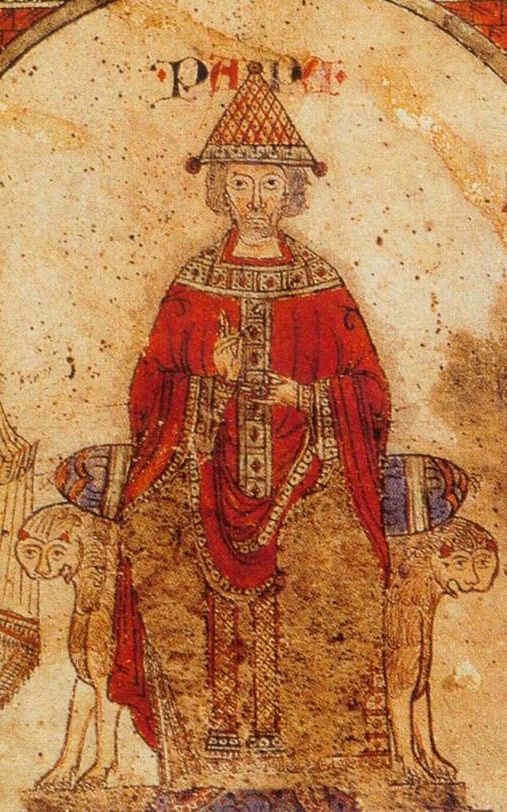
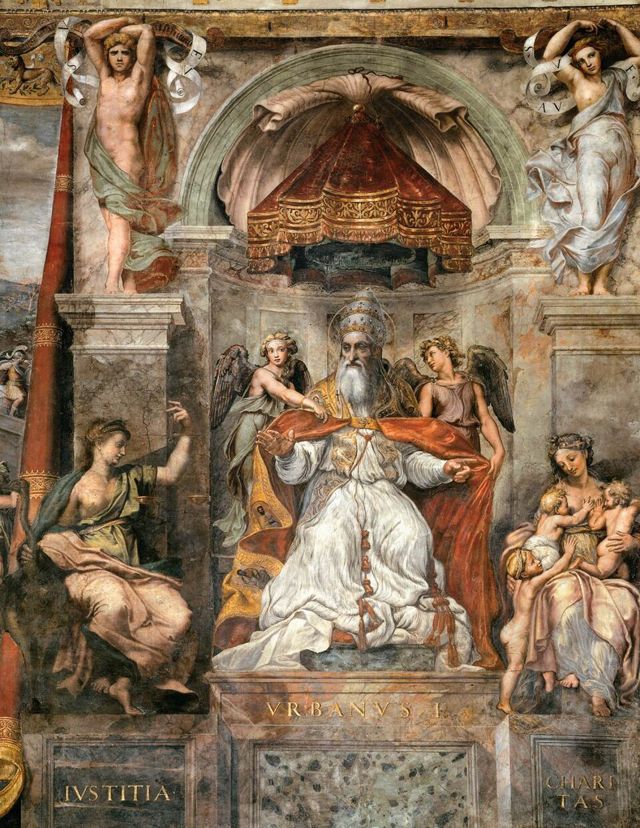
More about St. Gregory Vii., Pope

Checked against at least two sources, in our own words

Help us add to this saint's story

Everything is read by a person before anything appears. Facts are checked against trusted sources first.

Facts are welcome; a source link helps (optional).With your permission we may share it on this page.

Nine days · Free

Pray the novena
with us.

One short email a day for nine days. The day's prayer, a line from St. Gregory Vii.'s story, and a nudge to keep going.

Also on May 25
St. Urban I., Pope

St. Urban I.

May 25 · Martyr
M

Sts. Maximus and…

May 25 · Martyrs
I

Sts. Injuriosus and…

May 25 · Feast
← All 1970 saints in the library
Sources & notes

Feast-day sources

Story sources

Sources

Credits

Image: Exultet Rolls of Southern Italy, detail of Pope Gregory VII.jpg · Wikimedia Commons · Public domain, via Wikimedia Commons

Image: Wikimedia Commons, Wikimedia Commons (Public domain)

Retold in plain modern English from Baring-Gould’s public-domain text, sentence by sentence, keeping the same facts and order. Short explanations in parentheses are ours.

From Sabine Baring-Gould, The Lives of the Saints, new edition in 16 vols. (London: John C. Nimmo, 1897–98); text from the Internet Archive scan (OCR, lightly cleaned; errors possible). Public domain in the United States. Reproduced unedited, except for short bracketed notes in grey that we added to explain names and terms (“S.” is the old abbreviation for Saint). Some history and judgments reflect 19th-century scholarship.

Notes

Story retold in our own words from the cited sources.