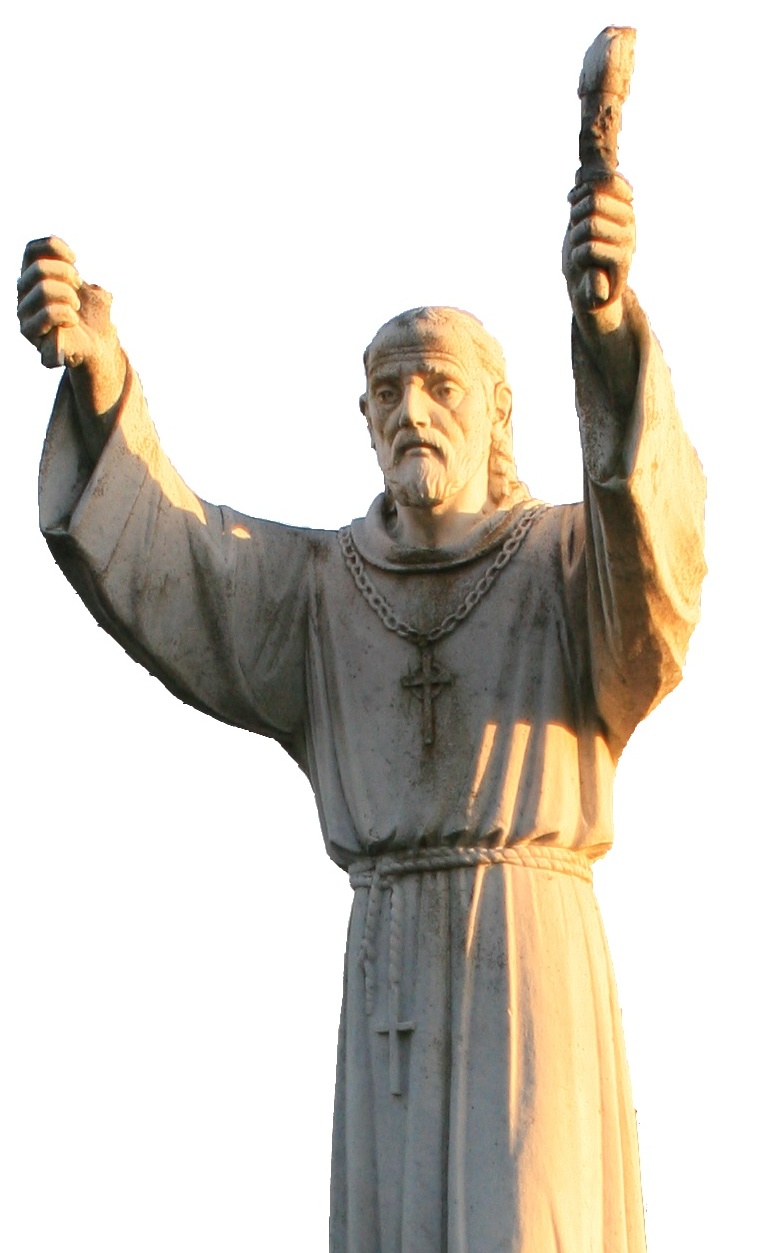
St. Finnian of Clonard

St. Finnian of Clonard, also known as Fionán, was born around 470 in the Kingdom of Leinster, likely near New Ross. Finnian was brought up by Bishop Fortkem, but when aged thirty, he went to St. Cayman of Darinis, and then, crossing the sea, visited Killmuinne or Menevia, in Wales, and had interviews with St. David, St. Gildas, St. Cadoc, and others.

Read the essentials →
Traditional feast December 12 · Bishop

St. Finnian of Clonard

Traditional feast

December 12
1914 / pre-1969 calendar, per Baring-Gould (1897)

Represents

Bishop

Feast days

Feast: December 12

This Saint’s Story

Written for this site from Wikipedia and Dictionary of National Biography, 1885-1900 and Catholic Encyclopedia (1913)

He was the son of Findlog and was baptized by St. Abban. As a young man, he began his religious education under Bishop Fortchern of Trim. Finnian later traveled to Gaul, where he studied at the monastic center of St. Martin of Tours, known for its strict discipline. He then spent about thirty years in Wales at the monastery of Cadoc, immersing himself in prayer and study, and making copies of important texts.

After returning to Ireland, Finnian founded several monastic communities, including one at Aghowle in County Wicklow, granted to him by King Oengus of Leinster. He is believed to have established a community on Skellig Michael, although this is debated by historians. Eventually, he was guided by an angel to Clonard, where he built a church and a cell, dedicating himself to a life of study and prayer. His reputation for holiness and learning attracted many students, leading to the establishment of a renowned school at Clonard that would educate future saints, including Ciarán and Columcille.

Finnian's school became a significant center of Scriptural learning, with reports of up to 3,000 pupils studying under him at one time. He emphasized the importance of overcoming sinful tendencies through penance and virtue, as reflected in his Penitential. His teachings and the ascetic lifestyle he promoted inspired many, and he became known for his role in training many of Ireland's saints. Finnian died around 549, likely from the plague, and was buried in his church at Clonard, which continued to be a place of veneration long after his passing.

What he represents

How he teaches us to live

Drawn from themes in the original account

Share your faith, in words and by example. Preaching and conversion are part of this story.

Celebrate this saint’s feast day. Remember him on December 12 with a short prayer, and ask for his help.

Read more

The full original · 374 words

Read Baring-Gould’s full account

Baring-Gould’s sources: Irish Martyrologies. Also on Feb. 23. Authorities: — A Life in Colgan on Feb. 23.

The early history of this famous saint is so full of anachronisms that it can scarcely be unravelled. It is 1 It U said to S. Martin [St. Martin of Tours (d. 397), soldier turned bishop], but that saint d ed in 401. [Dec. u generally admitted that he was a native of Leinster, and that he was son of Fintan, of the race of Loschain, and that his mother’s name was Talech. They are represented as Christians; and accordingly it is related that, soon after the child was born, they sent him to Roscar to be baptized by Bishop Fortkera.

The women who were carrying him were met on the way by S. Abban, who undertook to baptize him, and performed the ceremony at a place where two rivers meet. Finnian was brought up by Bishop Fortkem, but when aged thirty, he went to S. Cayman of Darinis, and then, crossing the sea, visited Killmuinne or Menevia, in Wales, and had interviews with S. David, S. Gildas, S. Cadoc, and others. He is said to have remained in Wales founding churches during thirty years. There is a church called Llanffinan in Anglesea, which may perhaps have been founded by him.

He must have been in Wales about 520, and certainly did not spend so many as thirty years there. He returned to Ireland, and was given land by Muircdeach, prince of Hykinsellagh. He founded churches, and then a school at Magna, perhaps Hy-barche in Carlow, where he taught during seven years. He removed to Clonard about 530, where he opened a school. His reputation for learning was so great, that crowds of students flocked to his school and monastery, among whom are mentioned the two Kierans, S. Columba [Irish abbot of Iona (d. 597), apostle of Scotland] of Iona, and S. Columba of Tirdaglas.

He is spoken of as being bishop as well as abbot of Clonard, yet he is never called so either in his Acts or in the Irish Kalendars. His usual food was bread and herbs, and his drink water. On festival days he ate fish and drank beer. He slept on the bare ground, and had a stone for his pillow. He was attended in his last illness by S. Columba, son of Crimthan, of Tirdaglas, and died at Clonard in the year Dec. xa.) S. Bertoara,

More about St. Finnian of Clonard

Checked against at least two sources, in our own words

Help us add to this saint's story

Everything is read by a person before anything appears. Facts are checked against trusted sources first.

Facts are welcome; a source link helps (optional).With your permission we may share it on this page.

Nine days · Free

Pray the novena
with us.

One short email a day for nine days. The day's prayer, a line from St. Finnian of Clonard's story, and a nudge to keep going.

Also on December 12
E

Sts. Epimachius and…

December 12 · Martyrs
A

Sts. Ammonarium and…

December 12 · Virgin, Martyr, Martyrs
C

St. Corentin of Quimper

December 12 · Bishop
← All 1970 saints in the library
Sources & notes

Feast-day sources

Story sources

Sources

Credits

Image: Statue St Finnian of Clonard (cropped).jpg · Andreas F. Borchert · CC BY-SA 4.0, via Wikimedia Commons

Image: Andreas F. Borchert, Wikimedia Commons (CC BY-SA 4.0)

From Sabine Baring-Gould, The Lives of the Saints, new edition in 16 vols. (London: John C. Nimmo, 1897–98); text from the Internet Archive scan (OCR, lightly cleaned; errors possible). Public domain in the United States. Reproduced unedited, except for short bracketed notes in grey that we added to explain names and terms (“S.” is the old abbreviation for Saint). Some history and judgments reflect 19th-century scholarship.