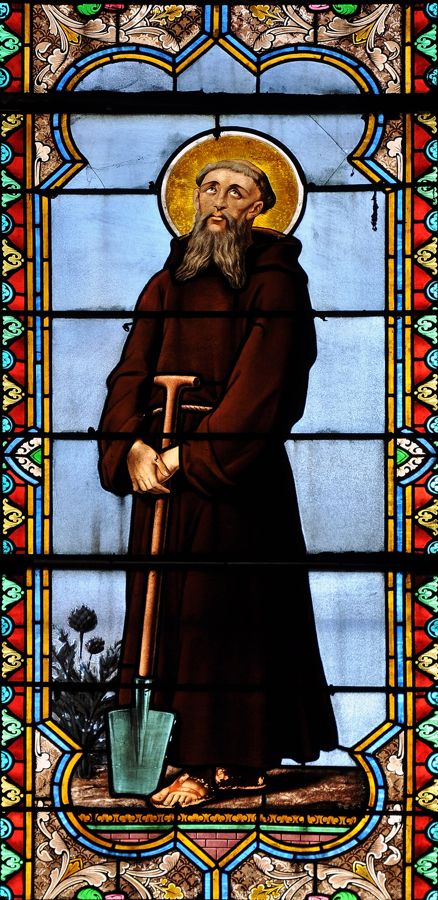
…brought to him, whom he cured by merely laying hands on them. After his death, the exact date of which cannot be determined, streams of pilgrims came to Breuil for the privilege and pleasure of sitting in the depression made by Fiacre in the solid stone. The relics of Saint Fiacre were moved to the Cathedral of Meaux in 1568 for protection against the violence of the Huguenots, but the stone was left at Breuil and escaped their attention. Access to the chapel of Saint Fiacre remained forbidden to women for a long time. Following a characteristic behavior of that sex, several women at various times persisted in trying to enter, and a series of miracles is recorded regarding how this curiosity was punished. One woman put her foot in at the door, and it swelled to enormous proportions, while the eyes of another who peeped in fell out.
Saint Fiacre died on the 18th of August, but his feast day is celebrated on the 30th. There exists a curious “Mystere de Monsieur Saint Fiacre” from the 15th century, published by M. Jubinal, and a very interesting window from the 16th century at the church of Saint Maclou in Pontoise represents his legend. Unfortunately, half of the window is destroyed, but what remains depicts eight scenes from his life, with the following inscriptions: 1. “As Saint Fiacre, in his youth, went to school to learn the Catholic faith.”
2. “As the father of Saint Fiacre, Duke of Hibernia, wanted to marry him to... a young lady,” (the rest is illegible).
3. Saint Fiacre departing from his parents. Inscription destroyed. 4. “As Saint Fiacre arrived at the sea and asked a sailor to take him across to France.”
5. “As Saint Fiacre, after crossing the sea, came to Saint Pharon, bishop of Meaux, and made a request to him.”
6. “As Saint Pharon gave permission to Saint Fiacre to go and make a hermitage in the woods to live in.” 7. “As Saint Fiacre cut down a large number of trees, which angered a peasant who reported him to Saint Pharon.” 8. “As Saint Pharon comforted Saint Fiacre and reproached him for his discouragement.”
Footnotes
- Mysteres inedits du xv° siecle. VOL. IX.
Baring-Gould’s own footnotes, in modern English.
Read the original 1870s text
Baring-Gould’s sources: Roman and Gallican Martyrologies, Aberdeen Breviary on Aug. 27, 1 and 30. Authority: — A life by an anonymous writer — late, 12th cent., and not trustworthy.] S. Fiacre, or Fiachre, was of an illustrious family in Ireland. Wishing to lead a solitary life, he withdrew to France with some followers, and applied to S. Faro of Meaux, who was fond of the Irish, for some lonesome spot that might serve him as a retreat from the bustle of the world. The bishop immediately promised him as much ground in his own patrimony of Breuil as he could dig in a day. Fiacre dug so lustily that a woman complained to the bishop he had taken an unfair advantage of him; wherefore women were not allowed to enter his chapel. “ It is said,” we are told by Hector Boece, “ All wemen that gangis in his chapell wil be othir blind or wod (mad).” The woman, finding S. Faro paid no attention to her complaint, returned to the forest, and began to abuse S. Fiacre with all that warmth, copiousness of verbiage, and bitterness of tongue of which only woman is capable. Fiacre sat very depressed under this torrent of words on a stone, and the impression of his person is left on the stone to this day. The stone, with a curved impression in the centre, was preserved in the nave of the church of S. Fiacre at Breuil, placed on a pedestal for the convenience of pilgrims, who, suffering from hsemorrhaids, sat upon it, and received miraculous healing.2 At Breuil Fiacre erected a monastery in honour of the Blessed Virgin, where he used to receive strangers and guests, living himself in a cell apart. His reputation became so great, that from all parts infirm persons used to be 1 As Fiacre B. of Autun; there never was such a bishorv. S. Fiacre.
…brought to him, whom he cured by merely laying hands on them. After his death also, the date of which cannot be fixed with precision, streams of pilgrims came to Breuil, for the privilege and gratification of sitting in the depression made by Fiacre in the solid stone. The relics [the bodily remains of a saint, or objects they used, kept with honor] of S. Fiacre were removed to the Cathedral of Meaux in 1568, for protection against the fury of the Huguenots, but the stone was left at Breuil, and escaped their notice. Access to the chapel of S. Fiacre remained for long forbidden to women. Following a peculiarity of that sex, several at various periods persisted in attempting an entrance, and a string of miracles is recorded of the manner in which this curiosity was punished. One woman put her foot in at the door, and it swelled up to elephantine proportions, and the eyes of another who peeped in dropped out.
S. Fiacre died on the 18th of August, but his festival is celebrated on the 30th. There exists a curious “ Mystere de Monsieur Saint Fiacre” of the 15th century, published by M. Jubinal and a very interesting window of the 16th century at the church of S. Maclou in Pontoise, represents his legend. Unfortunately half the window is destroyed, but what remains represents eight scenes in his life, with the following inscriptions 1. “ Comme Sainct Fiacre en son jeune age alloit h l’escole pour apprendre la foy catholique.”
2. “ Comme le pere de Saint Fiacre, due de Hybernie, le voulut marier, avec... Damoiselle, fille ” (the rest illegible).
3. S. Fiacre departing from his parents. Inscription destroyed. 4. “ Comme Sainct Fiacre arriva a. la mer et pria un marinier de le passer en France.”
1 Mys teres inedits du xv° sifccle. VOL. IX. 5. “ Comme Sainct Fiacre, après avoir passé la mer vint k Sainct Pharon, evesque de Meaux, et lui fit priere ”
6. “ Comme Sainct Pharon donna congd k Sainct Fiacre d’allerfaireun hermitage aubois pour soy y tenir.” 7. “ Comme Sainct Fiacre abattit grand nombre de boys et a tant fachd bequenaude qui le reprint et accusa k Saint Pharon.’' 8. “Comme Sainct Pharon consola Sainct Fiacre, et le reprint de son ddcouragement,”