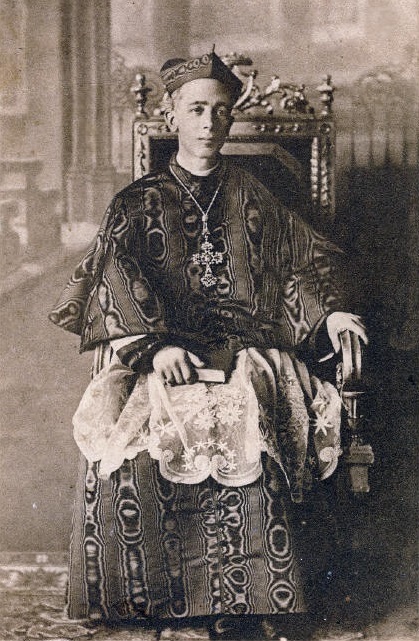
Bl. Alfredo Ildefonso Schuster

Alfredo Ildefonso Schuster is remembered as a compassionate Archbishop of Milan who navigated the challenges of fascism during his leadership. Alfredo Ildefonso Schuster was born on January 18, 1880, in Rome to Johann Schuster, a Bavarian tailor, and Maria Anna Tutzer.

Read the story →
August 30 · Bishop, Cardinal, Abbot

Bl. Alfredo Ildefonso Schuster

Feast

August 30
Dicastery for the Causes of Saints

Status

Blessed
Beatified 12 May 1996 by Pope John Paul II

Represents

Bishop
Cardinal
Abbot

Feast days

Feast: August 30

This Saint’s Story

Written for this site from Wikipedia and Dicastery for the Causes of Saints

He was baptized shortly after birth and had a challenging childhood, including a brief kidnapping. After his father's death in 1889, Schuster pursued his education and developed a strong religious calling, eventually joining the Benedictine (monks following the Rule of St. Benedict) Order in 1898, taking the name Ildefonso. He made his monastic vows in 1900 and later earned degrees in philosophy and theology.

In 1908, Schuster took on the role of novice master and was elected as the abbot of Saint Paul Outside the Walls in 1918. He was actively involved in various roles, including serving as Procurator General for the Cassinese Congregation and President of the Pontifical Oriental Institute. His dedication to education and pastoral care was evident as he visited seminaries across Italy and provided spiritual exercises for future Pope John XXIII.

In 1929, Schuster was appointed Archbishop of Milan and became a cardinal shortly after. He took a formal oath of loyalty to the Italian government, marking a significant moment in his episcopal career. Throughout his tenure, he ordained over a thousand priests and emphasized the importance of catechetics and Catholic Action (organized lay apostolate groups). His leadership was marked by a commitment to holiness and pastoral care, drawing inspiration from Saint Carlo Borromeo.

During World War II, Schuster's views evolved regarding fascism. Initially supportive, he became critical of the regime, especially after the introduction of racial laws in 1938. He condemned the anti-Christian elements of fascism and sought to protect the Church's interests. Schuster's efforts to mediate between partisans and Mussolini in 1945 demonstrated his desire for peace, though Mussolini ultimately rejected his counsel.

Schuster passed away on August 30, 1954, in Venegono Inferiore, and was buried in the Milan Cathedral. His legacy continued to be honored, leading to his beatification by Pope John Paul II on May 12, 1996, in Saint Peter's Square.
What he represents

How he teaches us to live

Drawn from their life story

Embrace change for the greater good. Schuster's shift from supporting fascism to opposing its anti-Christian elements illustrates the importance of adapting one's beliefs in response to moral challenges.

Prioritize pastoral care. His dedication to the spiritual and physical needs of his flock serves as a reminder of the core mission of church leaders.

Stand firm against injustice. Schuster's later denunciation of racial laws highlights the necessity of speaking out against oppression and defending human dignity.

More about Bl. Alfredo Ildefonso Schuster

Checked against at least two sources, in our own words

Help us add to this saint's story

Everything is read by a person before anything appears. Facts are checked against trusted sources first.

Facts are welcome; a source link helps (optional).With your permission we may share it on this page.

Nine days · Free

Pray the novena
with us.

One short email a day for nine days. The day's prayer, a line from Bl. Alfredo Ildefonso…'s story, and a nudge to keep going.

Also on August 30
F

Sts. Felix and Adauctus

August 30 · Martyrs
St. Fiacre

St. Fiacre

August 30 · Hermit, Confessor
St. Jeanne Jugan

St. Jeanne Jugan

August 30 · Foundress, Religious
← All 1970 saints in the library
Sources & notes

Feast-day sources

Story sources

Sources

Credits

Image: Cardinal Schuster (original, cropped).jpg · Giuseppe Farabola · Public domain, via Wikimedia Commons