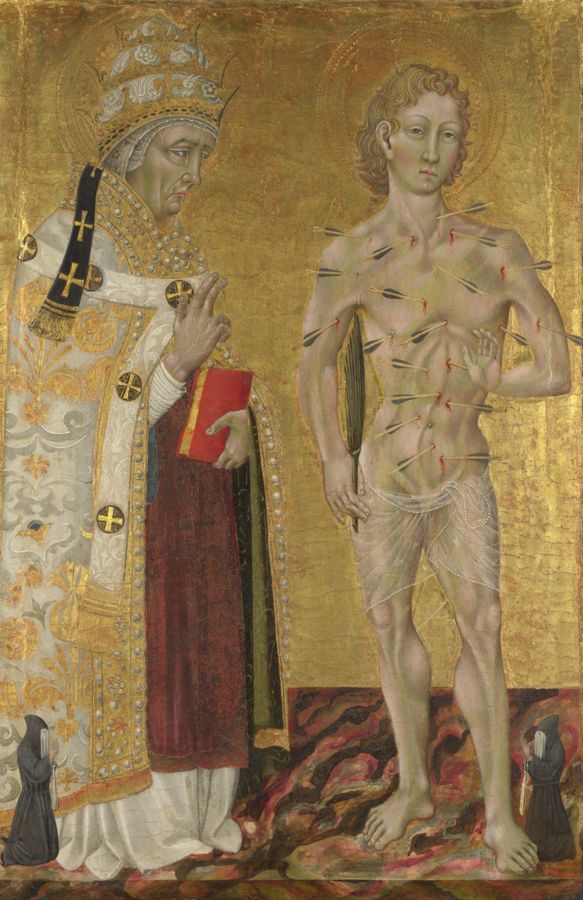
St. Fabian, Pope

St. Fabian (died 250) was pope and was martyred in the persecution of Decius. Tradition says a dove settled on his head at his election.

Read the essentials →
Feast January 20 · Martyr

St. Fabian, Pope

Current feast

January 20
Verified · General Roman Calendar

Traditional feast

January 20
1914 / pre-1969 calendar, per Baring-Gould (1914)

Represents

Martyr

Feast days

Feast: January 20

This Saint’s Story

Fabian was Bishop of Rome from 236 to 250. Eusebius (bishop of Caesarea, d. c. 339, the first historian of the Church) tells the remarkable story of his election. After the death of Anterus he had come into the city from his farm with some others, and was present when the brethren met to choose a successor. While the names of several illustrious men were being weighed, a dove suddenly came down and settled on the head of Fabian, of whom no one had thought. The sight recalled the Holy Spirit descending on the Saviour at His baptism, and the assembly cried out with one voice that he was worthy and placed him at once in the Chair of Peter.

His reign brought a lull in persecution, and little is known of it. The Liber Pontificalis (the early medieval 'Book of the Popes', not always reliable for the earliest ones) says he divided Rome into seven districts, each under a deacon, and appointed seven subdeacons to collect, with notaries, the court records of the martyrs' trials. Tradition holds that he instituted the four minor orders. Much work was done in the catacombs, and he had the body of Pope Pontian brought back from Sardinia to the catacomb of St Callistus. Later accounts, which the Catholic Encyclopedia calls more or less trustworthy, credit him with sending seven bishops to Gaul about 245, St Denys of Paris among them. St Cyprian records that he condemned Privatus, an African bishop, for heresy, and Origen defended his own orthodoxy before him.

Baring-Gould repeats the report that he converted and baptised the Emperor Philip; the Catholic Encyclopedia does not make this claim. When Decius succeeded Philip, a general persecution began, and Fabian was among its first victims, martyred on 20 January 250, the day on which he is still kept. He was buried in the Crypt of the Popes in the catacomb of St Callistus, where De Rossi found his Greek epitaph in 1850: “Fabian, bishop and martyr.” In art he is shown with the papal tiara and a dove. No patronage is assigned to him in the Catholic Encyclopedia.

For today: Most of Fabian's work was administration: districts, records, an end to a split. You can do that kind of work on a quiet day. The dove is Eusebius's story of the election. The death on 20 January 250 is the date the church kept.
Thin entry · the 1914 book gives only 241 words. We have not filled the gap with invented detail.

What he represents

How he teaches us to live

Drawn from themes in the original account

Share your faith, in words and by example. Preaching and conversion are part of this story.

Stay faithful when it costs you. Holding firm under pressure is part of this story.

Build up the community you belong to. Community life is part of this story.

Take one thing from this life into your own. An unexpected choice who led the Church faithfully until death.

The full story

Baring-Gould’s account retold in modern English

Read the full story · 223 words · about 1 min

Saint Fabian succeeded Anteros as the bishop of Rome. It is said that Fabian came to Rome from the countryside, and, by divine grace, he was chosen in a very remarkable way to be bishop. When all the brethren gathered in the church to ordain his successor, even though many distinguished and notable men were present, no one thought of anyone but Fabian. They say that a dove suddenly flew down and rested on his head, reminding them of the moment when the Holy Spirit descended upon the Savior. Then the entire assembly exclaimed with one voice, as if inspired by the Spirit of God, "He is worthy!" Without delay, they took him and placed him on the episcopal throne.

Saint Fabian led the Church of Rome for sixteen years. Some say that he converted and baptized Emperor Philip. "Philip, after a reign of seven years," says Eusebius, "was succeeded by Decius, who, because of his hatred for Philip, initiated a persecution against the Church, during which Fabian suffered martyrdom and was succeeded as Bishop of Rome by Cornelius."

Relics are found in the churches of Saint Martin de la Monte and Saint Praxedes, as well as a head and an arm in that of Saint Sebastian, in Rome.

In art, he is depicted wearing the papal tiara and accompanied by a dove.

Footnotes

  1. Eusebius is an early Christian historian.

Baring-Gould’s own footnotes, in modern English.

Read the original 1870s text

Baring-Gould’s sources: Roman Martyrology. Authorities: Eusebius, lib. vi. c. 29 and 39; the Liber de Romanis Pontificibus; S. Jerome, lib. de Eccles. Script. c. 54; a letter of S. Cyprian (55) to Cornelius, &c.

Saint Fabian succeeded Anteros in the see of Rome [a bishop’s “see” is his diocese, named from his seat (Latin sedes)]. It is said that Fabian had come to Rome out of the country, and, by divine grace, he was singled out in a very remarkable manner to be bishop. For, when all the brethren had assembled in the church for the purpose of ordaining him that should succeed in the episcopate, though there were many eminent and illustrious men present, yet no one thought of any but Fabian. They relate that a dove, suddenly fluttering down, rested upon his head, bringing up before their minds the scene when the Holy Spirit of old came down on the Saviour. Thereupon the whole body exclaimed with one voice, as if moved by the Spirit of God, "He is worthy!" [91] and without delay they took him and placed him upon the episcopal throne. [92]

S. Fabian governed the Church of Rome for sixteen years. He is said by some to have converted and baptized the Emperor Philip. "Philip, after a reign of seven years," says Eusebius, "was succeeded by Decius [Roman emperor 249–251, who ordered everyone to sacrifice to the gods], who, in consequence of his hatred to Philip, raised a persecution against the Church, in which Fabian suffered martyrdom, and was succeeded, as Bishop of Rome, by Cornelius." [93]

Relics, in the churches of S. Martin [St. Martin of Tours (d. 397), soldier turned bishop] de la Monte, S. Praxedes, a head and an arm in that of S. Sebastian, in Rome.

In art, he appears with the pontifical tiara and a dove.

More about St. Fabian, Pope

Checked against at least two sources, in our own words

Help us add to this saint's story

Everything is read by a person before anything appears. Facts are checked against trusted sources first.

Facts are welcome; a source link helps (optional).With your permission we may share it on this page.

Nine days · Free

Pray the novena
with us.

One short email a day for nine days. The day's prayer, a line from St. Fabian's story, and a nudge to keep going.

Also on January 20
S

St. Sebastian at Rome

January 20 · Martyr
St. Euthymius the Great

St. Euthymius the Great

January 20 · Abbot
F

St. Fechin of Fore

January 20 · Abbot
← All 1970 saints in the library
Sources & notes

Feast-day sources

Story sources

Sources

Credits

Image: Saints Fabian and Sebastian - Giovanni di Paolo.png · Giovanni di Paolo · Public domain, via Wikimedia Commons

Image: Giovanni di Paolo, Wikimedia Commons (Public domain)

Retold in plain modern English from Baring-Gould’s public-domain text, sentence by sentence, keeping the same facts and order. Short explanations in parentheses are ours.

From Sabine Baring-Gould, The Lives of the Saints, new and revised edition (Edinburgh: John Grant, 1914; first edition 1872). Public domain in the United States. Reproduced unedited, except for short bracketed notes in grey that we added to explain names and terms (“S.” is the old abbreviation for Saint). Some history and judgments reflect 19th-century scholarship.

Notes

Story retold in our own words from the cited sources.