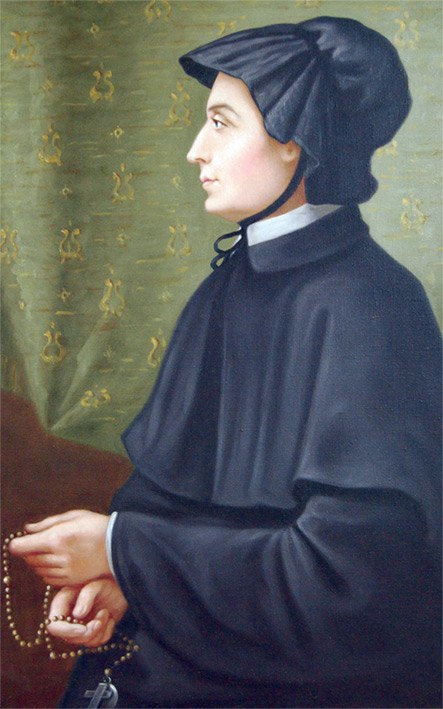
Foundress and first superior of the Sisters of Charity in the United States, b. in New York City, 28 Aug., 1774, of non-Catholic parents of high position; d. at Emmitsburg, Maryland, 4 Jan., 1821.
Her father, Dr. Richard Bayley (b. Connecticut and educated in England), was the first professor of anatomy at Columbia College and eminent for his work as health officer of the Port of New York. Her mother, Catherine Charlton, daughter of an Anglican minister of Staten Island, N.Y., died when Elizabeth was three yeas old, leaving two other young daughters. The father married again, and among the children of this second marriage was Guy Charleton Bayley, whose convert son, James Roosevelt Bayley, became Archbishop of Baltimore. Elizabeth always showed great affection for her stepmother, who was a devout Anglican, and for her stepbrothers and sisters. Her education was chiefly conducted by her father, a brilliant man of great natural virtue, who trained her to self-restraint as well as in intellectual pursuits. She read industriously, her notebooks indicating a special interest in religious and historical subjects. She was very religious, wore a small crucifix around her neck, and took great delight in reading the Scriptures, especially the Psalms, a practice she retained until her death.
She was married on 25 Jan., 1794, in St. Paul's Church, New York, to William Magee Seton, of that city, by Bishop Prevoost. In her sister-in-law, Rebecca Seton, she found the "friend of her soul", and as they went about on missions of mercy they were called the "Protestant Sisters of Charity". Business troubles culminated on the death of her father-in-law in 1798. Elizabeth and her husband presided over the large orphaned family; she shared his financial anxieties, aiding him with her sound judgment. Dr. Bayley's death in 1801 was a great trial to his favourite child. In her anxiety for his salvation she had offered to God, during his fatal illness, the life of he infant daughter Catherine. Catherine's life was spared, however, she died at the age of ninety, as Mother Catherine of the Sisters of Mercy, New York. In 1803 Mr. Seton's health required a sea voyage; he started with his wife and eldest daughter for Leghorn, where the Filicchi brothers, business friends of the Seton firm, resided. The other children, William, Richard, Rebecca, and Catherine, were left to the care of Rebecca Seton.
From a journal which Mrs. Seton kept during her travels we learn of her heroic effort to sustain the drooping spirits of her husband during the voyage, followed by a long detention in quarantine, and until his death at Pisa (27 Dec., 1803). She and her daughter remained for some time with the Filicchi families. While with these Catholic families and in the churches of Italy Mrs. Seton first began to see the beauty of the Catholic Faith. Delayed by her daughter's illness and then by her own, she sailed for home accompanied by Antonio Filicchi, and reached New York on 3 June, 1804. Her sister-in-law, Rebecca, died in July. A time of great spiritual perplexity began for Mrs. Seton, whose prayer was, "If I am right Thy grace impart still in the right to say. If I am wrong Oh, teach my heart to find the better way." Mr. Hobart (afterwards an Anglican bishop), who had great influence over her, used every effort to dissuade her from joining the Catholic Church, while Mr. Filicchi presented the claims of the true religion and arranged a correspondence between Elizabeth and Bishop Cheverus. Through Mr. Filicchi she also wrote to Bishop Carroll. Elizabeth meanwhile added fasting to her prayers for light. The result was that on Ash Wednesday, 14 March, 1805, she was received into the Church by Father Matthew O'Brien in St. Peter's Church, Barclay St., New York. On 25 March she made her first Communion with extraordinary fervour; even the faint shadow of this sacrament in the Protestant Church had had such an attraction for her that she used to hasten from one church to another to receive it twice each Sunday. She well understood the storm that her conversion would raise among her Protestant relatives and friends at the time she most needed their help. Little of her husband's fortune was left, but numerous relatives would have provided amply for her and her children had not this barrier been raised. She joined an English Catholic gentleman named White, who, with his wife, was opening a school for boys in the suburbs of New York, but the widely circulated report that this was a proselytizing scheme forced the school to close.
A few faithful friends arranged for Mrs. Seton to open a boarding-house for some of the boys of a Protestant school taught by the curate of St. Mark's. In January, 1806, Cecilia Seton, Elizabeth's young sister-in-law, became very ill and begged to see the ostracized convert; Mrs. Seton was sent for, and became a constant visitor. Cecilia told her that she desired to become a Catholic. When Cecilia's decision was known threats were made to have Mrs. Seton expelled from the state by the Legislature. On her recovery Cecilia fled to Elizabeth for refuge and was received into the Church. She returned to her brother's family on his wife's death. Mrs. Seton's boarding-house for boys had to be given up. Her sons had been sent by the Filicchis to Georgetown College. She hoped to find a refuge in some convent in Canada, where her teaching would support her three daughters. Bishop Carroll did not approve, so she relinquished this plan. Father Dubourg, S. S., from St. Mary's Seminary, Baltimore, met her in New York, and suggested opening in Baltimore a school for girls. After a long delay and many privations, she and her daughters reached Baltimore on Corpus Christi, 1808. Her boys were brought there to St. Mary's College, and she opened a school next to the chapel of St. Mary's Seminary and was delighted with the opportunities for the practice of her religion, for it was only with the greatest difficulty she was able to get to daily Mass and Communion in New York. The convent life for which she had longed ever since her stay in Italy now seemed less impracticable. Her life was that of a religious, and her quaint costume was fashioned after one worn by certain nuns in Italy. Cecilia Conway of Philadelphia, who had contemplated going to Europe to fulfill her religious vocation, joined her; soon other postulants arrived, while the little school had all the pupils it could accommodate.
Mr. Cooper, a Virginian convert and seminarian, offered $10,000 to found an institution for teaching poor children. A farm was bought half a mile from the village of Emmitsburg and two miles from Mt. St. Mary's College. Meanwhile Cecilia Seton and her sister Harriet came to Mrs. Seton in Baltimore. As a preliminary to the formation of the new community, Mrs. Seton took vows privately before Archbishop Carroll and her daughter Anna. In June, 1808, the community was transferred to Emmitsburg to take charge of the new institution. The great fervour and mortification of Mother Seton, imitated by her sisters, made the many hardships of their situation seem light. In Dec., 1809, Harriet Seton, who was received into the Church at Emmitsburg, died there, and Cecilia in Apr., 1810. Bishop Flaget was commissioned in 1810 by the community to obtain in France the rules of the Sisters of Charity of St. Vincent de Paul. Three of these sisters were to be sent to train the young community in the spirit of St. Vincent de Paul, but Napoleon forbade them to leave France. The letter announcing their coming is extant at Emmitsburg. The rule, however, with some modifications, was approved by Archbishop Carroll in Jan., 1812, and adopted. Against her will, and despite the fact that she had also to care for her children, Mrs. Seton was elected superior. Many joined the community; Mother Seton's daughter, Anna, died during her novitiate (12 March, 1812), but had been permitted to pronounce her vows on her death-bed. Mother Seton and the eighteen sisters made their vows on 19 July, 1813. The fathers superior of the community were the Sulpicians, Fathers Dubourg, David, and Dubois. Father Dubois held the post for fifteen yeas and laboured to impress on the community the spirit of St. Vincent's Sisters of Charity, forty of whom he had had under his care in France. The fervour of the community won admiration everywhere. The school for the daughters of the well-to-do prospered, as it continues to do (1912), and enabled the sisters to do much work among the poor. In 1814 the sisters were given charge of an orphan asylum in Philadelphia; in 1817 they were sent to New York. The previous year (1816) Mother Seton's daughter, Rebecca, after long suffering, died at Emmitsburg; her son Richard, who was placed with the Filicchi firm in Italy, died a few years after his mother. William, the eldest, joined the United States Navy and died in 1868. The most distinguished of his children are Most. Rev. Robert Seton, Archbishop of Heliopolis (author of a memoir of his grandmother, "Roman Essays", and many contributions to the "American Catholic Quarterly" and other reviews), and William Seton (q.v.).
Mother Seton had great facility in writing. Besides the translation [the solemn moving of a saint’s relics to a new shrine] of many ascetical French works (including the life of Saint Vincent de Paul, and of Mlle. Le Gras) for her community she has left copious diaries and correspondence that show a soul all on fire with the love of God and zeal for souls. Great spiritual desolation purified her soul during a great portion of her religious life, but she cheerfully took the royal road of the cross. For several years the saintly bishop (then Father) Bruti was her director. The third time she was elected mother (1819) she protested that it was the election of the dead, but she lived for two years, suffering finally from a pulmonary affection. Her perfect sincerity and great charm aided her wonderfully in he work of sanctifying souls. In 1880 Cardinal Gibbons (then Archbishop) urged the steps be taken toward her canonization. The result of the official inquiries in the cause of Mother Seton, held in Baltimore during several years, were brought to Rome by special messenger, and placed in the hands of the postulator of the cause on 7 June, 1911.
Her cause is entrusted to the Priests of the Congregation of the Mission, whose superior general in Paris is also superior of the Sisters of Charity with which the Emmitsburg community was incorporated in 1850, after the withdrawal of the greater number of the sisters (at the suggestion of Archbishop Hughes) of the New York houses in 1846. This union had been contemplated for some time, but the need of a stronger bond at Emmitsburg, shown by the New York separation, hastened it. It was effected with the loss of only the Cincinnati community of six sisters. With the Newark and Halifax offshoots of the New York community and the Greenburg foundation from Cincinnati, the sisters originating from Mother Seton's foundation number (1911) about 6000. The original Emittsburg community now wearing the cornette and observing the rule just as St. Vincent gave it, naturally surpasses any of the others in number. It is found in about thirty dioceses in the United States, and forms a part of the worldwide sisterhood, whilst the others are rather diocesan communities.
13 vols. of letters, diaries, and documents by Mother Seton as well as information concerning her, are in the archives of the mother-house at Emmitsburg, Maryland; ROBERT SETON, Memoirs, Letter and Journal of Elizabeth Seton (2 vols., New York, 1869); BARBEREY, Elizabeth Seton (6th ed., 2 vols., Paris, 1892); WHITE, Life of Mrs. Eliza. A. Seton (10th ed., New York, 1904); SADLIER, Elizabeth Seton, Foundress of the Amer. Sisters of Charity (New York, 1905); BELLOC, Historic Nuns (2nd ed., London, 1911).