…satisfied husband. The screams of the chief prevented any explanation. The husband and wife looked out and saw the chief seated on the horse, his hand stuck to the wall, while the horse grazed and gradually moved away from under him, similar to Don Quixote’s adventure at the inn. The prayers of the holy couple freed the chief, and in gratitude, he generously gave Efflam lands and promised not to disturb Honora with his advances in the future. Efflam built his wife a small cell a little distance from his own. After some years, hearing about the virtues of the people of Llannenock, she went there and was warmly welcomed by Saint Nennocha. She died in that community and is regarded as a saint, often invoked during fevers. Saint Efflam and his community did not eat anything on Mondays, Wednesdays, and Fridays. On the other days, an angel brought them delicious food from Paradise and set their table for them on the grass.
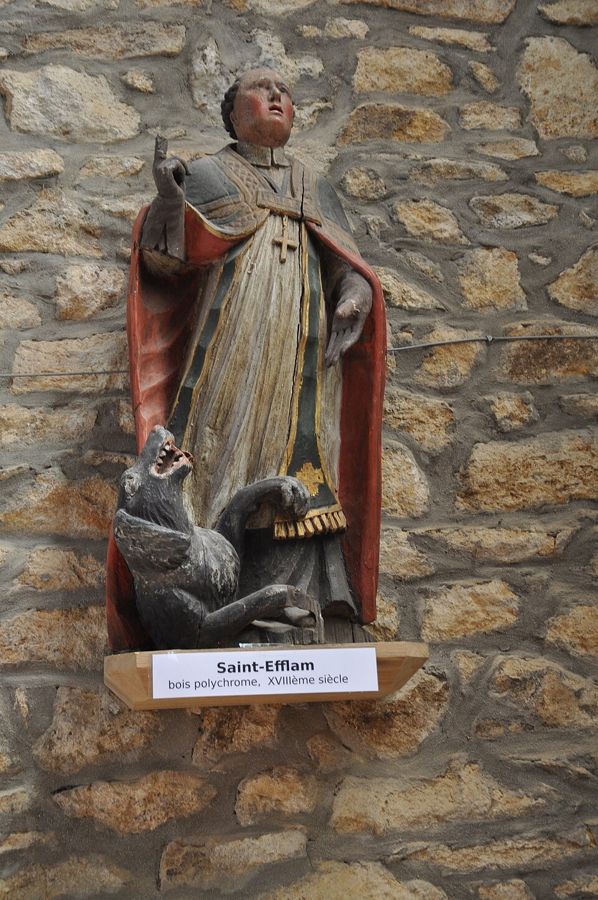
After some time, a priest named Gestin appeared at the cell door and claimed the hovel. He had built and lived in it but had abandoned it when he went on a pilgrimage to Rome. Efflam offered to leave, but when Gestin saw how virtuous he was, he chose not to reclaim his old cabin. An angel appeared and instructed Efflam to stay in possession while Gestin was to retreat to the nearby forest. The parish is named after him Plou-Gestin, which was shortened to Plestin. After serving God well in his hermitage, Efflam died on November 6th, at the end of the sixth century. He is depicted in royal attire, standing on a dragon. The tomb of Saint Efflam, built in the fourteenth or fifteenth century, was opened in 1819, but no traces of the body were found. All that was discovered was a stone with a carved hatchet on it, a small copper cross, and some bits of seaweed.
Baring-Gould’s own footnotes, in modern English.
Read the original 1870s text
Baring-Gould’s sources: Gallican Martyrologies. Authorities:— A Life in the Collection of Albert le Grand, taken from the MS. Legendaries of the parish of Plestin, from which the office of the Saint in nine lections was drawn np in 1575. Lobineau gives a life derived from some other MS. which he does not describe.] According to the legend, S. Efflam was the son of a British prince who waged an hereditary war with another prince in Britain. At length, when both parties were exhausted, it was agreed to form a lasting peace by marrying Efflam the son of one to Honora the daughter of the other. Efflam, however, had resolved to lead a monastic life. Yet his marriage was necessary for political reasons. Under the circumstances he reluctantly yielded, married Honora, and as soon as his bride was asleep, escaped from the house, took boat with some friends of the same way of thinking, and reached the coast of Brittany between Toul Efflam and Loc-mikel, under a great rock called Querlaz, in the present parish of Plestin, between Morlaix and Tréguier. He found a dilapidated hut of stones in a sheltered spot, and took up his abode in it At that time Hoel I. was prince of Armorica. He was akin to the great Arthur, who occasionally visited him and hunted VOL XHI. 1 1 in his preserves. Now there lived in a cave near the rock Querlaz, a hideous dragon. Arthur heard of it, and went in quest of the monster. He fought with it for a whole day and could not overcome it, Effiam and his companions looking on. Then Effiam asked the king to allow him to do battle with the dragon, and when consent was given, he made the sign of the cross, and the monstrous reptile, spouting blood and venom, plunged off the rock into the waves and perished. Hoel I., in gratitude to the Saint for having rid the country of this creature, gave him the land surrounding his cell. This legend probably represents the efforts of Effiam to destroy a huge serpent temple of upright stones, like that of Camac. Now Honora awoke from her sleep on the morrow of her marriage and found that her husband had fled. She soon learned that he had sailed for Brittany. Accordingly, she got possession of a wicker coracle covered with raw hides, got in and paddled out to sea. Wind and tide and her feeble efforts carried her across to the shores of Brittany, and the retreating tide left her stranded in an oyster-pan belonging to a young chief, at Coz-Gueaudet, the mouth of the little river Legud There the fisherman of the chief found her. He was much surprised. She asked him where Effiam was, and he pointed with his finger in the direction she was to go. Then he ran off and told his master what a beautiful girl had been left stranded by the tide in his oyster-pan. The chief was young and an admirer of the fair sex. He saddled and sprang on his horse, with spurs on his heels and a long whip in his hand, and spared neither spurs nor whip in the eagerness of his pursuit. But if the horse gallopped fast, Honora ran faster. She reached the door of Effiam *s cell a moment before the pursuer. As she was lifting the latch, he reached her, and putting one hand against the wall, extended the other to clasp her, when the door opened, and she precipitated herself into the arms of her astonished and illNor. C.] S. Efflam.
…satisfied husband. The screams of the chief prevented an explanation. The husband and wife looked out, and four\d the chief seated on the horse, glued by his hand to the wall, and the steed cropping the grass, and gradually retreating from under him, like Don Quixote’s adventure at the inn. The prayers of the holy couple released the chief, and he largely endowed Efflam with lands in gratitude, and promised not to disturb Honora with his attentions for the future. Efflam built his wife a cell at a little distance from his own. After some years, hearing of the virtues of the inhabitants of Llannenock, she went there, and was received by S. Nennocha with great warmth. She died in that community, and is regarded as a saint, and is invoked in fevers. S. Efflam and his community ate nothing on Mondays, Wednesdays, and Fridays. On the other days an angel brought them excellent viands from Paradise, and spread their table for them on the grass.
After some time a priest named Gestin appeared at the cell door and claimed the hovel. He had built and inhabited it, but had deserted it when he went on a pilgrimage to Rome. Efflam offered to remove, but when Gestin saw how virtuous he was, he declined to reoccupy his old cabin. An angel appeared and ordered Efflam to remain in possession, and Gestin to retire to the adjoining forest. The parish is called after him Plou-Gestin, contracted into Plestin. After having served God well in his hermitage, Efflam died, on November 6th, at the close of the sixth century. He is represented in royal habits, treading on a dragon. The tomb of S. Efflam, constructed in the fourteenth or fifteenth century, was opened in 1819, but no traces of the body were found. All that was discovered was a stone with an incised hatchet on it, a little copper cross, and some bits of sea- wrack.