St. Eata of Hexham

Eata was the second Bishop of Hexham; the date of his birth is unknown, and he died on 26 October 686.

Read the essentials →
Feast October 26 · Abbot, Bishop

St. Eata of Hexham

Current feast

October 26
Secondary source · Wikipedia infobox

Traditional feast

October 26
1914 / pre-1969 calendar, per Baring-Gould (1897)

Represents

Abbot
Bishop

Feast days

Feast: October 26

This Saint’s Story

The Catholic Encyclopedia records that whether this disciple of St. Aidan was of English or of aboriginal Pictish race there is no means of judging. As early as 651 he was elected Abbot of Melrose, then within the metropolitan jurisdiction of York. As the Christian population of northeastern Britain grew, the spiritual government of so wide a territory as Northumbria became too heavy a charge for one see; in 678 Archbishop Theodore constituted Bernicia (the land north of the River Tees) a suffragan diocese with episcopal sees at Hexham and Lindisfarne, at the two extremities of what is now Northumberland, and consecrated Eata its bishop, styled Bishop of the Bernicians. That arrangement lasted only three years: Hexham was then assigned to Trumbert, while Eata kept Lindisfarne.

In 684, after Trumbert's death, St. Cuthbert was elected Bishop of Hexham; when Cuthbert wished to remain in his old home rather than move to the more southern see, Eata readily exchanged with him. For the last two years of his life Eata occupied the See of Hexham while Cuthbert ruled as bishop at Lindisfarne. Like most of the early saints of the English Church, he was recognized as a saint by general repute of sanctity among the faithful in the regions which he helped to Christianize. His feast is kept on 26 October, the day of his death.

Baring-Gould, following Bede (the English monk-historian, d. 735), calls him a meek and simple man who guided the youth of the great Cuthbert at Melrose and later made Cuthbert provost of Lindisfarne. A twelfth-century anonymous Life also survives. A later Hexham story — that Archbishop Thomas of York, intending to remove Eata's body in 1113, was warned off in a dream — is legend and is not treated here as history.

Short entry · the summary here is 204 words; Baring-Gould’s fuller original text and its sources are below. We have not filled any gap with invented detail.

What he represents

How he teaches us to live

Drawn from themes in the original account

Celebrate this saint’s feast day. Remember him on October 26 with a short prayer, and ask for his help.

The full story

Baring-Gould’s account retold in modern English

Read the full story · 246 words · about 1 min

In 1131, Thomas, Archbishop of York, went to Hexham with the intention of moving the body of the old bishop to his own church. But during the night, Saint Eata appeared to him, holding a staff, and sternly said, “Why will you not let me rest in the church I governed, but will you remove me to another church?” Then, raising his staff, he struck Thomas on the shoulder. The archbishop woke up suffering from rheumatism and decided to leave Eata alone.

Saints Vincent, Sabina, and Chrysteta are commemorated on October 6. Saints Maximus, Vkanantius, and Lucian, martyrs, are remembered in the Abruzzo region of Italy; they lived in the first century. Saints Vincent, Sabina, and Chrysteta, martyrs, are honored at Avila; they are also mentioned alongside Saints Capitolina and Erotkis, martyrs, at Caesarea in Cappadocia. Saint Eucharius, Bishop and Martyr, is recognized in Lorraine; he died around A.D. 363. Saint Frumentius, Bishop and Apostle of Arabia Felix, lived around A.D. 380. Saint Abban, Abbot of Kill-Abban in Ireland, lived in the 5th century. Another Saint Abban, Abbot of Maghamotdhe in Ireland, lived in the 6th century. Saints Ia and Breach, Virgins, are commemorated in Cornwall; they lived in the 6th century. Saint Elbsbaan, King, is recognized in Abyssinia; he lived around A.D. 555. Saint Odhran, Martyr, is honored at Iona; he died around A.D. 563.

Saint Desidius, Bishop of Auxerre, lived around A.D. 602. Saint Colman, Abbot at Templekanborough in Ireland, lived around A.D. 630.

Footnotes

  1. Saint Eata was a bishop known for his role in the early English church.
  2. Arabia Felix refers to a region in the southern part of the Arabian Peninsula.
  3. Saint Odhran is often associated with early Irish Christianity.
  4. Saint Desidius was a bishop in the early church in France.
  5. Templekanborough is a location in Ireland associated with early monasticism.

Baring-Gould’s own footnotes, in modern English.

Read the original 1870s text

Baring-Gould’s sources: Dempster, in his Scottish Menology, on May 7. Menardus, in his Benedictine Martyrology, on Oct 26; Bollandists on same day. Authorities: — Mention by Bede; and a Life, written in the 12th cent, by an anonymous author.] When S. Aidan was summoned from his monastic seclusion at Iona to do the work of an apostle in Northumbria, from the beginning of his mission he attached to himself twelve English youths, whom he educated with the greatest care for the service of Christ, and of whom one, Eata, became a bishop. Eata, as Bede tells us, “a meek and simple man,” was first Abbot of Melrose, where he guided the youth of the great Cuthbert In 678, when Wilfred was driven from his see, two dioceses were constituted out of his see, one of the Bemicians, the seat of which was Hexham or Lindisfame; the other over the Deiri with the seat at York. Eata was consecrated Bishop of Hexham, and Bosa was consecrated to York. At the same time Lindsey was made the seat of a bishopric, and Edhed appointed to it All three were consecrated by Archbishop Theodore at York. Eata brought Cuthbert with him from Melrose, and constituted him provost of the island monastery of Lindisfame. Apparently Theodore designed a still further division of the diocese, Lindisfame and Hexham to be erected into separate dioceses, for three years after Tumbert was appointed Bishop of Hexham, and Eata retained the bishopric and abbacy of Lindisfame. But three years after, for some fault of disobedience, Tumbert was deposed and Cuthbert placed in his room. After a while, however, Cuthbert and Eata changed places, and shortly after his return to Hexham, Eata died.

In 1113 Thomas, Archbishop of York, went to Hexham with the design of removing the body of the old prelate to his own church. But in the night S. Eata appeared to him, staff in hand, and sternly said, “ Why will you not let me rest in the church I governed, but will remove me to another church ?” Then raising his staff, he smote him on the shoulder, and the archbishop awoke suffering from rheumatism, and resolved to let Eata alone.

SS. Vincent \ Sabina, and Chrysteta. 649 October vj. SS. Maximus, Vknantius, and Lucian, MM. in the Abruzri; 1 st cent. SS. Vincent, Sabina, and Chrysteta, MM. at Avila; cite* SS. Capitolina and Erotkis, MM. at Ceesarea in Cappadocia [a region of central Turkey]; S. Eucharius, B.M. in Lorraine; a.d. 36a. S. Frumkntius, B. Ap. 0/ Arabia Felix; circ. a.d. 380. S. Abban, Ab. qf Kill- Abban in Ireland; $th cent. S. Abban, Ab. of Maghamotdhe in Ireland; 6th cent. SS. Ia and Breach a, VV. in Cornwall; 6th cent. S. Elbsbaan, K. in Abyssinia; circ. A.D. 555. S. Odhran, Mk. C. at Iona; a.d. 563.

S. Desidsjuus, B. of Auxerre; circ. a.d. 6az. S. Colman, Ab. at Templekanborougk in Irelastd; circ. a.d. 63a.
From the Catholic Encyclopedia

1913 · 281 words

Eata, Saint, second Bishop of Hexham; date of birth unknown; d. October 26, 686. Whether this disciple of St. Aidan was of the English, or of the aboriginal Pictish, race, there is no means of judging. As early as 651 he was elected Abbot of Melrose, which was then within the metropolitan [the archbishop who heads a group of dioceses] jurisdiction of York. With the increase of the Christian population in northeastern Britain, the spiritual government of a territory so wide as that which was then called Northumbria [the Anglo-Saxon kingdom of northern England and south-east Scotland] became too heavy a charge for one see; accordingly, in 678 Archbishop Theodore constituted Bernicia (that part of the Northumbrian realm which lay to the north of the River Tees) a suffragan [a bishop under the authority of an archbishop] diocese and consecrated Eata its bishop. The new diocese was to have two episcopal sees, one at Hexham and the other at Lindisfarne, at the two extremities of what is now the County of Northumberland. Eata was to be styled "Bishop of the Bernicians". This arrangement lasted only three years, and the See of Hexham was then assigned to Trumbert, while Eata kept Lindisfarne. In 684, after the death of Trumbert, St. Cuthbert was elected Bishop of Hexham, but when the latter expressed a desire to remain in his old home rather than remove to the more southern see, Eata readily consented to exchange with him, and for the last two years of his life occupied the See of Hexham, while Cuthbert ruled as bishop at Lindisfarne. Like most of the early saints of the English Church, St. Eata was canonized by general repute of sanctity among the faithful in the regions which he helped to Christianize. His feast is kept on October 26, the day of his death.

Help us add to this saint's story

Everything is read by a person before anything appears. Facts are checked against trusted sources first.

Facts are welcome; a source link helps (optional).With your permission we may share it on this page.

Nine days · Free

Pray the novena
with us.

One short email a day for nine days. The day's prayer, a line from St. Eata of Hexham's story, and a nudge to keep going.

Also on October 26
St. Evaristus, Pope

St. Evaristus

October 26 · Martyr
L

Sts. Lucian and Marcian

October 26 · Martyrs
R

Sts. Rogatianus and…

October 26 · Feast
← All 1970 saints in the library
Sources & notes

Feast-day sources

Story sources

Sources

Credits

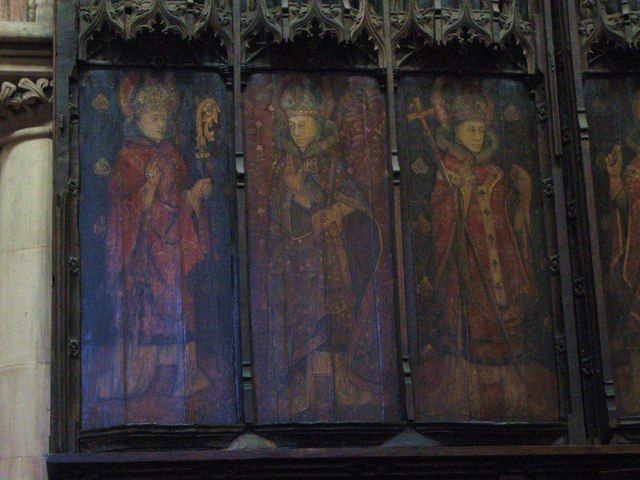
Image: The seven canonised Saxon bishops of Hexham (part 1), former reredos, Hexham Abbey - geograph.org.uk - 748673.jpg · Mike Quinn · CC BY-SA 2.0, via Wikimedia Commons

Image: Mike Quinn, Wikimedia Commons (CC BY-SA 2.0)

From “Catholic Encyclopedia (1913)/St. Eata,” The Catholic Encyclopedia (New York: Robert Appleton Company, 1907–1914), via Wikisource. Public domain. Matched by name and feast date; text unedited except for our bracketed notes in grey.

Retold in plain modern English from Baring-Gould’s public-domain text, sentence by sentence, keeping the same facts and order. Short explanations in parentheses are ours.

From Sabine Baring-Gould, The Lives of the Saints, new edition in 16 vols. (London: John C. Nimmo, 1897–98); text from the Internet Archive scan (OCR, lightly cleaned; errors possible). Public domain in the United States. Reproduced unedited, except for short bracketed notes in grey that we added to explain names and terms (“S.” is the old abbreviation for Saint). Some history and judgments reflect 19th-century scholarship.

Notes

Story retold in our own words from the cited sources.