Corbinian lived in a cell and survived on the charity of the local people. Below his cell was a cellar where he kept a barrel or two of wine. One year, when his cellar had recently been filled with wine thanks to the generosity of the neighborhood, a barrel exploded in the dead of night with a loud noise. Corbinian immediately knelt down and prayed until dawn. When morning came, he rang a bell for his servants, who came in. With a serious voice, Corbinian told them that the frightening noise they had heard during the night was not caused by demons, but by the new wine forcing out the bung.
Then Anseric, his cellar keeper, took the key and went down into the cellar. He stepped on the bung at the first step and, feeling reassured, approached the barrel to find, to his amazement, that not a drop of wine had been wasted. This was the first miracle attributed to Corbinian at the beginning of his ascetic life in his humble hermit's cell next to the church of Saint Germain.
One day, his mule ran away, which showed that the recluse was not completely isolated and allowed himself some fresh air. The hermit's servants searched the countryside for the mule, but they found nothing. In the evening, they returned to Corbinian to express their sorrow over the loss. He turned to prayer, and during the night, an angel appeared to him and told him that the mule would be returned in the morning and that the thief who had taken it would be severely punished.
The next day, while Corbinian was teaching his disciples, the mule walked in through the open door with the thief still on its back, clinging to the saddle as if he were glued to it, and fast asleep. Corbinian commanded the mule to shake the man off, and the obedient animal did so, causing the thief to fall to the ground like a log. When the thief woke up in surprise and asked where he was, Corbinian had him captured and delivered a long and impressive lecture. After that, he let the thief go, grateful that he had escaped so easily.
The fame of Corbinian spread, and Pepin of Herstall sent a message to ask for the hermit's prayers. After fourteen years in his cell, Corbinian went to Rome and visited Pope Gregory II. He asked the Pope to assign him a place of solitude where he could live alone and in abstinence. However, Gregory appointed him first as a priest and then as a bishop, without a fixed diocese, and sent him back to France. He returned to his former cell at Chartres.
After a while, he made another pilgrimage to Rome, taking a roundabout route. He stopped in Ratisbon (now Regensburg, Germany) on his way and met Theodo II, Duke of Bavaria, who tried hard to keep him in his lands. He also met Grimoald, Duke of Freising, who honored him greatly and tried to persuade him to become the bishop of his duchy. When Corbinian refused, Grimoald accompanied him to the borders of Tyrol and sent strict orders to the people along the way, and throughout the valley of the Vintscligau, that if the holy man returned, they should not allow him to go anywhere except into Bavaria.
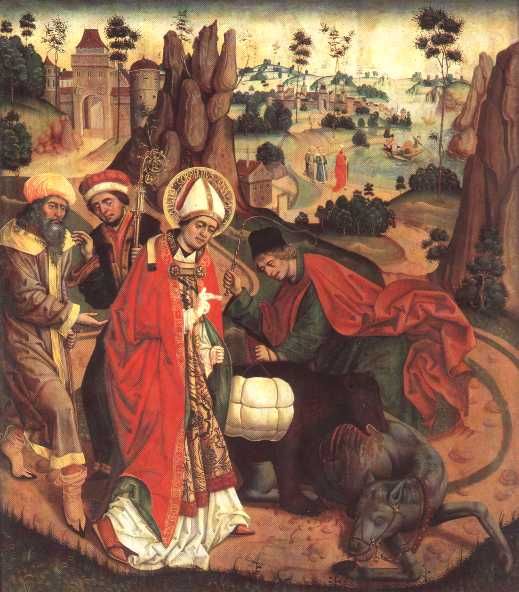
Corbinian, along with his cellarer Anseric and some servants, headed towards the Brenner pass, driving a packhorse in front of them. One night, while they rested in a forest, a bear ate the sumpter-horse of the saint. In the morning, Corbinian's servants found the bear lying on the dead horse, gnawing it leisurely. They ran to tell Anseric, who then informed his master.
“Take this whip,” said Corbinian, “and lash the beast well with it.”
“I am afraid,” replied Anseric.
“Do as you are told,” answered Corbinian, “and after that, put the pack and saddle on the back of the bear, and send him on with the horses.” So, the bear was made to carry a pack all the way to the gates of Rome.
Did the wonders of that remarkable road fill Corbinian's soul with awe? The still tarn near the Brenner head, the dazzling peaks that close the valley of Ridnaun, the mighty dolomite horn of the Schlem, and the wall of needles of the Rosengarten, the mystical region of Laurin the Dwarf King? We cannot know; the biographer does not say. We only hear that when Corbinian arrived in Trent, Count Husing, who ruled there, coveted the saint's horse, which was exceptionally fine, and offered a large sum for it. However, when the bishop refused to sell it, Husing stole it. In Pavia, Corbinian was honorably received by Luitprand, King of the Lombards, who gave him rich gifts. Orders were sent along the road to Rome that the bishop should not lack for anything. He had not traveled very far before a gentleman, sent by the king to accompany him, ran off with one of his best horses. Like the Count of Trent, he had offered to buy it but was refused, so he took it without permission. It is clear that Corbinian had an eye for good horses.
Meat and poultry were plentiful, but on Friday there was a shortage of fish. The ascetic bishop refused to eat anything else. What was to be done? His cook—who traveled with him along with his butler—was distressed. Suddenly, an eagle appeared overhead with a fish in its mouth and dropped it at the feet of the cook. The cook immediately put it into the frying pan for the bishop's dinner. We are not told what the servants had for dinner.
The following Friday, they were walking along the seashore when they spotted a large fish asleep on the surface of the water. Corbinian instructed one of his servants to go after it. The man stripped off his clothes, took a spear, swam behind the fish, and stabbed it. The fish was eleven feet long. Feeling itself wounded, it swam out to sea, and the man, holding on to his harpoon, swam after it, trying to steer the fish back to shore. The bishop and the other servants watched from the land, applauding, but they grew anxious as the man was becoming exhausted.
Fortunately, some fishermen were nearby, and they rowed to the spot and caught the fish. The swimmer then tried to climb into the boat, but the fishermen, wanting to keep the fish for themselves, tried to push him off. The servant managed to get one leg into the boat, grabbed an oar, and struck the boatmen on the head with it. His master and comrades on shore cheered him. The boatmen then reluctantly allowed him to push the boat to shore and present the fish to the bishop. Tents were set up, a fire was kindled, and everyone feasted. The bishop generously rewarded the boatmen with two pence and gave them a lecture on their bad behavior in trying to steal the fish.
Upon reaching Rome, S. Corbinian was warmly welcomed by the Pope, who refused to listen to his pleas to live a solitary and austere life. The Pope likely realized that Corbinian did not have a true calling for a mortified life, or he would have long ago done away with cooks and butlers, as well as fine horses and meat every day except Friday. Therefore, the Pope firmly ordered him to return to Bavaria. Corbinian retraced his journey and was pleased to learn, upon reaching Pavia, that the man who had stolen his horse was dead. The widow fell at the bishop’s knees and lamented the greed of her late husband. Even King Luitprand “jumped off his throne and prostrated himself before the bishop,” begging for forgiveness for the horse thief. A handsome sum of money was also offered to the bishop, and he agreed to absolve the soul of the deceased man for his sin of horse-stealing. He then continued on his way to Trent.
The news of the horse thief's death had spread throughout the Alps, and the Count of Trent was in a state of panic for his own safety. As it was known, he had also taken one of the bishop’s horses. He had suffered somewhat himself, having lost forty-two of his horses, which had died of elephantiasis (a disease causing severe swelling). He paid Corbinian two hundred gold pieces and two good horses for his theft, which was quite a significant amount for the use of a horse. Corbinian accepted the money with a satisfied smile. The humbled count escorted the bishop to the borders of Bavaria, which then extended to Botzen, and Corbinian was held at Meran, in the Vintschgau, until Grimoald was informed of his return.
While waiting in Meran, Corbinian took mountain excursions and was captivated by the area. One particular spot delighted him, a hill at Khaims, situated between two streams, where the vines were lush, the trees provided shade, and the view of the snowy peaks was stunning. The bishop inquired about the ownership of the land nearby and to whom each farm belonged, keeping the future in mind.
Eventually, orders arrived for the bishop to head north, and with a heavy heart, he left the lovely Meran. As soon as Corbinian arrived in Freising, he discovered that his protector Grimoald had married Piltrudis, the widow of his deceased brother. He sent a message stating that he would not see Grimoald until the incestuous marriage was ended. For forty days, he kept his distance from the duke, and finally, Grimoald agreed to end the relationship. He came to Bishop Corbinian to promise obedience, confess his sin, and seek penance.
“For penance, you must give me the estate of Khaims, near Meran,” Corbinian said. “It does not belong to me,” replied the duke. “No, but you must purchase it for me from its owner. I want all the land between the two streams, Timon and Finale, along with the pastures, fields, and vineyards, and part of the Alps that overlook the estate.”
Grimoald ordered the land to be purchased, and this became the first estate that was transferred to the see of Freising. Corbinian also bought other estates from his well-filled purse at Cortsch, near Meran.
One day, while riding through the streets of Freising, the bishop saw an old woman, accompanied by some men, carrying meat and leading a live animal. He had been warned that this old woman practiced witchcraft, so he stopped his horse and asked what she was doing. She replied that a young man was ill, and she was going to try her skills to cure him. This infuriated the bishop, and he jumped off his horse, grabbed the old woman by the neck, and struck her back vigorously with his horsewhip. He then ordered that the meat be taken outside the town walls and given to the poor. He was a passionate man, according to Aribo, his honest biographer.
Piltrudis was angered by the bishop's interference and the end of her relationship with Grimoald. She devised a plan with her secretary Ninus to have him ambushed and killed while he was on his way to a villa he had recently built. Erembert, a brother of Corbinian, learned of the conspiracy and informed him. The bishop, horrified, fled quickly back to his beloved Meran and the beautiful estates he had acquired there. He sent a message to Grimoald, telling him to deal with the Jezebel as she would have dealt with him. The duke refused to stain his hands with the blood of his sister-in-law and divorced wife, but he urged Corbinian to return to his duties at B. Seraphina.
Freising, and assuring him that he would provide for his personal safety. Corbinian firmly refused to leave Meran as long as Piltrudis was nearby. It was only after Grimoald was defeated and killed by Charles Martel, and Piltrudis was moved to a safe distance, that he dared to return to his diocese.
He did not live long after his return. His heart remained in Meran among the beautiful snowy peaks and Alpine flowers. When he sensed that he was dying, he sent his brother Erembert to the King of the Lombards, and another messenger to Hugbert, Duke of Bavaria, to obtain a promise from both that his bones would be laid to rest in Meran.
As he wished, his body was taken to Meran. However, it was not allowed to stay there for long; it was brought back to Bavaria. Now, part of his remains is at Freising, and part is at Munich, in the cathedral.
In art, S. Corbinian is depicted with a bear by his side, carrying a pack.
Footnotes
- Pepin of Herstall was a Frankish nobleman and supporter of the church.
- Pope Gregory II was the pope from 715 to 731.
- Chartres is a city in north-central France.
- Ratisbon is now known as Regensburg, Germany.
- elephantiasis: a disease causing severe swelling.
- Aribo, his candid biographer.
- S. Corbinian is depicted with a bear by his side, carrying a pack.
Baring-Gould’s own footnotes, in modern English.
Read the original 1870s text
Baring-Gould’s sources: Roman and German Martyrologies. Authority: — A Life by Aribo, Bishop of Freising, from 764 to 784; therefore a contemporary of part of the life of S. Corbinian.J S. Corbinian was born at Chatres, near Melun, in France in the reign of Cloth air III. His father, whose name was Waldegis, died before his birth. He received from his mother at the font the name of Waldegis, but she afterwards changed her mind, and called him Corbinian, after her own name, Corbiniana, when the first fervour of grief for the departed Waldegis had blown over. From early childhood the boy manifested a love of holy things, and when young built a cell beside the church of S. Germain near his castle, and dwelt in it.
S. Corbinian. 1 2 1 In this cell he lived on the alms of the people. Under his cell was a cellar, in which he kept a barrel or two of wine. One vintage, when his cellar had been lately stocked by the charity of the neighbourhood, in the dead of the night, at the most ghostly hour, when all is hushed, one of the barrels blew out its bung with a tremendous report. Corbinian flung himself on his knees, and remained in prayer till dawn, when he rang a bell for his servants, who came in, and then, with a solemn voice, Corbinian informed them that the dreadful noise which had so scared them in the night, proceeded, not from demons, but from the new wine having driven out the bung. Then Anseric, his cellarer, took the key, and went down into the vault; he put his foot upon the bung at the first step, and, reassured, went up to the barrel to find, to his admiration, that not a drop of wine was wasted. This is the first miracle recorded of Corbinian at the opening of his ascetic career in his miserable anchorite [a hermit, sometimes walled into a cell beside a church]’s cell adjoining the church of S. Germain. One day his mule ran away; so that apparently the recluse was not wholly immured, but allowed himself an occasional airing. The servants of the hermit scattered themselves over the country in quest of it, but all in vain. In the evening they returned from their ineffectual search to lament the loss to Corbinian. He betook himself to prayer, and in the night an angel appeared to him, and informed him the mule should be returned in the morning, and the fellow who had stolen it severely punished.
Next day Corbinian was giving an instruction to his disciples, when, through the open door, in walked the mule with the thief on his back, sticking to the saddle as tight as if he had been attached to it by the strongest fish-glue, and fast asleep. Corbinian ordered the mule to shake the man off, and the obedient animal released the fellow, who fell like a log on the ground, when the thief woke up with a start, and [Sept. & asked where he was, Corbinian had him fast, and delivered himself of an impressive and lengthy lecture, but after that let him go, thankful that he escaped so easily. The fame of Corbinian spread, and Pepin of Herstall sent to commend himself to the hermit's prayers. After fourteen years in his cell Corbinian went to Rome and visited Pope Gregory II., whom he asked to appoint him some place of solitude where he might live alone and in abstinence. But Gregory ordained him first priest, then bishop, without any fixed see, and sent him back into France, and he returned to his former cell at Chatres.
After a while he made another pilgrimage to Rome, going a roundabout way, for he took Ratisbon [Regensburg in Bavaria] on his road, and made acquaintance with Theodo II., Duke of Bavaria, who tried hard to retain him in his territories. He also met Grimoald, Duke of Freising, who showed him the greatest honour, and endeavoured to persuade him to become bishop of his duchy; and when he refused, accompanied him to the confines of Tyrol, and sent strict orders to the people along the way, and throughout the valley of the Vintscligau, should the holy man return, not to suffer him to go anywhere save into Bavaria.
Corbinian and his cellarer, Anseric, and some servants, set their faces to the Brenner pass, driving a packhorse before them. As they rested one night in a forest a bear ate the sumpter-horse of the saint, and in the morning the servants of Corbinian found the bear lying on the dead horse, gnawing it at its ease. They ran to tell Anseric, and Anseric told his master.
"Take this whip," said Corbinian, "and lash the brute well with it." "I am afraid," said Anseric. "Do as you are bid," answered Corbinian, "and after
that put the pack and saddle on the back of the bear, and send him on with the horses.'' So the bear was made to carry a pack all the way to the gates of Rome.
Did the glories of that wondrous road fill the soul of Corbinian with awe? The still tarn near the Brenner head, the dazzling peaks that close the valley of Ridnaun, the mighty dolomite horn of the Schlem, and the wall of needles of the Rosengarten, the mystic region of Laurin the Dwarf King? We cannot tell, the biographer is silent on this. We only hear that when Corbinian came to Trent, Count Husing, who ruled there, coveted the Saint's horse, which was a remarkably fine one, and bid a large sum for it, but as the bishop refused to sell it, he stole it. At Pavia Corbinian was honourably received by Luitprand, King of the Lombards [a Germanic people who ruled much of Italy from 568 to 774], and was given by him rich gifts; and orders were sent on, all along the road to Rome, that the bishop should be allowed to want for nothing. He had not gone very far before a gentleman, sent by the king to accompany him, made off with one of his best horses. He, like the Count of Trent, had offered to buy it, but was refused, and so took French leave with it. It is clear that Corbinian had an eye for horseflesh.
Meat and poultry were in plenty, but on Friday there was a deficiency of fish; and the ascetic bishop refused to eat anything else. What was to be done ? His cook — for he took his cook about with him as well as his butler — -was distracted, when suddenly an eagle appeared overhead with a fish in his mouth, and dropped it at the feet of the cook, who put it at once into the frying-pan for the bishop's dinner. What the servants dined on we are not told. Next Friday they were ambling along the sea-shore, when they spied a big fish asleep on the surface of the water. Corbinian bade one of his servants go in after it. The man stripped, and taking a spear swam behind the fish and stabbed it. The fish was eleven feet long. Feeling itself wounded it swam out to sea, and the man, holding on to his harpoon, swam after it, striving to turn the fish to land. The bishop and all the rest of the servants looked on applauding, from the land; but at length, anxious as to the result, for the man was becoming exhausted. Most opportunely some fishermen were near at hand, and they rowed to the spot and secured the fish. The swimmer then tried to scramble into the boat, but the fishermen having a fancy to keep the captured fish for themselves, tried to push him off. The servant got one leg into the boat, caught an oar and dealt the boatmen a blow on their heads with it. A shout of applause greeted him from his master and comrades on shore. The boatmen then sullenly allowed him to push the skiff to land and present the fish to the bishop. Tents were spread, a fke kindled, and all feasted. The boatmen he liberally fee's with twopence (duo tremisses) ana a lecture on their bad conduct in trying to steal the fish. On reaching Rome S. Corbinian was cordially received by the Pope, who refused to give ear to his entreaties to be allowed to live a solitary and severe life. He perhaps saw that Corbinian had no very real vocation for a mortified life, or he would have dispensed long ago with cooks and butlers, and handsome horses, and meat every day except Friday. He therefore peremptorily ordered him back to Bavaria. Corbinian therefore retraced his journey, and was not a little gratified to learn, on his reaching Pavia, that the man who had stolen his horse was dead. The widow flung herself at the bishop’s knees, and bitterly deplored the covetousness of her late husband; even King Luitprand “ jumped off his throne and prostrated himself before the bishop,” entreating pardon for him who had stolen the horse; a handsome sum of money being also offered the bishop, he sented to absolve the soul of the departed gentleman of his sin of horse-stealing; and then he went on his way to Trent. The news of the death of the horse-stealer had spread to the roots of the Alps, and the Count of Trent was in an agony of alarm for his personal safety, for, as it will be remembered, he also had appropriated one of the bishop’s stud. He also had suffered somewhat, for he had lost forty-two of his horses, which had died of elephantiasis (elefantino morbo perierunt). He paid Corbinian two hundred gold pieces and two good horses for his theft, which was a pretty considerable sum for the use of a horse, and Corbinian received the money with a smile of satisfaction. The humbled count conducted the bishop to the confines of Bavaria, which then stretched to Botzen, and Corbinian was detained at Meran, in the Vintschgau, till Grimoald was made aware of his return.
Whilst waiting at Meran, Corbinian took mountain excursions, and was fascinated with the spot. One point especially delighted him, a knoll at Khaims, between two torrents, where the vines were rich, the trees umbrageous, and the view of snowy summits was beautiful. The bishop made inquiries about the tenure of land thereabouts, and to whom each farm belonged, having an eye to the future.
At length orders came for the bishop to go north, and with a heavy heart he left delightful Meran. No sooner was Corbinian at Freising, than he found that his protector Grimoald was married to his deceased brother's wife Piltrudis. He sent word that he would not see the face of Grimoald till the incestuous union was broken off. For forty days he kept apart from the duke, and then at last Grimoald consented to break off the connexion. He came to Bishop Corbinian to promise obedience, confess his sin, and ask penance.
“ For penance you must give me the estate of Khaims, near Meran.” “ It does not belong to me/' said the duke. “ No, but you must buy it for me from its owner. I want all the land between the two streams Timon and Finale, with the pastures, fields, and vineyards, and part of the Alps that overhang the said estate.”
Grimoald sent orders to have the land purchased, and so this was the first estate that passed to the see of Freising [a bishop’s “see” is his diocese, named from his seat (Latin sedes)]. Corbinian bought other estates out of his well-lined purse at Cortsch, near Meran.
One day the bishop was riding through the streets of Freising, when he saw an old woman, attended by some men, carrying meat, and leading a live animal. He had been forewarned that this old woman dealt in witchcraft, so he stopped his horse and asked what was her business. She replied that a young man was ill, and she was going to try her skill in curing him. This so exasperated the bishop that he jumped off his horse, caught the old woman by the neck, and laid into her back lustily with his horsewhip, then ordered the meat to be taken outside the walls of the town, and given to the poor. He was a passionate man, says Aribo, his candid biographer.
Piltrudis resented the interference of the bishop, and the rupture of her union with Grimoald; and she concerted a plan with her secretary Ninus to have him waylaid and murdered, when on his way to a villa he had lately erected. Erembert, a brother of Corbinian, heard of the conspiracy, and told him. The bishop, horror-struck, fled precipitately to his dear Meran, and the charming estates he had there acquired, and sent word to Grimoald to deal with the Jezebel as she would have dealt with him. The duke declined to imbrue his hands in the blood of his sister-in-law and divorced wife, but sent to Corbinian urging his return to his duties at B. Seraphina.
Freising, and assuring him that he would provide for his personal safety. Corbinian resolutely refused to leave Meran as long as Piltrudis was within reach, and it was only when Grimoald was defeated and killed by Charles Martel, and Piltrudis was removed to a safe distance, that he ventured back to his see.
He did not live long after his return. His heart was at Meran among the beautiful snowy peaks and Alpine flowers. When he felt that he was dying, he sent his brother Erembert to the King of the Lombards, and another messenger to Hugbert Duke of Bavaria, to obtain from both a promise that his bones should lie at Meran.
As he had desired, his body was conveyed to Meran. But it was not long allowed to remain there, but was brought back to Bavaria, and now part is at Freising, and part at Munich, in the cathedral.
In art S. Corbinian is represented with the bear at his side laden with a pack.