St. Cecilia

Cecilia, virgin and martyr of Rome and, as the Catholic Encyclopedia states, patroness of church music, is among the most venerated martyrs of Christian antiquity.

Read the essentials →
Feast November 22 · Virgin, Martyr

St. Cecilia

Current feast

November 22
Verified · General Roman Calendar

Traditional feast

November 22
1914 / pre-1969 calendar, per Baring-Gould (1897)

Represents

Virgin
Martyr

Feast days

Feast: November 22

This Saint’s Story

Her feast was already kept in the Roman Church in the fourth century. Early itineraries point to her grave on the Via Appia in the Catacomb of Callistus, next to the crypt of the third-century popes; De Rossi identified a crypt there as her burial-place. Her feast on 22 November is tied to the ancient titular church in Trastevere that bears her name.

Acts of her martyrdom, composed about the mid-fifth century and used in early liturgical prefaces, tell a story the Catholic Encyclopedia treats as legendary: Cecilia, a Christian of senatorial family, was married to the pagan Valerianus; on their wedding night she told him an angel guarded her virginity and sent him to Bishop Urbanus for baptism; an angel crowned the couple with roses and lilies; his brother Tiburtius was converted; the brothers and the officer Maximus were put to death; Cecilia was condemned to be suffocated in her bath, survived, and when the executioner struck her neck three times without severing it she lived three days, leaving her goods to the poor and asking that her house become a church.

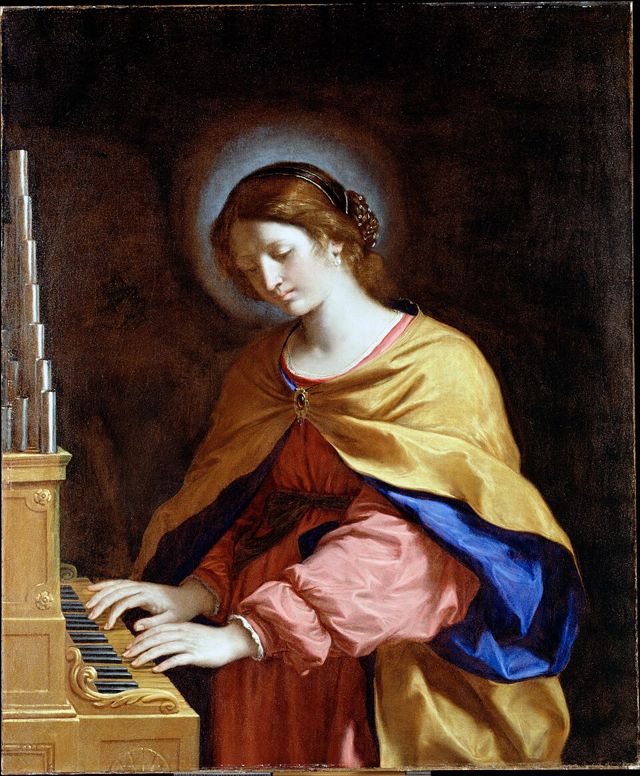
Baring-Gould is still more sceptical, calling the Acts (the written account of a martyr's trial and death) a romance and noting that no fierce persecution fits the reign of Alexander Severus, when Urban was pope. The Catholic Encyclopedia allows that Valerianus, Tiburtius and Maximus are historical and that their link with her may have some basis. About 821 Pope Paschal I translated a body he identified as hers to the Trastevere church. From the fourteenth century she has been shown with an organ, from the line that while instruments played she sang in her heart to God alone.

For today: If you hear music on her day, you are following a picture from the later Acts: that she sang to God in her heart while the wedding instruments played. The early marks of her honor are her name in the Canon, the church in Trastevere, and a grave in the catacomb of Callistus. The feast is 22 November.

What she represents

How she teaches us to live

Drawn from themes in the original account

Stay faithful when it costs you. Holding firm under pressure is part of this story.

Share your faith, in words and by example. Preaching and conversion are part of this story.

Pray a little every day. Prayer is part of this story.

The full story

Baring-Gould’s account retold in modern English

Read the full story · 741 words · about 3 min

…of blessed Peter the Apostle, which is called Palmaria.” The next synod met on November 6, 502, in the church of St. Peter, and in 533, “before the confession of blessed Peter,” and also in 504 in the basilica of St. Peter. Therefore, until better evidence is provided, we must conclude that St. Cecilia was not known or venerated in Rome until around the time when Pope Gelasius (who served from 496) included her name in his Sacramentary. However, in 821, there was an old church that had fallen into decay, dedicated to St. Cecilia; but Pope Paschal I dreamed that the body of the saint was in the cemetery of St. Callixtus (a cemetery in Rome), along with that of her husband Valerian. He then searched for them and found them, or at least some bodies, which he believed were those of Cecilia and Valerian, in the catacombs. He transferred these relics to the church of St. Cecilia and founded a monastery in their honor.

The story of St. Cecilia is not without beauty and merit. There was a virgin in the city of Rome named Cecilia, who was given in marriage to a young man named Valerian. She wore sackcloth next to her skin, fasted, and prayed to the saints, angels, and virgins, asking them to protect her virginity. She said to her husband, “I will tell you a secret if you swear not to reveal it to anyone.” When he swore, she added, “There is an angel who watches over me and protects me from anyone who would touch me.” He replied, “Dearest, if this is true, show me the angel.” “That can only happen if you believe in one God and are baptized.” She sent him to Pope St. Urban (who served from 223-230), who baptized him; and when he returned, he saw Cecilia praying in her chamber, with an angel beside her, having flaming wings, holding two crowns of roses and lilies, which he placed on their heads before vanishing. Shortly after, Tibertius, Valerian's brother, entered and was amazed by the fragrance and beauty of the flowers at that time of year. When he heard how they had received these crowns, he also agreed to be baptized. After their baptism, the two brothers dedicated themselves to burying the martyrs who were killed daily by the prefect of the city, Turcius Almachius. They were arrested and brought before the prefect, and when they refused to sacrifice to the gods, they were executed by the sword.

In the meantime, Saint Caecilia, through her preaching, had converted four hundred people, whom Pope Urban immediately baptized. Then Caecilia was arrested and sentenced to be suffocated in the baths. She was locked in for a night and a day, and the fires were piled high, glowing and roaring at their maximum, but Caecilia did not even sweat from the heat. When Almachius heard this, he sent an executioner to behead her in the bath. The man struck three times without being able to sever her head from her body. He left her bleeding, and she lived for three days. Crowds came to her, collecting her blood with napkins and sponges, while she preached to them or prayed. After that period, she died and was buried by Pope Urban and his deacons.

Alexander Severus, who was emperor when Urban was Pope, did not persecute the Church, although it is possible that some Christians may have suffered during his reign. Herodian states that no one was condemned during Alexander's reign except according to the usual legal process and by judges of the highest integrity. A few Christians may have suffered, but there could not have been any violent persecutions, such as those described in the Acts as being carried out by the apocryphal prefect, Turcius Almachius.

Urbanus was the prefect of the city, and Ulpian, who had significant influence at the beginning of Alexander's reign as the principal secretary of the emperor and commander of the Praetorian Guards, is thought to have encouraged persecution. Usuardus claims that Caecilia suffered under Commodus. Molanus moves the martyrdom to the reign of Marcus Aurelius. However, it is pointless to expect to extract history from romance.

In 1599, Cardinal Paul Emilius Sfondrati, the nephew of Pope Gregory XIV, rebuilt the church of Saint Caecilia. Saint Caecilia is regarded as the patroness of music and is depicted in art with an organ or organ pipes in her hand.

Footnotes

  1. Pope Gelasius served from 496.
  2. Pope St. Urban served from 223-230.
  3. Turcius Almachius was a Roman prefect.
  4. Usuardus claims that Caecilia suffered under Commodus.
  5. Molanus moves the martyrdom to the reign of Marcus Aurelius.

Baring-Gould’s own footnotes, in modern English.

Read the original 1870s text

Baring-Gould’s sources: Roman Martyrology. Greek Menreas and Menologies. Usuardus, Ado, Notker, &c. Anglican Reformed Kalendar, and all Western Kalendars after 9th cent. Not in the Roman 4th cent. Kalendar, published by Bucherius, nor in the 5th cent. Carthaginian Kalendar. Authority: — The Greek Acts in Metaphrastes.] In the 4th century appeared a Greek religious romance on the Loves of Caecilia and Valerian, written, like those of Chrysanthus and Daria, Julian and Basilissa, in glorification of the virginal life, and with the purpose of taking the place of the sensual romances of Daphnis and Chloe, Chereas and Callirhoe, &c., which were then popular. There may have been a foundation of fact on which the story was built up; but the Roman Kalendar of the 4th century, and the Carthaginian Kalendar of the 5th, make no mention of Caecilia. It is said, however, that there was a church dedicated to S. Caecilia in Rome in the 5 th century, in which Pope Symmachus held a council in 500. But Symmachus held no council in that year. That held at Easter, 501, was in the “basilica Julii; ” that on September 1, 501, was held in the “ basilica Sessoriana that on October 23, 501, was in “porticu S. CJ& CILIA, S. Cere ilia.

…beati Petri apostoli quae appellatur Palmaria.” The next synod, November 6, 502, met in the church of S. Peter; that in 533, “ ante confessionem beati Petri and that in 504 also in the basilica of S. Peter. Consequently, till better evidence is produced, we must conclude that S. Caecilia was not known or venerated in Rome till about the time when Pope Gelasius (496) introduced her name into his Sacramentary. In 821, however, there was an old church fallen into decay with the dedication to S. Caecilia; but Pope Paschal I. dreamed that the body of the saint lay in the cemetery of S. Calixtus, along with that of her husband Valerian [Roman emperor 253–260, who persecuted bishops and clergy]. He accordingly looked for them and found them, or, at all events, some bodies, as was probable, in the catacombs, which he was pleased to regard as those of Caecilia and Valerian. And he translated these relics [the bodily remains of a saint, or objects they used, kept with honor] to the church of S. Caecilia, and founded a monastery in their honour.

The story of S. Caecilia is not without beauty and merit. There was in the city of Rome a virgin named Caecilia, who was given in marriage to a youth named Valerian. She wore sackcloth next her skin, and fasted, and invoked the saints and angels and virgins, beseeching them to guard her virginity. And she said to her husband, “ I will tell you a secret if you will swear not to reveal it to any one.” And when he swore, she added, “ There is an angel who watches me, and wards off from me any who would touch me.” He said, “ Dearest, if this be true, show me the angel.” “ That can only be if you will believe in one God, and be baptized.” She sent him to Pope S. Urban (223-230), who baptized him; and when he returned, he saw Caecilia praying in her chamber, and an angel by her with flaming wings, holding two crowns of roses and lilies, which he placed on their heads, and then vanished. Shortly after, Tibertius, the brother of Valerian, entered, and wondered at the fragrance and beauty of the flowers at that season of the year. When he heard the story of how they had obtained these crowns, he also consented to be baptized. After their baptism the two brothers devoted themselves to burying the martyrs slain daily by the prefect of the city, Turcius Almachius.1 They were arrested and brought before the prefect, and when they refused to sacrifice to the gods were executed with the sword.

In the meantime, S. Caecilia, by preaching, had converted four hundred persons, whom Pope Urban forthwith baptized. Then Caecilia was arrested, and condemned to be suffocated in the baths. She was shut in for a night and a day, and the fires were heaped up, and made to glow and roar their utmost, but Caecilia did not even break out into perspiration through the heat.2 When Almachius heard this he sent an executioner to cut off her head in the bath. The man struck thrice without being able to sever the head from the trunk. He left her bleeding, and she lived three days. Crowds came to her, and collected her blood with napkins and sponges, whilst she preached to them or prayed. At the end of that period she died, and was buried by Pope Urban and his deacons.

Alexander Severus, who was emperor when Urban was Pope, did not persecute the Church, though it is possible some Christians may have suffered in his reign. Herodian says that no person was condemned during the reign of Alexander, except according to the usual course of the law, and by judges of the strictest integrity. A few Christians may have suffered, but there can have been no furious persecutions, such as is described in the Acts as waged by the apocryphal prefect, Turcius Almachius.

Urbanus was the prefect of the city, and Ulpian, who had much influence at the beginning of Alexander's reign as “ Nulla pars omnino ex ejus membris vel minimo sudoris signo fuit humectata.*' The Marriage Feast. S. CECILIA. “I will tell you a secret.' S. Ccecilia.

principal secretary of the emperor and commander of the Praetorian Guards, is thought to have encouraged persecution. Usuardus [a 9th-century monk of Paris who compiled a list of saints for each day] makes Caecilia suffer under Commodus. Molanus [a 16th-century Flemish scholar who edited saints’ calendars] transfers the martyrdom to the reign of Marcus Aurelius. But it is idle to expect to extract history from romance.

In 1599 Cardinal Paul Emilius Sfondrati, nephew of Pope Gregory XIV., rebuilt the church of S. Caecilia. S. Caecilia is regarded as the patroness of music, and is represented in art with an organ or organ-pipes in her hand.

From the Catholic Encyclopedia

1913 · 2379 words

Virgin and martyr, patroness of church music, died at Rome.

This saint, so often glorified in the fine arts and in poetry, is one of the most venerated martyrs of Christian antiquity. The oldest historical account of St. Cecilia is found in the "Martyrologium Hieronymianum"; from this it is evident that her feast was celebrated in the Roman Church in the fourth century. Her name occurs under different dates in the above-mentioned martyrology; its mention under 11 August, the feast of the martyr Tiburtius, is evidently a later and erroneous addition, due to the fact that this Tiburtius, who was buried on the Via Labicana, was wrongly identified with Tiburtius, the brother-in-law of St. Cecilia, mentioned in the Acts of her martyrdom. Perhaps also there was another Roman martyr of the name of Cecilia buried on the Via Labicana. Under the date of 16 September Cecilia is mentioned alone, with the topographical note: "Appiâ viâ in eâdem urbe Româ natale et passio sanctæ Ceciliæ virginis (the text is to be thus corrected). This is evidently the day of the burial of the holy martyr in the Catacomb of Callistus. The feast of the saint mentioned under 22 November, on which day it is still celebrated, was kept in the church in the Trastevere quarter at Rome, dedicated to her. Its origin, therefore, is to be traced most probably to this church. The early medieval guides (Itineraria) to the burial-places of Roman martyrs point out her grave on the Via Appia, next to the crypt of the Roman bishops of the third century (De Rossi, Roma sotterranea, I, 180-181). De Rossi located the burial-place of Cecilia in the Catacomb of Callistus in a crypt immediately adjoining the crypt or chapel of the popes; an empty niche in one of the walls contained, probably, at one time the sarcophagus with the bones of the saint. Among the frescoes of a later time with which the wall of the sepulchre are adorned, the figure of a richly-dressed woman appears twice and Pope Urban, who was brought personal into close relation with the saint by the Acts of her martyrdom, is depicted once. The ancient titular church of Rome, mentioned above was built as early as the fourth century and is still preserved in the Trastevere. This church was certainly dedicated in the fifth century to the saint buried on the Via Appia; it is mentioned in the signatures of the Roman Council of 499 as "titulus sanctae Caeciliae" (Mansi, Coll, Conc. VIII, 236). Like some other ancient Christian churches of Rome, which are the gifts of the saints whose names they bear, it may be inferred that the Roman Church owes this temple to the generosity of the holy martyr herself; in support of this view it is to be noted that the property, under which the oldest part of the true Catacomb of Callistus is constructed, belonged most likely, according to De Rossi's researches, to the family of St. Cecilia (Gens Caecilia), and by donation passed into the possession of the Roman Church. Although her name is not mentioned in the earliest (fourth century) list of feasts (Depositio martyrum), the fact that in the "Sacramentarium Leoniam", a collection of masses completed about the end of the fifth century, are found no less than five different masses in honour of St. Cecilia testifies to the great veneration in which the saint was at that time held in the Roman Church ["Sacram. Leon.", ed. Muratori, in "Opera" (Arezzo, 1771), XIII, I, 737, sqq.].

About the middle of the fifth century originated Acts of the martyrdom of St. Cecilia which have been transmitted in numerous manuscripts; these acts were also translated into Greek. They were utilized in the prefaces of the above-mentioned masses of the "Sacramentarium Leonianum". They inform us, that Cecilia, a virgin of a senatorial family and a Christian from her infancy, was given in marriage by her parents to a noble pagan youth Valerianus. When, after the celebration of the marriage, the couple had retired to the wedding-chamber, Cecilia told Valerianus that she was betrothed to an angel who jealously guarded her body; therefore Valerianus must take care not to violate her virginity. Valerianus wished to see the angel, whereupon Cecilia sent him to the third milestone on the Via Appia where he should meet Bishop (Pope) Urbanus. Valerianus obeyed, was baptized by the pope, and returned a Christian to Cecilia. An angel then appeared to the two and crowned them with roses and lilies. When Tiburtius, the brother of Valerianus, came to them, he too was won over to Christianity. As zealous children of the Faith both brothers distributed rich alms and buried the bodies of the confessors who had died for Christ. The prefect, Turcius Almachius, condemned them to death; an officer of the prefect, Maximus, appointed to execute this sentence, was himself converted and suffered martyrdom with the two brothers. Their remains were buried in one tomb by Cecilia. And now Cecilia herself was sought by the officers of the prefect. Before she was taken prisoner, she arranged that her house should be preserved as a place of worship for the Roman Church. After a glorious profession of faith, she was condemned to be suffocated in the bath of her own house. But as she remained unhurt in the overheated room, the prefect had her decapitated in that place. The executioner let his sword fall three times without separating the head from the trunk, and fled, leaving the virgin bathed in her own blood. She lived three days, made dispositions in favour of the poor, and provided that after her death her house should be dedicated as a church. Urbanus buried her among the bishops and the confessors, i.e. in the Catacomb of Callistus.

Read the rest of the article

In this shape the whole story has no historical value; it is a pious romance, like so many others compiled in the fifth and sixth century. The existence of the aforesaid martyrs, however, is a historical fact. The relation between St. Cecilia and Valerianus, Tiburtius, and Maximus, mentioned in the Acts, has perhaps some historical foundation. These three saints were buried in the Catacomb of Praetextatus on the Via Appia, where their tombs are mentioned in the ancient pilgrim Itineraria. In the "Martyrologium Hieronymianum" their feast is set down under 14 April with the note: "Romae via Appia in cimiterio Prætextati"; and the octave under 21 April, with the comment: "Rome in cimiterio Calesti via Appia". In the opinion of Duchesne the octave was celebrated in the Catacomb of Callistus, because St. Cecilia was buried there. If, therefore, this second notice in the martyrology is older than the aforesaid Acts, and the latter did not give rise to this second feast, it follows that before the Acts were written this group of saints in Rome was brought into relation with St. Cecilia. The time when Cecilia suffered martyrdom is not known. From the mention of Urbanus nothing can be concluded as to the time of composition of the Acts; the author without any authority, simply introduced the confessor [in old usage, a saint who was not martyred, or who suffered for the faith without being killed] of this name (buried in the Catacomb of Praetextatus) on account of the nearness of his tomb to those of the other martyrs and identified him with the pope of the same name. The author of the "Liber Pontificalis" used the Acts for his notice of Urbanus. The Acts offer no other indication of the time of the martyrdom. Venantius Fortunatus (Miscellanea, 1, 20; 8,6) and Ado (Martyrology, 22 November) place the death of the saint in the reign of Marcus Aurelius and Commodus (about 177), and De Rossi tried to prove this view as historically the surest one. In other Western sources of the early Middle Ages and in the Greek "Synaxaria" this martyrdom is placed in the persecution of Diocletian [Roman emperor 284–305, who began the ‘Great Persecution’ of Christians in 303]. P.A. Kirsch tried to locate it in the time of Alexander Severus (229-230); Aubé, in the persecution of Decius [Roman emperor 249–251, who ordered everyone to sacrifice to the gods] (249-250); Kellner, in that of Julian the Apostate [Roman emperor 361–363 who tried to restore paganism] (362). None of these opinion is sufficiently established, as neither the Acts nor the other sources offer the requisite chronological evidence. The only sure time-indication is the position of the tomb in the Catacomb of Callistus, in the immediate proximity of the very ancient crypt of the popes, in which Urbanus probably, and surely Pontianus and Anterus were buried. The earliest part of this catacomb dates at all events from the end of the second century; from that time, therefore, to the middle of the third century is the period left open for the martyrdom of St. Cecilia.

Her church in the Trastevere quarter of Rome was rebuilt by Paschal I (817-824), on which occasion the pope wished to transfer thither her relics [the bodily remains of a saint, or objects they used, kept with honor]; at first, however, he could not find them and believed that they had been stolen by the Lombards [a Germanic people who ruled much of Italy from 568 to 774]. In a vision he saw St. Cecilia, who exhorted him to continue his search, as he had already been very near to her, i.e. near her grave. He therefore renewed his quest; and soon the body of the martyr, draped in costly stuffs of gold brocade and with the cloths soaked in her blood at her feet, was actually found in the Catacomb of Prætextatus. They may have been transported thither from the Catacomb of Callistus to save them from earlier depredations of the Lombards in the vicinity of Rome. The relics of St. Cecilia with those of Valerianus, Tiburtius, and Maximus, also those of Popes Urbanus and Lucius, were taken up by Pope Paschal, and reburied under the high altar of St. Cecilia in Trastevere. The monks of a convent founded in the neighbourhood by the same pope were charged with the duty of singing the daily Office in this basilica. From this time the veneration of the holy martyr continued to spread, and numerous churches were dedicated to her. During the restoration of the church in the year 1599 Cardinal Sfondrato had the high altar examined and found under it the sarcophagi, with the relics of the saints, that Pope Paschal had transported thither. Recent excavations beneath the church, executed at the instigation and expense of Cardinal Rampolla, disclosed remains of Roman buildings, which have remained accessible. A richly adorned underground chapel was built beneath the middle aisle, and in it a latticed window, opening over the altar, allows a view of the receptacles in which the bones of the saints repose. In a side chapel of the church there have long been shown the remains of the bath in which, according to the Acts, Cecilia was put to death.

The oldest representations of St. Cecilia show her in the attitude usual for martyrs in the Christian art of the earlier centuries, either with the crown of martyrdom in her hand (e.g. at S. Apollinare Nuovo in Ravenna, in a sixth-century mosaic) or in the attitude of prayer, as an Orans (e.g. the two sixth and seventh-century pictures in her crypt). In the apse of her church in Trastevere is still preserved the mosaic made under Pope Paschal, wherein she is represented in rich garments as patroness of the pope. Medieval pictures of the saint are very frequent; since the fourteenth and fifteenth centuries she is given the organ as an attribute, or is represented as playing on the organ, evidently to express what was often attributed to her in panegyrics and poems based on the Acts, viz., that while the musicians played at her nuptials she sang in her heart to God only ("cantantibus organis illa in corde suo soi domino decantabat"); possibly the cantantibus organis was erroneously interpreted of Cecilia herself as the organist. In this way the saint was brought into closer relation with music. When the Academy of Music was founded at Rome (1584) she was made patroness of the institute, whereupon her veneration as patroness of church music in general became still more universal; today Cecilian societies (musical associations) exist everywhere. The organ is now her ordinary attribute; with it Cecilia was represented by Raphael in a famous picture preserved at Bologna. In another magnificent masterpiece, the marble statute beneath the high altar of the above-mentioned church of St. Cecilia at Rome, Carlo Maderna represented her lying prostrate, just as she had received the death-blow from the executioner's hand. Her feast is celebrated in the Latin and the Greek Church on 22 November. In the "Martyrologium Hieronymainum" are commemorated other martyrs of this name, but of none of them is there any exact historical information. One suffered martyrdom in Carthage with Dativus in 304.

MOMBRITIUS, Sanctuarium, I, 186 sqq.; BOSIO, Atti di S. Cecilia (Rome, 1600); SURIUS, De vitis Sanctorum (Venice, 1581), VI, 161 sqq.; LADERCHI, S. Caciliae virg. et mart. acta ac transtiberina basilica (Rome, 1722); BOLLANDISTS ed., Bibliotheca hagiographica latina (Brussels, 1898-99), I, 224; SIMEON METAPHRASTES, in P.G., CXVI; BARONIUS, Annales, ad an. 821, 15 xv (the spurious document of Pope Paschal I); BOLLANDISTS ed., Synaxarium Constatinopolitanum (Brussels, 1902), 243; Liber Pontificalis, ed. DUCHESNE, I, xciii sq., 143, and II, 55-57, 65; TILLEMONT, Hist. ecclés., III, 259 sqq.; De Rossi, Roma Sotterranea, II, xxxii sq.; GUERANGER, Histoire de Ste Cecile (Paris 1849; 2nd ed., 1852); IDEM, Ste Cecile et la societe romaine (Paris, 1878); MORSE, BIRKS, and HOLE, in Dict. of Christian Biog., s.v.; AUBE, Les chrétiens dans l'empire romain (2nd ed., Paris, 1881), 352 sqq.; ALLARD, Histoire des persecutions, I, 427 sqq.; ERBES, Die heilige Cacilia im Zusammenhang mit der Papstcrypta sowie der altesten Kirche Roms, in Zeitschrift fur Kirchengeschichte, IX, 1888, 1 sqq.; P.A. KIRSCH, Die heilge Cacilia, Jungfrau und Martyrin (Ratisbon [Regensburg in Bavaria], 1901); IDEM, Das Todesjahr der heiligen Cacilia, in Stromation Archaiologikon (Rome, 1900), 42-77; KELLNER, Das wahre Zeitalter der heil. Cacilia, in Theologische Quartalschrift (Tubingen, 1902), 237 sqq.; (1903), 321 sqq.; (1905), 258 sqq.; DUFOURCQ, Les Gesta martyrum romains (Paris, 1900), 116 sqq., 293 sqq.; MARUCCHI, Basiliques et eglises de Rome (Rome, 1902), 438 sqq.; BIANCHI-CAGLIESI, S. Cecilia e sua basilica (Rome, 1902); DETZEL, Christl. Ikonographie (Freiburg im Br., 1896), 220 sqq.; ROHAULT DE FLEURY, Les saints de la Messe, I, pl, 16-17; P. SIXTUS, Elucubrationes historico-liturgicae de recenti quadem sententia circa aetatem S. Caeciliae martyris, in Ephemerides liturgicae (Rome, Sept.-Oct. 1907). See also the accounts in BUTLER, Lives of the Saints, 22 November.
Patron saint of

  • Church music Catholic Encyclopedia (1913)
    The Catholic Encyclopedia names her patroness of church music.

More about St. Cecilia

Checked against at least two sources, in our own words

Help us add to this saint's story

Everything is read by a person before anything appears. Facts are checked against trusted sources first.

Facts are welcome; a source link helps (optional).With your permission we may share it on this page.

Nine days · Free

Pray the novena
with us.

One short email a day for nine days. The day's prayer, a line from St. Cecilia's story, and a nudge to keep going.

Also on November 22
P

Sts. Philemon and Appia

November 22 · Martyrs
← All 1970 saints in the library

Did you know

Related

Sources & notes

Feast-day sources

Story sources

Sources

Credits

Image: Guercino - St. Cecilia - Google Art Project.jpg · Guercino · Public domain, via Wikimedia Commons

Image: Guercino, Wikimedia Commons (Public domain)

From “Catholic Encyclopedia (1913)/St. Cecilia,” The Catholic Encyclopedia (New York: Robert Appleton Company, 1907–1914), via Wikisource. Public domain. Matched by name and feast date; text unedited except for our bracketed notes in grey.

Retold in plain modern English from Baring-Gould’s public-domain text, sentence by sentence, keeping the same facts and order. Short explanations in parentheses are ours.

From Sabine Baring-Gould, The Lives of the Saints, new edition in 16 vols. (London: John C. Nimmo, 1897–98); text from the Internet Archive scan (OCR, lightly cleaned; errors possible). Public domain in the United States. Reproduced unedited, except for short bracketed notes in grey that we added to explain names and terms (“S.” is the old abbreviation for Saint). Some history and judgments reflect 19th-century scholarship.

Notes

Story retold in our own words from the cited sources.