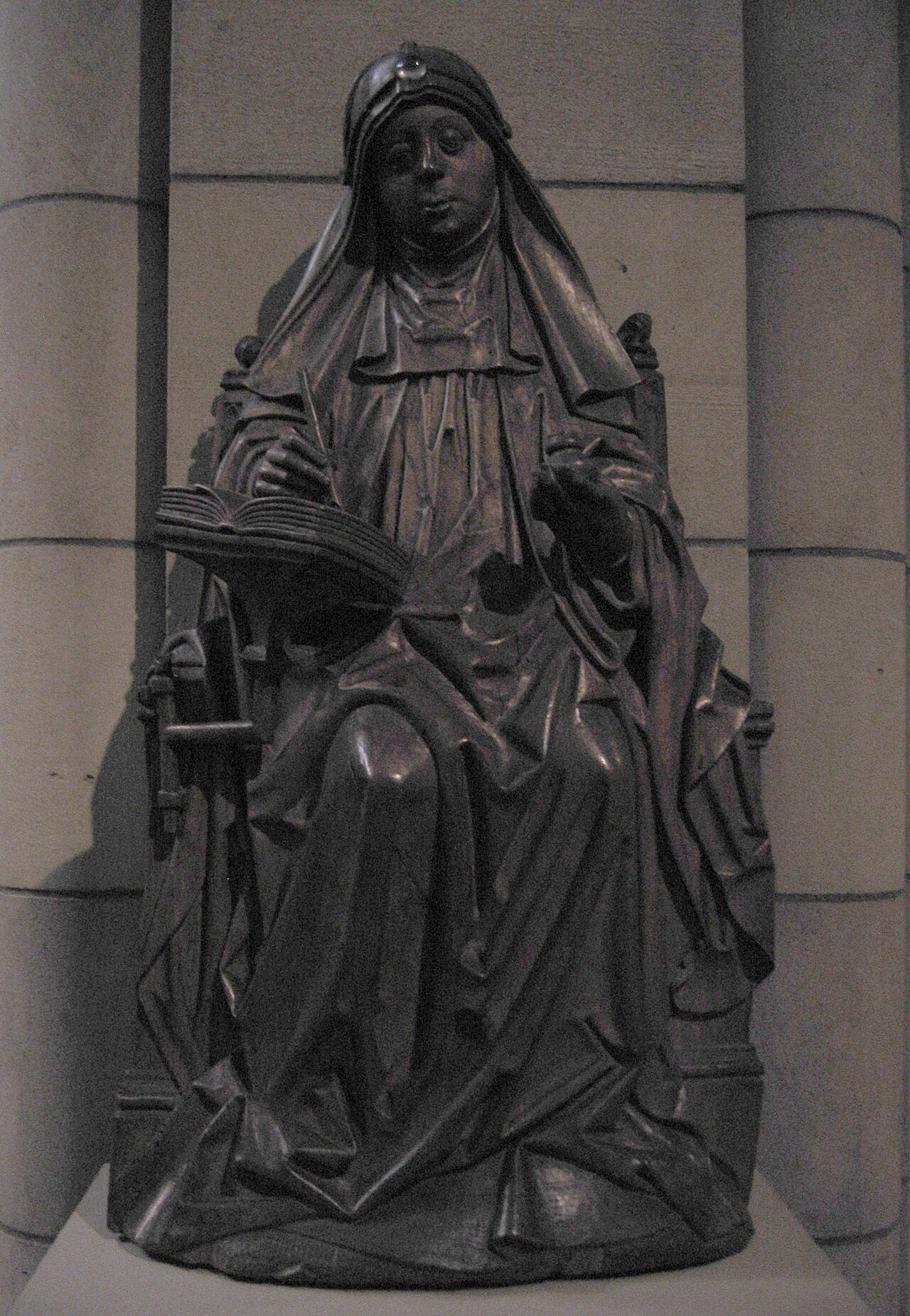
…that he fully approved of his marriage. "If you had not taken her as your wife yourself, brother, in good faith, I might have done it myself.” One night, the chroniclers say, a glorious maiden in rich clothing was seen in the heavens, holding a scroll that was inscribed with these words: “A daughter is born to Birgir whose fame shall be sung throughout the world!” That very night, the lady Birgitta was born, known as Britta in Sweden.
But her mother was nearly drowning in a storm at sea due to a shipwreck, but she was saved by Dukes Eric and Waldemar. She came ashore near Bredsatra, where a chapel was later built in honor of Saint Britta. On the promontory, the ruined chapel of grey stone still stands today. Next to it is a solitary thorn tree and a spring covered with a cracked slab of sandstone — Saint Britta’s well. On the grassy area by the shore, a marble floriated cross, twelve feet tall, marks the spot where Ingibjorg first set foot on land.
That night, the lady was informed in a vision that she had been saved from drowning only for the sake of the unborn child she carried in her womb. Lady Ingibjorg was a holy woman; she died not long after the birth of Birgitta, leaving several children. Among them, Israel became lagman (a title for a regional leader) of the Uplands after his father. Her daughter Margaret married Nicolas Ingiraldsen, chief of Hammerstad. Another daughter, Catherine, married Gudmar, lagman of West-Gothland.
Birger, Archbishop of Upsala, who wrote more than a century after Birgitta's death, tells wonderful stories of her childhood. He recounts how, when Birgitta was hard at work one day at the age of twelve, making feather trimmings for her dress, an angel came and helped her. They descended from Birgir and Ingibjorg, the parents of Saint Birgitta. Birgir bore the eagle’s wings on his coat of arms, which are still the arms of the Brahes. A piece of her feather-work was set aside and venerated after her death as a revered relic.
At the age of fourteen, she married Ulf of Ulfsa, son of Gudmar, lagman of Nerik, and by him had four sons and as many daughters. Her sons were Carl, Birger, Benedict, and Gudmar. Of these, Benedict died before reaching adulthood, and Gudmar died in infancy. Her daughters were Maeretta, Caecilia, Catherine, and Ingibjorg. Maeretta was married twice: first to Siord Ribbing and then to Knut Aigoth, and she became lady-in-waiting to Margaret, wife of Hako, King of Norway. Caecilia was forced against her will to enter the convent of Skening. Her brother Carl then went to the convent and carried her off, and she married a knight who was poisoned at the marriage of Queen Margaret, daughter of Waldemar of Denmark, to Hako of Norway, at the same time as Blanche of Namur, Queen of Sweden.
At that ill-fated wedding, King Magnus of Sweden tasted poison, but his life was saved by his physician, Laurence Jonsen, and he gave the bereaved Caecilia to the physician as his reward. Catherine, the third daughter, became a saint (March 24), and Ingibjorg died young in a convent. In her married life, Birgitta was exemplary. She received Communion every Sunday and on solemn festivals.
She was appointed lady-in-waiting to Blanche of Namur, the bad Queen of Magnus Smek. Birgitta was in the habit of seeing visions, having revelations, and sharing them as messages from heaven with everyone they concerned. Magnus and Blanche often made jokes about St. Birgitta, and Magnus frequently asked her son, “Well, Birger, what did your mother dream about us last night?” Some of her visions were political in nature; among other things, she was shown how to bring about an eternal peace between the kings of England and France. She was told, “If the former does not accept, he will prosper in none of his transactions, but will end his life in pain, and leave his kingdom and his children in tribulation and anguish. His family will set themselves against each other, and cause a confusion that all will be astonished at.” This prophecy was fulfilled by the calamitous death of Richard II and the Wars of the Roses.
However, some of her revelations were more practical and down-to-earth. People were unclean in her time; for twice it was revealed to her that, although it was not pleasing to heaven for people to take baths just for enjoyment, Christians might be allowed to take a bath every fortnight, or at least once a month, for health reasons. One day, while her husband was still alive, she had a state bed prepared with great care. Suddenly, she received a blow to the head from an unseen hand, causing her so much pain that she could not move for several minutes. Then a voice asked her why she took such pains to lie comfortably. St. Birgitta, bursting into tears, had the bed taken down; and from that day on, even though she was a lady-in-waiting to the queen, she not only slept on straw and a bearskin, but also made her husband do the same. During one of her confinements, she was attended by the Blessed Virgin herself, if we can believe her biographers. One day, she learned that her son Carl had not fasted on the vigil of St. John the Baptist. In an agony of grief and horror, she wept, fasted, and prayed until the holy Precursor appeared to her and said, “Because you have wept for your son’s offense against me by not fasting on my vigil, and would rather see him my servant than an earthly monarch, I will support him and be his patron and protector.”
At last, she convinced her husband to join her on a pilgrimage to Compostella. On their way, Ulf became ill, and she constantly urged him to make a vow to enter a monastery. He agreed, fearing death, and entered the Alvastra monastery, where he died. Now she was free to pursue her own desires. She traveled on pilgrimage through Norway to the tomb of Saint Olaf, then to France, to Tarascon, to the shrine of Saint Martha, to Marseilles to visit the relics of Saint Mary Magdalen, to Cologne to honor the heads of the three kings; and finally, she went to Rome, accompanied by her sons Birger and Carl.
When they arrived, she presented them before the Pope. Birger was dressed in a long robe that reached his feet, tied around his waist; Carl stood tall in knightly attire, wearing a short tunic, with a silver belt holding a dagger at his waist. “He wore over all a mantle covered with entire ermine skins, from top to bottom, so that when he walked, it looked as if ermines were running over him; and each ermine’s head had a small gilded bell hung around its neck and a gold ring in its mouth.” When the Pope saw them, he said to Birger, “You are your mother’s son,” and then turning to Carl, he said, “You are a son of this world.” Birgitta fell at the feet of the Pope and begged him to absolve her sons of their sins. Then the Holy Father felt Carl’s belt and mantle and said, “The weight of these items will atone for the sin of wearing them.” “Let your holiness absolve him,” said Birgitta, “and I will remove his belt.”
Saint Brigitta went on with her sons to Naples in 1362, where Joanna was Queen. Joanna had been married in her youth to her relative Andrew, from the royal house of Hungary. She was publicly accused of being an adulteress, if not an accomplice, for having conspired in the murder of her husband. Louis, the King of Hungary, invaded the kingdom to avenge his brother’s death and to claim his right to the throne as the heir of Charles Martel. Joanna fled to Avignon and obtained from the Pope a dispensation for her marriage to her relative, Louis of Tarento. She returned to Saint Brigitta of Sweden.
to Naples, having sold to the Pope the city of Avignon and part of her kingdom of Provence. War continued to rage in Naples between the Hungarian faction and that of Joanna and Louis of Tarento. Eventually, the outcome of the conflict was referred to the Pope. Joanna claimed that she had been placed under a magic spell, which had forced her to hate her husband and tarnish his honor. The Pope accepted this claim, and Joanna was absolved by Clement VI. Louis of Tarento died in 1362, and Joanna married James of Aragon, King of Majorca, after he escaped from prison, where he had languished for twelve years. Joanna grew to dislike him, just as she had her first husband, and he retired to Catalonia in 1375. Joanna was forty-six when Saint Britta arrived with her two handsome sons. Before they were introduced to the queen, Saint Britta instructed her sons on how to behave in her presence; they were to prostrate themselves and kiss her foot. Birger, who had gone in a long dress before the Pope, was very respectful and demure. But the lively, handsome Carl, instead of bowing to Joanna's foot, boldly approached her and gave her a hearty kiss on her red lips. This delighted Joanna so much that she vowed she would marry no one but Carl. In vain did his mother protest that he had a wife in Sweden — his third wife. That was no obstacle, said Joanna: Sweden was far away, and some reason for a divorce could easily be found. Whether Carl was tempted by the prospect of a crown and inclined to forget his fair-haired Catharine in the Swedish Uplands is uncertain, but it seems likely, for Saint Britta could not get him away from Naples. The queen was madly in love with him and quite ready to rid herself of the detestable James of Aragon. Britta had no recourse but her prayers. They were answered, and Carl died of fever in Naples on Ascension Day, 1372. After the death of her husband, Saint Britta entered the monastery of Alvastra and devoted herself to extreme self-mortification. She stopped using linen, and for her bed, she had only one bolster and pillow. Instead of covering herself with eider-down quilts, she threw her clothes over the coverlet to keep warm. Every Friday, she dripped melted wax on her flesh until she formed a blister, and then kept it raw with her nails until the following Friday. On the same day, she took bitter medicine made from the root of gentian. She wore a knotted cord around her waist, next to her skin, to constantly irritate it, and sought various other ways to torment herself. Her charitable donations were very generous. In Rome, three years went by without her receiving any money from Sweden. Yet Britta continued to give alms. “It would be better to pay your debts,” said her steward; “there is no charity in giving what is not yours.” The saint silenced him, but her creditors became demanding and would have taken her to prison if she had not received a revelation from the Blessed Virgin that the money would arrive soon — and it did. In 1344, she built the monastery of Wadstena, in the diocese of Linkoping, and placed in it sixty nuns and twenty-five austere canons, thirteen of whom were priests, four were deacons, and eight were lay brothers. The convents for men and women were separate, but they used the same church, with the women sitting in a gallery and the men below on the floor.
After Saint Britta had spent two years in Wadstena, she went on a pilgrimage to Rome and stayed there until her death, except for a visit to Jerusalem with her daughter Catherine. She wrote a book of prayers about the sufferings and love of Christ, which are very beautiful and show that she was a woman of passionate spirit. She also created a Rule, in thirty-one chapters, for the nuns and friars of her Order. This Rule was approved in 1363 by Pope Urban V under the title of “The Rule of the Order of Our Saviour.”
Additionally, she wrote the "Book of Revelations," which is a very popular work and interesting to some people. Lastly, she composed an “Angelical Discourse on the Excellence of Our Lady.”
She died on July 23, 1373, at the age of seventy-one. Her body was laid to rest in the church of Saint Laurence in Panis Pema, which belonged to a convent of Poor Clares in Rome. However, a year after her death, in July 1374, she was exhumed, and her body was moved to Wadstena. The Pope requested to keep one arm as a special favor. A second arm is still preserved at Lund, a third at Wadstena, and a fourth, enshrined in a gilded silver case, can be seen in the museum of Stockholm.
Footnotes
- Birgir: a name of Scandinavian origin.
- Birgitta: a name of Scandinavian origin.
- Catherine became a saint on March 24.
- A prophecy fulfilled by the calamitous death of Richard II and the Wars of the Roses.
- The weight of these items will atone for the sin of wearing them.
- Saint Britta is also known as Saint Bridget of Sweden.
- Panis Pema: a location in Rome associated with a convent of Poor Clares.
Baring-Gould’s own footnotes, in modern English.
Read the original 1870s text
Baring-Gould’s sources: Roman Martyrology. Canonized by Boniface IX. in 1391. Authorities: — The Bull of her Canonization; a life by Birger Gunnarsen, archbishop of Upsala, 1496-1519; and another life by Berthold, monk of S. Salvador. Another life, the Chronicon de S. Brigitta, by Margaretta, abbess of Wadstena, circa 1430; also the Diarium Vazstenense, 1344-1545. The Revelations of S. Briget have gone through numerous editions, and have been translated into Italian, French, German, English, Swedish, Dutch, &c.] S. Briget, or more properly Birgitta, was bom at Finnstad near Upsala, in Sweden, in 1302. Her father was Birgir, lagman of Upland, a pious man, the founder of many churches and of the monastery of Skoo on the Maeler lake. His wife, Ingibjorg, was daughter of Sigrid the Fair and Bengt, brother of Earl Birgir. Sigrid was of low extraction. On account of this the haughty Birgir sent his newly-married brother a coat, half of which was made of the costliest velvet wrought with gold, and the other of the coarsest homespun. Having caused the homespun to be embroidered with pearls and gems, so that it became of more worth than the velvet, Bengt returned it to Birgir, to remind him that beauty and virtue are of greater value than noble birth. The earl grew angry, and threatened his brother with a visit. Bengt left his home the day Birgir was expected; but his wife received their guest so well, and behaved so sweetly and prudently, that he was not able to resist the grace of this “gem among fair women.” Next day when Bengt returned home, Birgir hastened to meet him, and assure him S. Briget of Sweden.
…that he fully approved his marriage. " Hadst thou not taken her to wife thyself, brother, in good faith, I might have done it myself.” 1 One night, say the chroniclers, a glorious maiden in rich attire was seen in the heavens, bearing in her hand a scroll, inscribed with these words: “ Of Birgir is born a daughter whose fame shall be sung throughout the world!” That selfsame night was born the lady Birgitta, — Britta as she is called in Sweden.
But her mother was nigh perishing in a storm at sea, by shipwreck, but was saved by Dukes Eric and Waldemar, and she came ashore near Bredsatra, where a chapel was erected in later times in honour of S. Britta. On the promontory stands at this day the ruined chapel of grey stone. Beside it is a solitary thorn tree, and a spring covered over with a cracked slab of sandstone — S. Britta’s well. On the greensward by the strand a marble floriated cross, twelve feet in height, marks the spot where Ingibjorg first set foot on land. In the night the lady was informed in a vision that she had been saved from drowning only for the sake of the unborn child she bore in her womb. The Lady Ingibjorg was a holy woman; she died not long after the birth of Birgitta, leaving several children, of whom Israel became lagman of the Uplands after his father; her daughter Margaret married Nicolas Ingiraldsen, chief of Hammerstad; another daughter, Catherine, married Gudmar, lagman of West-Gothland. Birger, Archbishop of Upsala, who wrote more than a century after the death of Birgitta, tells wonderful stories of her childhood, — how that when Birgitta was hard at work one day, at the age of twelve, making feather trimmings for her dress, an angel came and helped her. The descended from Birgir and Ingibjorg, the parents of S. Birgitta. Birgir bore the eagle’s wings on his escutcheon, which are still the arms of the Brahes. bit of feather-work was put aside and venerated after her death as an august relic. At the age of fourteen she was married to Ulf of Ulfsa, son of Gudmar, lagman of Nerik, and by him had four sons and as many daughters. Her sons were Carl, Birger, Benedict, and Gudmar; of these Benedict died before he came of age, and Gudmar in infancy. Her daughters were Maeretta, Caecilia, Catherine, and Ingibjorg. Maeretta was married twice: first to Siord Ribbing and afterwards to Knut Aigoth, and became lady-in-waiting to Margaret, wife of Hako, King of Norway. Caecilia was forced against her will to enter the convent of Skening. Her brother Carl thereupon went to the convent and carried her off, and she married a knight, who was poisoned at the marriage of Queen Margaret, daughter of Waldemar of Denmark, to Hako of Norway, at the same time as Blanche of Namur, Queen of Sweden. At that ill-fated wedding King Magnus of Sweden tasted poison, but his life was saved by his physician, Laurence Jonsen, and he gave the bereaved Caecilia to the physician as his reward.
Catherine, the third daughter, became a saint (March 24), and Ingibjorg died young in a convent. In her married life Birgitta was exemplary. She communicated every Sunday and solemn festival.
She was appointed lady-in-waiting on Blanche of Namur, the bad Queen of Magnus Smek. Birgitta was all this while in the habit of seeing visions, having revelations, and relating them as messages from heaven to all whom they concerned. Magnus and Blanche were apt to make a joke of S. Birgitta, and Magnus often asked her son, “ Well, Birger, what did your mother dream about us last night ? ” Her visions were sometimes of a political nature; among other things was revealed to her the manner of bringing about an eternal peace between the kings of England and France, “ which, if the former does not accept, he will prosper in none of S. Briget of Sweden.
his transactions, but will end his life in pain, and leave his kingdom and his children in tribulation and anguish. His family will set themselves against each other, and cause a confusion that all will be astonished at.” A prophecy fulfilled by the calamitous death of Richard II., and the Wars of the Roses.
But some of her revelations were of a more homely and practical description. People were dirty in her day; for twice it was revealed to her that, though it was not pleasing to heaven that folks should take baths for the sake of enjoying them, yet that Christians might, as a matter of health, be allowed a tub every fortnight, or at any rate once a month. One day, during the lifetime of her husband, on her causing a state bed to be mounted with uncommon care, she suddenly got a blow over the head from an unseen hand, so that she could not move from sheer pain for some minutes afterwards. Then a voice asked her why she took such pains to lie softly. S. Birgitta, bursting into tears, had the bed taken down; and from that day, lady-in-waiting to the queen though she was, she not only slept upon straw and a bearskin, but made her husband do so also. In one of her confinements she was attended by the Blessed Virgin herself, if we may believe her biographers. One day she learned that her son Carl had not fasted on the vigil of S. John the Baptist. In an agony of grief and horror she wept and fasted and prayed, till the holy Precursor appeared to her and said: “Because thou hast wept at thy son’s offending me, in not fasting on my vigil, and would rather see him my servant than an earthly monarch, I will support him, and be his patron and protector.”
At last she persuaded her husband to accompany her on a pilgrimage to Compostella. On his way, Ulf fell ill, and she urged him incessantly to make a vow to enter a monaster)’. He consented, under the fear of death, and entered the Alvastra monastery, where he died. She was now free to follow her own desires. She rambled in pilgrimage through Norway to the tomb of S. Olaf, into France, to Tarascon, to the shrine of S. Martha, to Marseilles to visit the relics [the bodily remains of a saint, or objects they used, kept with honor] of S. Mary Magdalen, to Cologne to venerate the heads of the three kings; and finally she went to Rome, accompanied by her sons Birger and Carl. With them she was presented before the Pope. Birger was dressed in a long habit reaching to his feet, girded about his waist; Carl stood erect in knightly guise, with a short kirtle, girded round his waist by a silver belt bearing a dagger. “He wore over all a mantle on which were sewn entire ermine skins, from top to bottom, so that when he walked it looked as if ermines were running over him; and each ermine’s head had a little gilded bell hung about the neck and a gold ring in its mouth/* When the Pope saw them, he said to Birger, “You are your mother’s son then turning to Carl, he said, “ You are a son of this world.” Birgitta flung herself at the feet of the Pope and implored him to absolve her sons their sins. Then the Holy Father felt the belt and mantle of Carl, and said, “ The weight of these articles will expiate the sin of wearing them.” “Let your sanctity absolve him,” said Birgitta, “ and I will disbelt him.”
S. Britta went on with her sons to Naples, in 1362, where Joanna was Queen. Joanna had been married in early youth to her kinsman Andrew, of the royal house of Hungary. She stood arraigned before the world as an adulteress, — if not an accomplice, as having connived at the murder of her husband. Louis, King of Hungary, invaded the kingdom to avenge his brother’s death, and to assert his right to the throne as heir of Charles Martel. Joanna fled to Avignon, and obtained from the Pope a dispensation for her marriage with her kinsman, Louis of Tarento. She returned S. Briget of Sweden.
to Naples, having sold to the Pope the city of Avignon, and part of her kingdom of Provence. War continued to rage in Naples between the Hungarian faction and that of Joanna and Louis of Tarento. At length the determination of the contest was referred to the Pope. Joanna pleaded that she had been placed under a magic spell, which had compelled her to hate her husband and stain his honour. The Pope admitted this plea, and Joanna was absolved by Clement VI. Louis of Tarento died in 1362, and Joanna married James of Aragon, King of Majorca, on his escape from prison, in which he had languished twelve years. Joanna took a dislike to him, as she had to her first husband, and he retired to Catalonia in 1375. Joanna was forty-six when S. Britta arrived with her two handsome sons. Before they were presented to the queen, S. Britta gave her sons instructions how to conduct themselves in her presence; they were to prostrate themselves and kiss her foot Birger, who had gone in a long dress before the Pope, was most obsequious and demure. But the gay, handsome Carl, instead of bending to the foot of Joanna, went boldly up to her and imprinted a very hearty kiss on her red lips. This so delighted Joanna that she vowed she would marry none but Carl. In vain his mother protested that he had a wife in Sweden — his third wife. That was no impediment, said Joanna: Sweden was a long way off, and some excuse for a divorce might easily be raked up. Whether Carl was dazzled by the prospect of a crown, and inclined to forget his fair-haired Catharine in the Swedish Uplands, is not certain, but seems probable, for S. Britta could not get him away from Naples. The queen was madly in love with him and quite ready to shake off the odious James of Aragon. Britta had no resource but her prayers. They were answered, and Carl died of fever at Naples on Ascension Day, 1372. On the death of her husband, S. Britta had entered the monastery of Alvastra, and gave herself up to extravagant self-mortification. She abandoned the use of linen, and for her bed had but one bolster and pillow, and, instead of covering herself with eider-down quilts, flung her clothes over the coverlet to keep her warm. Every Friday she dropped melted wax on her flesh till she had established a blister, and then kept it raw with her nails till the ensuing Friday. On the same day she took bitters made from the root of the gentian. She wore a knotted cord round her waist, next her skin, to gall it incessantly, and sought out various other ways of tormenting herself. Her alms were most profuse. At Rome three years elapsed without her receiving a remittance from Sweden. Yet Britta continued giving alms. “Much better pay your debts,” said her steward; “ there is no charity in giving what is not your own.” The saint silenced him, but her creditors became clamorous, and would have carried her to prison, had not she received a revelation from the B. Virgin that the money would soon arrive — and so it did. In 1344 she built the monastery of Wadstena, in the diocese of Linkoping, and placed in it sixty nuns and twenty-five austere canons, thirteen of whom were priests, four deacons, and eight laybrothers. The convents of the men and women are separate, but they made use of the same church, the women sitting in a gallery, the men below on the floor.
After S. Britta had spent two years in Wadstena, she undertook a pilgrimage to Rome, and remained there till her death, except only when she paid a visit to Jerusalem, in company with her daughter Catherine. She composed a book of prayers on the sufferings and love of Christ, which are very beautiful, and show that she was a woman of fervent spirit; also a Rule, in thirty-one chapters, for the nuns and friars of her Order; it was approved, in 1363, by Urban V., under the title of “ The Rule of the Order of Our Saviour.” Also a *S\ Briget of Sweden.
“ Book of Revelations,” a very popular work, and interesting to some persons. And lastly, an “ Angelical Discourse on the Excellence of Our Lady.”
She died on July 23, 1373, aged seventy-one. Her body was laid in the church of S. Laurence, in Panis Pema, belonging to a convent of Poor Clares, at Rome; but a year after her death, in July, 1374, she was dug up, and her body removed to Wadstena, the Pope begging to retain, as a special favour, one arm; a second is still preserved at Lund; a third at Wadstena; and a fourth, enshrined in a gilded silver case, may be seen in the museum of Stockholm.