Maximianus Galerius was at Thessalonica about the year 306, where he amused his leisure with gladiatorial fights in the amphitheatre.
Read the essentials →Maximianus Galerius was at Thessalonica about the year 306, where he amused his leisure with gladiatorial fights in the amphitheatre.
Read the essentials →October 8 (also listed: October 26, April 9)
October 8
Martyr
Stay faithful when it costs you. Holding firm under pressure is part of this story.
Celebrate this saint’s feast day. Remember him on October 8 with a short prayer, and ask for his help.
The passion (a narrative of the martyrdom of a saint) connects the incidents and elevates the saint. It makes Nestor ask for his blessing before he confronts Lyseus, but there is no indication of this in the earliest Acts.
Maximianus Galerius [Diocletian’s co-emperor in the East and driving force of the Great Persecution] was at Thessalonica about the year 306, where he amused his leisure with gladiatorial fights in the amphitheatre. He had a favourite gladiator, named Lyaeus, a man large of body, powerful and agile; he had been the death of so many men, that scarce any could be found who would meet him in the arena. One day, MaxtO0Lt imian went to the amphitheatre accompanied by 'Lyaeus, when he was met on the road by his officers, conveying Demetrius, a Christian, whom they had apprehended, to prison. Maximian [Diocletian’s co-emperor in the West, 286–305] halted, and ordered him to be thrust into a room in the public baths till he returned from the sports, when he would examine him himself.
Then he strode on and took his accustomed place in the circus. Lyaeus stood forth in the arena, and defied all men to contend with him. No one accepted the challenge. Then Maximian offered large rewards to the man who would fight with Lyaeus. Instantly a young man named Nestor jumped into the middle of the lists, and offered to fight the practised gladiator. Maximian hesitated, then called the youth up to him and said, “ Hark ye, I know that you have challenged Lyaeus because you are needy; and you think, if you kill him, you will gain great rewards; and if you die — well, there is an end to poverty and misery.
But, young man, I have pity on your youth, and I will give you a present because of your pluck in defying this champion of mine.” “Sire,” answered Nestor, “ I have not challenged him for reward, but for the honour of fighting so redoubted a gladiator.” So they met, and Lyaeus was prostrated at one blow and killed. Maximian was angry at having lost his favourite fighting-man. He rose from his seat, and left the amphitheatre without rewarding Nestor. He was in this mood, when the officers stood before him on his way home and asked what was to be done with Demetrius. “Run him through with your spears,” said the angry tyrant.
And Demetrius, unheard, was thus privately despatched in a room of the baths. When persecution ceased, Leontius, Christian prefect of Illyria, purged the baths, and erected over the scene of the martyrdom and the body of the martyr, a Christian church, which he also richly endowed, in honour of the martyr Demetrius. The later historians of tS\ Thais.
Feast: October 8
One short email a day for nine days. The day's prayer, a line from St. Demetrius's story, and a nudge to keep going.
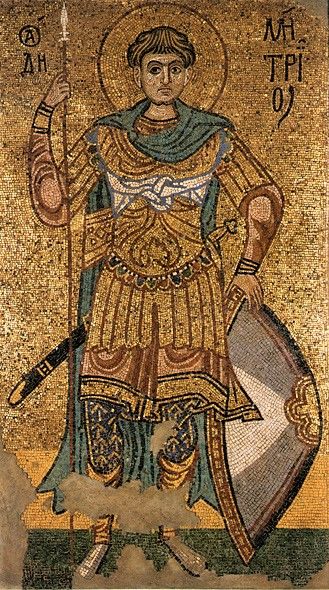
Image: Demetrius of Thessalonica (St Michael's, Kyiv).jpg · Unknown · Public domain, via Wikimedia Commons
Image: Unknown, Wikimedia Commons (Public domain)
Retold in plain modern English from Baring-Gould’s public-domain text, sentence by sentence, keeping the same facts and order. Short explanations in parentheses are ours.
From Sabine Baring-Gould, The Lives of the Saints, new edition in 16 vols. (London: John C. Nimmo, 1897–98); text from the Internet Archive scan (OCR, lightly cleaned; errors possible). Public domain in the United States. Reproduced unedited, except for short bracketed notes in grey that we added to explain names and terms (“S.” is the old abbreviation for Saint). Some history and judgments reflect 19th-century scholarship.
