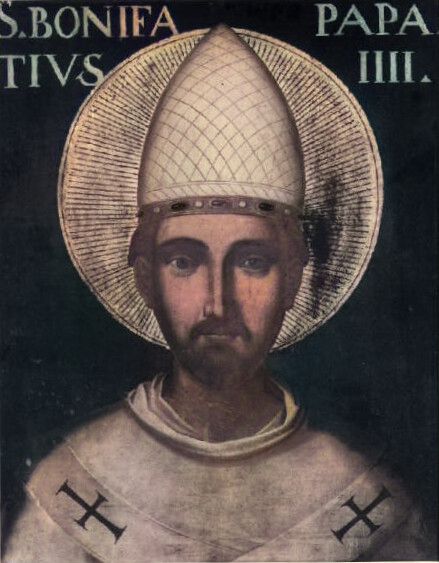
St. Boniface IV., Pope

Boniface IV was a Marsian from Valeria, the son of a physician named John. Boniface IV., a Marsian, of the city of Valeria, the son of a physician, is celebrated for the conversion of the Pantheon into a Christian Church.

Read the essentials →
Feast May 8 · —

St. Boniface IV., Pope

Current feast

May 8
Secondary source · Wikipedia infobox

Traditional feast

May 25
1914 / pre-1969 calendar, per Baring-Gould (1897)

Represents

Feast

Feast days

Feast: May 8
Traditional: May 25

This Saint’s Story

Under Gregory the Great he served as a Roman deacon and as the chief official administering the papal estates. He succeeded Boniface III after a vacancy of more than nine months. The Catholic Encyclopedia gives alternative chronologies: consecration on 25 August or 15 September 608, and death on 8 or 25 May 615.

His best-known work was the conversion of the Pantheon into a Christian church, with permission from the Emperor Phocas. The ancient temple was dedicated to the Virgin Mary and all the martyrs, becoming Santa Maria Rotunda. Baring-Gould dates the dedication to 15 September 608; the Encyclopedia instead gives 13 May, probably in 609. It calls this the first transformation of a pagan temple into a Christian place of worship at Rome. Tradition holds that twenty-eight cartloads of martyrs' bones were brought from the catacombs and placed beneath the high altar.

Mellitus, the first bishop of London, visited Rome during this pontificate to consult about the newly established English Church. He attended a council concerned with the life and peace of monks and carried its decree and papal letters back to England. Baring-Gould also records his visit. The Encyclopedia cautions that the surviving council decrees are spurious; scholars disagreed about the authenticity of the letter addressed to King Ethelbert.

Between 612 and 615 Columban, then at Bobbio, wrote sharply to Boniface about the condemnation of the Three Chapters (writings of three 5th-century theologians condemned by Emperor Justinian), a theological controversy inherited from the previous century. The Encyclopedia warns against treating this letter as a declaration of independence from papal authority. Meanwhile Rome endured famine, pestilence, and floods. Boniface had made his own house a monastery, a detail preserved by both accounts, and died in monastic retirement. He was buried in the portico of St Peter's. The Roman Martyrology (the Church's official list of saints for each day) commemorates him on 25 May.
What he represents

How he teaches us to live

Drawn from themes in the original account

Build up the community you belong to. Community life is part of this story.

Celebrate this saint’s feast day. Remember him on May 8 with a short prayer, and ask for his help.

From the Catholic Encyclopedia

1913 · 645 words

Son of John, a physician, a Marsian from the province and town of Valeria; he succeeded Boniface III after a vacancy of over nine months; consecrated 25 August, 608; d. 8 May, 615 (Duchesne); or, 15 September, 608-25 May, 615 (Jaffé). In the time of Pope St. Gregory the Great he was a deacon of the Roman Church and held the position of dispensator, i.e., the first official in connexion with the administration of the patrimonies. Boniface obtained leave from the Emperor Phocas to convert the Pantheon into a Christian Church, and on 13 May, 609 (?) the temple erected by Agrippa to Jupiter the Avenger, to Venus, and to Mars was consecrated by the pope to the Virgin Mary and all the Martyrs. (Hence the title S. Maria Rotunda.) It was the first instance at Rome of the transformation of a pagan temple into a place of Christian worship. Twenty-eight cartloads of sacred bones were said to have been removed from the Catacombs and placed in a porphyry basin beneath the high altar. During the pontificate of Boniface, Mellitus, the first Bishop of London, went to Rome "to consult the pope on important matters relative to the newly established English Church" (Bede [English monk and historian (d. 735)], H. E., II, iv). Whilst in Rome he assisted at a council then being held concerning certain questions on "the life and monastic peace of monks", and, on his departure, took with him to England the decree of the council together with letters from the pope to Lawrence, Archbishop of Canterbury, and to all the clergy, to King Ethelbert, and to all the English people "concerning what was to be observed by the Church of England". The decrees of the council now extant are spurious. The letter to Ethelbert (in William of Malmesbury, De Gest. Pont., I, 1464, ed Migne) is considered spurious by Hefele (Conciliengeschichte, III, 66), questionable by Haddan and Stubbs (Councils, III, 65), and genuine by Jaffé [Regest. RR. PP., 1988 (1548)].

Between 612-615, St. Columban, then living at Bobbio in Italy, was persuaded by Agilulf, King of the Lombards [a Germanic people who ruled much of Italy from 568 to 774], to address a letter on the condemnation of the "Three Chapters" to Boniface IV, which is remarkable at once for its expressions of exaggerated deference and its tone of excessive sharpness. In it he tells the pope that he is charged with heresy (for accepting the Fifth Council, i.e. Constantinople, 553), and exhorts him to summon a council and prove his orthodoxy. But the letter of the impetuous Celt, who failed to grasp the import of the theological problem involved in the "Three Chapters", seems not to have disturbed in the least his relation with the Holy See, and it would be wrong to suppose that Columban regarded himself as independent of the pope's authority. During the pontificate of Boniface there was much distress in Rome owing to famine, pestilence, and inundations. The pontiff died in monastic retirement (he had converted his own house into a monastery) and was buried in the portico of St. Peter's. His remains were three times removed-in the tenth or eleventh century, at the close of the thirteenth under Boniface VIII, and to the new St. Peter's on 21 October, 1603. For the earlier inscription on his tomb see Duchesne; for the later, Groisar, "Analecta Romana", I, 193. Boniface IV is commemorated as a saint in the Roman Martyrology on 25 May.

Liber Pontificalis (ed. DUCHESNE), I, 317; JAFFÉ, Regesta RR. PP. (2nd ed.), I, 220; Acta et Epistolæ in MANSI, X, 501; PAUL THE DEACON, Hist. Longobard., IV, 36 (37); GASQUET, A Short History of the Catholic Church in England (London, 1903), 19; HUNT, A History of the English Church from its Formation to the Norman Conquest (London, 1901), 42; MANN, Lives of the Popes, I, 268-279; VON REUMONT, Gesch. der Stadt Rom (Berlin, 1867), II, 156, 165; GREGOROVIUS, II, 104; LANGEN, 501.

Read more

The full original · 144 words

Read Baring-Gould’s full account

Baring-Gould’s sources: Roman Martyrology. Authority: — Anastasius Bibliothecarius.

Boniface IV., a Marsian, of the city of Valeria, the son of a physician, is celebrated for the conversion of the Pantheon into a Christian Church. With the sanction of the Emperor Phocas, this famous temple, in which were assembled all the gods of the Roman world, was purified and dedicated on Sept. 15th, 608, to the Blessed Virgin Mary and all the martyrs. He also turned his own house into a monastery. Having convoked a council of all the bishops of Italy, measures were taken for the restoration of ancient discipline, which had fallen into abeyance.

Mellitus, Bishop of London, who was then in Rome, about the affairs of the English Church, is said to have been present at this council, and to have carried back its decrees, together with the letters of Boniface, to England. Nothing further is known of the pontiff.

More about St. Boniface IV., Pope

Checked against at least two sources, in our own words

Help us add to this saint's story

Everything is read by a person before anything appears. Facts are checked against trusted sources first.

Facts are welcome; a source link helps (optional).With your permission we may share it on this page.

Nine days · Free

Pray the novena
with us.

One short email a day for nine days. The day's prayer, a line from St. Boniface IV.'s story, and a nudge to keep going.

Also on May 25
St. Urban I., Pope

St. Urban I.

May 25 · Martyr
M

Sts. Maximus and…

May 25 · Martyrs
I

Sts. Injuriosus and…

May 25 · Feast
← All 1970 saints in the library
Sources & notes

Feast-day sources

Story sources

Sources

Credits

Image: Papa Bonifacio IV.png · Giuseppe Franco · Public domain, via Wikimedia Commons

Image: Giuseppe Franco, Wikimedia Commons (Public domain)

From “Catholic Encyclopedia (1913)/Pope St. Boniface IV,” The Catholic Encyclopedia (New York: Robert Appleton Company, 1907–1914), via Wikisource. Public domain. Matched by name and feast date; text unedited except for our bracketed notes in grey.

From Sabine Baring-Gould, The Lives of the Saints, new edition in 16 vols. (London: John C. Nimmo, 1897–98); text from the Internet Archive scan (OCR, lightly cleaned; errors possible). Public domain in the United States. Reproduced unedited, except for short bracketed notes in grey that we added to explain names and terms (“S.” is the old abbreviation for Saint). Some history and judgments reflect 19th-century scholarship.

Notes

Story retold in our own words from the cited sources.