St. Blane of Bute

Blane (or Blaan), bishop and confessor in Scotland, was born on the island of Bute; the date of his birth is unknown.

Read the essentials →
Feast August 11 · Bishop

St. Blane of Bute

Current feast

August 11
Secondary source · Wikipedia infobox

Traditional feast

August 10
1914 / pre-1969 calendar, per Baring-Gould (1897)

Represents

Bishop

Feast days

Feast: August 11
Traditional: August 10

This Saint’s Story

He was a nephew of St Cathan and, according to the Catholic Encyclopedia, was educated in Ireland under Sts Comgall and Kenneth. He became a monk, returned to Scotland, and eventually was bishop among the Picts (the ancient people of northern Scotland). The Encyclopedia keeps his feast on 10 August and places his death in 590.

The Aberdeen Breviary (the book of the Church's daily prayer) relates several miracles of him, among them the restoration of a dead boy to life. The Bollandists (Jesuit scholars who since the 1600s have critically studied the lives of the saints) reject those details. Tradition also preserves other Breviary and local tales—among them a voyage home without oars and a light struck from his fingers—but the Encyclopedia rests the firm outline on his Irish training, his episcopal work among the Picts, and the early Scottish cult. Devotion to Blane was popular in Scotland from early times. His monastery became the site of the Cathedral of Dunblane; a church of St Blane stood in Dumfries and another at Kilblane; and the bell of his monastery is still kept at Dunblane.

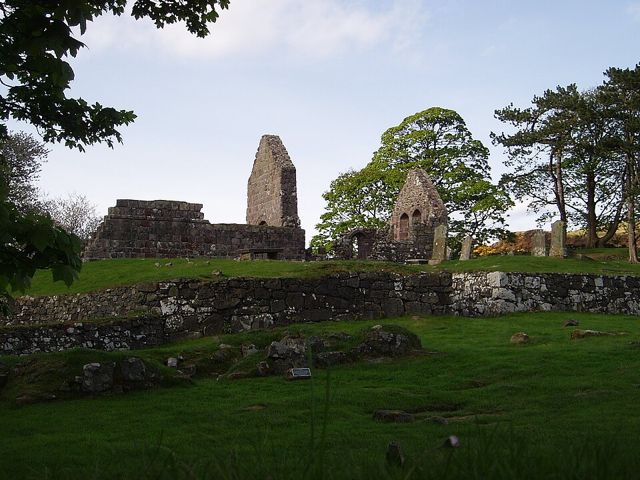
Years given for his death vary widely. Butler's Lives put it at 446, which the Encyclopedia calls evidently incorrect. The date 1000, found in Adam King's Kalendar of Scottish Saints, in Dempster's Menologium Scotorum, and in the Acta Sanctorum, seems to have crept in by confusing St Kenneth, whose disciple Blane was, with a Kenneth who was King of Scotland about the year 1000. The highest authorities, the Encyclopedia says, place the saint's death in 590. He was buried at Kingarth on Bute, where the ruins of his church still stand and remain an object of antiquarian interest. This page keeps the memorial on 10 August.
What he represents

How he teaches us to live

Drawn from themes in the original account

Celebrate this saint’s feast day. Remember him on August 11 with a short prayer, and ask for his help.

From the Catholic Encyclopedia

1913 · 263 words

Bishop and Confessor in Scotland, b. on the island of Bute, date unknown; d. 590. His feast is kept on 10 August. He was a nephew of St. Cathan, and was educated in Ireland under Sts. Comgall and Kenneth; he became a monk, went to Scotland, and eventually was bishop among the Picts. Several miracles are related of him, among them the restoration of a dead boy to life. The Aberdeen Breviary gives these and other details of the saint's life, which are rejected however, by the Bollandists [Jesuit scholars who since the 1600s have critically studied the lives of the saints]. There can be no doubt that devotion to St. Blane was, from early times, popular in Scotland. His monastery became the site of the Cathedral of Dunblane. There was a church of St. Blane in Dumfries and another at Kilblane. The year of the saint's death is variously given as 446, 590, and 1000; 446 (Butler, Lives of the Saints) is evidently incorrect; the date 1000, found in Adam King, "Kalendar of Scottish Saints" (Paris, 1588), in Dempster, "Menologium Scotorum" (Bonn, 1622), and in the "Acta SS.", seems to have crept in by confusing St. Kenneth, whose disciple Blane was, with a Kenneth who was King of Scotland about A.D. 1000. The highest authorities say the saint died 590. The ruins of his church at Kingarth, Bute, where his remains were buried, are still standing and form an object of great interest to antiquarians; the bell of his monastery is preserved at Dunblane.

FORBES, Kalendars of Scottish Saints (Edinburgh, 1872); BARRETT, A Calendar of Scottish Saints (Fort Augustus, 1904); Acta SS., 10 August, XXXVI, 560.

Read more

The full original · 147 words

Read Baring-Gould’s full account

Baring-Gould’s sources: Scottish and Irish Martyrologies. Authority: — The Lessons in the Aberdeen Breviary.

S. Blaan, or Blane, of Bute, was the son of Ertha, sister of S. Cathan. He was, during seven years in Ireland, instructed by S. Comgall and S. Kenneth. He returned with his mother, in a boat without oars, to the island of his nativity, where he was heartily received by S. Cathan, and devoted to the service of God. His light having gone out one night, he is said to have struck fire out of his finger-ends, as when flint is struck with steel. He was raised to the episcopate, and then went to Rome, and after receiving the Pope’s blessing, returned on foot through Anglia.

In a northern city he performed an extraordinary miracle on a wicked boy, blind of one eye, who was just dead. He raised him to life, then restored sight to his blind eye, and finally cleansed him of his sins.

Help us add to this saint's story

Everything is read by a person before anything appears. Facts are checked against trusted sources first.

Facts are welcome; a source link helps (optional).With your permission we may share it on this page.

Nine days · Free

Pray the novena
with us.

One short email a day for nine days. The day's prayer, a line from St. Blane of Bute's story, and a nudge to keep going.

Also on August 10
St. Laurence

St. Laurence

August 10 · Deacon, Martyr
M

St. Malchus of Lismore

August 10 · Bishop
← All 1970 saints in the library
Sources & notes

Feast-day sources

Story sources

Sources

Credits

Image: St Blane's Church - full view.JPG · Akerbeltz · CC BY-SA 3.0, via Wikimedia Commons

Image: Akerbeltz, Wikimedia Commons (CC BY-SA 3.0)

From “Catholic Encyclopedia (1913)/St. Blane,” The Catholic Encyclopedia (New York: Robert Appleton Company, 1907–1914), via Wikisource. Public domain. Matched by name and feast date; text unedited except for our bracketed notes in grey.

From Sabine Baring-Gould, The Lives of the Saints, new edition in 16 vols. (London: John C. Nimmo, 1897–98); text from the Internet Archive scan (OCR, lightly cleaned; errors possible). Public domain in the United States. Reproduced unedited, except for short bracketed notes in grey that we added to explain names and terms (“S.” is the old abbreviation for Saint). Some history and judgments reflect 19th-century scholarship.

Notes

Story retold in our own words from the cited sources.