St. Bernward of Hildesheim

Bernward, thirteenth Bishop of Hildesheim, was born about the middle of the tenth century of a noble Saxon family; his grandfather was Athelbero, Count Palatine of Saxony. This Bernward was son of Dietrich, count of Sommerschenburg by the daughter of Adalbero, Count Palatine.

Read the essentials →
Feast November 20 · Bishop

St. Bernward of Hildesheim

Current feast

November 20
Secondary source · Wikipedia infobox

Traditional feast

November 20
1914 / pre-1969 calendar, per Baring-Gould (1897)

Represents

Bishop

Feast days

Feast: November 20

This Saint’s Story

Orphaned early, he was placed under his uncle Volkmar, Bishop of Utrecht, who entrusted him to Thangmar, director of the cathedral school. Under that master he advanced in piety and in the sciences, and became proficient in mathematics, painting, architecture, and especially in making ecclesiastical vessels and ornaments of silver and gold. He finished his studies at Mainz and was ordained priest by Archbishop Willigis. Preferring to comfort his aged grandfather rather than accept a rich preferment in Utrecht, he stayed with Athelbero until the latter’s death in 987, then became chaplain at the imperial court. The Empress-Regent Theophano soon appointed him tutor to her son Otto III, then six years old; the Catholic Encyclopedia notes that the youthful emperor’s learning and religion owed no small debt to that instructor.

Bernward remained at court until 993, when he was elected Bishop of Hildesheim. His nearly thirty-year episcopate left a deep mark on the diocese. Thangmar, later his biographer, describes how after cathedral duties the bishop would visit the workshops of the cathedral school and with his own hands fashion gold and silver vessels for the altars. Under his direction rose churches, other buildings, and even fortifications against Norman raids. Works still associated with his skill at Hildesheim include the Bernward Cross, the Bernward column with reliefs of the life of Christ, the cathedral’s bronze doors with Scriptural scenes, and candlesticks symbolic of Christ as the light of the world. St. Michael’s abbey-church at Hildesheim, one of the great German basilicas, is also cited as a monument of his zeal and craft, later become a Protestant church. His arts, the Catholic Encyclopedia says, were wholly employed in the service of the Church.

A man of extraordinary piety, given to prayer and mortification, he had himself invested with the Benedictine (monks following the Rule of St. Benedict) habit shortly before his death on 20 November 1022. Pope Celestine III canonized (officially declared a saint by the pope) him in 1193. His feast is 20 November.

What he represents

How he teaches us to live

Drawn from themes in the original account

Build up the community you belong to. Community life is part of this story.

Feed your mind with Scripture and good books. Learning and the Scriptures matter in this life.

Make time for silence. Time alone in prayer is part of this story.

The full story

Baring-Gould’s account retold in modern English

Read the full story · 5,458 words · about 24 min

But in 993, Bernward became the bishop of Hildesheim, and at that time, S. Willigis was the archbishop of Mainz. The abbey of Gandersheim became a source of conflict between them for several years, causing scandal, expense, and riots; and, as usual, a woman was at the center of the trouble. This woman was Sophia, the daughter of Otho II, who had decided to take the veil in the abbey of Gandersheim, intending to eventually become its abbess. Osdag was the bishop of Hildesheim at that time — a venerable prelate, very old and very holy, but still just a bishop. The Princess Sophia, as she was about to renounce the world, wanted to do so in a royal manner and receive the veil from no ecclesiastic lower than an archbishop. She informed Willigis of Mainz, the primate of all Germany, that she wanted him to perform the ceremony. Willigis readily agreed to her request, ignoring the fact that he was intruding into the diocese of another. He might have claimed that Pope Agapetus II had issued a bull exempting the abbey of Gandersheim from episcopal jurisdiction, making it dependent only on the Holy See. However, the abbesses had never acted on this bull; they had always asked the bishops of Hildesheim to perform all the ecclesiastical functions they needed.

The Princess Sophia was to renounce the world and all its pomp and vanities on the feast of S. Luke. Before that day, Bishop Osdag visited the archbishop of Mainz and privately asked him by what authority he planned to invade the diocese of Hildesheim. To avoid a scene and a scandal, the old bishop made this inquiry in private. Willigis, who seemed to be unaware of the bull of Agapetus, arrogantly replied that he considered Gandersheim to be within the boundaries of his own diocese. He stated that on the appointed day, he would be there and, in defiance of Bishop Osdag, would veil the princess and those who were about to renounce the world with her, exercising the full extent of his archiepiscopal authority in Gandersheim.

When the feast day of Saint Luke arrived, Emperor Otho III was present with his mother, Empress Theophania. The bishops of Paderborn, Minden, and Worms were also there, and both Osdag and Willigis appeared on the scene. A loud and angry argument broke out in the church over who had rights there. Suddenly, Osdag ordered his servants to place his throne in the middle of the apse. He seated himself on it and declared to everyone that he had taken his rightful position in the church and that he would defend it. Willigis was furious, and violence might have erupted if the empress had not intervened with the other bishops to reach a reluctant compromise. Willigis was to say Mass at the altar; both were to hold the veil and together cover Sophia with it; but Osdag was to perform the rest of the ceremony. Willigis also had his throne brought into the apse, and “that day,” says Thankmar, “the unusual thing was done, never before seen by us, of two bishops sitting together at the side of the altar, both vested in their full pontificals.”

When it came time for the veiling of the nuns during the Mass, Bishop Osdag stood up and turned to the emperor. He asked if the emperor consented to his sister's renunciation of the world. Then he asked everyone else involved, and after receiving affirmative responses, he asked Princess Sophia and the other candidates whether they would take the oath of obedience to the see of Hildesheim, to him and to his successors. After they took the required oath, he publicly announced to the clergy and the people that Archbishop Saint Bernward had neither right nor jurisdiction within those walls and that he could not minister there without authorization from the bishop of Hildesheim. So matters concluded and remained until the quarrel broke out again, when Bernward, whom we have already mentioned, was bishop of Hildesheim. This Bernward was the son of Dietrich, count of Sommerschenburg, and the daughter of Adalbero, Count Palatine. His mother's brother was Folkmar, who later became bishop of Maestricht. He was educated by Thankmar, the master of the school at Hildesheim, who outlived him and became his biographer.

Bernward was a man who loved art. He painted and also worked with metal, showing greater skill than many blacksmiths who dedicate their lives to this craft. Several examples of Bernward’s work still exist today. He personally cast the bronze gates, which are sixteen feet high, for his cathedral in 1015. These gates are unmatched as examples of early metalwork. The bas-reliefs on them, which he designed and created, depict the First and Second Adam. In the cathedral square, there still stands his bronze pillar, fourteen feet high, which features twenty-eight representations of the events of our Lord’s Life and Passion, winding around it like a scroll from the base upwards, similar to those on Trajan’s column. This pillar dates back to 1022.

In the treasury of St. Michael’s, there is a crucifix that is twenty inches high, covered with gold plates, set with precious stones, and decorated with filigree, all made by the bishop. The same treasury also holds two silver crosses, one of silver gilt, and two candlesticks made of a mixed metal. There is also a gold chalice adorned with jewels. The bishop obtained permission from the king and his mother to celebrate Mass there on the feast day of St. Luke the Evangelist, and to conduct the unveiling of the aforementioned Sophia, while he would provide for the other veiled virgins as was his right.

The candlesticks bear the inscription: "Bernward, the bishop, made this candlestick for his son, not for gold but for the work of Bernward." He is known to have created other objects that were lost during the Thirty Years' War when Hildesheim was occupied by the Swedes. Additionally, he was diligent in providing copies of the Gospels. At Hildesheim, a beautifully written and illuminated book of the Four Gospels, created for Bishop Bernward, is still preserved and dates to 1011. It bears the inscription, “I, Bernward, had this codex written out at my own cost and gave it to the beloved saint of God, Michael. Anathema to anyone who alienates it.” This inscription is written in his own hand. Another book of the Gospels includes a portrait of him in pontifical vestments, but without a mitre, kneeling before an altar.

He built and funded monasteries and churches, and strengthened the town with strong towers. He was a good man, chaste, pious, and self-disciplined, and is regarded as a saint. Willigis, the archbishop of Mainz, was born in Schoningen, near Helmstadt, and was the son of a wheelwright. His talents led to his advancement. He became a canon of Hildesheim and was appointed chaplain to Emperor Otto II. He was fortunate to be elevated to the primatial see of Mainz by the emperor in 975, and Benedict VII sent him the pallium (a vestment worn by bishops).

The story goes that when he arrived in Mainz and proceeded in a procession to the minster (cathedral) to be installed, he noticed that the proud townspeople, impatient at the thought of being ruled by someone who had risen from humble beginnings, had chalked cartwheels on every fence and blank wall. Children mockingly spun along the street on their hands and toes, mimicking the motion of a wheel. Upon reaching the cathedral, Willigis saw a blank shield hanging over the throne. He asked what it was for and was told that the arms of the reigning archbishop were always displayed there. “Go,” said Willigis to a servant, “fetch me a painter, and tell him to decorate the shield with a white cartwheel, and inscribe underneath it as my motto, ‘Willigis, remember whence thou art sprung!’”

It is certain that the city of Mainz, after Willigis's death, adopted this shield as its arms out of gratitude for the many benefits it had received through him. His white cartwheel on a red field remains the coat of arms of Mainz to this day.

However humble Willigis may have been on the first day of his elevation, his humility quickly vanished when he felt his power as a prince of the empire, primate of Germany, and lord with the authority of life and death, making war and concluding peace over a vast territory.

The proverb, “Set a beggar on horseback, and he will ride to the devil,” seemed to be exemplified in the case of Willigis.

Otho II had entrusted him with the education of his son. When his pupil ascended to the throne as Otho III, Willigis took control of the government during the young prince's minority, from 983 to 989. Relying on his influence with the emperor and feeling jealous of Bernward, who was favored by Otho III, Willigis decided to reassert his claim to the abbey of Gandersheim. By doing so, he aimed to extend his authority while also insulting and humiliating his young rival.

Sophia soon provided him with an opportunity. According to Thankmar, under the elderly abbess Gerburg II, the discipline of the convent had significantly weakened. A group of young nuns, raised in luxury, as Thankmar describes, and not restrained by a superior who was too old to fulfill her duties, were likely to act on their own whims. Thankmar notes, “This anger and indignation of the archbishop against the venerable prelate was primarily caused by the special familiarity of the Lord Emperor, who favored him with a particular devotion of piety... because of this, he stirred up the animosity and envy of many against him, especially that of the Bishop of Mainz, who was indignant that someone besides himself had a place of familiarity with the emperor.”

Sophia defied the abbess and, despite her protests, left the convent for the more appealing palace. She spent one to two years there, engaging in intrigues with Willigis's faction and living in a way that led to scandalous rumors. When these stories reached Bishop Bernward, he confronted her and urged her to return to the peaceful life she had vowed in her cell at Gandersheim. At first, Sophia listened impatiently, but then she refused to listen at all. She forbade the bishop from seeing her and rushed to the archbishop to vent her anger and malicious accusations against the Bishop of Hildesheim, who had dared to reprimand a princess of royal blood.

“I renounce all allegiance to Bernward,” the furious woman declared. “You, archbishop, have veiled me; neither I nor the convent of Gandersheim belong to the diocese of Hildesheim. If you ask for proof, I can provide it. There are many at Gandersheim who will attest to this.”

Then Sophia returned to her abbey and did everything she could to incite the nuns to rebel against the bishop. Upon hearing that this was happening, Bernward felt it was his duty to visit the abbey. He was met with deliberate rudeness, even insults.

Now it happened that the church, which had been greatly enlarged and beautified, needed to be consecrated. Gerburg, being too old to manage affairs, had Sophia take charge of the arrangements for the consecration. Without consulting the bishop, she sent a message to Archbishop Willigis, requesting him to dedicate the church. He was very pleased to have the opportunity to reaffirm his authority, and he set the day of the Exaltation of the Cross, in the year 1000, for the ceremony. The abbess sent a messenger to Bishop Bernward, inviting him to the dedication and informing him of the date.

However, shortly after, Willigis postponed the ceremony for a week, until Saint Matthew’s Day, probably because he knew that Bernward could not attend that week; he would be engaged, according to his turn at court, in other duties. On the originally scheduled day, the bishop of Hildesheim arrived at the abbey and found nothing prepared, except for some retainers of the abbess, who were ready to resist him by force should he attempt to consecrate the church. The bishop entered the sacred building and said Mass before a large congregation, as the people from the neighborhood flocked in when they heard that their bishop was there. The nuns stood in their stalls, sullen and contemptuous.

It was customary at that time on solemn days for the people to make offerings of bread (oblationes); these were blessed by the priest or bishop and then distributed among the congregation. When blessed, they were called Eulogise, and were given to those present and sent to those absent as tokens of love and intercommunion. This rite still exists in some French churches. The blessing and distribution of the blessed bread is a unique feature of the ritual in the diocese of Paris.

This blessed bread is, of course, quite distinct from the Host. It is, like the Greek antidoron, a remnant of the ancient agape, or love feast, that followed the celebration of the Eucharist.

When the deacons and subdeacons went to the nuns of Gandersheim for their offerings, they refused to give anything. When the bread presented by the people had been blessed and some of it was offered to them, they threw the pieces away, loudly cursing the bishop. Bernward, ashamed of the noise and indecency of the nuns, burst into tears, and “charitably attributing this conduct to the ignorance, rather than the malevolence, of these furious women,” he finished the Mass with a broken voice, blessed the congregation, and departed.

In the meantime, Sophia was living with Archbishop Willigis on very friendly terms, and she was using all her skills day and night to incite him against Bishop Bernward. Since the bishop could not attend at Gandersheim on Saint Matthew's day, he commissioned Eckhardt, the bishop of Schleswig, who had been driven from his see by the invasions of the Slavonians, to represent him and to protest to the archbishop.

On the eve of Saint Matthew's day, Willigis arrived at Gandersheim with the bishops of Paderborn and Verden, Duke Bernard of Saxony, and a large group of followers. The next morning at dawn, Bishop Eckhardt and a group from Hildesheim, consisting of clerks and monks, appeared. After greeting the archbishop and the duke, they announced that the bishop of the diocese was detained at court and could not attend. However, he expressed his surprise that the archbishop would invade his diocese and attempt to consecrate a church outside the limits of his proper jurisdiction, and in all brotherly charity, he requested that the archbishop refrain from doing so. The archbishop became furious and vowed that he would certainly perform the consecration the following day, which was a Sunday.

But when that day arrived and the archbishop appeared in the church, Bishop Eckhardt and the clergy of Hildesheim put up such strong opposition that the matter was referred to a synod to be held on Saint Andrew’s day. Willigis ordered the bull of Pope Agapetus II. to be read aloud to all the people.

Thankmar disingenuously concealed the fact, saying that he caused some previously unheard-of privileges granted to the convent to be rehearsed.

The bishops of Verden and Paderborn, who were unaware before that Willigis was acting against the bishop, took Eckhardt aside and urged him that Bernward should appeal to the emperor and the Pope. They argued that otherwise, in the absence of Otho III. in Italy, there was no one to oppose the archbishop and prevent him from carrying things through with a heavy hand, establishing a precedent that would be difficult to overturn later. Bernward took the hint and set off for Rome as soon as possible.

He hurried south over the Brenner Pass, down the valley of the Adige past Trent, and arrived in Rome on January 4, 1001, having left Hildesheim on November 5. Considering that it was winter and the mountain passes were deep in snow, he certainly accomplished his journey with great speed.

When the emperor heard that Bernward was approaching Rome, he went out to meet him, kissed him, and invited him to stay as his guest in the palace. Silvester II, the learned Gerbert, was the Pope at that time. Otho had appointed his relative and chaplain Bruno to the throne of Saint Peter, under the title of Gregory V. He had been driven from Rome by the unruly citizens acting under the consul Crescentius. Gregory was restored by the emperor's forces, and the anti-Pope John XVI, who had been set up by Crescentius, was mutilated and insulted by his rival, while Crescentius was executed by the emperor.

Gregory V died, reportedly from poison, and Otho III appointed the learned Gerbert to replace him. Rome erupted into revolt but was once again subdued by the young emperor. Bishop Bernward arrived when Otho was master of Rome, and Silvester II was reluctantly acknowledged as Pope by the sullen Romans.

The day after Bernward arrived, the Pope summoned him to his presence and listened to his story. The disturbances at Gandersheim had already reached the Pope's ears, so Bernward found him prepared for what he had to say and eager to address the scandal. Meanwhile, the synod called by the archbishop of Mainz for Saint Andrew's Day had convened at Gandersheim. The archbishop had brought with him the bishop of Paderborn, several Hessian and Thuringian clergy, and some from the part of Saxony that belonged to his archdiocese. Eckhardt of Schleswig appeared on behalf of the absent bishop of Hildesheim and read a formal prohibition to the archbishop, instructing him not to interfere with the duties of another prelate who was absent, and he appealed to the emperor and the Pope.

When the archbishop heard this, his face darkened with rage, and he angrily commanded Eckhardt to be silent and to tend to his own flock in the wilderness.

"My diocese," replied Eckhardt, "is devastated by the invasions of barbarians, my city is deserted, and my church is in ruins. I no longer have a see and have become the servant of the church of Hildesheim."

The archbishop then called witnesses to swear that Gandersheim was part of the diocese of Mainz. However, the bishops present intervened, knowing that Bemward was with the emperor and the Pope. They argued that it was unlawful to accept such oaths in his absence. Eckhardt raised his voice again and renewed his protest. Willigis roughly ordered him to be silent, threatening to have his servants remove him from the church. This caused a commotion. Eckhardt and all the clergy from Hildesheim who were present stood up, stating that they refused to acknowledge the synod, and withdrew, leaving only Archbishop Willigis and his supporters in the church. Witnesses were called to testify about the boundaries, but no agreement was reached. Some swore that the river Innerste, which flows near Lauterbach, marked the limit of the diocese of Hildesheim, while others claimed it was bounded by the Oder, which joins the Leinne at Nordheim. The archbishop summarized the situation in his favor and declared that the monastery belonged to the archdiocese of Mainz. He threatened excommunication to anyone who rejected his authority or interfered with it in the area of Gandersheim. A report of what had occurred at the synod was immediately sent to Bishop Bernward. At this time, Henry, duke of Bavaria, who would later become emperor, was with Otho in Rome. He was a devout man and was deeply troubled by the scandal this unfortunate conflict was causing. He joined Bernward in urging the Pope to put an end to it. Following his advice, Silvester summoned a synod of twenty Roman prelates, along with some from Tuscany. Bishops Siegfried of Augsburg, Henry of Wurzburg, and Hugh of Zeitz were also present at the assembly with the emperor.

The assembly took place in the church of Saint Sebastian. After the Gospel was read and a blessing was given, Bernward stood up from his seat and stepped forward to briefly present his case before the Pope, the emperor, the duke of Bavaria, and all the bishops present. The Pope then asked the council for their judgment. The bishops requested permission to retire and consult privately. Permission was granted, and upon their return, Silvester again asked for their decision. They responded that no bishop had the right to enter another diocese to hold a synod or perform any services there without the consent of the bishop of that diocese. They also stated that the gathering held by Willigis at Gandersheim could not be considered a synod.

“Then what do you call it?” asked the Pope. The council replied, “We call it a schism conciliating discords.”

Silvester asked, “Are its decisions, then, to be rejected?” The council answered, “By the authority of the canons and of the holy fathers, they are to be annulled.” Then Silvester announced, “By my Apostolic power and the authority of the assembled holy fathers, we dissolve, break, and annul all that has been decided and established by Archbishop Willigis and his confederates at Gandersheim, in the absence of his brother bishop Bernward.” He added, “Our brother, Bishop Bernward, asks that the investiture from which he has been deprived by the archbishop may be restored and confirmed to him. What do you say to that, my brethren?”

The council replied, “There is no necessity for restoring an investiture from which the archbishop was incompetent to deprive him. But because he requests this, if it pleases the emperor, let the staff of your Apostolic Holiness restore and confirm it to him.”

The Pope replied, “Let it be done according to your wishes.” And he placed his staff in the hand of the bishop, saying, “We restore and confirm to you the convent of Gandersheim with its adjacent farms and boundaries, and by the apostolic authority of Saints Peter and Paul, I forbid anyone from interfering with you therein, except as the canons permit.”

After this was done, the Pope asked the council what further steps should be taken. The council replied that a synod should be appointed to be held on June 22, at Pohlde, near Herzberg, in Saxony, under the presidency of Frederick, cardinal priest, a Saxon by birth, who should be sent there as a legate from the Holy See to communicate the decision of the council and of the Pope to the bishops of Germany. Bernward did not leave Italy immediately. The revolt of Tibur and later of Rome delayed him. He was unwilling to abandon the emperor during a time of difficulty. But when Tibur was subdued and Rome had submitted, he took his departure, bidding farewell to the young emperor, who was soon to fall victim either to the climate of Rome or to the poison of the vengeful widow of Crescentius. Bernward, laden with relics, crossed the Saint Bernard pass, was hospitably received at Agaunum by Rudolf, the Burgundian king, and arrived at Hildesheim on April 10, 1001, which was Maundy Thursday.

Frederick, the papal legate, arrived in Germany with the grandeur and entourage appropriate for his position, and on the scheduled day for the synod, he appeared at Pohlde. He was received with anything but respect by the archbishop of Mainz, who was aware of the contents of the document he brought from Rome. The legate's entrance into the meeting was met with jeers and groans from the archbishop and his supporters. No proper seat was provided for the legate, so Bernward and the archbishop of Hamburg had to make space for him between them. It was difficult to control the uproar of curses and shouts.

When silence was finally achieved, the legate began by urging everyone present to pursue peace and charity. After displaying his credentials, he presented a letter from the Pope to the archbishop of Mainz. Willigis refused to touch or even look at it. Thankmar, the biographer of Bernward, accompanied the bishop to Italy; his account of the council is vivid, as he was an eyewitness.

The letter contained a reprimand for the archbishop regarding his actions in the matter of Gandersheim. At a signal, the doors of the church were thrown open, and the armed followers of the archbishop rushed in, shouting and threatening Bernward and the legate. The meeting broke up in chaos, and the legate adjourned it to the following day while trying to make himself heard above the noise of weapons. The archbishop left the church, but the legate stubbornly followed him and ordered him to attend the adjourned synod the next day, warning him that failure to do so would result in excommunication. The archbishop contemptuously ignored the summons and left for Mainz with his servants and supporters.

At the appointed hour, the legate took his place in the church, and when he learned that the archbishop had left Pohlde, he prohibited him from carrying out his duties with the following statement: “Because you have withdrawn from the synod and have disobeyed the commands of the Roman Pontiff, by the authority of the holy apostles Peter and Paul, and their vicar, Pope Silvester, know that you are suspended from all priestly functions until the feast of the Nativity, and that you are summoned in person to appear before the Pope.”

The angry legate then hurried back to Rome and reported the treatment he had received to the Pope and the emperor. Both were filled with anger and ordered the German bishops to come to Rome, not only to hold a synod but also, accompanied by their vassals, to help the emperor in controlling the unruly Italians. Shortly after his return, Frederick, the legate, was appointed to the see of Ravenna.

At Hildwardshausen, there was a convent of nuns led by Rotegard, the aunt of Bernward. This nunnery had been given by the emperor to the bishop of Hildesheim, and in the same year, he went there to consecrate the church. However, the archbishop sent his servants ahead of time, and they removed all the preparations made for the ceremony, resisted the bishop, prevented him from entering, and beat his servants. Bernward, unable or unwilling to force his way in, went instead to Gandersheim; but Sophia, hearing of his approach, summoned the vassals of the archbishop to assist her. When Bernward arrived, he found an armed crowd ready to block his passage.

The bishops of North Germany, determined to end this scandalous conflict, called a synod at Frankfort to meet right after the Feast of the Assumption. The archbishops of Cologne and Trier were invited to attend and appeared on the appointed day along with Willigis of Mainz, Rhietar of Paderborn, Robert of Spires, Beringar of Werden, and Eckhardt of Schleswig. Eckhardt, along with Thankmar, the priest and Bernward’s biographer, represented the interests of the bishop of Hildesheim, who was ill.

Willigis, annoyed by Bernward's absence, along with some of his equally hot-headed supporters, angrily demanded that Bernward appear in person. However, Thankmar managed to calm them down by assuring the council that the bishop was genuinely ill and unable to attend. Willigis refused to give up his claims over Gandersheim, and the council adjourned after ruling that neither the archbishop nor the bishop could perform episcopal functions there until after the assembly scheduled for the octave of Pentecost in the following year, at Fritzlar.

As the time approached for Bernward to leave for Rome to attend the council called for Christmas Day, he found himself unable to make the journey due to ongoing illness. He had to send his old schoolmaster, Thankmar, in his place, and we owe the details of the Gandersheim dispute to him. Thankmar met the emperor at Spoleto and stayed with him until December 27, when the council convened in the city of Todi. Only three German bishops attended: those from Augsburg, Liege, and Zeitz, although several others, particularly Heribert of Cologne, had intended to come. Willigis scornfully refused to even send delegates to represent his case. Bernward was represented by Thankmar.

The Pope invited Thankmar to present the case. He threw himself on his knees before the emperor and the Pope and begged them to defend his master's cause, which was the cause of justice and canon law. He recounted the entire story and was followed by Frederick, the bishop of Ravenna, who vividly described the insults and abuses he had suffered at Pohlde. His account stirred murmurs of indignation among the Italian bishops present regarding the audacity, defiance, and insubordination of the archbishop of Mainz, and they called for his immediate excommunication. However, the German bishops urged a delay until archbishop Heribert of Cologne could arrive, and the council was postponed until January 6, 1002. But by that date, no additional bishops had come from Germany, and the meeting was again postponed to the next day. Since they still had not appeared on that day, no final decision was reached.

On January 13, Thankmar returned to his homeland, carrying gifts from the emperor. A few days later, Otho III died, poisoned by Stephania, the widow of Crescentius. She had harbored a desire for revenge and had cunningly ensnared the young emperor, leading him to become a victim first of her beauty and then of her vengeance. She became his mistress to gain the opportunity to poison him. He died at the age of twenty-two.

The death of Otho prevented the meeting of the assembly at Fritzlar. Italian poison, which had removed a barbarian emperor from Rome, quickly also freed it from the presence of a German and virtuous Pope. Silvester II died on May 12, 1003. According to popular belief, the cup was also mixed for him by Stephania. Otho died without children, leading to a dispute over the succession to the throne. Henry of Bavaria claimed the throne as the closest relative and was supported by the clergy because of his piety and generosity towards the Church. The other contenders were Hermann of Swabia and Eckhardt of Meissen. However, Henry’s faction was significantly strengthened by the support of Willigis. Eckhardt, his most dangerous rival, lost his life before he could implement his plans.

Henry was crowned at Aix-la-Chapelle, and Hermann gave up his claims. On August 10, Henry II arrived at Paderborn, where his wife Cunegund was crowned by Willigis. Meanwhile, Gerburg II, the abbess of Gandersheim, had died, and Sophia was elected to replace her. She immediately contacted Willigis, and he installed the new abbess, as Bernward was unable to resist, since she had obtained permission from the emperor to have the ceremony performed by the archbishop.

Henry, who had been troubled by the conflict before becoming emperor, now that he was in power, made every effort to promote reconciliation between Willigis and Bernward. In 1007, the emperor celebrated Christmas at Pohlde, surrounded by his lay and ecclesiastical princes. He took the opportunity to urge Willigis to submit the matter of Gandersheim to his arbitration.

Henry then announced that the consecration of the church at Gandersheim would take place on January 5 of the following year. The veiling of the nuns would occur the next day, on the Feast of the Epiphany. He invited both Willigis and Bernward to be present and hear his decision.

On the appointed day, the emperor arrived, and Bernward was required to say Mass. When Mass was finished, the king went out with the archbishop and bishop and addressed the people. He stated that he recognized the church and the nearby farms as belonging to the bishop of Hildesheim. Willigis, feeling ashamed of his past stubbornness, handed his pastoral staff to Bernward and said, “Beloved brother, I renounce all rights over this church, and I give you this pastoral staff which I hold, as a testimony before Christ, the king, and our brethren, that neither I nor my successors can have any rights here.”

Thus, the unfortunate conflict was resolved by the king, before whose presence, as Thankmar says, all disputes melted away, and enemies became friends. For the rest of his life, Willigis maintained a good relationship with Bernward, likely regretting the impulsiveness and ambition that had caused such discord and brought him considerable reproach.

Willigis died in 1011 and is regarded as a saint. In the lessons for his festival in the diocese of Mainz (February 23), every reference to the Gandersheim affair is carefully excluded. The same is true for a biography of the saint that exists in manuscript form in the Mainz Cathedral library. Bernward has stronger claims to a place in the calendar, which he occupies on October 26. He died in the reputation of holiness around A.D. 1022 and was canonized by Pope Celestine III in 1194.

Footnotes

  1. Otho II, by his wife Theophania, the Byzantine princess, had three daughters: Sophia, abbess of Gandersheim; Adelheid, abbess of Quedlinburg; and Mathilda, who married Ezo, Count Palatine.
  2. "Secundi imperatoris Othonis filia fomes, ut pace omnium dicam, hujusmodi dissentionis dum a suo episcopo, domino videlicet Osdago, sacrum velamen accipere spemit, Willegisum appetit; indignum sestimans, nisi a palligero consecrari, quod ipse annuit.” — Thankmar, c. 21.
  3. Saint Bernward was an archbishop known for his contributions to the church.
  4. Silver with some other metals united with it.
  5. pallium: a vestment worn by bishops.
  6. Thankmar notes, “This anger and indignation of the archbishop against the venerable prelate was primarily caused by the special familiarity of the Lord Emperor, who favored him with a particular devotion of piety... because of this, he stirred up the animosity and envy of many against him, especially that of the Bishop of Mainz, who was indignant that someone besides himself had a place of familiarity with the emperor.”
  7. "Oblatas incredibili furore et indignatione projiciunt, saeva maledicta episcopo ingerunt." — Thankmar.
  8. Thankmar disingenuously conceals the fact, saying that he caused some previously unheard-of privileges granted to the convent to be rehearsed.
  9. Pope John XVI had his eyes put out, his nose and tongue cut off, and in this state, it is said by the command of the hardhearted Pope himself, he was paraded through the streets on an ass with his face to the tail, and with a wine-bladder on his head. An heroic monk of Calabria, S. Nilus, in vain implored that such ignominy might not be offered by one consecrated prelate to another. His voice was not listened to by the Pope, flushed with success.
  10. The river Innerste flows near Lauterbach.
  11. The Oder joins the Leinne at Nordheim.
  12. Saint Sebastian is a Christian martyr and saint.
  13. The revolt of Tibur and later of Rome delayed him.
  14. Bernward, laden with relics, crossed the Saint Bernard pass.
  15. Thankmar, the biographer of Bernward, accompanied the bishop to Italy; his account of the council is graphic, it is that of an eye-witness.
  16. The letter contained a rebuke to the archbishop for his conduct in the matter of Gandersheim.
  17. The archbishop of Trier is a senior church official in Germany.
  18. The Feast of the Assumption celebrates the belief that Mary was taken up into heaven.
  19. Thankmar was Bernward's old schoolmaster.
  20. Otho III was a Holy Roman Emperor.
  21. According to popular belief, the cup was also mixed for him by Stephania.
  22. Willigis died in 1011.
  23. Bernward died around A.D. 1022.

Baring-Gould’s own footnotes, in modern English.

Read the original 1870s text

Baring-Gould’s sources: Roman Martyrology on Oct. 26. Molanus, in his additions to Usuardus, Aut. 1583, on Nov. 20, under the name of Bertuald. Surius on Nov. 20, which was the day of his death. Authority Thankmar, “Vita Bemwardi Hildesheimensis episc.” Thankmar was priest of Bemward, sent by him to Rome in the matter of the contention about Gandersheim. He is partial, no doubt, for he gives only his master’s side of the question. His statements are borne out by the “ Annales Hildesheimensis,” ad ann. 1001, 1002, 1007, in Pertz, Mon. Scr. Germ, t. i. p. 92 sq. Thankmar’s Life of Bernward is in Pertz, t. v. p. 765 — 775, and in the “Acta Sanctorum” for October, t. xi. p. 996—1024.] The abbey of Gandersheim, on the river Gander, a confluent of the Seine, stood on the borders of the ancient diocese of Hildesheim. It had been founded in 856 by Ludolf, duke of Saxony, for his daughter, Hathumod, who, at the age of twelve, was made abbess, under the supervision of Altfrid, bishop of Hildesheim. Bishop Altfrid and Hathumod died the same year, in 874. Altfrid had been a munificent benefactor of the abbey, and his successors in the see continued to feel a lively interest in the abbey, which they regarded as an ornament to the diocese. Bishop Wigbert completed all the buildings except the church; and on the death of Gerburg, the second abbess, instituted her successor. Bishop Otwin invested Gerburg II. with the office of abbess, as his predecessors had done before him; and when nuns desired to be veiled, the ceremony was invariably performed by the bishops of Hildesheim.

But in 993 Bernward became bishop of Hildesheim, and at this time S. Willigis was archbishop of Mainz. GanderS. Bernward' sheim became a bone of contention between them during several years, causing scandal, expense, and riot; and, as usual, a woman was at the bottom of the mischief. This woman was Sophia, daughter of Otho II [German king and emperor, co-ruler with his father Otto I from 967 and sole ruler 973–983].,1 who had set her mind on taking the veil in the abbey of Gandersheim, with the purpose of becoming eventually its abbess. Osdag was at the time bishop of Hildesheim — a venerable prelate, very old and very holy, but only a bishop; and the Princess Sophia, as she was about to renounce the world, chose to do so royally, and receive the veil from no ecclesiastic lower than an archbishop.2 She signified to Willigis of Mainz, primate [the leading bishop of a country] of all Germany, that she chose him to perform the ceremony. Willigis readily assented to the request, regardless of the fact that he was invading the diocese of another. There was this plea he might have alleged to extenuate his conduct, that Pope Agapetus II. had by bull exempted the abbey of Gandersheim from episcopal jurisdiction, and made it dependent on the Holy See alone. But the abbesses had never acted on this bull; they had invariably applied to the bishops of Hildesheim to perform all the ecclesiastical functions that they required.

The Princess Sophia was to renounce the world and all its pomps and vanities on the feast of S. Luke. Bishop Osdag, before the day, visited the archbishop of Mainz, and asked him by what authority he was about to invade the diocese of Hildesheim. To avoid a scene and a scandal, the old bishop made this inquiry in private. AVilligis, who seems to have been ignorant of the bull of Agapetus, insolently replied that he regarded Gandersheim as within the limits of his own 1 Otho II., by his wife Theophania, the Byzantine princess, had three daughters: Sophia, abbess of Gandersheim; Adelheid, abbess of Quedlinburg; and Mathilda, who married Ezo, Count Palatine.

3 ** Secundi imperatoris Othonis filia fomes, ut pace omnium dicam, hujusmodi dissentionis dum a suo episcopo, domino videlicet Osdago, sacrum velamen accipere spemit, Willegisum appetit; indignum sestimans, nisi a palligero consecrari, quod ipse annuit.” — Thankmar, c. 21.

VOL. XIV. diocese, and that on the day appointed he would be on the spot, and, in defiance of Bishop Osdag, would veil the princess and those who were about to renounce the world with her, and exercise in Gandersheim the plenitude of his archiepiscopal authority.

When S. Luke’s day came, and the Emperor Otho III. was present with his mother, the Empress Theophania, the bishops of Paderborn, Minden, and Worms, both Osdag and Willigis appeared on the scene, and a loud and angry altercation ensued in the very church, as to which had rights therein. Suddenly Osdag bade his servants plant his throne in the middle of the apse, and seating himself thereon, he proclaimed to all that he had taken his rightful position in the church, and that he would maintain it. Willigis was furious, and violence would have ensued had not the empress intervened with the other bishops, and effected a compromise reluctantly submitted to. Willigis was to say mass at the altar; both were to hold the veil, and together cover Sophia with it; but Osdag was to perform the rest of the ceremony. Willigis had his throne drawn also into the apse, and “that day,” says Thankmar, “the unusual thing was done, never before seen by us, of two bishops sitting together at the side of the altar, both vested in their full pontificals.”

Now when it came to the veiling of the nuns, in the middle of the mass, Bishop Osdag rose, and turning to the emperor, asked him if he gave his consent to the renunciation of the world by his sister. Then he asked all the rest concerned; and when he had received a reply in the affirmative, he demanded of the Princess Sophia, and after her of the other candidates, whether they would take the oath of obedience to the see of Hildesheim [a bishop’s “see” is his diocese, named from his seat (Latin sedes)], to him and to his successors. When they had taken the required oath, he announced publicly to clergy and people that the archbishop vS. Bernward.

had neither right nor jurisdiction within those walls, and that he could not venture to minister therein unauthorized by the bishop of Hildesheim.1 So matters ended, and rested till the quarrel broke out again, when Bernward, whom we have already mentioned, was bishop of Hildesheim. This Bernward was son of Dietrich, count of Sommerschenburg by the daughter of Adalbero, Count Palatine. His mother’s brother was Folkmar, afterwards bishop of Maestricht. He was educated by Thankmar, master of the school at Hildesheim, who survived him and became his biographer.

Bernward was a man with a love of art. He painted, and also wrought in metal with greater skill than many a smith whose life is spent in his art. Several specimens of Bernward’s work remain. He cast the bronze gates, sixteen feet high, himself, for his cathedral, in 1015. They are unsurpassed as specimens of early metal work. The subject of the basreliefs on them, designed and executed by himself, is the First and Second Adam. In the cathedral square stands at the present day his brazen pillar, fourteen feet high, bearing, in bas-relief, twenty-eight representations of the events of our Lord’s Life and Passion, winding round it like a scroll, from the base upwards, after the manner of those of Trajan [Roman emperor 98–117]’s column. The date of this is 1022. In the treasury of S. Michael’s is a crucifix twenty inches high, covered with gold plates, set with precious stones, and ornamented with filigree, made by the bishop. In the same treasury are two silver crosses and one of silver gilt, and two candlesticks of a mixed metal; 2 also a gold chalice set with jewels, all the obtentu regis ejusque matris licentiam ab eodem episcopo (Osdago) obtinuit (Willigisus) ut ibi (Gandersheimii) in natali S. Lucse Evangelistse missam celebraret archiepiscopus et praedictae Sophiae velationem simul cum eo ageret; de cseteris vero velandis virginibus noster praesul suo jure provideret.” 2 Silver with some other metals united with it. They bear the inscription: ** Bemwardus praesul candelabrum hoc puerum suum primo hujus artes flore non auro non handiwork of Bernward. He is known to have made other objects, which were lost in the Thirty Years' War, when Hildesheim was occupied by the Swedes. He was moreover diligent in providing copies of the Gospels. At Hildesheim is still preserved a book of the Four Gospels, beautifully written and illuminated for Bishop Bernward, and dates ioii. It bears the inscription, “ I Bernward had this codex written out, at my own cost, and gave it to the beloved saint of God, Michael. Anathema to him who alienates it.” This is written with his own hand. Another book of the Gospels contains a portrait of him in pontifical vesture, but without mitre, kneeling before an altar.

He built and endowed monasteries and churches, and fortified the town with strong towers. He was a good man, chaste, pious, and abstemious, and is regarded as a saint. Willigis, archbishop of Mainz, was born at Schoningen, near Helmstadt, and was the son of a wheelwright. His talents procured his advancement. He became canon of Hildesheim, and was appointed chaplain to the Emperor Otho II., and had the good fortune to be raised to the primatial see of Mainz by the emperor in 975, and Benedict VII. sent him the pall. The story goes that when he arrived at Mainz, and proceeded in procession to the minster to be installed, he noticed that the haughty burghers, impatient at the idea of being ruled by a man risen from the ranks, had chalked cartwheels on every hoarding and blank wall, and urchins derisively span along the street on hands and toes, after the fashion of a wheel. On reaching the cathedral, Willigis noticed a blank shield hung over the throne. He asked its purpose, and was told that the arms of the reigning archbishop were always emblazoned thereon. “ Go,” said Willigis to a servant, “ fetch me a painter, and bid him argento et tamen ut cernis conflare jubebat.” They were found buried with him when his body was taken up in 1 194.

S. Bernward. decorate the shield with a white cartwheel, and inscribe under it as my motto, ‘ Willigis, remember whence thou art sprung ! ’ ” it is certain that the city of Mainz, after the death of Willigis, out of gratitude for the many advantages it had gained through him, adopted this shield as its arms, and his white cartwheel on a field gules remains the coat of Mainz to this day.

However humble may have been Willigis on the first day of his elevation, his humility speedily evaporated when he felt his power as a prince of the empire, primate of Germany, and lord with power of life and death, making war and concluding peace, over a vast territory.

The proverb, “ Set a beggar on horseback, and he will ride to the devil/’ bade fair to be exemplified in the case of Willigis.

Otho II. had confided to him the education of his son, and when his pupil had come to the throne, under the title of Otho III., Willigis seized the reins of government during the minority of the prince, between 983 and 989. Relying on his influence with the emperor, and inspired with jealousy of Bernward, who was a favourite with Otho III.,1 Willigis resolved on reasserting his claim to the abbey of Gandersheim, and of thereby at once extending his authority, and insulting and humiliating his young rival. Sophia was not long in affording him an opportunity. If we may trust Thankmar, under the aged abbess Gerburg II., the discipline of the convent had become greatly relaxed. A bevy of young nuns, nursed in the lap of luxury, as Thankmar says, and unrestrained by a superior too old to attend to her duties, were likely to follow their own caprices. 1 “Hanc iram et indignationem archiepiscopi adversus venerandum praesulcm creavit maxime praecipua familiaritas domini Imperatoris, qua ilium speciali devotione pietatis ceteris familiarius percoluit.... ob hoc animositatem et invidiam plurimorum in se commovebat, apprime quoque Moguntini episcopi, qui indignabatur aliquem praeter se familiaritatis locum apud imperatorem habere." — Thankmar. Sophia set the abbess at defiance, and, in spite of her remonstrances, left the cloister for the more congenial palace, and spent from one to two years there, intriguing with the faction of Willigis, and living in such a manner as to cause ugly scandals to circulate.1 When these stories reached the ears of Bishop Bernward he remonstrated with her, and urged her to return to the quiet of the life she had vowed in her cell at Gandersheim. Sophia listened at first impatiently, then refused to listen at all, forbade the bishop access to her, and flew to the archbishop, to pour into his ear a torrent of wrathful and malicious speeches against the bishop of Hildesheim, who had dared to rebuke a princess of blood royal. u I renounce all allegiance to Bernward,” said the furious woman. “You, archbishop, veiled me; neither I nor the convent of Gandersheim belong to the diocese of Hildesheim; and if you ask for proofs, I can find them. There are plenty at Gandersheim who will swear to this.”

Then Sophia returned to her abbey, and did her utmost to incite the nuns to rebellion against the bishop. Bernward, hearing that this was going on, thought it his duty to visit the abbey. He was received with studied discourtesy, even with insult.

Nowit happened that the church, which had been greatly enlarged and beautified, needed consecration. Gerburg being too old to manage affairs, Sophia had taken the arrangement of the consecration into her own hands. Without consulting the bishop, she sent to Archbishop Willigis, and requested him to dedicate the church. He was only too glad to have the opportunity for reasserting his claim, and he fixed the day of the Exaltation of the Cross, a.d. iooo, for the ceremony. The abbess sent a messenger to Bishop Bernward, 1 Sophia, domina Gerburga invita multumque renitente, ad palatium factione Willegisi se contulit: ibique annum vel biennium commorata, dissolubilis vitae traunitem incedens, varium de se sparsit rumorem." — Thankmar. S. Bernward.

inviting him to the dedication, and informing him of the day. However, shortly after, Willigis postponed the ceremony for a week, till S. Matthew’s day, probably because he knew that in that week Bernward could not attend; he would be engaged, according to his turn in court, in other duties. On the day first appointed, the bishop of Hildesheim arrived at the abbey, and found nothing prepared, except some retainers of the abbess, ready to resist him by force should he attempt to consecrate the church. The bishop entered the sacred building, and said mass before a large congregation, as the people from the neighbourhood flocked in when they heard that their diocesan was there. The nuns stood in their stalls, sullen and contemptuous. It was customary then on solemn days for the people to make offerings of bread (oblationes); these were blessed by the priest or bishop, and were then distributed among the congregation. When blessed they were termed Eulogise, and were given to those present, and sent to those absent, as tokens of love and intercommunion. The rite still subsists in some French churches. The benediction and distribution of the pain benit is a peculiar feature of the ritual in the diocese of Paris.

This blessed bread is, of course, quite distinct from the Host. It is, like the Greek antidoron, a relic of the ancient agape, or love feast, following the celebration of the Eucharist.

When the deacons and subdeacons went to the nuns of Gandersheim for their oblations, they refused to give anything, and when the bread presented by the people had been blessed, and some of it was offered to them, they flung the pieces away, with curses loudly expressed upon the bishop.1 1 “ Oblatas incredibili furore et indignatione projiciunt, saeva maledicta episcopo ingerunt.”— Thankmar.

Bernward, ashamed of the noise and indecency of the nuns, burst into tears, and “ charitably attributing this conduct to the ignorance, rather than the malevolence, of these furious women,” he finished the mass with broken voice, blessed the congregation, and departed.

In the meantime Sophia was living with Archbishop Willigis on the most familiar terms,1 and using all her arts night and day to incite him against Bishop Bernward. As the bishop could not attend at Gandersheim on S. Matthew's day, he commissioned Eckhardt, bishop of Schleswig, driven from his see by the incursions of the Slavonians, to represent him, and remonstrate with the archbishop.

On the vigil of S. Matthew's day Willigis arrived at Gandersheim with the bishops of Paderborn and Verden, Duke Bernard of Saxony, and a large body of followers. On the morrow at dawn, appeared Bishop Eckhardt and a party from Hildesheim of clerks and monks, and after saluting the archbishop and the duke, announced that the bishop of the diocese was detained at court, and could not attend, but that he expressed his surprise that the archbishop should invade his diocese, and undertake to consecrate a church beyond the bounds of his proper jurisdiction 3 and in all fraternal charity he requested him to desist. The archbishop blazed forth into fury, and vowed that he would certainly perform the consecration on the following day, which was a Sunday.

But when on that day the archbishop appeared in the church, Bishop Eckhardt and the clergy of Hildesheim made such strenuous opposition, that the matter was referred to a synod to be held on S. Andrew’s day, and Willigis bade the bull of Pope Agapetus II. be read aloud to all the people.2 1 “ Sophia illi assidue cohserens et cohabitans, haec interdiu noctuque ambigebat.” — Thankmar.

Thankmar disingenuously disguises the fact, saying that he caused some previously unheard of privileges accorded to the convent to be rehearsed. 5. Bernward.

The bishops of Verden and Paderborn, who were unaware before that Willigis was acting in opposition to the bishop, took Eckhardt aside and urged that Bernward should make appeal to the emperor and the Pope, for that otherwise, in the absence of Otho III. in Italy, there was no one to oppose the archbishop, and prevent his carrying matters through with a high hand, and establishing a precedent which it would be difficult afterwards to upset. Bernward took the hint, and started as soon as possible for Rome.

He hastened south over the Brenner, down the valley of the Adige past Trent, and arrived at Rome on the 4th January, 1001, having left Hildesheim on the 5th November. Considering that it was winter, and the passes were deep in snow, he had certainly accomplished his journey with great speed.

When the emperor heard that Bernward was approaching Rome, he went out to meet him, kissed him, and made him take up his abode as his guest in the palace. Silvester II.— the learned Gerbert — was then Pope. Otho had appointed his kinsman and chaplain Bruno, to the throne of S. Peter, under the title of Gregory V. He had been driven from Rome by the turbulent citizens acting under the consul Crescentius. Gregory was replaced by the arms of the emperor, and the anti-Pope John XVI., set up by Crescentius, was mutilated and insulted by his rival,1 and Crescentius put to death by the emperor.

Gregory V. died, it is said by poison, and Otho III. appointed the learned Gerbert in his room. Rome broke out into revolt, but was again crushed into submission by the young emperor. Bishop Bernward arrived when Otho was 1 Pope John XVI. had his eyes put out, his nose and tongue cut off, and in this state, it is said by the command of the hardhearted Pope himself, he was paraded through the streets on an ass with his face to the tail, and with a wine-bladder on his head. An heroic monk of Calabria, S. Nilus, in vain implored that such ignominy might not be offered by one consecrated prelate to another. His voice was not listened to by the Pope, flushed with success. master of Rome, and Silvester II. was acknowledged as Pope by the reluctant and sullen Romans.

The day after Bemward arrived, the Pope summoned him to his presence, and listened to his tale. The disturbances at Gandersheim had already reached his ears, and therefore Bernward found the Pope prepared for what he had to say, and eager to address himself to remedy a scandal. In the meantime the synod convoked by the archbishop of Mainz, for S. Andrew's day, had met at Gandersheim. He had brought with him the bishop of Paderbom, a number of Hessian and Thuringian ecclesiastics, and some from that portion of Saxony which belonged to his arch-diocese. Eckhardt of Schleswig appeared on behalf of the absent bishop of Hildesheim, and read a formal prohibition to the archbishop to intrude upon the cure of another prelate who was absent, and carrying his appeal to the feet of the emperor and the Pope.

When the archbishop heard this, his countenance blackened with rage, and he burst into a furious command to Eckhardt to hold his tongue, and go look after his own sheep in the wilderness.

“ My diocese,” answered Eckhardt, “ is depopulated by the invasions of barbarians, my city deserted, my church desolate. I have no longer a see, and am become the servant of the church of Hildesheim.”

The archbishop then summoned witnesses to swear that Gandersheim was in the diocese of Mainz. But the bishops present interfered, knowing that Bemward was with the emperor and Pope, and argued that in his absence it was unlawful to receive such oaths. Eckhardt again raised his voice and renewed his protest. Willigis roughly ordered him to keep silence, or he would order his servants to eject him from the church. This led to a tumult. Eckhardt, and all the clergy of Hildesheim who were present rose, and protesting that they refused to acknowledge the synod, withdrew, leaving in the church only Archbishop Willigis and his own creatures. Witnesses were called to swear to the boundaries, but no agreement was come to. Some swore that the river Innerste, which flows by Lauterbach, was the limit of the diocese of Hildesheim, others that it was bounded by the Oder, which enters the Leinne at Nordheim. The archbishop summed up in his own favour, and pronounced that the monastery belonged to the arch-diocese of Mainz, and threatened with excommunication whoever should reject his authority or interfere with it, in the district of Gandersheim. A report of what had taken place at the synod was at once forwarded to Bishop Bernward. At this time Henry, duke of Bavaria, afterwards emperor, was with Otho in Rome. He was a pious man, and felt keenly the scandal this miserable contest was causing, and he joined with Bernward in urging the Pope to put an end to it. By his advice, Silvester summoned a synod of twenty Roman prelates, and some from Tuscany. Bishops Siegfried of Augsburg, Henry of Wurzburg, and Hugh of Zeitz, there, with the emperor, attended also.

The assembly was held in the church of S. Sebastian. After the Gospel had been read, and benediction given, Bernward rose from his seat, and stepping forward, briefly narrated his case before the Pope, the emperor, the duke of Bavaria, and all the bishops present. The Pope then asked the council what judgment they gave. The bishops requested permission to retire and consult in private. Permission was accorded, and on their return, Silvester again asked them their decision. They replied, that no bishop had a right to enter another diocese and hold a synod there, or perform any ministrations therein without the consent of the bishop of the diocese; nor could such a gathering as that held by Willigis at Gandersheim be termed a synod.

“By what name do you then designate it?” asked the Pope. The council replied, “ We entitle it a schism conciliating discords.”

Silvester asked, “Are its decisions, then, to be rejected ?” The council answered, “ By authority of the canons and of the holy fathers they are to be annulled.” Then Silvester announced, “ By my Apostolic power and the authority of the assembled holy fathers, we dissolve, break, and annul all that has been decided and established by Archbishop Willigis and his confederates at Gandersheim, in the absence of his brother bishop Bernward.” He added, “ Our brother, the bishop Bernward asks that the investiture of which he has been despoiled by the archbishop, may be restored and confirmed to him. What say you to that, my brethren ?”

The council replied, “ There is no necessity for restoring an investiture of which the archbishop was incompetent to deprive him. But because he beseeches this, if it please the emperor, let the staff of your Apostolic Holiness restore and confirm it to him.”

The Pope replied, “ Be it done, according to your pleasure.” And he put his staff in the hand of the bishop, saying, “We restore and confirm to you the convent of Gandersheim with its adjacent farms and boundaries, and by the apostolic authority of SS. Peter and Paul I forbid any one from interfering with you therein, except so far as the canons permit.”

This done, the Pope asked the council what further steps should be taken. The council replied, that a synod should be appointed to be held on June 22, at Pohlde, near Herzberg, in Saxony, under the presidence of Frederick, cardinal priest, a Saxon by birth, who should be sent thither as legate [an official representative sent by the pope] from the Holy See, to communicate the deciS. Bernward.

sion of the council and of the Pope to the bishops of Germany.1 Bernward did not at once leave Italy. The revolt of Tibui and afterwards of Rome detained him. He was unwilling to desert the emperor at a season of difficulty. But when Tibur was reduced and Rome had submitted, he took his departure, bidding farewell to the young emperor, who was so speedily to fall a victim either to the climate of Rome, or to the poison of the vengeful widow of Crescentius. Bernward, laden with relics [the bodily remains of a saint, or objects they used, kept with honor], crossed the S. Bernard pass, was hospitably received at Agaunum by Rudolf, the Burgundian king, and arrived at Hildesheim on April ioth, 1001, being Maundy Thursday.

Frederick, the papal legate, arrived in Germany with the pomp and retinue befitting his office, and on the day appointed for the synod appeared at Pohlde. He was received with anything but obsequiousness by the archbishop of Mainz, who knew the tenour of the paper he brought from Rome. The entry of the legate into the conclave was received with hooting and groans from the archbishop and his party. No proper seat was provided for the legate, and Bernward and the archbishop of Hamburg had to make room for him between them. It was with difficulty that the storm of curses and yells could be controlled.2 When at length silence was obtained, the legate began by urging all present to peace and charity, and then having exhibited his credentials, he presented a letter from the Pope to the archbishop of Mainz. Willigis refused to touch or look at it.3 The 1 Thankmar, the biographer of Bernward, accompanied the bishop to Italy; his account of the council is graphic, it is that of an eye-witness. 2 “ Archiepiscopus et qui ei favebant, mira indignatione et execratione ilium spernabant; quum ad concilium ventum est vix dici poterit, quanta seditione et tumultu agitetur. Nam nec locus sessionis Vicario Apostolici idoneus conceditur; horribilis strepitus ingeminatur, jus fasque contemnatur, canonica disciplina annullatur.” — Thankmar.

3 “Epistolam papae.... profert, publiceque recitari precatus, quam cum archiepiscopus tangere vel videre dedignaretur,” &c. — Ibid. Vicar Apostolic then ordered it to be read publicly. It contained a rebuke to the archbishop for his conduct in the matter of Gandersheim. At a signal, the doors of the church were thrown open, and the armed retainers of the archbishop burst in, shouting, and threatening Bernward and the legate. The conclave broke up in tumult, and was adjourned to the following day by the legate, who strove to make himself heard above the din of arms. The archbishop left the church, but the legate pertinaciously followed him, and bade him attend the adjourned synod next day, on pain of being put under the ban of excommunication. The archbishop scornfully ignored the summons, and departed for Mainz at the head of his servants and adherents.

At the hour appointed the legate took his place in the church, and when he learned that the archbishop had left Pohlde, he interdicted him from the execution of his office in the following terms: — “ Because thou hast withdrawn thyself from the synod, and hast been disobedient to the commands of the Roman Pontiff, by the authority of the holy apostles Peter and Paul, and their vicar, Pope Silvester, know that thou art suspended from all sacerdotal functions till the feast of the Nativity, and that thou art summoned in person to appear before the Pope.”

The indignant legate then sped back to Rome, and laid an account of the treatment he had undergone before the Pope and the emperor. Both were filled with indignation, and issued orders to the German bishops to appear in Rome, not only to hold a synod, but also, attended by their vassals, to assist the emperor in constraining the turbulent Italians. Shortly after his return, Frederick, the legate, was appointed to the see of Ravenna.

At Hildwardshausen was a convent of nuns ruled by Rotegard, aunt of Bernward. This nunnery had been given by the emperor to the bishop of Hildesheim, and in the same 6". Bernward \ year he went there to consecrate the church. But the arcnbishop sent his servants beforehand, and they removed all the preparations made for the ceremony, resisted the bishop, prevented him from entering, and beat his servants. Bernward, unable, or unwilling to force his entrance, went thence to Gandersheim; but Sophia hearing of his approach summoned the vassals of the archbishop to her assistance, and when Bernward arrived he found an armed multitude prepared to dispute his passage.

The bishops of North Germany, determined if possible to bring this scandalous strife to an end, summoned a synod at Frankfort, to meet directly after the Feast of the Assumption. The archbishops of Cologne and Trhves were invited to attend, and appeared on the appointed day together with Willigis of Mainz, Rhietar of Paderborn, Robert of Spires, Beringar of Werden, and Eckhardt of Schleswig. The last named, together with Thankmar, the priest, Bemward’s biographer, represented the interests of the bishop of Hildesheim, who was ill.

Willigis, irritated at the absence of Bernward, along with some of his party as hot-blooded as himself, angrily demanded that Bernward should appear in person; but Thankmar succeeded in pacifying them by assuring the council that the bishop was really ill and unable to attend. Willigis refused to abandon his pretensions over Gandersheim, and the council separated, after having ruled that neither the archbishop nor the bishop should exercise episcopal functions therein till after the diet which was convoked for the octave of Pentecost in the ensuing year, at Fritzlar. When the time approached for Bernward to depart for Rome to attend the council summoned for Christmas Day, he found himself unable to make the journey through continued sickness, and he was obliged to despatch in his place hiF old schoolmaster, Thankmar, to whom we are indebted for all the particulars of the Gandersheim contest. Thankmar met the emperor at Spoleto, and tarried with him till the 27th of December, when the council met in the city of Todi. Only three German bishops had come, those of Augsburg, Liege, and Zeitz, though several others, especially Heribert of Cologne, had started to attend it. Willigis contemptuously refused even to send delegates to plead his cause. Bemward was represented by Thankmar. The Pope invited Thankmar to explain the case. He flung himself on his knees before the emperor and the Pope, and implored them to defend his master’s cause, the cause of justice and of canon law. He narrated the whole story, and was followed by Frederick, bishop of Ravenna, who gave a lively picture of the insults and outrages to which he had been subjected at Pohlde. His narrative elicited murmurs of indignation from the assistant Italian bishops on the audacity, the defiance, and insubordination of the archbishop of Mainz, and they demanded his immediate excommunication. But the German prelates urged delay till archbishop Heribert of Cologne should arrive, and the council was prorogued till January 6, 1002. But by that day no more bishops had come out of Germany, and the assembly was again postponed to the morrow. As on that day they had not appeared, no final decision was arrived at.

On January 13 Thankmar departed for his own country, laden with presents from the emperor. A few days later Otho III. died, poisoned by Stephania, the widow of Crescentius, who had nursed her revenge, and with subtle malignity had woven her spells round the young emperor till he had fallen a victim, first to her beauty and then to her vengeance. She became his mistress that she might obtain the chance of poisoning him. He died at the age of twenty-two S. Bernward.

The death of Otho prevented the assembly of the diet at Fritzlar. Italian poison, which had freed Rome of the presence of a barbarian emperor, speedily relieved it also from that of a German and virtuous Pope. Silvester II. died May 12, 1003. The cup was mixed for him also by Stephania, according to popular belief.1 Otho dying childless, the succession to the throne was disputed. Henry of Bavaria claimed it as the nearest of kin, and was supported by the clergy on account of his piety, and munificence towards the Church. The other competitors were Hermann of Swabia, and Eckhardt of Meissen. But Henry’s party was considerably strengthened by the adhesion of Willigis. Eckhardt, his most dangerous opponent, lost his life before he could carry his projects into execution.

Henry was crowned at Aix-la- Chap ell e, and Hermann resigned his pretensions. On August 10 Henry II. arrived at Paderborn, and there his wife Cunegund was crowned by Willigis. In the meantime, Gerburg II., abbess of Gandersheim, had died, and Sophia was elected in her room. She sent at once to Willigis, and he instituted the new abbess, without Bernward being in a position to resist, for she had wrung from the emperor permission to have the ceremony performed by the archbishop.

Henry, who had been distressed at the contest before he was emperor, now that he was in power used his best endeavours to bring about a conciliation between Willigis and Bernward. In 1007 the emperor celebrated Christmas at Pohlde, surrounded by his princes lay and ecclesiastical. He took the opportunity to urge on Willigis to submit the matter of Gandersheim to his arbitration. The archbishop 1 “Veneficio ejusdem mulieris etiam Papa Romanus gravatus asseritur; ita ut loquendi usum amiserit.” — Ann. Saxo.

VOL. XIV. 8 felt it was not to his interest to oppose the king. Henry then announced that the consecration of the church at Gandersheim should take place on the 5th January next ensuing, and the veiling of the nuns on the following day, the Feast of the Epiphany, and he invited both Willigis and Bernward to be present and hear his award. On the appointed day the emperor arrived, and Bernward was required to say mass. When mass was ended, the king went forth with the archbishop and bishop and addressed the people. He said that he recognized the church and the adjacent farms as belonging to the bishop of Hildesheim. Willigis, shamed at his past pertinacity, thrust his pastoral staff into the hand of Bernward, and said, “ Beloved brother, I renounce all right over this church, and I give to you this pastoral staff which I hold, as a testimony before Christ, the king, and our brethren, that neither I nor my successors can have any right here/’ Thus the wretched contest had been brought to an end by the king, before whose face, as Thankmar says, all strifes melted away, and foes became friends. For the rest of his days Willigis remained on the best terms with Bernward, probably heartily regretting the impetuosity and ambition which had caused such discord, and had brought upon himself not a little reproach.

Willigis died in ion, and is regarded as a saint. From the lessons for his festival in the diocese of Mainz (February 23) every allusion to the Gandersheim affair is carefully excluded. It is the same with a life of the saint existing in MS. in the Mainz Cathedral library. Bernward has greater claims to a place in the Kalendar, which he occupies on October 26. He died in the odour of sanctity about a.d. 1022, and was canonized by Pope Celestine III. in 1194.
Help us add to this saint's story

Everything is read by a person before anything appears. Facts are checked against trusted sources first.

Facts are welcome; a source link helps (optional).With your permission we may share it on this page.

Nine days · Free

Pray the novena
with us.

One short email a day for nine days. The day's prayer, a line from St. Bernward of…'s story, and a nudge to keep going.

Also on November 20
A

St. Agapius

November 20 · Martyr
N

Sts. Narses and…

November 20 · Bishop, Martyr, Martyrs
St. Edmund

St. Edmund

November 20 · King, Martyr
← All 1970 saints in the library
Sources & notes

Feast-day sources

Story sources

Sources

Credits

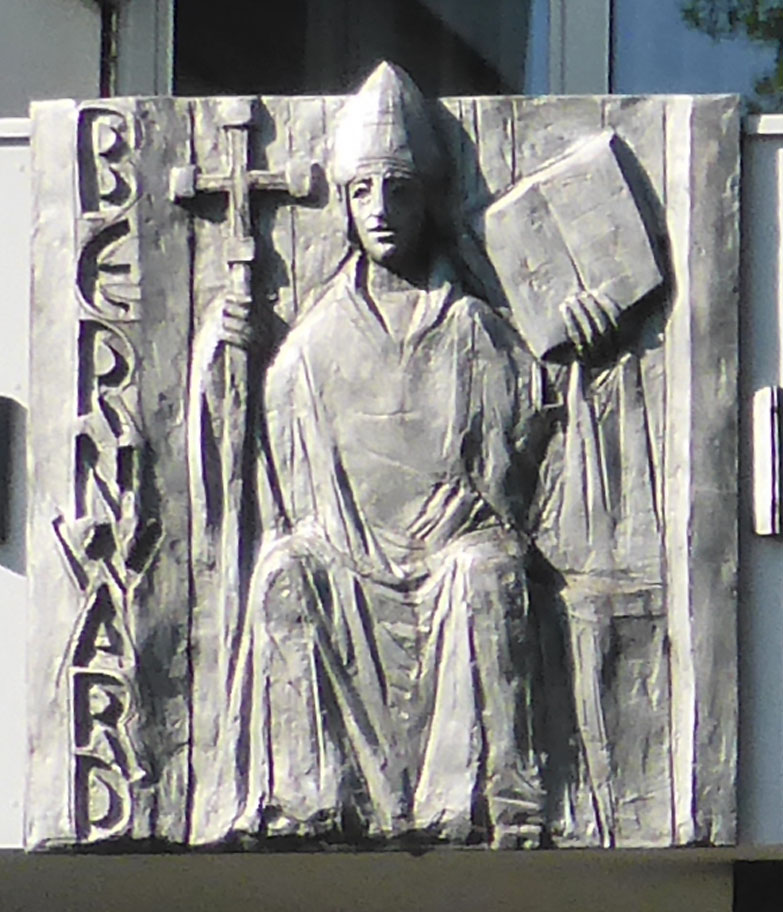
Image: Grone HK Bernward.jpg · Kirchenfan · CC0, via Wikimedia Commons

Image: Kirchenfan, Wikimedia Commons (CC0)

Retold in plain modern English from Baring-Gould’s public-domain text, sentence by sentence, keeping the same facts and order. Short explanations in parentheses are ours.

From Sabine Baring-Gould, The Lives of the Saints, new edition in 16 vols. (London: John C. Nimmo, 1897–98); text from the Internet Archive scan (OCR, lightly cleaned; errors possible). Public domain in the United States. Reproduced unedited, except for short bracketed notes in grey that we added to explain names and terms (“S.” is the old abbreviation for Saint). Some history and judgments reflect 19th-century scholarship.

Notes

Story retold in our own words from the cited sources.