Nothing is known for certain of St. Aristobulus, who was one of the seventy disciples of our Lord.
Read the essentials →Nothing is known for certain of St. Aristobulus, who was one of the seventy disciples of our Lord.
Read the essentials →March 15 (also listed: March 16)
March 15
Martyr
Short entry · the summary here is 78 words; Baring-Gould’s fuller original text and its sources are below. We have not filled any gap with invented detail.
Share your faith, in words and by example. Preaching and conversion are part of this story.
Celebrate this saint’s feast day. Remember him on March 15 with a short prayer, and ask for his help.
Nothing is known for certain about St. Aristobulus, who was one of the seventy disciples of our Lord. The Greeks say that he preached in Britain. He may be the Arystly who, according to the Welsh Triads, was one of the founders of Christianity in Britain. The Spaniards claim him as one of their apostles. The Greeks also say that he was the brother of St. Barnabas, that he was ordained as a bishop, and died as a martyr.
Nothing is known for certain of S. Aristobulus, who was one of the seventy disciples of our Lord. He is said by the Greeks to have preached in Britain. He may be the Arystly who, according to the Welsh Triads, was one of the founders of Christianity in Britain. The Spaniards claim him as one of their apostles. The Greeks say that he was the brother of S. Barnabas, that he was ordained bishop, and died a martyr.
Feast: March 15
One short email a day for nine days. The day's prayer, a line from St. Aristobulus's story, and a nudge to keep going.
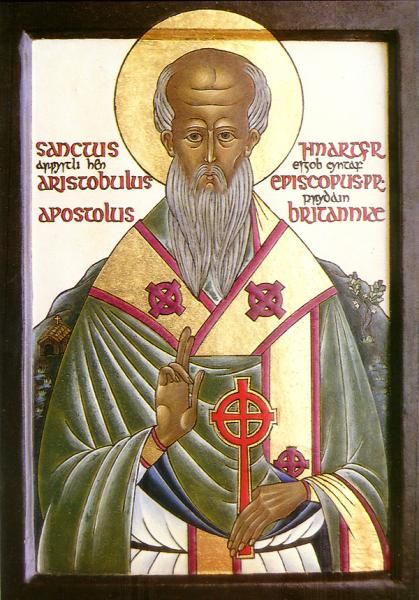
Image: St. Aristobulus of Britain.jpg · Wikimedia Commons · Public domain, via Wikimedia Commons
Image: Wikimedia Commons, Wikimedia Commons (Public domain)
Retold in plain modern English from Baring-Gould’s public-domain text, sentence by sentence, keeping the same facts and order. Short explanations in parentheses are ours.
From Sabine Baring-Gould, The Lives of the Saints, new edition in 16 vols. (London: John C. Nimmo, 1897), digitized text from Project Gutenberg. Public domain in the United States. Reproduced unedited, except for short bracketed notes in grey that we added to explain names and terms (“S.” is the old abbreviation for Saint). Some history and judgments reflect 19th-century scholarship.