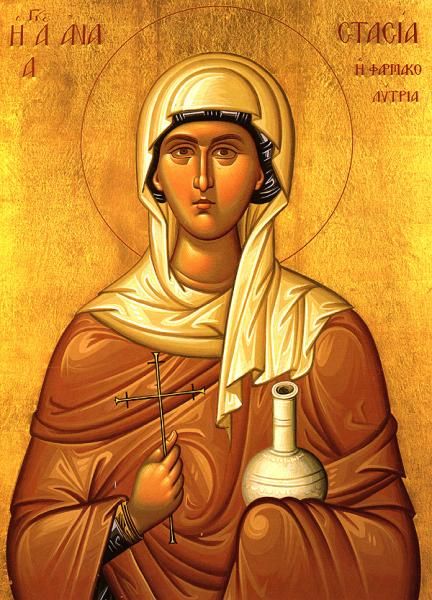
St. Anastasia

Anastasia, martyr of Sirmium, holds a place unique in the Roman liturgy: a special commemoration in the second Mass of Christmas Day.

Read the essentials →
Feast December 25 · Martyr

St. Anastasia

Current feast

December 25 (also listed: December 22, September 28)
Secondary source · Wikipedia infobox

Traditional feast

December 25
1914 / pre-1969 calendar, per Baring-Gould (1897)

Represents

Martyr

Feast days

Feast: December 25

This Saint’s Story

That Mass was originally celebrated not for Christ's Nativity but in her honour, and toward the end of the fifth century her name was also inserted in the Roman Canon (Eucharistic Prayer I, the ancient prayer said at Mass; saints named in it after the consecration were honored very early). She is not a Roman saint. All that is historically certain, the Catholic Encyclopedia stresses, is that a martyr named Anastasia gave her life for the faith at Sirmium and that the church there kept her memory. She was not venerated at Rome until almost the end of the fifth century.

In the second half of that century, during the patriarchate of Gennadius (458–471), her body was moved to Constantinople and laid in a church hitherto called Anastasis (Resurrection); thereafter the church took her name. Her cult reached Rome through an already famous church at the foot of the Palatine above the Circus Maximus—known from the fourth century as the titulus Anastasiae, whether from a foundress Anastasia or from an older Anastasis dedication. Once devotion to the Sirmium martyr rose, that church became the titulus of St Anastasia, and her feast gained unusual prominence among the churches of Rome.

A Passio (an account of a martyr's sufferings) no earlier than the sixth century, which the Encyclopedia calls purely legendary, makes her a Roman, daughter of the noble Praetextatus and pupil of St Chrysogonus. In that tale Chrysogonus is martyred at Aquileia under Diocletian (Roman emperor 284–305, who launched the last and fiercest persecution of Christians in 303); Anastasia goes to Sirmium, is beheaded on 25 December on the island of Palmaria, and is buried in the house of Apollonia, turned into a basilica. Baring-Gould retells still fuller legendary episodes—ships, fires, mass companions—which rest on the same late Passio tradition. Feast, 25 December.

What she represents

How she teaches us to live

Drawn from themes in the original account

Stay faithful when it costs you. Holding firm under pressure is part of this story.

Celebrate this saint’s feast day. Remember her on December 25 with a short prayer, and ask for her help.

The full story

Baring-Gould’s account retold in modern English

Read the full story · 295 words · about 1 min

The emperor was on a diplomatic mission to Persia when he died on the way, which greatly pleased his wife. She immediately resumed her visits to the martyrs. She was arrested in Aquileia and brought before Floras, the prefect of Illyria. While in prison, she was visited by S. Theodota, who later became a martyr.

S. Anastasia was placed on a ship along with a Christian named Eutychianus and one hundred and twenty pagans who were condemned to death. The ship was taken out to sea, scuttled, and those on board were left to drown. Water was already pouring in through the holes when S. Theodota appeared, took the helm, and steered the ship to shore. This miracle led to the conversion of the one hundred and twenty idolaters, and three days later, they suffered martyrdom.

Anastasia was taken to the island of Palmaria with two hundred men and seventy women who were also condemned to death for their faith in Christ. There, she was tied to posts stuck in the ground, her hands and feet stretched out like a cross, and a fire was lit around her, which quickly consumed her. The rest of the group faced various forms of martyrdom.

Her relics were taken to Constantinople under the patriarch Gennadius and placed in the basilica of the Resurrection. This church in Constantinople was dedicated to the Anastasis, or Resurrection, just as the great metropolitan church was dedicated to S. Sophia, the Eternal Wisdom. Due to popular misunderstanding, Sophia was mistakenly regarded as a female saint and martyr, and similarly, the Anastasis was also considered a saint and martyr. The name of Anastasia appears in the Canon of the Mass, but it likely refers not to this legendary martyr but to Anastasia the elder.

Footnotes

  1. August and: Refers to the month of August, traditionally associated with the martyrdom of saints.

Baring-Gould’s own footnotes, in modern English.

Read the original 1870s text

Baring-Gould’s sources: Roman Martyrology. Usuardus. By the Greeks on Dec. 22. Authority: — The apocryphal Acts, undeserving of confidence, in Metaphrastes. Also the equally untrustworthy Acts of S. Chrysogonus.] S. Anastasia the younger, to distinguish her from the saint of the same name who is commemorated on October 28th, was the daughter of a heathen father and a Christian mother. She was married to a Roman nobleman called Publius, who was a pagan, and strongly prejudiced against Christianity. Anastasia devoted her time and means to the relief of the martyrs in prison, during the persecution of Diocletian. Her husband then forbade her leaving the house. She wrote letters to S. Chrysogonus, and received replies from him. The letters are extant, but they are not genuine, they are fabrications by the authors of the Acts of S. Chrysogonus and S. Anastasia. Publius was sent by the Dec.asO S. Anastasia.

…emperor on an embassy to Persia, and died on his way, to the great satisfaction of his wife. She at once recommenced her attendance on the martyrs. She was arrested at Aquileja, and brought before Floras, prefect of Illyria. In prison she was visited by S. Theodota, afterwards a martyr (August 2nd).

S. Anastasia was put in a ship along with a Christian named Eutychianus [followers of Eutyches, who said Christ had only a divine nature; condemned at Chalcedon in 451], and a hundred and twenty pagans, condemned to death. The vessel was conveyed out to sea, scuttled, and those on board were left to perish. The water was already flowing in at the holes, when S. Theodota appeared, seized the helm, and guided the ship to the shore. This miracle caused the conversion of the hundred and twenty idolaters, and three days after they suffered martyrdom.

Anastasia was conveyed to the island of Palmaria with two hundred men and seventy women condemned to death for believing in Christ. She was there stretched to posts stuck in the earth, her hands and feet extended like a S. Andrew’s cross, and a fire was lighted about her which speedily consumed her. The rest of the company suffered various kinds of martyrdom.

Her relics [the bodily remains of a saint, or objects they used, kept with honor] were conveyed to Constantinople under the patriarch [the title of the bishops of the great ancient sees: Rome, Constantinople, Alexandria, Antioch, Jerusalem] Gennadius, and placed in the basilica of the Resurrection. This church at Constantinople was dedicated to the Anastasis or Resurrection, as the great metropolitan [the archbishop who heads a group of dioceses] church was dedicated to S. Sophia, the Eternal Wisdom. Popular ignorance made of Sophia a female saint and martyr, and so also the Anastasis became a saint and martyr. The name of Anastasia occurs in the Canon of the Mass, but probably not the name of this most mythical martyr, but of Anastasia the elder.

From the Catholic Encyclopedia

1913 · 824 words

​Anastasia, Saint, Martyr.—This saint enjoys the distinction, unique in the Roman liturgy, of having a special commemoration in the second Mass on Christmas day. This Mass was originally celebrated not in honour of the birth of Christ, but in commem​oration of this martyr, and towards the end of the fifth century her name was also inserted in the Roman canon of the Mass. Nevertheless, she is not a Roman saint, for she suffered martyrdom at Sirmium, and was not venerated at Rome until almost the end of the fifth century. It is true that a later legend, not earlier than the sixth century, makes Anastasia a Roman, though even in this legend she did not suffer martyrdom at Rome. The same legend connects her name with that of St. Chrysogonus, likewise not a Roman martyr, but put to death in Aquileia, though he had a church in Rome dedicated to his honour. According to this "Passio", Anastasia was the daughter of Prætextatus, a Roman vir illustris, and had Chrysogonus for a teacher. Early in the persecution of Diocletian [Roman emperor 284–305, who began the ‘Great Persecution’ of Christians in 303] the Emperor summoned Chrysogonus to Aquileia where he suffered martyrdom. Anastasia, having gone from Aquileia to Sirmium to visit the faithful of that place, was beheaded on the island of Palmaria, 25 December, and her body interred in the house of Apollonia, which had been converted into a basilica. The whole account is purely legendary, and rests on no historical foundations. All that is certain is that a martyr named Anastasia gave her life for the faith in Sirmium, and that her memory was kept sacred in that church. The so-called "Martyrologium Sieronymianum" (ed. De Rossi and Duchesne, Acta SS., 2 November) records her name on 25 December, not for Sirmium alone, but also for Constantinople, a circumstance based on a separate story. According to Theodorus Lector (Hist. Eccles., II, 65), during the patriarchate of Gennadius (458–471) the body of the martyr was transferred to Constantinople and interred in a church which had hitherto been known as "Anastasis" (Gr. Ἀνάστασις, Resurrection); thenceforth the church took the name of Anastasia. Similarly the cultus of St. Anastasia was introduced into Roman from Sirmium by means of an already existing church. As this church was already quite famous, it brought the feast of the saint into especial prominence. There existed in Rome from the fourth century, at the foot of the Palatine and above the Circus Maximus, a church which had been adorned by Pope Damasus (366–384) with a large mosaic. It was known as "titulus Anastasiæ", and is mentioned as such in the Acts of the Roman Council of 499. There is some uncertainty as to the origin of this name; either the church owes its foundation to and was named after a Roman matron Anastasia, as in the case of several other titular churches of Rome (Duchesne), or it was originally an "Anastasis" church (dedicated to the Resurrection of Christ), such as existed already at Ravenna and Constantinople; from the word "Anastasis" came eventually the name "titulus Anastasiæ" (Grisar). Whatever way this happened, the church was an especially prominent one from the fourth to the sixth century, being the only titular church in the centre of ancient Rome (see Rome, Early Christian), and surrounded by the monuments of the city's pagan past. Within its jurisdiction was the Palatine where the imperial court was located. Since the veneration of the Sirmian martyr, Anastasia, received a new impetus in Constantinople during the second half of the fifth century, we may easily infer that the intimate contemporary relations between Old and New Rome brought about an increase in devotion to St. Anastasia at the foot of the Palatine. At all events the insertion of her name into the Roman Canon of the Mass towards the end of the fifth century, show that she then occupied a unique position among the saints publicly venerated at Rome. Thenceforth the church on the Palatine is known as "titulus sanctæ Anastasiæ", and the martyr of Sirmium became the titular saint of the old fourth-century basilica. Evidently because of its position as titular church of the district including the imperial dwellings on the Palatine this church long maintained an eminent rank among the churches of Rome; only two churches preceded it in honour: St. John Lateran [St. John Lateran, the pope’s cathedral in Rome], the mother-church of Rome, and St. Mary Major. This ancient sanctuary stands today quite isolated amid the ruins of Rome. The commemoration of St. Anastasia in the second Mass on Christmas day is the last remnant of the former prominence enjoyed by this saint and her church in the life of Christian Rome.

Dufourcq, Etude sur les Gesta Martyrum romains, 121 sqq., 137 sqq. (Paris, 1900); Acta SS., Oct., XII, 513 sqq.; Duchesne, Sainte Anaatasie; Notes sur la topographie de Rome au moyendge, N. III, in Mélanges d'archeol. et d'hist., VII, 3S9 sqq. (1887); Grisar, S. Anastasia di Roma, in Analecta Romano, I, 595 sqq.; Butler, Lives, 25 Dec.
More about St. Anastasia

Checked against at least two sources, in our own words

Help us add to this saint's story

Everything is read by a person before anything appears. Facts are checked against trusted sources first.

Facts are welcome; a source link helps (optional).With your permission we may share it on this page.

Nine days · Free

Pray the novena
with us.

One short email a day for nine days. The day's prayer, a line from St. Anastasia's story, and a nudge to keep going.

Also on December 25
Sts. Martyrs at Nicomedia

Sts. Martyrs at Nicomedia

December 25 · Feast
A

St. Adalsendis

December 25 · Virgin
Bl. Peter the Venerable

Bl. Peter the Venerable

December 25 · Abbot
← All 1970 saints in the library
Sources & notes

Feast-day sources

Story sources

Sources

Credits

Image: Saint Anastasia.jpg · Wikimedia Commons · Public domain, via Wikimedia Commons

Image: Wikimedia Commons, Wikimedia Commons (Public domain)

From “Catholic Encyclopedia (1913)/St. Anastasia,” The Catholic Encyclopedia (New York: Robert Appleton Company, 1907–1914), via Wikisource. Public domain. Matched by name and feast date; text unedited except for our bracketed notes in grey.

Retold in plain modern English from Baring-Gould’s public-domain text, sentence by sentence, keeping the same facts and order. Short explanations in parentheses are ours.

From Sabine Baring-Gould, The Lives of the Saints, new edition in 16 vols. (London: John C. Nimmo, 1897–98); text from the Internet Archive scan (OCR, lightly cleaned; errors possible). Public domain in the United States. Reproduced unedited, except for short bracketed notes in grey that we added to explain names and terms (“S.” is the old abbreviation for Saint). Some history and judgments reflect 19th-century scholarship.

Notes

Story retold in our own words from the cited sources.