St. Alkmund

The accounts of Alkmund disagree badly. He was succeeded, not by his son Ethelwald, but by another Ethelwald, surnamed Moll, who was banished in 765, when Alcred, son of Eanwin, a descendant of Ida, came to the throne.

Read the essentials →
Feast March 19 · Martyr

St. Alkmund

Current feast

March 19
Secondary source · Wikipedia infobox

Traditional feast

March 19
1914 / pre-1969 calendar, per Baring-Gould (1897)

Represents

Martyr

Feast days

Feast: March 19

This Saint’s Story

Adapted in modern English from Baring-Gould (1897) · original text below

The source sets aside William of Malmesbury and follows Simeon of Durham. Alkmund was the younger son of Alcred, a descendant of Ida who ruled Northumbria from 765 until he was banished in 774. Northumbria in those years was a place of crime and violence, its kings banished and murdered one after another. Alkmund's elder brother Osred became king in 788, was deposed in 790 by Ethelred, son of Ethelwald Moll, and was put to death in 792.

Alkmund spent some years in exile among the Picts (the ancient people of northern Scotland). He was loved and revered for his spotless innocence and gentleness. In 800 he was murdered on the orders of King Eardulf, who had taken the throne in 797. The source rejects later claims that he fell in battle against the West Saxons or was Ethelred's son.

He was buried at Lilleshall in Shropshire. His body was later moved to Derby, and he is honoured as that town's patron.

What he represents

How he teaches us to live

Drawn from themes in the original account

Stay faithful when it costs you. Holding firm under pressure is part of this story.

Celebrate this saint’s feast day. Remember him on March 19 with a short prayer, and ask for his help.

The full story

Baring-Gould’s account retold in modern English

Read the full story · 307 words · about 1 min

There is a significant difference in the accounts given of this saint. Malmesbury cannot be trusted in his account, so we should follow the account of Simeon of Durham. Ceolwulf, the king of Northumbria, abdicated in 737 and was succeeded by Egbert. Egbert was succeeded in 758 by his brother Osulf, who was killed in 759, leaving a son named Ethelwald. However, he was not succeeded by his son Ethelwald, but by another Ethelwald, known as Moll, who was banished in 765. At that time, Alcred, the son of Eanwin and a descendant of Ida, came to the throne. Alcred was banished in 774, and the crown then went to Ethelred, the son of Ethelwald Moll. Ethelred was banished in 779 and succeeded by Ethelwald, the son of Osulf. This Ethelwald was killed in 788, after which Osred, the son of Alcred, ascended to the throne. Osred's younger brother was Saint Alkmund, who is the subject of this memoir. However, Osred was deposed in 790 by Ethelred, the son of Ethelwald Moll, who had been exiled in 779. This king had Osred put to death in 792. Alkmund was murdered in 800 by order of King Eardulf, who came to the throne in 797 after the assassination of Ethelred in 796.

Alkmund had spent several years in exile among the Picts and was loved and respected for his pure innocence and gentleness during a time of crime and violence. Harpsfield, following Radulph Diceto, states that Alkmund fell in battle against the West Saxons, which is certainly incorrect. He also mistakenly claims that Alkmund was the son of Ethelred, and Malmesbury refers to his father as Alfred. The name was likely Alcfred.

Saint Alkmund was buried at Lilleshut, in Shropshire, but his body was later moved to Derby, where he is honored as the patron of that town.

Footnotes

  1. Alkmund was loved and revered for his spotless innocence and gentleness in a period of crime and violence.
  2. Harpsfield, following Radulph Diceto, says Alkmund fell in battle against the West Saxons, which is certainly wrong.
  3. He also makes Alkmund the son of Ethelred, which is also a mistake; and Malmesbury calls his father Alfred.
  4. The name probably was Alcfred.

Baring-Gould’s own footnotes, in modern English.

Read the original 1870s text

Baring-Gould’s sources: Anglican Martyrologies. Authorities:—Florence of Worcester, William of Malmesbury, Simeon of Durham, and Thurgot of Durham.

A great discrepancy exists in the accounts given of this saint. Malmesbury is certainly not to be trusted in his relation, and we must follow the account of Simeon of Durham. Ceolwulf, king of Northumbria [the Anglo-Saxon kingdom of northern England and south-east Scotland], abdicated in 737, and was succeeded by Egbert, who was succeeded in 758 by his brother Osulf, who was killed in 759, leaving a son, named Ethelwald. He was succeeded, not by his son Ethelwald, but by another Ethelwald, surnamed Moll, who was banished in 765, when Alcred, son of Eanwin, a descendant of Ida, came to the throne. He was banished in 774, and the crown rested on the head of Ethelred, son of Ethelwald Moll, who was banished in 779, and succeeded by Ethelwald, son of Osulf. But this Ethelwald was killed in 788, whereupon Osred, son of Alcred, came to the throne. Osred's younger brother was S. Alkmund, the subject of this memoir. But Osred was deposed, in 790, by Ethelred, son of Ethelwald Moll, who had been exiled in 779, and this king put Osred to death in 792; and Alkmund, in 800, was murdered by order of king Eardulf, who came to the throne in 797, after the assassination of Ethelred in 796.

Alkmund had spent some years in banishment among the Picts, and was loved and revered for his spotless innocence and gentleness in a period of crime and violence. Harpsfield, following Radulph Diceto, says Alkmund fell in battle against the West Saxons, which is certainly wrong. He also makes Alkmund the son of Ethelred, which is also a mistake; and Malmesbury calls his father Alfred. The name probably was Alcfred.

S. Alkmund was buried at Lilleshut, in Shropshire, but his body was afterwards translated to Derby, and he is honoured as the patron of that town.
Help us add to this saint's story

Everything is read by a person before anything appears. Facts are checked against trusted sources first.

Facts are welcome; a source link helps (optional).With your permission we may share it on this page.

Nine days · Free

Pray the novena
with us.

One short email a day for nine days. The day's prayer, a line from St. Alkmund's story, and a nudge to keep going.

Also on March 19
St. Joseph

St. Joseph

March 19 · Feast
P

St. Pancharius

March 19 · Martyr
J

St. John at…

March 19 · Abbot
← All 1970 saints in the library
Sources & notes

Feast-day sources

Story sources

Sources

Credits

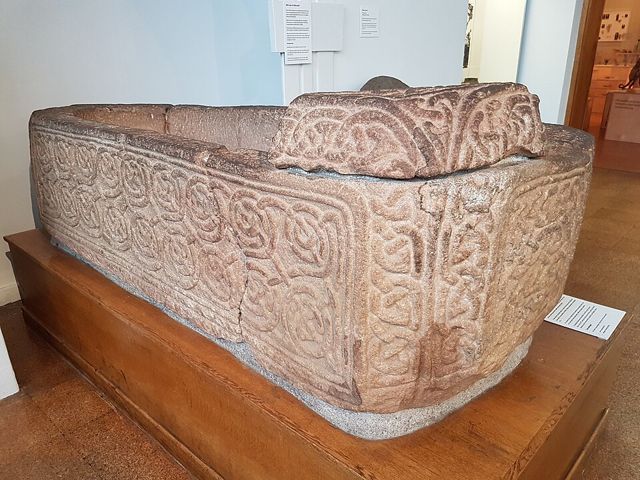
Image: St Alkmund sarcophagus .jpg · Kelly · CC BY-SA 3.0, via Wikimedia Commons

Image: Kelly, Wikimedia Commons (CC BY-SA 3.0)

Retold in plain modern English from Baring-Gould’s public-domain text, sentence by sentence, keeping the same facts and order. Short explanations in parentheses are ours.

From Sabine Baring-Gould, The Lives of the Saints, new edition in 16 vols. (London: John C. Nimmo, 1897), digitized text from Project Gutenberg. Public domain in the United States. Reproduced unedited, except for short bracketed notes in grey that we added to explain names and terms (“S.” is the old abbreviation for Saint). Some history and judgments reflect 19th-century scholarship.