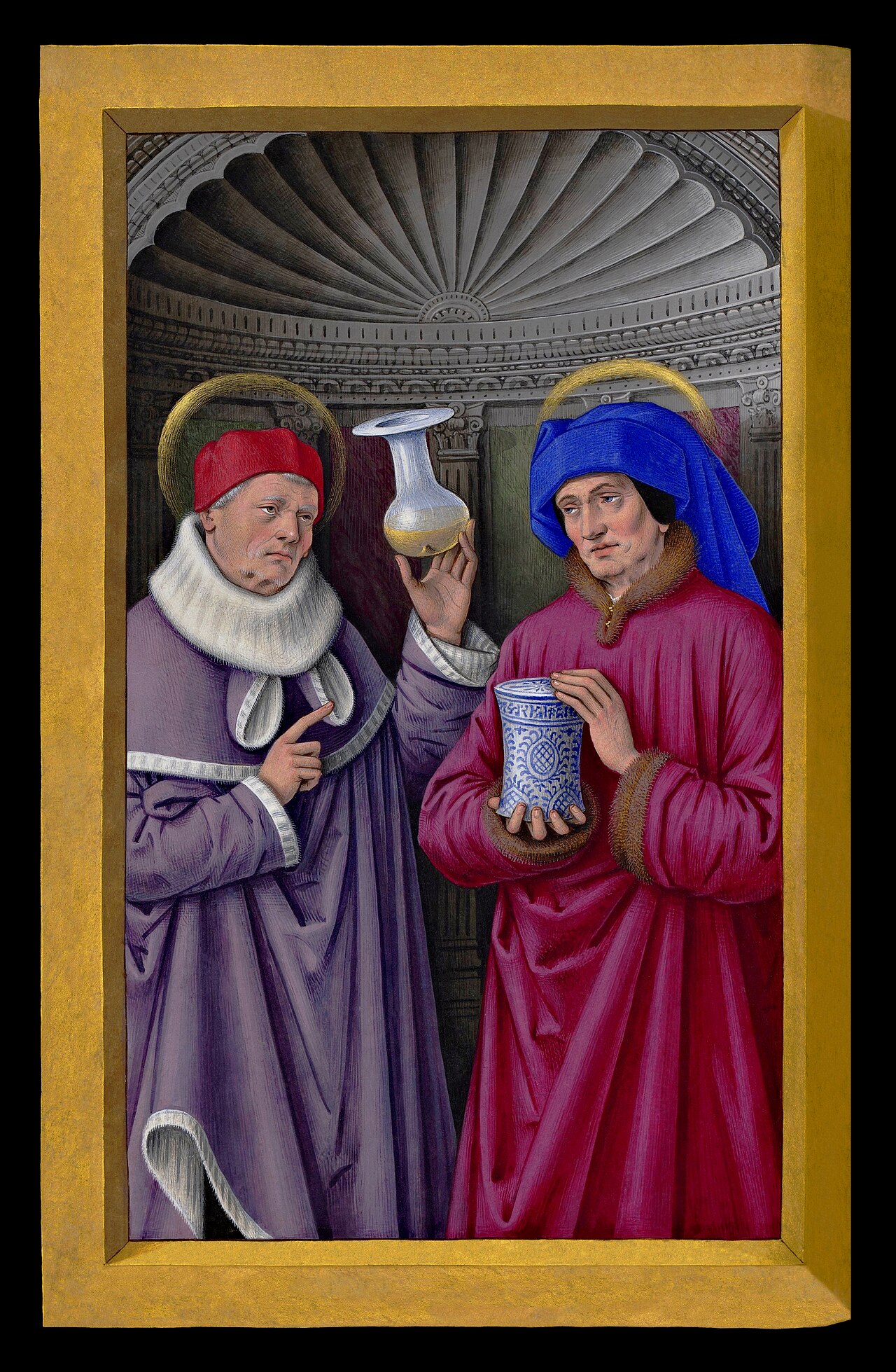
The governor said, “Bring in the men accused of the false religion of the Christians.” The officer replied, “They stand before your tribunal, lord.”
The governor asked, “What is your religion? What is your fortune, and what are your names and nationalities?” Cosmas and Damian answered, “We are from Arabia.” The governor continued, “What are your names?” Cosmas replied, “I am called Cosmas, and my brother’s name is Damian. We come from a good family, and we are physicians by profession. We have other brothers, and if you wish, we will name them.”
Lycias said, “Speak boldly.” Cosmas responded, “Their names are Anthimius, Leontius, and Euprepius.” The governor asked, “What is your religion?” Cosmas replied, “We are Christians.”
The governor said, “Come, deny your God and sacrifice to the deities who created the world.” Then Cosmas, Damian, Anthimius, Leontius, and Euprepius all exclaimed together, “Your gods are nothing but empty idols, and we will not worship them, for they are not gods, but demons.”
The governor ordered, “Bind them hand and foot, and torture them until they sacrifice.” But they said, “Lysias, we ask you to torment us further, for we do not feel pain.”
The governor said, “I wish that, through these minor tortures, I could persuade you to sacrifice; but now you insult both the Emperors and me.”
At this point, what is reliable in the Acts is interrupted. They have been altered. The judge orders the martyrs to be thrown into the sea, and when they touch the water, their chains break, and they safely reach the shore. Then he swears by the “name of his God, Adrian” that he will follow their faith, at which point two demons appear and slap him.
After this ridiculous addition, the genuine questioning resumes. Cosmas and Damian are still on the rack. From these Acts, it is clear that Anthimius, Leontius, and Euprepius had been arrested along with Cosmas and Damian. The later expanded legends suggest that their arrest happened later.
Saints Cosmas and Damian. Cosmas said, “Judge! Your idols are just wood and stone, and they can neither see nor hear; they are the dwelling place of demons. How can stones be angry? Our God is immortal and a just judge.”
The governor said, “I will no longer tolerate your blasphemies against the gods. Come and worship the gods, and you will be released in peace.” The martyrs replied, “Shall we honor your foolish Emperors, who lack reason, and your stocks and stones?” In a fit of rage, the governor ordered the brothers to be decapitated.
These Acts are very informative. As presented above, they are likely in their original form, taken from the proconsular registers. However, they have already been heavily altered. Absurd fables have been inserted into the narrative wherever possible. But even this was not enough. The story continued to expand. The many existing editions of the Acts show the legend in all its stages of development. When fully developed, it is as follows.
A holy woman from the city of Aigse, named Theodota, had five sons: Cosmas, Damian, Anthimius, Leontius, and Euprepius. The two eldest sons were physicians who, remarkably, did not accept any fees for their services. One day, Damian healed a woman named Palladia, and when she insisted that he accept payment, he reluctantly agreed to take three eggs from her. When Cosmas learned of this, he became so angry that he requested that when they died, he and Damian should not be buried in the same grave. However, that night he was warned in a vision that his anger was unreasonable and ill-timed.
The brothers were arrested shortly after; the questioning was retained with few changes, but in all the interpolations noted above, great liberties were taken, and lengthy prayers were put into the mouths of the martyrs. After being thrown into the sea and into the fire, Lysias ordered them to be crucified and stoned while on the cross. They were indeed hung on crosses, and crowds gathered to throw stones at them, but all the stones rebounded on those who threw them, causing them to retreat, bruised and groaning. Then Lysias commanded four cohorts of archers to shoot the martyrs. A cohort consists of about 500 men. However, the arrows, instead of hitting the martyrs, turned around in the air and struck the archers themselves.
Consequently, Lysias ordered that the martyrs have their heads cut off, and this was done without any difficulty. It is a peculiar fact that in all the embellished and legendary accounts of martyrdom, when every other form of torture and execution has been attempted and has failed, the judges ultimately resort to cold steel, which always proves effective. This can be taken as an infallible indication that all the previously recorded tortures are fictitious additions by later writers. After the heads of the martyrs had been severed, the Christians took their bodies and were about to bury Cosmas and Damian separately, as Cosmas had stated that he did not want to be laid to rest beside his brother.
However, a camel ran after the funeral procession, with tears in its eyes, and in a pleading voice exclaimed, “You Christian men, who have witnessed the miraculous healings performed by these martyrs, not only on your bodies but also on our cattle, listen to me. I have come on behalf of the cattle to thank the martyrs and to inform you that it is a mistake to think of separating the bodies of the saints. Bury them together.” The Christians were persuaded and followed the advice of the eloquent camel.
In the sixth century, according to Procopius, the relics of the saintly brothers Cosmas and Damian were visited and venerated by the sick.
SS. Cosmas and Damian were in Cyrus (a city in what is now Syria), where a church was built over them. Pope Felix IV built a church in their honor in Rome in A.D. 530. It is said that the bodies of the saints were moved to Rome, but the exact time is not known. The bodies of all five brothers were laid under the high altar.
There are other bodies of S. Cosmas and S. Damian in Venice, in the church of S. George; relics of these two saints are also found in Verona and Bologna; a head of S. Cosmas is at Imola; the greater part of the bodies of SS. Cosmas and Damian is at Amalfi; the backbone of S. Cosmas is at Malta; and other relics are at Tagliacozzo in the Abruzzi region.
In the fifth century, a hundred years earlier, they are known to have been intact in Cyrus, Syria. S. Germanus of Auxerre brought relics of these saints from Rome into Gaul. The complete bodies were later moved by John de Beaumont from Cyrus to Paris during the time of Alexander III (A.D. 1159-1181). These relics were placed at Luzarches, in a collegiate church dedicated in their honor. The church of Luzarches no longer possesses any relics; they were dispersed in 1793. However, the church of Longpont, near Paris, claims to have a portion of them.
The bodies of SS. Cosmas and Damian were also brought from Rome to Bremen by Bishop Adaldag in A.D. 964. After the change of religion, they were moved from Bremen to Munich in A.D. 1649 and placed in the Jesuit church. These bodies still have their heads. Portions of their skulls are also in Prague; two large bones are in Cologne; and the sword with which they were executed, still stained with their blood, is at Essen in Westphalia. A finger of S. Damian is at Douai; two bones are at Tournai; and others are at Cambrai.
SS. Cosmas and Damian are the patrons of surgeons and barbers. They gained great fame as patrons of the illustrious Medici family when that family was at the height of its splendor.
Footnotes
- The names Anthimius, Leontius, and Euprepius are mentioned as brothers of Cosmas and Damian.
- A cohort is a mere matter of 500 men.
- Procopius was a Byzantine historian.
- A.D. stands for Anno Domini, Latin for "in the year of our Lord."
- The Medici family was a powerful and influential family in Florence during the Renaissance.
Baring-Gould’s own footnotes, in modern English.
Read the original 1870s text
Baring-Gould’s sources: Nearly all Latin Martyrologies on this day. By the Greeks on July 1; again on Oct. 17 with their brothers Leontius, Anthimius, and Euprepius; again on Nov. 1, Cosmas and Damian alone. So also the Russians. In the Arabic Kalendar published by Simoni, on July 1 and Nov. 1, and in the Arabic Martyrology again on Oct. 17. In many Greek Menseas, also a fourth commemoration, on Oct. 28. Many versions of the Acts in Greek and Latin exist, but all are fabulous. The original proconsular Acts possibly subsist under a gradually growing accretion of fable.] The earliest and briefest Acts of these saints, in Greek, state that they were brought before Lysias, the governor at ^Egis, in Cilicia, in the reign of Diocletian and Maximian.
The governor said, “ Bring in the men accused of the false religion of the Christians.” The officer answered, “ They stand before thy tribunal, lord.”
The governor said, “ Of what religion are you? What is your fortune, and what are your names and nations ?” Cosmas and Damian replied, “ We are of Arabia.” The governor said, “What are your names?” Cosmas said, “ I am called Cosmas, and my brother’s name is Damian. We are of good race, and by profession physicians. We have other brothers, and if you desire, will name them.”
Lycias said, “ Speak boldly.” Cosmas said, “ Their names are Anthimius, Leontius, and Euprepius.” 1 The governor said, “ Of what religion are you ?” Cosmas said, “ We are Christians.”
The governor said, “Come, and denying your God, sacrifice to the deities who made the world.” Then Cosmas, Damian, Anthimius, Leontius, and Euprepius, with one voice, exclaimed, “ Thy gods are but vain, and we will not adore idols, for they are not men, but demons.”
The governor said, “ Bind them hand and foot, and torture them till they sacrifice.” But they said, “ Lysias, we pray you torment us further, for we suffer not.”
The governor said, “ I would that, by these slight tortures, I could persuade you to sacrifice; but now you insult both the Emperors and myself.”
Here what is trustworthy in the Acts breaks of. They have been interpolated. The judge orders the martyrs to be cast into the sea, and when they touch the water, their chains break, and they come safe to land. Then he vows by the “name of his God, Adrian (!)” that he will follow their faith, whereupon two devils appear, and box his ears.
After this absurd interpolation, the genuine interrogatory is resumed. Cosmas and Damian are still on the rack. 1 From these Acts it is clear that Anthimius, Leontius, and Euprepius had been arrested along with Cosmas and Damian. The later amplified legends make their arrest a subsequent matter.
SS. Cosmas and Damian. Cosmas said, “ Judge ! thy idols are stocks and stones, and can neither see nor hear; but they are the habitation of devils. How can stones be wroth ? Our God is immortal, and a just judge.’"
The governor said, “ I will no longer endure your blasphemies against the gods.1 Come and worship the gods, and you shall be let go in peace.1' The martyrs answered, “ Shall we honour your foolish Emperors, devoid of reason, and your stocks and stones ?” Then the governor, in a rage, ordered the brothers to be decapitated.2 These Acts are very instructive. As given above, they are probably in their original form, as extracted from the proconsular registers. But they have already undergone gross interpolation. Grotesque fables have been squeezed in between the joints of the narrative wherever it was possible. But even this did not suffice. The story grew and grew. The numerous editions of the Acts that are extant show the legend in all its stages of growth. When full blown it is as follows.
A holy woman of the city of Aigse, named Theodota, had five sons, Cosmas, Damian, Anthimius, Leontius, and Euprepius. The two elder were physicians, who — marvellous to relate — took no fees. One day Damian healed a lady named Palladia, and when she urged him to take pay, reluctantly accepted of her three eggs. When Cosmas heard this, he was so angry that he begged when they died that he and Damian might not be laid in the same grave. But in the night he was warned in a vision that his wrath was unreasonable and inopportune. The brothers were 1 Here follows another interpolation. The text, perhaps, suggested the opportunity of interjecting here another torment. Cosmas and Damian are placed on a blazing pile of wood, then the earth opens and swallows up the martyrs, but dashes the burning wood among the bystanders and kills many. When the fire is extinguished, the earth throws up Cosmas and Damian again. 2 Not without a third preposterous interpolation. arrested shortly after; the interrogatory is retained with few alterations, but in all the interpolations above noted, great liberties are taken; lengthy prayers are put in the mouths of the martyrs. After having been flung into the sea and into the fire, Lysias orders them to be crucified, and stoned whilst on the cross. They are accordingly hung on crosses, and crowds come to pelt them, but all the stones recoil on those that throw them, and they retire, black and blue, and groaning. Then Lysias orders up four cohorts of archers to shoot the martyrs. A cohort is a mere matter of 500 men. But the arrows, instead of hitting the martyrs, turn round in the air, and transfix the bowmen. So Lysias orders the martyrs to have their heads struck off, and this is executed without the smallest difficulty. It is a singular fact that in all amplified and fabulous martyrdoms, when every other sort of torture and death has been tried and has failed, as a last resort the judges try cold steel, and cold steel invariably answers. This may be assumed as an infallible proof that all the previously recorded tortures are fictitious insertions of later writers. When the heads of the martyrs had been struck off, the Christians took up their bodies, and were about to bury Cosmas and Damian apart, as Cosmas had said that he would not be laid by his brother; but a camel ran after the funeral convoy, with tears in its eyes, and in an imploring voice exclaimed, “ You Christian men, who have seen the marvels of healing wrought by these martyrs, not only on your bodies, but on us cattle also, listen to me. I have come in the name of the cattle to thank the martyrs, and also to announce to you that it is quite a mistake to think of separating the bodies of the saints. Bury them together. " The Christians were convinced, and followed the advice of the eloquent camel.
In the sixth century, according to Procopius, the relics [the bodily remains of a saint, or objects they used, kept with honor] of THE SAINTLY BROTHERS COSMAS AND DAMIAN VISITING AND RELIEVING THE SICK. After a Picture by Francesco Peselli in the Gallery of the Louvre. SS. Cosmas and Damian.
SS. Cosmas and Damian were in Cyrus in Syria, where a church was built over them. Pope Felix IV. built a church in their honour at Rome in a.d. 530. The bodies of the saints, it is said, were translated to Rome, but when is not known. The bodies of all five brothers were laid under the high altar. Other bodies of S. Cosmas and S. Damian at Venice, in the church of S. George; relics of these two saints also at Verona and Bologna; a head of S. Cosmas at Imola; the greater part of the bodies of SS. Cosmas and Damian at Amalfi; the backbone Of S. Cosmas at Malta; other relics at Tagliacozzo in the Abruzzi. In the fifth century, a hundred years before, they are known to have been entire at Cyrus, in Syria; S. Germanus of Auxerre conveyed relics of these saints from Rome into Gaul [roughly modern France and Belgium]; the entire bodies were afterwards translated by John de Beaumont from Cyrus to Paris in the days of Alexander III. (1 159-1181). These relics were laid at Luzarches, in a collegiate church dedicated in their honour. The church of Luzarches possesses none now; the relics were dispersed in 1793. But the church of Longpont, near Paris, claims the possession of a portion. The bodies of SS. Cosmas and Damian were also brought from Rome to Bremen by Bishop Adaldag in a.d. 964. After the change of religion they were carried from Bremen to Munich, a.d. 1649, and placed in the Jesuit church. These bodies have their heads. Portions of skulls also at Prag; two large bones at Cologne; the sword with which they were executed, still red with their blood, at Essen in Westphalia. A finger of S. Damian at Douai; two bones at Tournai; others at Cambrai.
SS. Cosmas and Damian are the patrons of surgeons and barbers; they obtained great fame as patrons of the illustrious family of the Medici, when that family was at the height of its splendour.