This Saint’s Story
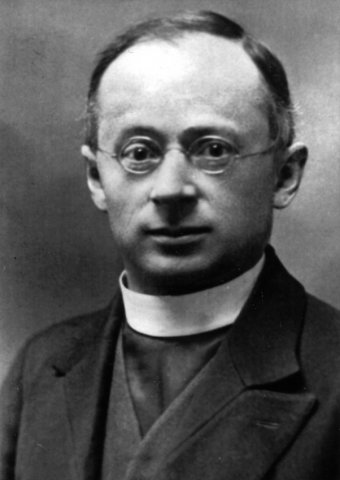
Otto Neururer was born on March 25, 1882, in Piller, Austria, as the youngest of twelve children in a humble farming family. His father passed away when Otto was just eight, leaving his devout mother to raise the children. Otto was known for his academic talents but also struggled with a timid nature and bouts of depression, similar to his mother. With support from his uncle, he pursued studies for the priesthood at the seminary in Brixen, where he was ordained in June 1907. He celebrated his first Mass in his hometown and served in various parishes, becoming a respected teacher of religious education and a member of the Christian Social Movement, which sometimes put him at odds with his superiors.
In 1932, Neururer became the parish priest in Götzens, near Innsbruck. His pastoral work was marked by a deep commitment to his community, where he was loved as a father figure. However, the political landscape shifted dramatically with the Nazi takeover of Austria in 1938. During this turbulent time, Neururer advised a young parishioner against marrying a divorced man with a questionable reputation. Unfortunately, this man was connected to a high-ranking Nazi official, leading to Neururer's arrest on December 15, 1938, under the accusation of undermining German marriage.
Neururer was initially imprisoned in Innsbruck before being transferred to Dachau Concentration Camp on March 3, 1939, and later to Buchenwald on September 26, 1939. Despite the harsh conditions and frequent torture, he maintained his priestly duties, sharing his meager food rations with weaker prisoners. In April 1940, he performed a forbidden baptism for a fellow inmate, which led to severe punishment. He was hanged upside down, enduring excruciating pain for 34 hours before his death on May 30, 1940. His execution was ordered by SS Hauptscharführer Martin Sommer, known for his cruelty.
After his death, Neururer's remains were cremated, and his ashes were sent to Götzens, where they are now interred beneath the altar of the local parish church. His life and martyrdom became a symbol of resistance against the Nazi regime's oppression of the Church and its values.
Otto Neururer was beatified (declared 'Blessed', the step before sainthood) on November 24, 1996, by Pope John Paul II, who recognized his sacrifice as a testament to his faith, declaring that he died for the sake of his beliefs.