And when what Irmgard had heard was noised abroad, the clergy of the church bored a hole in the head that had nodded, put into the hole a sacred Host, and closed it up St. Rosalia.
Read the essentials →And when what Irmgard had heard was noised abroad, the clergy of the church bored a hole in the head that had nodded, put into the hole a sacred Host, and closed it up St. Rosalia.
Read the essentials →September 4
September 4
Virgin
Short entry · the summary here is 129 words; Baring-Gould’s fuller original text and its sources are below. We have not filled any gap with invented detail.
Look after people who are sick or suffering. Care for the sick is part of this story.
Give to people in need. The account records care for the poor.
When what Irmgard had heard became widely known, the clergy of the church bored a hole in the head that had nodded, placed a sacred Host into the hole, and sealed it up.
From that point on, the image was considered miraculous and drew crowds of the faithful. Irmgard made her will and left all her lands, the Castle of Aspel, and the estate of Suchtelen to the churches of Saint Peter and Saint Pantaleon in Cologne. She built a hospital at Hachtforch, and after entering it, she died on one of the pallets prepared for the poor.
Herman, her brother, was the Abbot of Saint Pantaleon and died in 1120. Irmgard probably died earlier, at the end of the 11th century or the beginning of the 12th century.
And when what Irmgard had heard was noised abroad, the clergy of the church bored a hole in the head that had nodded, put into the hole a sacred Host, and closed it up S. Rosalia.
again; and thenceforth the image was regarded as miraculous, and attracted crowds of the faithful. Irmgard made her will, and left to the churches of S. Peter and S. Pantaleon at Cologne all her lands, the Castle of Aspel, and the estate of Suchtelen. She built a hospital at Hachtforch, and entering into it died on one of its pallets prepared for the poor.
Herman, her brother, was Abbot of S. Pantaleon, and died in 1120. Irmgard probably died earlier, at the end of die nth cent, or the beginning of the 12th,
Feast: September 4
One short email a day for nine days. The day's prayer, a line from Bl. Irmgard's story, and a nudge to keep going.
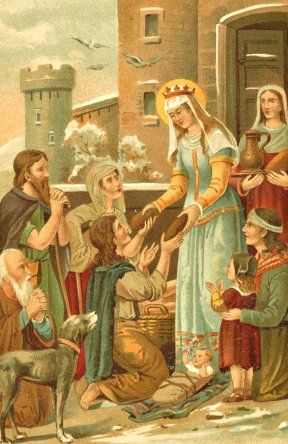
Image: De Heilige Irmgardis te midden der Armen.jpg · ER (Ed. Rahms?) · Public domain, via Wikimedia Commons
Image: ER (Ed. Rahms?), Wikimedia Commons (Public domain)
Retold in plain modern English from Baring-Gould’s public-domain text, sentence by sentence, keeping the same facts and order. Short explanations in parentheses are ours.
From Sabine Baring-Gould, The Lives of the Saints, new edition in 16 vols. (London: John C. Nimmo, 1897–98); text from the Internet Archive scan (OCR, lightly cleaned; errors possible). Public domain in the United States. Reproduced unedited, except for short bracketed notes in grey that we added to explain names and terms (“S.” is the old abbreviation for Saint). Some history and judgments reflect 19th-century scholarship.