Whether Hermione was a virgin and a martyr is doubtful.
Read the essentials →September 4 (also listed: April 14)
September 4
Feast
Short entry · the summary here is 55 words; Baring-Gould’s fuller original text and its sources are below. We have not filled any gap with invented detail.
Pray a little every day. Prayer is part of this story.
Celebrate this saint’s feast day. Remember this saint on September 4 with a short prayer, and ask for this saint’s help.
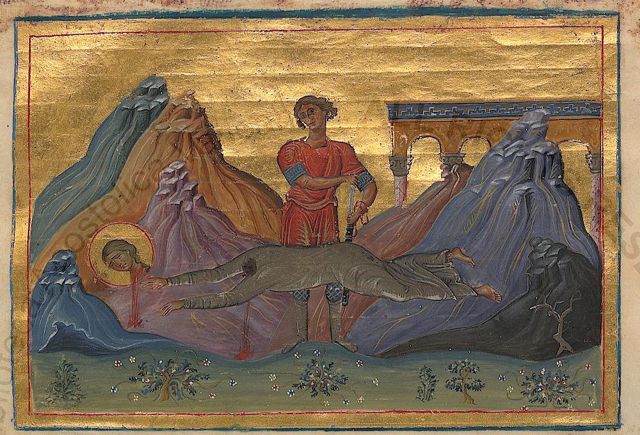
Whether Hermione was a virgin and a martyr is uncertain. Clement of Alexandria tells us in his Stromata that "Philip married his daughters to husbands." According to the longer Mensea, as Hermione was being led to execution, she prayed to God to release her. Then she knelt down and surrendered her soul with a sigh.
Whether Hermione was a virgin and a martyr is doubtful. Clemens Alexandrinus tells us in his Stromata that “ Philip married his daughters to husbands/' According to the longer Mensea, as Hermione was being led to execution she prayed God to release her, then she knelt down and gave up her soul with a sigh.
Feast: September 4
One short email a day for nine days. The day's prayer, a line from St. Hermione's story, and a nudge to keep going.
Image: Menologion of Basil 011.jpg · Authors of Menologion of Basil II (circa 985 AC, Constantinople), Byzantine manuscript illuminators[1]: Pantoleon with G · Public domain, via Wikimedia Commons
Image: Authors of Menologion of Basil II (circa 985 AC, Constantinople), Byzantine manuscript illuminators[1]: Pantoleon with G, Wikimedia Commons (Public domain)
Retold in plain modern English from Baring-Gould’s public-domain text, sentence by sentence, keeping the same facts and order. Short explanations in parentheses are ours.
From Sabine Baring-Gould, The Lives of the Saints, new edition in 16 vols. (London: John C. Nimmo, 1897–98); text from the Internet Archive scan (OCR, lightly cleaned; errors possible). Public domain in the United States. Reproduced unedited, except for short bracketed notes in grey that we added to explain names and terms (“S.” is the old abbreviation for Saint). Some history and judgments reflect 19th-century scholarship.
