Blessed Virgin Mary. The reader is referred to what has already been said on this topic in the article on Mary, the wife of Cleopas (April 9th). The sacred story does not mention the birthplace of St. James. In the Talmud, he is referred to more than once as “a man of the town of Sechania.” There is no distinct account of him during our Savior's ministry until after His Resurrection, when St. James was honored with a special appearance of our Lord to him. This event, though not mentioned by the Evangelists, is recorded by St. Paul, who states that after appearing to the five hundred brethren at once, “He was seen of James.”
St. Jerome (September 30th) provides a fuller account from the Hebrew Gospel of the Nazarenes (see Life of St. Matthew, September 21st). He relates that St. James had solemnly sworn that from the time he had drunk from the Cup at the Last Supper, he would eat no more bread until he saw the Lord risen from the dead. Therefore, after returning from the grave, our Lord came and appeared to him. He commanded that bread be set before him, which He took, blessed, broke, and gave to St. James, saying, “Eat thy bread, my brother, for the Son of Man is truly risen from among them that sleep.”
After Christ's Ascension, St. James was chosen as the bishop of Jerusalem, preferred above all the others for his close relationship to Christ. This was later the reason why Simeon was chosen to be his immediate successor in that position, as he was, after St. James, our Lord's next kinsman. This consideration led St. Peter and the two sons of Zebedee, despite their special honors from our Savior, not to contend for this high and honorable position, but to freely choose James the Just to be its bishop. It was to St. James that St. Paul addressed himself after his conversion, and he was honored with the right hand of fellowship by him. St. Peter sent him the news of his miraculous deliverance.
prison, “Go show these things to James and to the brethren.” James presided over the Synod in Jerusalem during the significant debate about the Mosaic laws. There, he issued the final and decisive ruling that Gentile converts should not be burdened with the Jewish laws. He carried out his responsibilities with great care and diligence, leaving no part of his role as a faithful guide of souls unattended. He strengthened the weak, educated the ignorant, corrected the misguided, and reproved the stubborn. Through his consistent preaching, he overcame the resistance of that difficult and rebellious generation he faced, with many of the nobler and better individuals converting from Judaism to the Christian Faith.
He was so diligent and effective in his role that it provoked the hostility of his enemies, who conspired to bring about his downfall. Unable to achieve this under the rule of Festus, they made a more effective attempt before the new governor, Albinus, took office. Ananias the Younger, who was then the high priest and a member of the Sadducees, decided to eliminate him before the new governor could arrive. To this end, a council was quickly convened, and the apostle, along with some others, was accused and condemned as violators of the law.
To make their actions appear more legitimate, they enlisted the Scribes and Pharisees to trap him. They approached him with flattering words to ensnare him. They told him that they all had great confidence in him and that the entire nation, along with themselves, viewed him as a very just man who did not show favoritism. Therefore, they requested that he correct the misconceptions the people had about Jesus being the Messiah. They wanted to take advantage of the gathering for the Passover celebration to clarify these matters. For this purpose, they planned to place him on the roof of the Temple, where he could be seen and heard by everyone.
On the appointed day, positioned advantageously on a pinnacle of the Temple, the Scribes addressed him: “Tell us, O Justus, whom we have every reason to trust, since the people are generally misled by the doctrine of Jesus who was crucified. Tell us, what is this teaching of the crucified Jesus?” The apostle responded loudly, “Why do you ask about Jesus, the Son of Man? He is in heaven, at the right hand of the Majesty on High, and will return in the clouds of heaven.” The crowd below, hearing this, praised the blessed Jesus and shouted, “Hosanna to the Son of David!”
The Scribes and Pharisees realized that they had missed their goal. Instead of turning the people away from Christ, they had strengthened their reverence for Him. They saw that the only option left was to execute James immediately, so that others would be warned not to believe in Him. Suddenly, they shouted that Justus himself had been deceived and had become an impostor, and they threw him down from the place where he stood. Although he was bruised, he did not die from the fall. He regained enough strength to get on his knees and pray for them. A Rechabite who was nearby, whom Epiphanius says was Simeon, the apostle's relative and successor, intervened and begged the Jews to spare James, a just and righteous man, who was then praying for them. However, they rained down stones on S. James until one person, more cruelly merciful than the others, struck him in the head with a fuller’s club. Thus, the holy apostle died in the year 62 AD, at the age of ninety-six, about twenty-four years after our Lord's Ascension. Josephus tells us that his death caused great sorrow among all good people, even among the Jews themselves. S. Gregory of Tours states that S. James was buried on Mount Olivet in a tomb he had built for himself, where he also buried Zacharias and S. Simeon.
The Catholic Epistle of S. James, his only authentic work, was likely written not long before his martyrdom, as indicated by some passages that relate to the impending destruction of the Jewish nation. In addition to this Epistle, there is a Gospel attributed to him, called the Protevangelium, which contains the early life of our Lord and His Mother. However, this book is certainly apocryphal. It could not have been written before the 2nd century, and in its current form, it belongs to a later century. It is filled with errors and inconsistencies.
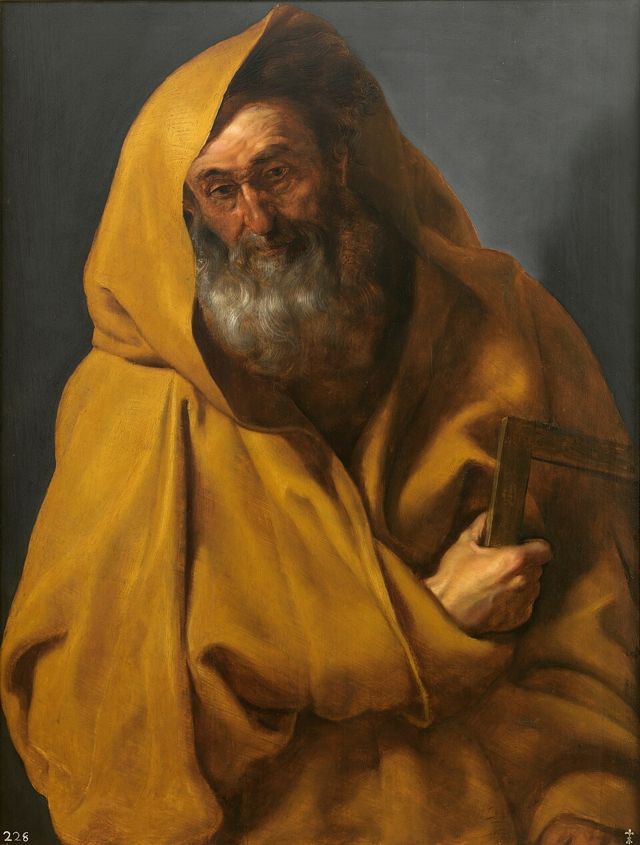
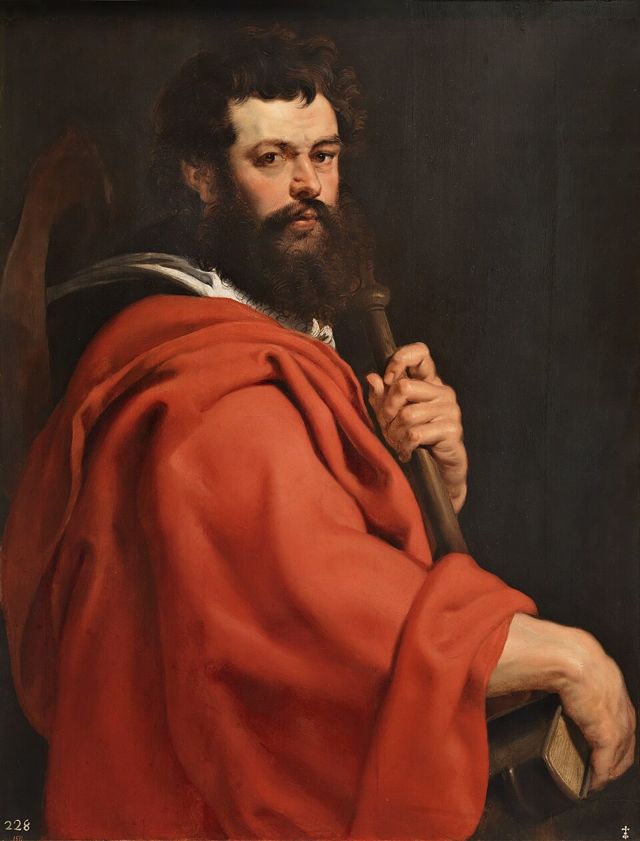
S. James the Less is typically depicted with a uniquely shaped club, known as the fuller's bat, which was the instrument of his martyrdom. According to an early tradition, he closely resembled our Lord in appearance and mannerisms, making it difficult to tell them apart. A touching legend states that this exact resemblance made it necessary for the traitor Judas to give Jesus a kiss to identify Him to the soldiers.
The body of S. James the Less was taken from Jerusalem, where he was buried, and transported to Constantinople. His head is now displayed in Compostella, Spain, having been brought from Jerusalem by Bishop Didacus Gelmirez in the 13th century.
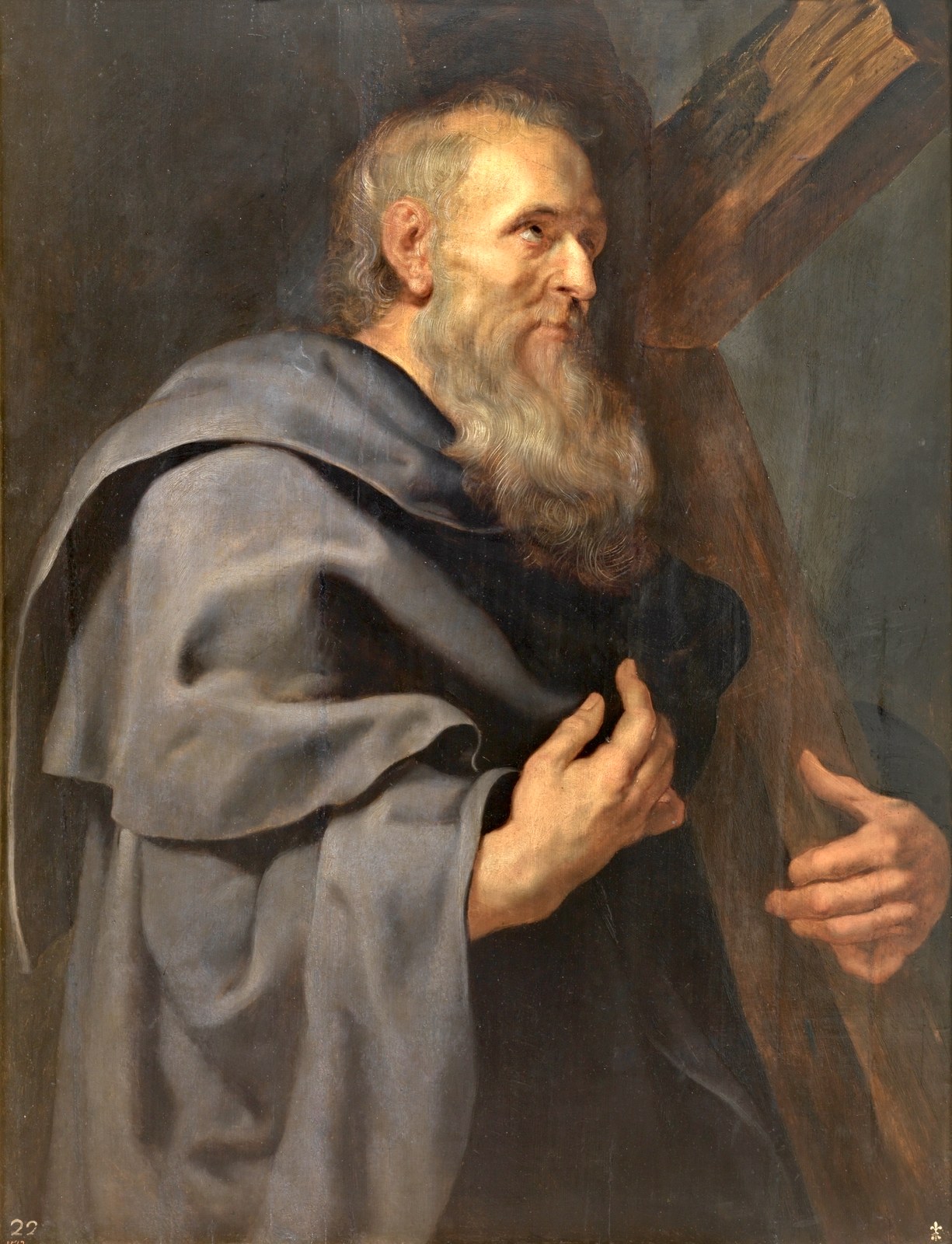
But the head is also claimed to be possessed by the church of Saint Marrie de Mare, located in Camargo, Provence. A jawbone is preserved in Forli, Italy; another part of the head is in Ancona; and an arm is in Gembloux, Belgium. However, the relics of Saint James are said to have been found in 1395 on Monti Grigiano, near Verona. The body is preserved in the church of Saints Philip and James in Rome, along with that of Saint Philip, at the high altar. The arm is separately enshrined and is displayed there on this day. According to Saussaye, the head and other relics were in Toulouse, and an arm of Saint James was in Langres. Three portions of the skull are in the church of Saint Charles in Antwerp.
Footnotes
- St. Jerome provides a fuller account from the Hebrew Gospel of the Nazarenes.
- St. James was honored with the right hand of fellowship by St. Paul.
- Justus: a name used for James, indicating his righteousness.
- Epiphanius: a 4th-century church father known for his writings on heresies.
- S. Gregory of Tours: a 6th-century historian and bishop known for his work on the history of the Franks.
- Didacus Gelmirez: a 13th-century bishop of Santiago de Compostela, known for his role in the church's development.
- Saussaye: a reference to a scholar or historian.
Baring-Gould’s own footnotes, in modern English.
Retold in plain modern English from Baring-Gould’s public-domain text, sentence by sentence, keeping the same facts and order. Short explanations in parentheses are ours.