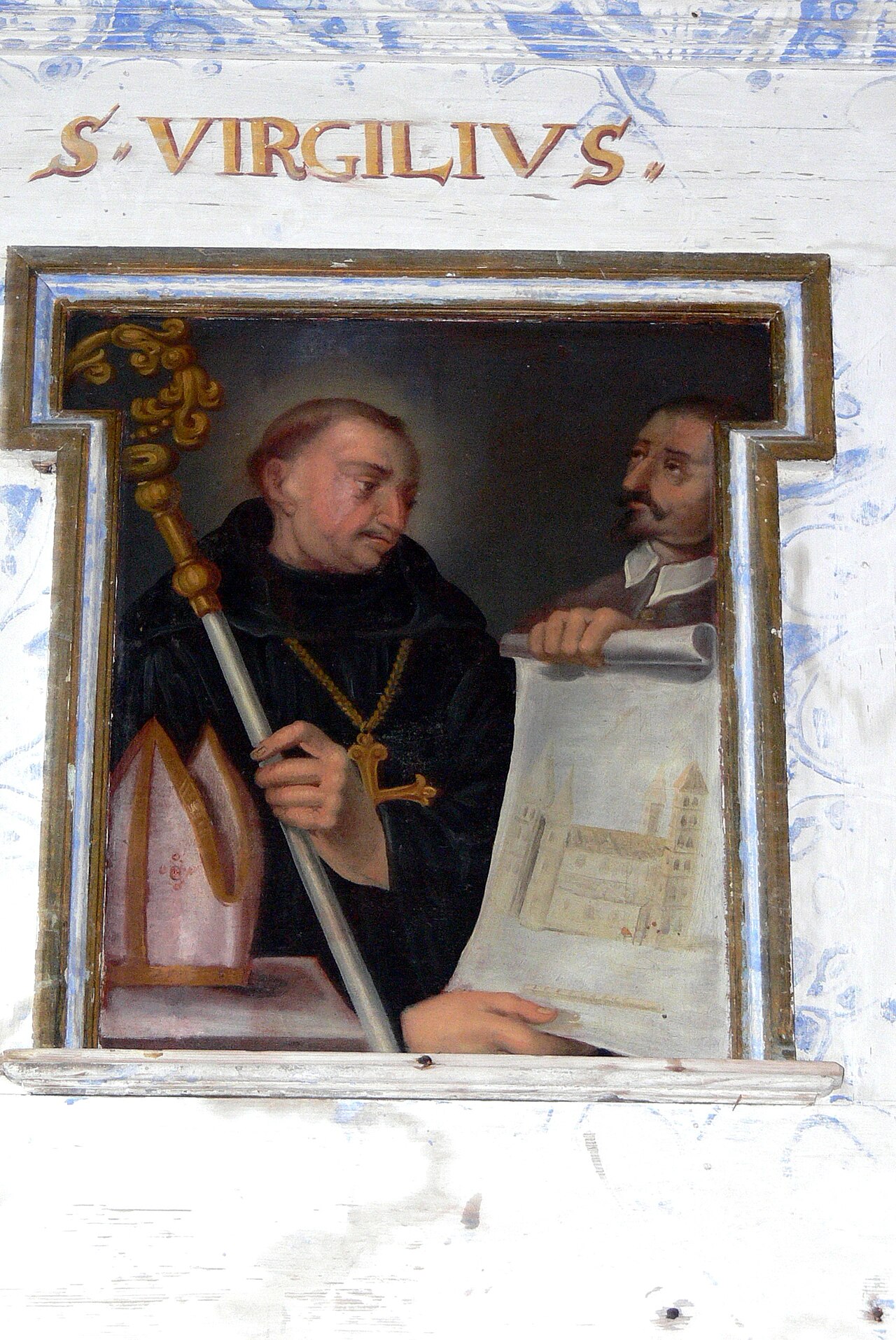
St. Virgilius of Salzburg

Sidonius wrote to Pope Zacharias, and he at once sent a letter to Boniface expressing his surprise at his decision, and confirming the opinion of Virgilius.

Read the essentials →
Traditional feast November 27 · Bishop

St. Virgilius of Salzburg

Feast

Traditional feast: November 27 (Roman Martyrology 1916 (archive.org OCR, sources/rm1916.txt))
Traditional date · cited source, no current calendar entry found

Traditional feast

November 27
1914 / pre-1969 calendar, per Baring-Gould (1897)

Represents

Bishop

Feast days

Feast: November 27

This Saint’s Story

Adapted in modern English from Baring-Gould (1897–98) · original text below

(The surviving account on this page begins partway through the story.)

Virgilius had defended baptisms given by a priest with poor Latin, and Pope Zacharias supported him against St. Boniface, saying those baptized in the name of the Trinity without error of doctrine should not be baptized again. Boniface, apparently stung, looked for charges against him.

Virgilius seems to have believed the mountain people's tales of little folk living underground in a world lit by its own sun and moon, whose hammers miners heard. Boniface reported this to the Pope (his own letter is lost, so we know the teaching only from the Pope's reply), who called it a perverse doctrine and said that if Virgilius taught it he should be tried and deposed. Baring-Gould says it is often wrongly claimed that the Pope condemned the idea of a round earth with people on the other side. The letter of Zacharias suggests the issue was an underground world, and Virgilius may simply have believed the local legends. The Pope asked Duke Odilo of Bavaria to send him to Rome, but there is no sign he went or that a council tried him; the matter probably lapsed.

After the death of John, bishop of Salzburg, Virgilius reluctantly accepted the see from Duke Odilo at Pepin's request. He delayed his consecration, letting an Irish bishop, Dobda, perform the bishop's duties, and was consecrated in 767.

When the Huns attacked Carinthia, its duke Boruth won Bavarian help, and his son Charast and later his nephew Chetimar were raised Christians and became dukes. Chetimar invited Virgilius to preach to his Sclaves (Slavs). Virgilius did not go, which Baring-Gould puts down to a lack of missionary enthusiasm, but sent Bishop Modestus and priests, who stayed until Modestus died. When Chetimar asked again, and there was unrest in the duchy, Virgilius judged it wiser to send the priest Latinus than to go himself, but Latinus found it too dangerous and would not stay. When calm returned he sent the priests Madelhohus and then Wargmann. After Chetimar's death a fight over the succession held back the mission. When Watung became duke, a third invitation came; Virgilius sent the priests Heumann and Reginbald and the deacon Majoran, then more clergy, and when Carinthia had been brought at least outwardly into the Church, he visited it himself. He fell ill after the exhausting journey and died at Salzburg in old age in 780.

What he represents

How he teaches us to live

Drawn from themes in the original account

Share your faith, in words and by example. Preaching and conversion are part of this story.

Celebrate this saint’s feast day. Remember him on November 27 with a short prayer, and ask for his help.

The full story

Baring-Gould’s account retold in modern English

Read the full story · 849 words · about 4 min

Sidonius wrote to Pope Zacharias, and he immediately sent a letter to Boniface expressing his surprise at Boniface's decision and confirming the opinion of Virgilius. “We cannot,” he said, “consent to the rebaptism of those whom this priest baptized in ignorance of the language and without any error of doctrine. Those who have been baptized by heretics are accepted as having received a valid sacrament if they received it in the name of the Trinity.”

Apparently, S. Boniface was upset at not being able to outsmart Virgilius, and he looked for accusations against him to achieve his humiliation, if not his downfall. Soon, an opportunity arose. Virgilius seems to have believed in the popular legends of elves or gnomes that were common among the people. These were little beings who lived in the depths of the mountains in a marvelous world illuminated by a mysterious sun and moon made of brilliant stones, and whose little hammers, clinking as they worked the ore, could be heard by miners in their shafts. S. Boniface wrote to the Pope denouncing Virgilius's error. Zacharias responded that the belief in a world of men underground, with another sun and moon, was “a perverse and unjust doctrine, uttered against God and his own soul.” He stated that if Virgilius taught this, he should be tried by a council and removed from his priesthood. It has often been incorrectly claimed that Zacharias condemned the idea of a round world and the existence of antipodes. It is impossible to say exactly what Virgilius taught; we only know about his doctrine from Zacharias's letter, as S. Boniface's letter has been lost. However, it seems from the wording of the letter that Virgilius's teaching was not about the world being round, but rather about the existence of an underground world with its own sun and moon, different from those that light our skies. Since this belief aligns with the popular superstition among the mountaineers and miners with whom Virgilius lived, it is just as likely that he believed their tales as that he adopted the theories of Thales of Miletus and Pythagoras.

Zacharias wrote to Odilo, Duke of Bavaria, asking him to send Virgilius to Rome to justify himself. The outcome of this is not known. It does not appear that he went to Rome, nor that a council convened to address his alleged heresy. It is likely that he wrote an explanation of his views to the Pope, and the matter was allowed to fade away.

After the death of Saint John, the bishop of Salzburg, Virgilius was appointed to the position at the request of Pepin by Odilo, the Duke of Bavaria. Virgilius accepted the appointment very reluctantly. However, he did not want to be consecrated immediately. Instead, he made an Irish bishop named Dobda, who had come with him from Ireland, his coadjutor to ordain and confirm him. It was not until two years later, in 767, that Virgilius was consecrated.

During the reign of Dagobert, Samo, the duke of the Slavs in Carinthia, killed the ambassadors sent to him by the Frank king. Dagobert avenged this outrage by conquering the Carinthian Slavs. While Virgilius was bishop of Salzburg, the Huns attacked Carinthia. Boruth, the duke, appealed to the Bavarians for help, and the combined forces of the Carinthians and Bavarians drove back the invaders. However, in exchange for their assistance, the Bavarians required the duke to surrender his son Charast as a hostage to the empire and to have him educated as a Christian. After Boruth died, Charast was sent back to Carinthia as duke. He died three years later, and by order of Pepin, the Carinthians received Chetimar, Boruth's nephew, as their duke. Chetimar had also been baptized and taught Christian teachings. Chetimar invited Saint Virgilius to visit Carinthia and preach to the Slavs, but the bishop was unable to do so. Instead, he sent Modestus, a bishop, along with four priests to Carinthia. Modestus remained there until his death. Chetimar then urged Virgilius again to visit his people, but Virgilius refused once more, seemingly lacking much missionary enthusiasm or energy. Additionally, there was some unrest in the duchy, and he thought it wiser to send Latinus, a priest, to Carinthia rather than risk his own safety. Latinus found the situation too dangerous and refused to stay. Once peace was restored, Virgilius sent the priest Madelhohus there, followed by another priest, Wargmann. After Chetimar's death, a struggle for succession distracted the duchy and hindered missionary work. However, when Watung became duke, a third request was made to Virgilius to come personally and organize the young Church in Carinthia. He sent two priests, Heumann and Reginbald, along with a deacon named Majoran, and later sent another group of clergy. When Carinthia was brought under the Gospel, at least in terms of outward uniformity, Virgilius traveled throughout the duchy to arrange and organize everything as he thought best. After this visitation, which required great effort from him, he fell ill and died in Salzburg at an advanced age in 780. His relics are preserved in Salzburg.

Footnotes

  1. Zacharias stated that if Virgilius taught this, he should be tried by a council and removed from his priesthood.
  2. It has often been incorrectly claimed that Zacharias condemned the idea of a round world and the existence of antipodes.
  3. Samo was the first known ruler of the Slavs in the region.
  4. Charast was a hostage to ensure loyalty to the Frankish Empire.
  5. Chetimar was a Christian leader in Carinthia.
  6. Virgilius's efforts helped establish the Church in the region.

Baring-Gould’s own footnotes, in modern English.

Read the original 1870s text

Baring-Gould’s sources: Roman and Benedictine Martyrology. Canonized by Pope Gregory IX. Authority: — A Life written after 1 181, derived from the “ Libellus de conversione Bagoariorum et Carantanorum,” by an anonymous writer in 871. This Libellus in Pertz, xi. pp. 4-15. The Life in Mabillon, Acta SS. O.S.B. ssec. iii. 2, and Pertz, xi. pp. 86-95. Fragmenta ex Libro donationum Eccl. Saltzburgensis, in Mabillon, after the Life. Also S. Boniface, Ep. 140.] Virgilius, an Irishman, came to France in the beginning of the 8th century, and was well received by Pepin, then Mayor of the Palace, at Cressy, and remained at court nearly two years. After that he was made abbot of S. Peter’s at Salzburg. It was then that he had a difference with S. Boniface. Virgilius and his companion Sidonius found a priest in Bavaria who was so ignorant of Latin, that when baptizing he used the formula, “ Baptizo te in nomine Patria, et Filia, et Spiritua sancta.” They corrected his error, but did not judge that his baptism had been invalidated by his bad Latin. S. Boniface heard of this decision of theirs, was indignant, and pronounced that these baptisms were not valid, and that the sacrament must be reiterated over those who had received it from the ignorant priest. Virgilius and ft -ft S. Virgilius.

Sidonius wrote to Pope Zacharias, and he at once sent a letter to Boniface expressing his surprise at his decision, and confirming the opinion of Virgilius. “ We cannot/7 said he, “ consent to the rebaptism of those whom this priest baptized thus in ignorance of the language, and without any error of doctrine; for those who have been baptized by heretics are admitted to have received the valid sacrament, if they have received it in the name of the Trinity.”

Apparently S. Boniface [English missionary to Germany, martyred 754] was mortified at not getting the better of Virgilius, and he lay in wait to find some accusations against him, and effect his humiliation, if not his ruin. Such an opportunity shortly occurred. Virgilius seems to have believed the popular legends of elves or gnomes prevalent among the people, of little folks who lived in the depths of the mountains, in a marvellous world illuminated by a mysterious sun and moon of brilliants and other precious stones, and whose little hammers, clinking as they worked the ore, were heard by the miners in their shafts. S. Boniface wrote to the Pope denouncing his error Zacharias answered that the doctrine of a world of men underground, with another sun and moon, was “ a perverse and unjust doctrine, uttered against God and his own soul,” and that Virgilius, if he taught it, should be tried by a council, and deposed from his priesthood.1 It has been often asserted, erroneously, that Zacharias condemned the doctrine of the world being round and of there being antipodes.2 It is impossible to say exactly what Virgilius taught; we only know about his doctrine from the letter of Zacharias, as that of S. Boniface is lost. But it would seem from the est, si clarificatum fuent ita eum confiteri, quod alius- mundus et alii homines sub terras sint, hunc accito Concilio ab Ecclesia pelle sacerdotii honore privatum.” — 2 See also “ L’evSque Virgile et les Antipodes,” in Barthelemy, “ Erreurs et mensonges historiques,” Paris, 1866.

wording of the letter, that his teaching was not that of the world being round, but rather that of there being an underground world with a sun and moon of its own, different from those which illuminate our skies. And as this is precisely the popular superstition among mountaineers and miners with whom Virgilius lived, it is quite as probable that he believed their tales, as that he had adopted the theory of Thales of Miletus and of Pythagoras.

Zacharias wrote to Odilo, Duke of Bavaria, to send Virgilius to Rome to justify himself. What the result was is not known. It does not seem that he went to Rome, or that a council sat on his heresy. Probably he wrote an explanation of his views to the Pope, and the matter was allowed to drop.

After the death of S. John, bishop of Salzburg, Virgilius was appointed to the see, at the request of Pepin, by Odilo, Duke of Bavaria. Virgilius most reluctantly received the appointment. He would not, however, at once be consecrated, but made an Irish bishop, Dobda, who had accompanied him from Ireland, his coadjutor [an assistant bishop who will succeed the current one], to ordain and confirm, and it was not till two years after, in 767, that Virgilius was consecrated.

In the reign of Dagobert, Samo, duke of the Sclaves in Carinthia, killed the ambassadors of the Frank king sent to him. Dagobert revenged the outrage by subduing the Carinthian Sclaves. Whilst Virgilius was bishop of Salzburg the Huns [nomadic invaders from Central Asia, led in the 5th century by Attila] attacked Carinthia, and Boruth, the duke, appealed to the Bavarians for help, and the united forces of the Carinthians and Bavarians repelled the invaders; but in return for their assistance, the latter required the duke to give up his son Charast as a hostage of submission to the empire, and to be educated as a Christian. On the death of Boruth, Charast was sent back to Carinthia as duke. He died three years after, and by order of Pepin the Carinthians received Chetimar, the nephew of Boruth, as their duke, who had also been baptized and taught Christian truth. Chetimar invited S. Virgilius to visit Carinthia and preach to the Sclaves, but the bishop was unable to do so. He, however, sent Modestus, a bishop, and four priests to Carinthia. Modestus remained there till his death. Then Chetimar again urged Virgilius to visit his people, but Virgilius again refused, not apparently being endowed with much missionary enthusiasm or energy of disposition. There was some disturbance, moreover, in the duchy, and he considered it wiser to send Latinus, a priest, to Carinthia, than to risk his own person. Latinus found the place too hot for him, and refused to remain. As soon as tranquillity was restored, Virgilius sent thither the priest, Madelhohus, and after him the priest Wargmann. On the death of Chetimar, a contest for the succession distracted the duchy and impeded missionary enterprise. But when Watung became duke, a third appeal was made to Virgilius to come in person and organize the infant Church in Carinthia. He sent two priests, Heumann and Reginbald, and a deacon, Majoran; and afterwards another batch of ecclesiastics. When Carinthia was brought under the Gospel, at least unto outward uniformity, Virgilius went himself throughout the duchy arranging and ordering all as seemed best fitting. On his return from this visitation, which cost him great labour, he fell sick and died at Salzburg, at an advanced age, in 780. His relics [the bodily remains of a saint, or objects they used, kept with honor] are preserved at Salzburg.
Help us add to this saint's story

Everything is read by a person before anything appears. Facts are checked against trusted sources first.

Facts are welcome; a source link helps (optional).With your permission we may share it on this page.

Nine days · Free

Pray the novena
with us.

One short email a day for nine days. The day's prayer, a line from St. Virgilius of Salzburg's story, and a nudge to keep going.

Also on November 27
B

Sts. Barlaam and Josaphat

November 27 · Feast
F

Sts. Facundus and…

November 27 · Martyrs
J

St. Justus

November 27 · Priest, Confessor
← All 1970 saints in the library
Sources & notes

Feast-day sources

Story sources

Sources

Credits

Image: St.Adolari - Empore 6 Virgil.jpg · Wolfgang Sauber · CC BY-SA 3.0, via Wikimedia Commons

Image: Wolfgang Sauber, Wikimedia Commons (CC BY-SA 3.0)

Retold in plain modern English from Baring-Gould’s public-domain text, sentence by sentence, keeping the same facts and order. Short explanations in parentheses are ours.

From Sabine Baring-Gould, The Lives of the Saints, new edition in 16 vols. (London: John C. Nimmo, 1897–98); text from the Internet Archive scan (OCR, lightly cleaned; errors possible). Public domain in the United States. Reproduced unedited, except for short bracketed notes in grey that we added to explain names and terms (“S.” is the old abbreviation for Saint). Some history and judgments reflect 19th-century scholarship.