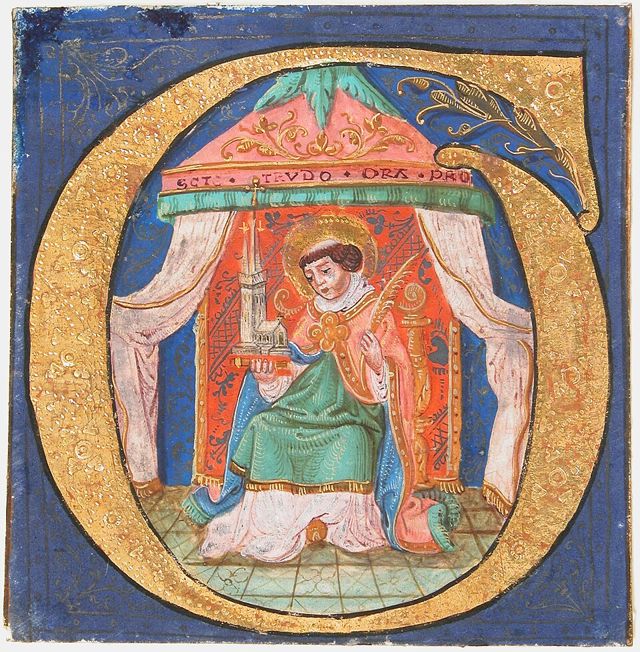
St. Trudo

Trudo—also called Tron, Trond, Trudon, Trutjen or Truyen—is honoured as the apostle of the Hesbaye (Hasbein) in Brabant. St. Trudo, commonly called St. Trond, was born of noble and wealthy Frank parents in Hesbain.

Read the essentials →
Feast November 23 · Priest, Confessor

St. Trudo

Current feast

November 23
Secondary source · Wikipedia infobox

Traditional feast

November 23
1914 / pre-1969 calendar, per Baring-Gould (1897)

Represents

Priest
Confessor

Feast days

Feast: November 23

This Saint’s Story

The Catholic Encyclopedia gives his death as 698, with 693 as an alternative, and his feast as 23 November. He was the son of Blessed Adela, of the family of the dukes of Austrasia; Baring-Gould calls his parents noble and wealthy Franks of the Hesbaye.

Devoted to God from early youth, Trudo went to St. Remaclus, Bishop of Liège, who sent him to Chlodulf, Bishop of Metz. He was educated at the church of St. Stephen in Metz, which he loved all his life and to which he gave his later foundation. Baring-Gould tells the story that as a small boy he built a little oratory of stones on waste ground to pray in, and that a woman who thought him simple kicked its walls down; he adds that after his father's death Trudo made over his whole inheritance to St. Stephen's.

After ordination he returned to his own district, preached the Gospel, and built a church at Sarchinium on the Cylindria. St. Theodard, Bishop of Liège, blessed it about 656 in honour of Sts. Quentin and Remigius. Disciples gathered around him and in time an abbey grew there, later called St-Trond. He also founded a convent for women at Odeghem near Bruges, which came to bear his name. Baring-Gould says he died at sixty-five.

He was buried in his own church. In 880 his relics were translated together with those of St. Eucherius of Orléans, who had died there in exile. Hidden in a crypt against the Normans, they were lost after the great fire of 1085, found again in 1169, and solemnly recognized on 11 August that year; these translations explain several further dates in the martyrologies. His life was written by Donatus, a deacon of Metz, at the order of Bishop Angilram (769–91), and later rewritten by Theodoric, Abbot of St-Trond (d. 1107).
What he represents

How he teaches us to live

Drawn from themes in the original account

Pray a little every day. Prayer is part of this story.

Celebrate this saint’s feast day. Remember him on November 23 with a short prayer, and ask for his help.

From the Catholic Encyclopedia

1913 · 360 words

Apostle of Hasbein in Brabant; d. 698 (693). Feast 23 November. He was the son of Blessed Adela of the family of the dukes of Austrasia. Devoted from his earliest youth to the service of God, Trudo came to St. Remaclus, Bishop of Liège (Acta SS., I Sept., 678) and was sent by him to Chlordulph, Bishop of Metz. Here he received his education at the Church of St. Stephen, to which he always showed a strong affection and donated his later foundation. After his ordination he returned to his native district, preached the Gospel, and built a church at Sarchinium, on the River Cylindria. It was blessed about 656 by St. Theodard, Bishop of Liège, in honour of Sts. Quintinus and Remigius. Disciples gathered about him and in course of time the abbey arose. The convent for women, established by him at Odeghem near Bruges, later also bore his name ("Gallia Christiana", Paris, 1887, V, 281). After death he was buried in the church erected by himself. A translation [the solemn moving of a saint’s relics to a new shrine] of his relics [the bodily remains of a saint, or objects they used, kept with honor], together with those of St. Eucherius, Bishop of Orleans, who had died there in exile in 743, was made in 880 by Bishop France of Liège. On account of the threatened inroads of the Normans the relics were later hidden in a subterranean crypt. After the great conflagration of 1085 they were lost, but again discovered in 1169, and on 11 Aug. of that year an official recognition and translation was made by Bishop Rudolph III. On account of these translations the dates 5 and 12 Aug. and 1 and 2 Sept. are noted in the martyrologies. The "Analecta Bollandiana" (V, 305) give an old office of the saint in verse. The life was written by Donatus, a deacon of Metz, at the order of his bishop, Angibram (769-91). It was rewritten by Theodoric, Abbot of St-Trond (d. 1107).

BUTLER, Lives of the Saints; WATTENBACH, Geschichtsquellen, Deutschl., I (Berlin, 1873), 146; HAUCK, Kirchengeschichte Deutschl., I (Leipzig, 1904), 306; FRIEDRICH, Kirchengeschichte Deutschl., II (Bamberg, 1869), 347; STADLER, Heiligenlexicon; Bulletin de la societe d'art et d'histoire du diocese de Lieuve, XIV (1904), 251; MABILLON, Acta SS. O.S.B., II, 1022.

Read more

The full original · 160 words

Read Baring-Gould’s full account

Baring-Gould’s sources: Roman and Belgian Martyrologies. Usuardus, Ado, Florus, Wandelbert, &c. Authority: — A Life by Donatus, deacon (of Metz ?), written in the 8th cent., in Mabillon, Acta SS. O.S.B. sec. ii. p. 10691086. There is another Life, by Theodoric, abbot of S. Trond (d. 1107), but it is a mere rewriting of the earlier Life. Also a notice of the saint in the “Gesta abbatum Trudonensium,” written in 1108 by the Abbot Rudolf. This is of no value compared to the Life by Donatus.

S. Trudo, commonly called S. Trond, was born of noble and wealthy Frank parents in Hesbain. From childhood he devoted himself to the service of God. It is said that even as a little boy he amused himself with constructing an oratory of stones on a bit of waste ground, in which he might pray. A woman thinking him a little fool, one day kicked his walls down. When Trudo’s father died, and he succeeded to his estates and fortune, he went, at the advice of S. Remacle, to Chlodulf, bishop of Metz, and was by him ordained priest.

He made over all his fortune and lands to the church of S. Stephen at Metz, and then returned to S. Remacle, and built a church at the place which now bears his name, S. Trond, in honour of S. Quentin. He died in the odour of sanctity at the age of sixty-five, and his relics [the bodily remains of a saint, or objects they used, kept with honor] are preserved at S. Trond.

Help us add to this saint's story

Everything is read by a person before anything appears. Facts are checked against trusted sources first.

Facts are welcome; a source link helps (optional).With your permission we may share it on this page.

Nine days · Free

Pray the novena
with us.

One short email a day for nine days. The day's prayer, a line from St. Trudo's story, and a nudge to keep going.

Also on November 23
St. Clement

St. Clement

November 23 · Bishop, Martyr
St. Amphilochius

St. Amphilochius

November 23 · Bishop
A

St. Alexander Nevski

November 23 · Confessor
← All 1970 saints in the library
Sources & notes

Feast-day sources

Story sources

Sources

Credits

Image: Manuscript Illumination with Saint Trudo (Trond) in an Initial O, from a Choir Book MET sf31-134-4s1.jpg · Unknown · CC0, via Wikimedia Commons

Image: Unknown, Wikimedia Commons (CC0)

From “Catholic Encyclopedia (1913)/St. Trudo,” The Catholic Encyclopedia (New York: Robert Appleton Company, 1907–1914), via Wikisource. Public domain. Matched by name and feast date; text unedited except for our bracketed notes in grey.

From Sabine Baring-Gould, The Lives of the Saints, new edition in 16 vols. (London: John C. Nimmo, 1897–98); text from the Internet Archive scan (OCR, lightly cleaned; errors possible). Public domain in the United States. Reproduced unedited, except for short bracketed notes in grey that we added to explain names and terms (“S.” is the old abbreviation for Saint). Some history and judgments reflect 19th-century scholarship.

Notes

Story retold in our own words from the cited sources.