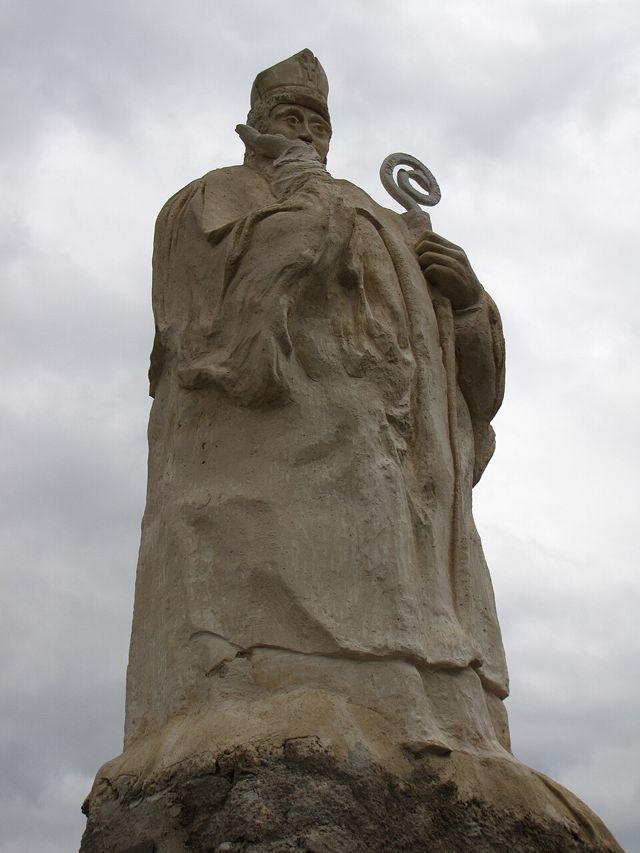
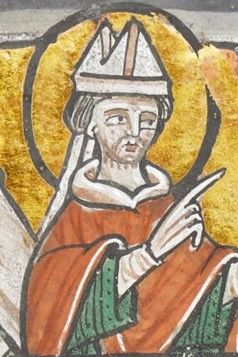
The first bishop of Arles was Trophimus, and the members of that Church like to think he was the favorite disciple of Saint Paul. However, this is purely a guess and very unlikely. He is also mentioned as one of the six companions of Saint Dionysius of Paris by Gregory of Tours, who indicates that this saint preached in Gaul in the middle of the third century. During the time of Decius, Martian, the bishop of Arles, supported the Novatian heresy. Martian was probably bishop around the year 252, and we can place Saint Trophimus around the year 250. In 417, Pope Zosimus wrote letters in support of Patroclus, the bishop of Arles, to the bishops of Gaul, and in one of these letters, he mentions Saint Trophimus as having been sent by the Holy See into Gaul and as having been the source of true faith there. If he had considered Trophimus to be the disciple of Saint Paul, sent by him and Saint Peter, he would likely have stated that. The first mention of Trophimus of Arles being identified with Trophimus, the disciple of Saint Paul, comes from the bishops of the province of Arles in 450. The tradition or belief began to be accepted then, and when their delegation met with Saint Leo that year, they presented Trophimus, the founder of the see of Arles, as having been sent into Gaul by Saint Peter. On the other hand, Pseudo Hippolytus claims that Trophimus was martyred alongside Saint Paul. However, he also states that Trophimus was one of the seventy disciples, which could not be true since no Gentile was among the seventy. The Greeks believe he suffered martyrdom with Saints Peter and Paul and commemorate their passion on the same day, October 29. Saint Crescens.
The Roman Martyrology confirms the identity of Trophimus of Arles with Trophimus, the disciple of Saint Paul.
Footnotes
- Gregory of Tours: a historian from the 6th century.
- Pseudo Hippolytus: a work attributed to Hippolytus, an early Christian writer.
- Roman Martyrology: a catalog of saints recognized by the Roman Catholic Church.
Baring-Gould’s own footnotes, in modern English.
Read the original 1870s text
Baring-Gould’s sources: Roman and Gallican Martyrologies. Usuardus, Ado, Notker, &c. By the Greeks on April 14 and 15, along with Aristarchus and Pudens. In some Menaeas on July 31, in all along with SS. Peter and Paul ot> ROPHIMUS and Tychicus, two natives of Asia Minor, accompanied S. Paul on his third missionary expedition. Both of them attended S. Paul from Macedonia on his return journey, as far as Asia Minor, where Tychicus remained; but Trophimus proceeded with the apostle to Jerusalem. There he was the innocent cause of the tumult in which S. Paul was apprehended. From the account we have given us of this tumult, we learn that Trophimus was an Ephesian and a Gentile. We hear no more of Trophimus for a long time; but in the last letter written by S. Paul, shortly before his martyrdom, from Rome, he mentions both Trophimus and Tychicus: the latter he had sent to Ephesus, of which place he, probably, like Trophimus, was a native; Trophimus had been left at Miletus, sick. From this we may conclude that the apostle had been shortly before in the Levant, and that Trophimus had accompanied him. Trophimus is probably one of the two brethren who, with Titus, conveyed the Second Epistle to the Corinthians to its destination. He was evidently closely attached to the apostle, and thoroughly in his confidence.
The first bishop of Arles was a Trophimus, and it pleases the members of that Church to suppose him to have been this favourite disciple of S. Paul. But this is quite conjectural, and very improbable. He is also spoken of as one of the six companions of S. Dionysius of Paris, by ‘6. Gregory of Tours [bishop and historian of the Franks (d. 594)], who represents that saint as having preached in Gaul [roughly modern France and Belgium] in the middle of the third century. In the time of Decius [Roman emperor 249–251, who ordered everyone to sacrifice to the gods], Martian, bishop of Arles, favoured the Novatian heresy. Martian probably was bishop in 252, and we may put S. Trophimus at 250. In 417 Pope Zosimus wrote letters in favour of Patroclus, bishop of Arles, to the bishops of Gaul, and in one of these he mentions S. Trophimus as having been sent by the Holy See into Gaul, and as having been the source of true faith there. Had he considered him as the disciple of S. Paul, and sent by him and S. Peter, he would probably have said so. The first instance of Trophimus of Arles being identified with Trophimus disciple of S. Paul, is by the bishops of the province of Arles in 450. The tradition or conceit began then to be received, and when their deputation waited on S. Leo in that year, they represented Trophimus, the founder of the see of Arles [a bishop’s “see” is his diocese, named from his seat (Latin sedes)], as having been sent into Gaul by S. Peter. On the other hand, Pseudo Hippolytus says that Trophimus suffered martyrdom along with S. Paul. But he also makes him one of the seventy disciples, which could not have been. No Gentile was of the seventy. The Greeks regard him as having suffered martyrdom with SS. Peter and Paul, and commemorate their passion on the same day, October 29. S. Crescens.
The Roman Martyrology asserts the identity of Trophimus of Arles with Trophimus disciple of S. PauL