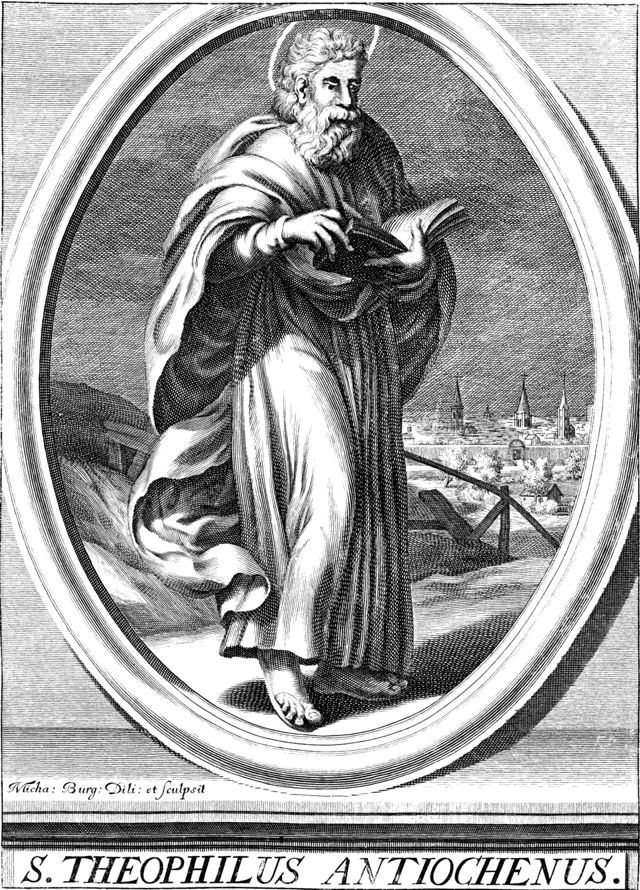
St. Theophilus of Antioch. I

Theophilus was born to Gentile parents and educated in philosophy. Theophilus was brought up in the darkness of paganism, j and he only learned the doctrines of Christianity by reading | the sacred Scriptures for the purpose of combating them.

Read the essentials →
Feast October 13 · Bishop

St. Theophilus of Antioch. I

Current feast

October 13
Secondary source · Wikipedia infobox

Traditional feast

October 13
1914 / pre-1969 calendar, per Baring-Gould (1897)

Represents

Bishop

Feast days

Feast: October 13

This Saint’s Story

Adapted in modern English from Alban Butler's Lives of the Saints · Baring-Gould original below · little is known

He came to the faith by reading the prophets and gospels. The doctrine of the resurrection troubled him for a long time, but he overcame his doubts through scripture and reflection on images of resurrection in nature. He tells this to his friend Autolychus.

He became bishop of Antioch in 168, after the death of Eros. He wrote against the heresies of Marcion and Hermogenes, and his three books to Autolychus, a defence of Christianity, survive. Baring-Gould's year is unclear in the text and is omitted.

Struggles & surrender

His struggles

  • Doubt about the resurrection ·
    Butler: the doctrine of the resurrection was long a stumbling-block to him, until he overcame it by reading scripture and reflecting on images of resurrection in nature.

What he represents

How he teaches us to live

Drawn from themes in the original account

Feed your mind with Scripture and good books. Learning and the Scriptures matter in this life.

Build up the community you belong to. Community life is part of this story.

The full story

Baring-Gould’s account retold in modern English

Read the full story · 69 words · about 1 min

...minus, the seventh from the apostles in the church of Antioch." It is uncertain how long he served as bishop. According to Eusebius, he served for eight years, but others say twelve or thirteen years. The latter estimate is the most likely; his work addressed to Autolycus was definitely written after the death of Marcus Aurelius, which was after A.D. 180. Only the three books to Autolycus have survived.

Footnotes

  1. Eusebius: a historian of the early Christian church.

Baring-Gould’s own footnotes, in modern English.

Read the original 1870s text

Baring-Gould’s sources: The “Mart. Parvum,” Ado, Usuardus, Notker, and other Latin artyrologies, the Modem Roman Martyrology. Authorities: — Euseb., “Hist. Eccl.,” iv. c. 24; S. Jerome, “CataL Script EccL,” c. 25.

Theophilus was brought up in the darkness of paganism, j and he only learned the doctrines of Christianity by reading | the sacred Scriptures for the purpose of combating them. But the study of these books, and especially of the Prophets, convinced him of the truth of Christianity. 1 We know no details of his career till the year 168, when Eros, fifth bishop of Antioch, died, when Theophilus was elected in his room. Eusebius [Eusebius of Caesarea (d. c. 339), the first historian of the Church] says: “ There are three books containing the ele* ments of the faith, addressed to Autolycus, which are ascribed to Theophilus, whom we have mentioned as Bishop of Antioch.

Another also, which has the title, ‘Against the heresy of Hermogenes/ in which he uses testimony from the Revelation of John, and also some catechetical works. And as the heretics, no less then than at any other time, were like tares destroying the pure seed of apostolic doctrines, the pastors of the churches everywhere hastened to restrain them as wild beasts from ravaging the fold of Christ. Sometimes they did it by their exhortations and admonitions to the brethren, sometimes more openly contending with the heretics themselves, in oral discussions and refutations, and then again confuting them in written works.

Theophilus, therefore, with others, also contended against these, as is manifest from a work of no mean character, written by him against Marcion, which together with the others we have mentioned, is still preserved. He was succeeded by MaxiS. Faustus and Others.
Help us add to this saint's story

Everything is read by a person before anything appears. Facts are checked against trusted sources first.

Facts are welcome; a source link helps (optional).With your permission we may share it on this page.

Nine days · Free

Pray the novena
with us.

One short email a day for nine days. The day's prayer, a line from St. Theophilus of…'s story, and a nudge to keep going.

Also on October 13
C

St. Carpus

October 13 · Feast
F

Sts. Faustus

October 13 · Martyr
F

St. Florentius

October 13 · Martyr
← All 1970 saints in the library
Sources & notes

Feast-day sources

Story sources

Sources

Credits

Image: Theophilus Antiochenus.png · William Cave · Public domain, via Wikimedia Commons

Image: William Cave, Wikimedia Commons (Public domain)

Retold in plain modern English from Baring-Gould’s public-domain text, sentence by sentence, keeping the same facts and order. Short explanations in parentheses are ours.

From Sabine Baring-Gould, The Lives of the Saints, new edition in 16 vols. (London: John C. Nimmo, 1897–98); text from the Internet Archive scan (OCR, lightly cleaned; errors possible). Public domain in the United States. Reproduced unedited, except for short bracketed notes in grey that we added to explain names and terms (“S.” is the old abbreviation for Saint). Some history and judgments reflect 19th-century scholarship.