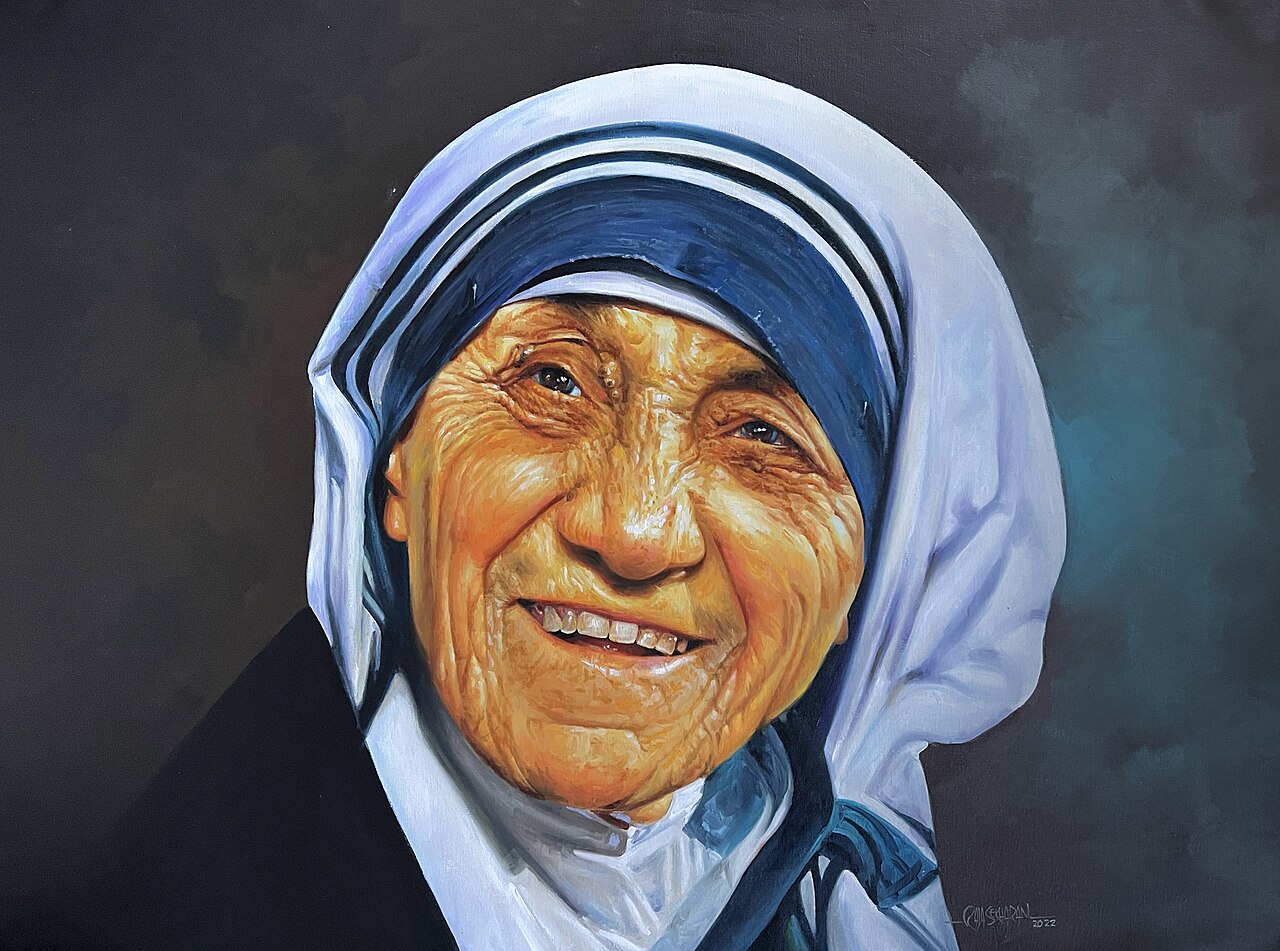
This Saint’s Story
Her father died suddenly when she was about eight, leaving the family poor, and her mother raised the children firmly and lovingly. Her parish, run by Jesuits (the Society of Jesus, founded by St. Ignatius of Loyola), fed her wish to be a missionary.
At eighteen she joined the Sisters of Loreto in Ireland, taking the name Teresa after St. Thérèse of Lisieux, and in January 1929 she arrived in Calcutta (Kolkata). She taught at St. Mary's School for girls for nearly twenty years, later as its principal.
On September 10, 1946, on a train to Darjeeling for her retreat, she received what she called a "call within a call": to serve Christ in the poorest of the poor. After two years of waiting for permission, she left the convent in August 1948 in a white sari with a blue border. She took a short nursing course, and in December went into the slums for the first time. Former students joined her, and in 1950 the Missionaries of Charity were founded. Houses followed across India and then on every continent, along with branches for brothers, priests, contemplatives and lay co-workers. She won the Nobel Peace Prize in 1979, accepting it, she said, in the name of the poor.
Only after her death did the world learn of her inner "darkness", a painful sense of being far from God that lasted from the start of her work to the end of her life, while she went on serving.
She died in Calcutta on September 5, 1997, when her sisters numbered nearly 4,000 in 123 countries. India gave her a state funeral. John Paul II beatified (declared 'Blessed', the step before sainthood) her in 2003 and Pope Francis canonized (officially declared a saint by the pope) her in 2016. Her feast is September 5.
