St. Telemachus

The historian Theodoret (5th-century bishop and church historian) tells the story briefly.

Read the essentials →
Feast January 1 · Hermit, Martyr

St. Telemachus

Current feast

January 1
Secondary source · Wikipedia infobox

Traditional feast

January 1
1914 / pre-1969 calendar, per Baring-Gould (1914)

Represents

Hermit
Martyr

Feast days

Feast: January 1

This Saint’s Story

Adapted in modern English from Baring-Gould (1914) · original text below

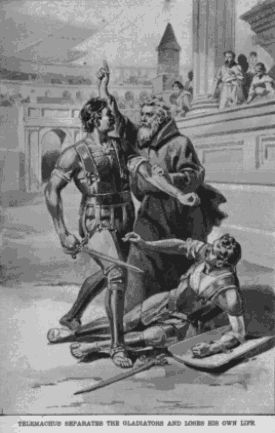
Telemachus was a monk who came to Rome from the East (some said from Nitria in Egypt, others from Phrygia) while gladiator shows were being staged. He watched from the stands, then went down into the arena and tried to pull the fighters apart. The crowd, furious at losing their sport, stoned him to death. When Emperor Honorius heard of it, he counted Telemachus among the martyrs and abolished the shows.

Baring-Gould sets the scene. For centuries young captives, slaves, criminals and even free men who sold themselves had been trained to kill one another for the amusement of Roman crowds, sometimes thousands in a day. There were some eighteen classes of fighter: blindfolded Andabatae, who made the crowd laugh, armored Hoplomachi, Mirmillones with a fish on the helmet matched against net-and-trident Retiarii. All were drilled and fed in 'families' by trainers who hired them out. Even high-born women had gone down to fight. These butcheries were often held at the gods' holiest festivals.

Since Tertullian (North African Christian writer, c. 200), Christian writers had protested, and emperors had issued edicts against the shows, but the mobs of the great cities were stronger than saints or emperors. Augustine recalled the horrible joy he had seen on the faces of the crowd. When Honorius revived the old Secular Games (an ancient Roman festival held roughly once a century) with gladiators, around 404, Telemachus leapt into the Colosseum and parted the combatants 'in the name of Christ and God'. His death brought a sudden change of heart: the games were forbidden for ever. The Colosseum, now useless, slowly crumbled, 'purified', men said, 'from the blood of tens of thousands by the blood of this true and noble martyr'.

What he represents

How he teaches us to live

Drawn from themes in the original account

Celebrate this saint’s feast day. Remember him on January 1 with a short prayer, and ask for his help.

The full story

Baring-Gould’s account retold in modern English

Read the full story · 672 words · about 3 min

The following account of the martyrdom of St. Telemachus is given by Theodoret in his Ecclesiastical History, book 5, chapter 26: "Honorius, who had received the empire of Europe, abolished the ancient exhibitions of gladiators in Rome for the following reason: A certain man named Telemachus, who had embraced a monastic life, came from the East to Rome at a time when these cruel spectacles were being held. After watching the combat from the amphitheater, he descended into the arena and tried to separate the gladiators. The bloodthirsty spectators, possessed by the devil, who delights in the shedding of blood, were angered by the interruption of their savage sports and stoned him for causing the disruption. Upon learning of this, the admirable Emperor honored him as one of the victorious martyrs and abolished these wicked spectacles."

For centuries, the mass killings of the gladiatorial shows had continued throughout the Roman Empire. Human beings, in the prime of youth and health—captives or slaves, condemned criminals, and even free-born men who volunteered for death—had been trained to kill each other in the amphitheater for the amusement of not only the Roman mob but also the Roman ladies. Thousands had been "butchered to make a Roman holiday," sometimes in a single day.

The training of gladiators had become a science. They were categorized into regular classes based on their weapons, armor, and fighting styles, with antiquarians counting up to eighteen distinct types. Andabatæ wore helmets without eye openings, forcing them to fight blindfolded, which amused the spectators. Hoplomachi fought in complete suits of armor. Mirmillones had fish images on their helmets and fought with short swords, usually matched against Retiarii, who fought without armor and used a casting net and a trident. These and other types of fighters were trained and fed in "families" by lanistæ (professional trainers), who rented them out to those wishing to put on a show. In earlier times, even high-born women had been seized by the madness of fighting and, as shameless as they were cruel, had entered the arena to entertain the Roman people with their own wounds and blood.

And these things happened, and they happened too often under the approval of the gods and during their most sacred festivals. Such a deliberate and organized system of mass slaughter has probably never existed on this earth before or since, not even in the worship of those Mexican gods, whose idols Cortez and his soldiers found fed with human hearts, and the walls of their temples covered with human blood. Gradually, the spirit of the Gospel had been overcoming this abomination. Ever since the time of Tertullian, in the second century, Christian preachers and writers had raised their voices in the name of humanity. Towards the end of the third century, the Emperors themselves had begun to yield to the voice of reason by forbidding gladiatorial fights through edicts. However, public opinion among the crowds in most of the great cities had been too strong for both Saints and Emperors. Augustine himself tells us about the horrible joy that he, in his youth, witnessed on the vast ring of flushed faces at these dreadful spectacles. The weak Emperor Honorius thought about celebrating once again the pagan festival of the Secular Games and formally allowed an exhibition of gladiators. But, in the middle of that show, this monk Telemachus jumped into the arena of the Colosseum in Rome. Some said he came from Nitria, while others said he was from Phrygia, and he personally separated the combatants in the name of Christ and God. The crowd, momentarily deprived of their enjoyment, attacked him and stoned him to death. However, this crime was followed by a sudden change in public sentiment. By an edict of the Emperor, gladiatorial games were banned forever; and the Colosseum, from that point on useless, slowly crumbled into the vast ruin that remains to this day, purified, as people said, from the blood of tens of thousands by the blood of this true and noble martyr.

Footnotes

  1. Some said he came from Nitria, while others said he was from Phrygia.

Baring-Gould’s own footnotes, in modern English.

Read the original 1870s text

The following account of the martrydom of S. Telemachus is given by Theodoret, in his Ecclesiastical History, book v., chap. 26:—"Honorius, who had received the empire of Europe, abolished the ancient exhibitions of gladiators in Rome on the following occasion:—A certain man, named Telemachus, who had embraced a monastic life, came from the East to Rome at a time when these cruel spectacles were being exhibited. After gazing upon the combat from the amphitheatre, he descended into the arena, and tried to separate the gladiators. The bloodthirsty spectators, possessed by the devil, who delights in the shedding of blood, were irritated at the interruption of their savage sports, and stoned him who had occasioned the cessation. On being apprised of this circumstance, the admirable Emperor numbered him with the victorious martyrs, and abolished these iniquitous spectacles."

For centuries the wholesale murders of the gladiatorial shows had lasted through the Roman empire. Human beings, in the prime of youth and health, captives or slaves, condemned malefactors, and even free-born men, who hired themselves out to death, had been trained to destroy each other in the amphitheatre for the amusement, not merely of the Roman mob, but of the Roman ladies. Thousands, sometimes in a single day, had been

"Butchered to make a Roman holiday."

The training of gladiators had become a science. By their weapons, and their armour, and their modes of fighting, they had been distinguished into regular classes, of which the antiquaries count up full eighteen: Andabatæ, who wore helmets, without any opening for the eyes, so that they were obliged to fight blindfold, and thus excited the mirth of the spectators; Hoplomachi, who fought in a complete suit of armour; Mirmillones, who had the image of a fish upon their helmets, and fought in armour, with a short sword, matched usually against the Retiarii, who fought without armour, and whose weapons were a casting-net and a trident. These, and other species of fighters, were drilled and fed in "families" by lanistæ, or regular trainers, who let them out to persons wishing to exhibit a show. Women, even high-born ladies, had been seized in former times with the madness of fighting, and, as shameless as cruel, had gone down into the arena, to delight with their own wounds and their own gore, the eyes of the Roman people.

And these things were done, and done too often under the auspices of the gods, and at their most sacred festivals. So deliberate and organized a system of wholesale butchery has never perhaps existed on this earth before or since, not even in the worship of those Mexican gods, whose idols Cortez and his soldiers found fed with human hearts, and the walls of their temples crusted with human gore. Gradually the spirit of the Gospel had been triumphing over this abomination. Ever since the time of Tertullian, in the second century, Christian preachers and writers had lifted up their voice in the name of humanity. Towards the end of the third century, the Emperors themselves had so far yielded to the voice of reason, as to forbid, by edicts, the gladiatorial fights. But the public opinion of the mob, in most of the great cities, had been too strong both for Saints and for Emperors. S. Augustine himself tells us of the horrible joy which he, in his youth, had seen come over the vast ring of flushed faces at these horrid sights. The weak Emperor Honorius bethought himself of celebrating once more the heathen festival of the Secular Games, and formally to allow therein an exhibition of gladiators. But, in the midst of that show, sprang down into the arena of the Colosseum of Rome, this monk Telemachus, some said from Nitria [a desert monastic settlement west of the Nile Delta], some from Phrygia, and with his own hands parted the combatants, in the name of Christ and God. The mob, baulked for a moment of their pleasure, sprang on him, and stoned him to death. But the crime was followed by a sudden revulsion of feeling. By an edict of the Emperor, the gladiatorial sports were forbidden for ever; and the Colosseum, thenceforth useless, crumbled slowly away into that vast ruin which remains unto this day, purified, as men well said, from the blood of tens of thousands, by the blood of this true and noble martyr. [14]
Patron saint of

  • Opponents of blood sports
    He died stopping a gladiator fight, and the games were then abolished (Theodoret).

Help us add to this saint's story

Everything is read by a person before anything appears. Facts are checked against trusted sources first.

Facts are welcome; a source link helps (optional).With your permission we may share it on this page.

Nine days · Free

Pray the novena
with us.

One short email a day for nine days. The day's prayer, a line from St. Telemachus's story, and a nudge to keep going.

Also on January 1
C

The Circumcision of Our…

January 1 · Feast
C

St. Concord

January 1 · Priest, Martyr
E

Sts. Elvan and Mydwyn

January 1 · Feast
← All 1970 saints in the library
Sources & notes

Feast-day sources

Story sources

Sources

Credits

Image: Telemachus.JPG · John Foxe. · Public domain, via Wikimedia Commons

Image: John Foxe., Wikimedia Commons (Public domain)

Retold in plain modern English from Baring-Gould’s public-domain text, sentence by sentence, keeping the same facts and order. Short explanations in parentheses are ours.

From Sabine Baring-Gould, The Lives of the Saints, new and revised edition (Edinburgh: John Grant, 1914; first edition 1872). Public domain in the United States. Reproduced unedited, except for short bracketed notes in grey that we added to explain names and terms (“S.” is the old abbreviation for Saint). Some history and judgments reflect 19th-century scholarship.