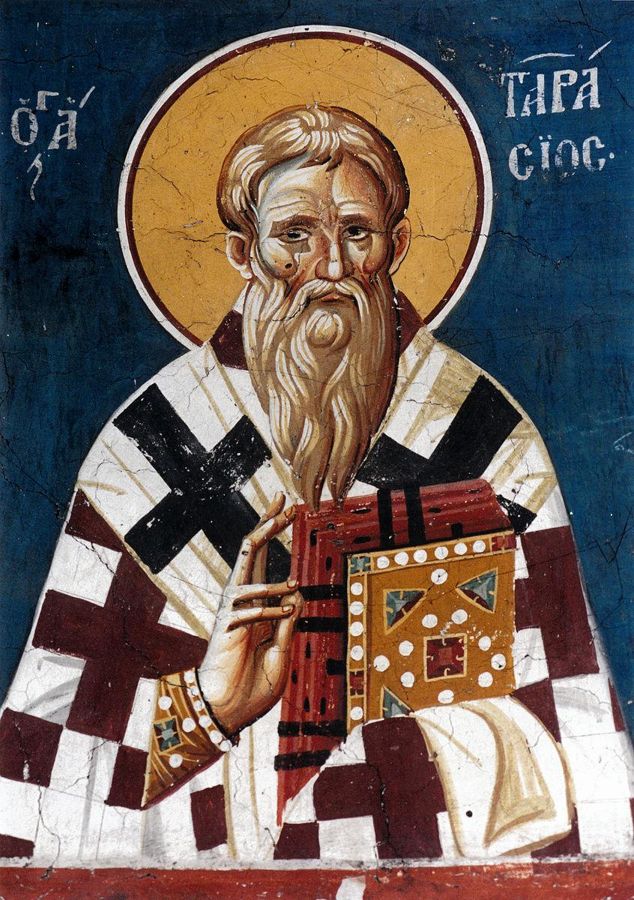
St. Tarasius of Constantinople

Tarasius was Patriarch of Constantinople from 784 until his death on 25 February 806.

Read the essentials →
Feast February 25 · Patriarch

St. Tarasius of Constantinople

Current feast

February 25 (also listed: February 18)
Secondary source · Wikipedia infobox

Traditional feast

February 25
1914 / pre-1969 calendar, per Baring-Gould (1897)

Represents

Patriarch

Feast days

Feast: February 25

This Saint’s Story

The Catholic Encyclopedia says his date of birth is unknown. He was the son of George, a patrician and prefect of the city, and his wife Eukratia. He entered the service of the State, and in 784, when Patriarch Paul IV died, he was an imperial secretary and a known defender of the veneration of images. Paul may have recommended him to the Empress Irene, regent for her son Constantine VI. At a great assembly before the Magnaura Palace the people named Tarasius the worthiest candidate.

Tarasius at first refused. He called himself unworthy and said it was risky to raise a layman to the see. He also said the Church of Constantinople was cut off from the Catholics of the West and from the other Eastern patriarchates. He would accept only if Church unity were restored and an ecumenical council called together with the pope. This was agreed, and he was consecrated on 25 December 784. Pope Hadrian (Roman emperor 117–138) I disapproved of a layman being raised straight to the episcopate against the canons, but he recognised Tarasius because of his orthodoxy. With the pope and the court, Tarasius then convened the Second Council of Nicaea (787), the Seventh Ecumenical Council, which rejected Iconoclasm and restored union with Rome.

Hard years followed. Strict monks blamed him for restoring bishops who had once been iconoclasts (the movement to destroy religious images) and had since submitted. They also accused him of tolerating simony (buying or selling church offices). He denied this in writing and issued a severe synodal letter against simonists. When Constantine VI put away his lawful wife to marry Theodata, Tarasius refused to perform the marriage. The monks led by Plato of Saccudium and Theodore of Studium still judged him too weak toward the emperor, and the encyclopedia notes that Theodore later changed his view of him. After Irene deposed Constantine in 797, Tarasius deposed the priest Joseph who had performed the marriage, and peace returned. He lived simply, curbed clerical luxury, preached zealously, and was generous to the poor. The Roman Martyrology (the Church's official list of saints for each day) names him on 25 February.

What he represents

How he teaches us to live

Drawn from themes in the original account

Pray a little every day. Prayer is part of this story.

Stay faithful when it costs you. Holding firm under pressure is part of this story.

Practise small acts of self-denial. Fasting and penance are part of this story. Skipping a snack or setting your phone aside for an hour is a start.

The full story

Baring-Gould’s account retold in modern English

Read the full story · 3,156 words · about 14 min

The Incarnation of God was the descent of the Most High to meet human needs. People had difficulty believing in and loving the Infinite; human language could only express the nature of God through many abstractions and negations. He was not limited, did not have a specific location, and was not understandable by humans; this is what the philosophers taught, and they tried to make people believe it. People made the effort to believe, but in doing so, their devotion faded. The philosophers had elevated God to the realm of an idea, and in doing so, they stripped Him of His personality. When His personality was lost, all interest in Him faded away. To them, God became an object of speculation rather than an object of worship. God the Father, knowing that humans naturally struggle to grasp the Godhead, sent His Son into the world, taking on human flesh. Now, people had a God-Man, whose nature and personality were clearly presented for them to believe in and love. God was "manifest in the flesh"; the visible and the invisible, the spiritual and the material, the finite and the infinite, the local and the omnipresent were united in One. From that point on, God's interactions with humanity were to align with their natural abilities. The visible would become the means to understand the invisible, the material would serve as the vehicle for the spiritual, the omnipresent would be made known through a local presence, and the infinite would be discernible through the finite. In Jesus Christ, people saw God and lived; and when He was taken from their sight, He did not leave them as orphans, but continued His presence in the Holy Eucharist, even until the end of the world.

In the ancient pagan world, people were either idolaters or philosophers. The idolater saw his God in a material image, while the philosopher claimed that God was present everywhere and looked down on the idol. Christianity brought together the truth taught by the philosopher and the longing felt by the idolater. Through the sacraments, which are outward and visible means, grace was given to humanity, primarily through the Holy Eucharist. Worship was directed to God through sacred images and the holy cross. The law of the Incarnation is that through the seen, one reaches the unseen, and from the unseen, one comes to humanity through the seen.

At first, because of the idolatry that surrounded them, the early Christians did not think it wise to introduce images into their churches. Idolatry was so widespread that the first lesson they had to teach the non-believers was about the omnipresence of God. However, when paganism was overcome, the danger of idolatry diminished, and the risk shifted in the opposite direction. People began to emphasize the infinite nature of the Godhead and denied the possibility of God becoming local through incarnation. They were willing to accept that Christ was inspired by a divine influence, but not that He was truly and eternally God. Therefore, it became essential for the Church to make every effort to impress upon people's minds and hearts the truth that God had become fully human, sharing in the substance of His mother. Consequently, pictures and images were introduced into churches. We must remember that the Church, in defending the truth, had to take on seemingly contradictory positions, because the truth was twofold. This helps us understand how she initially opposed images and later defended them. She did not contradict herself; her stance was compelled by the need to uphold a dual truth.

The use of images was widely accepted in the East when Emperor Leo the Isaurian decided to abolish the practice. The conflict began around the year 725. He was opposed by Pope Gregory II, Germanus, the patriarch of Constantinople, and Saint John Damascene. The first wrote passionately to him about this issue. He argued that the Word, by making Himself visible in a human body, subjected Himself to all the conditions of being a man. He maintained that just as it was lawful to represent any man, whether an emperor or a prince, it was also lawful to create representations of Christ. However, he stated that Christians do not worship the cloth on which the picture is painted or the stone from which the statue is carved. Instead, they use these visible representations as a means of recalling the memory of the saints and elevating their minds to God. He denied that images received divine honors, but if someone says, "Lord Jesus, save us," before an image of Christ, "Holy Mother of God, intercede with Your Son for us," before one of the Virgin, and "Intercede for us," before one of a Martyr, these prayers are not directed to the image but to Christ, the Holy Virgin, or the Saint that the figure is meant to represent.

Constantine Copronymus, the son of Leo, followed in his father's footsteps. To better establish his purpose, he called a council in A.D. 754 at Constantinople, which was made up of 338 bishops. The council began its sessions in February and concluded in August. The Western Church, along with the patriarchates of Alexandria, Antioch, and Jerusalem, was not represented at this council. Thus, it was composed of prelates who were under the direct control of the emperor, gathered in his imperial city, surrounded by guards. Unfortunately, the majority of these bishops had a time-serving and obsequious attitude that characterized and disgraced the episcopal order in the Eastern Empire for many centuries. This council decreed the destruction of images in churches and the erasure of paintings on the walls.

By the authority of the emperor, a significant part of the Eastern Church accepted and executed this decree. However, Irene, who had married Leo the Fourth, the son of Constantine Copronymus, though a cruel and ambitious woman, perhaps out of caprice, took the opposite side. After the death of her husband, during the minority of her son Constantine, who was only ten years old, she assumed the regency. She halted the brutal persecution of the monks and the ruthless destruction of images that had continued without interruption during the three preceding reigns. Paul III, the patriarch of Constantinople, had been appointed to that position by the late emperor. He was a timid man who wanted to remain in favor with the court, so he had submitted to the emperor's will regarding images. However, he was a good and charitable man, greatly loved by the poor. When he realized that the Iconoclasts were now out of favor and fearing for his own safety, he suddenly resigned from his patriarchal position and took refuge in a monastery.

The empress and her son visited him and tried to persuade him not to go through with his decision, but they found him resolute. Tarasius, an officer of the court known for his piety, was then appointed patriarch, despite his strong objections. He declared that he would not accept the office until a council had been convened that showed the characteristics of being ecumenical, which the previous council had lacked, and that could resolve the differences that had troubled the Eastern Church. Once this was agreed upon, he was formally declared patriarch and was consecrated soon after, on Christmas Day.

His first action was to write letters to the patriarchs of Rome, Alexandria, Antioch, and Jerusalem, calling for a general council. Pope Adrian sent two priests to serve as his representatives, and the Eastern bishops did the same. The council gathered on August 1, 786, in the Church of the Apostles in Constantinople. However, a disturbance broke out, and soldiers besieged the bishops in the church, attempting to disrupt the council. As a result, it was postponed until the following year, when it met in Nicæa. The papal representatives sat first, followed by Tarasius, the patriarch of Constantinople, and then the representatives of the Eastern bishops, who could not attend themselves because they were not allowed by the Saracen conquerors. After them came Agapetus, the bishop of Cæsarea in Cappadocia, John, the bishop of Ephesus, Constantine, the metropolitan of Cyprus, along with 250 bishops and archbishops, over 100 priests and monks, and two commissioners from the emperor and empress to maintain order.

The first session took place on September 24, 787, in the Church of S. Sophia. It began with the reading of a letter from Empress Irene and the emperor, in which they assured the bishops that they had convened the synod with the agreement of the patriarchs and that they allowed the bishops full freedom to express their opinions. They stated that Paul, the last patriarch of Constantinople, had acknowledged his mistake in accepting the decrees of the council of the Iconoclasts, had left his position, and had caused Tarasius to be elected in his place. Tarasius had initially refused the honor, but after being urged to accept it, he requested that a council be held to resolve the division in the Church regarding images. Therefore, this council was convened in response to his request. In conclusion, the empress and her son encouraged the bishops to judge honestly and bravely, in line with Catholic doctrine and practice. They also mentioned that letters had been received from Pope Adrian, which would be read to the assembly.

After this, many of the prelates who had supported the Iconoclasts or had accepted the decrees, noticing that the political climate had shifted, changed their positions with eager compliance. Among them were Basil, the bishop of Ancyra, Theodosius of Myra, Theodosius of Amorn, Hypatius of Nicæa, and others, who now admitted that they honored sacred images.

In the next session, the letters of Pope Adrian were read. He declared that images are useful for teaching the ignorant and for awakening piety and remorse. He also demanded that all archbishops in his patriarchate should receive ordination from the bishop of Rome. Additionally, he insisted that the primacy of the see of Rome should be recognized universally, and that the patriarch of Constantinople should be prevented from claiming the title of "Universal Bishop." The Greek fathers did not transcribe these latter points. The historian Dupin suggests that the Pope's legates likely did not think it wise to present them at that moment.

A letter from Adrian to Tarasius was then read. In it, the Pope expressed his concern over the news of a layman being appointed to the influential see of Constantinople. He urged Tarasius to work towards condemning the synod that had forbidden images in churches. After this letter was read, the Papal legates asked Tarasius if he approved of it. He replied that he did, and that he reverently honored the images of Christ, the Holy Virgin, and the saints. However, he stated that true adoration and worship (latria) are due only to God. The synod approved of this statement.

Our English word "worship" has a different meaning today than it did in the past. Nowadays, worship means to adore as God, with supreme reverence, and such worship cannot be given to any creatures, no matter how exalted. However, the old meaning of the word did not carry this weight and was synonymous with reverence. For example, in the Anglican prayer book, during the marriage service, the husband says to the wife, "With my body I thee worship," meaning to honor her. Magistrates are also referred to as "worshipful." When Protestants accuse Catholics of worshipping images, they are correct in one sense but incorrect in another. Catholics do show respect and honor to sacred images, but they do not give them the kind of honor implied by the modern sense of the word "worship." In the old sense of the word, a sailor worships the quarterdeck when he touches his cap as he passes it. A soldier worships the royal standard when he presents arms to it, and peers worship the throne when they bow to it upon taking their places in the House of Lords.

In the third session of the council, a letter from the patriarch of Jerusalem, approved by his bishops, was read. In this letter, he acknowledged that reverence and honor should be shown to sacred images.

In subsequent sessions, the acts of the Iconoclastic Council at Jerusalem were examined and refuted in order. The council concluded with the usual acclamations and prayers for the prosperity of the emperor and empress. After this, synodal letters containing the decrees were sent to all churches. Pope Adrian approved of everything that had been decreed and sent copies of the Acts to France, where pictures and images were used historically, but no honor, such as burning candles or offering incense before them, was allowed.

Upon receiving these copies, Charlemagne wrote, or had written, or published under his name, a work that examined the decrees of the second council of Nicæa, which was authored by some bishops, with Alcuin as the chief. This work rejected these Acts and opposed image-worship. It maintained that respect was due to pictures and statues of the Saviour and the Saints, but denied the right to offer them any sort of religious honor, such as lighting candles or incensing them. This work was presented to Pope Adrian by Engilbert, the ambassador of Charlemagne, and it prompted a response from the pope. However, this response did not change the practice of the Gallican Church. In the Council of Frankfort, held in 794, the decrees related to the worship of images passed by the second Council of Nicæa were rejected, as they were again in a council held at Paris in 824.

Meanwhile, Tarasius, obedient to the decrees of the synod, restored holy images throughout his patriarchate. His life was a model of perfection for both clergy and laity. He lived a quiet, austere life amidst magnificence and luxury. He minimized the expenses of his household and gave to the poor what he had saved. He often took dishes of meat from his table to distribute among the poor with his own hands and assigned them a large annual revenue. To ensure that none were overlooked, he visited every house and hospital in Constantinople. His teachings focused on the mortification of the senses, and he was particularly severe against all theatrical entertainments, which at that time encouraged and spread licentiousness.

Some time later, the emperor became infatuated with Theodota, a maid of honor to his wife, the empress Mary. After being married for seven years, in 795, he decided to divorce the empress. He made every effort to persuade the patriarch to support him. He sent an officer to inform the patriarch that a plot by the empress to poison him had been discovered. However, St. Tarasius received the request to divorce the emperor and marry him to Theodota with a stern refusal. "Tell him that I would rather suffer death and all kinds of torments than consent to his plan."

The emperor, hoping to win him over with flattery, summoned him to the palace and said, "I can conceal nothing from you, whom I regard as my father. No one can deny that I may divorce someone who has attempted my life. The Empress Mary deserves death or perpetual penance." He then produced a vessel full of poison, which he claimed she had prepared for him. The patriarch, rightly judging this to be an attempt to deceive him, responded that he was convinced that the emperor's passion for Theodota was the true reason behind all his complaints against the empress. He boldly declared to Constantine that even if she were guilty of the crime alleged against her, a second marriage during her lifetime would be adulterous.

The monk John, who had been the legate of the Eastern patriarchs at the council in Nicæa, was also present and spoke resolutely to the emperor. The emperor was so angered that he expelled them both from his presence, and John narrowly escaped with his life. Once they were gone, he expelled the empress Mary from the palace and forced her to take the veil. Tarasius continued to refuse to marry the emperor to Theodota, and the ceremony was performed by Joseph, the treasurer of the church of Constantinople. From that point on, the patriarch became a target of persecution by the emperor, who placed spies around him, allowed no one to speak with him without permission, and banished many of his relatives and servants. This confinement gave the patriarch more time for prayer and contemplation.

Meanwhile, the ambitious Irene, unhappy at no longer being in charge of the administration, plotted to dethrone her son. The secret was kept for over eight months until the emperor, suspicious of his safety, fled from Constantinople, intending to appeal to the provinces and armies. This hasty escape left the empress on the edge of a precipice. She sent a private letter to the friends she had placed around him, threatening that unless they acted, she would reveal their treason. Their fear made them bold. They seized the emperor on the Asian shore and brought him back to Constantinople, where his mother and the other conspirators decided to make him incapable of ruling by blinding him. Her agents attacked the sleeping prince and stabbed his eyes. He survived for several years, oppressed by the court and forgotten by the world, while his unnatural mother regained the power he had taken from her by reaching adulthood. She reigned for five years, during which she recalled all the banished and favored the Catholics. However, she was eventually conspired against by the high treasurer, Nicephorus, who was secretly invested with the imperial purple and crowned at St. Sophia by the patriarch. The empress was exiled to the island of Lesbos, where she was forced to earn a meager living by spinning wool until her proud spirit consumed her, and she died of grief.

Under Nicephorus, Saint Tarasius continued peacefully with his practices of penance and his responsibilities as a pastor. During his final illness, he offered the holy Sacrifice daily for as long as he was able to move. A little before his death, he fell into a trance, as the author of his life, who witnessed the scene, recounts. In this trance, he was heard arguing with several accusers who were busy examining his entire life and questioning his actions. He appeared to be fearful and agitated, defending himself against all the accusations made against him. This caused fear among those present, as they witnessed the efforts of the enemy of man trying to find some fault in the life of such a holy and blameless bishop. However, a great calm followed, and the holy man peacefully surrendered his soul to God on February 25th, in the year 806, having served for twenty-one years and two months. God honored his memory with miracles, some of which are described by the author of his life. His feast began to be celebrated under his successor.

Footnotes

  1. Emperor Leo the Isaurian was a Byzantine emperor known for his opposition to the use of religious images.
  2. Saint John Damascene was an important theologian and defender of the veneration of icons.
  3. The council was held in A.D. 754.
  4. Paul III was the patriarch of Constantinople.
  5. Tarasius was an officer of the court.
  6. Empress Irene was a Byzantine empress who ruled in the late 8th century.
  7. The Iconoclasts were those who opposed the veneration of icons in the Church.
  8. Dupin was a historian known for his works on church history.
  9. Tarasius was the patriarch of Constantinople.
  10. St. Sophia refers to the Hagia Sophia, a famous cathedral in Constantinople.
  11. February 25th, in the year 806, having served for twenty-one years and two months.

Baring-Gould’s own footnotes, in modern English.

Read the original 1870s text

Baring-Gould’s sources: By Greeks and Latins on the same day. Authority:—His life by Ignatius, deacon and keeper of the sacred vessels at Constantinople, afterwards bishop of Nicæa, a disciple of Tarasius; also the Church historians of the period.

The Incarnation of God was the descent of the Most High to the level of human necessity. Man had found a difficulty in believing in and loving the Infinite; human language failed to express the nature of God save by a multitude of abstractions and negations. He was not limited, had no localized habitation, was not comprehensible by man; so the philosophers taught, and so they strove to make men believe; men made the effort, believed, and in the effort, their devotion expired. The philosophers had lifted God into the region of an idea, and in so doing, had divested him of personality; and when His personality was lost, all interest in Him died away. God was to them an object of speculation, not an object of worship. God the Father, knowing man's natural incapacity for realizing the Godhead, sent His Son into the world clothed in flesh. Man had now a God-Man, whose nature and personality had been brought vividly before him to believe in and to love. God was "manifest in the flesh," the visible and the invisible, the spiritual and the material, the finite and the infinite, the local and the omnipresent were united in One. Thenceforth the law of God's dealings with man was to be in accordance with his natural capacities, the visible was to become the medium of the invisible, the material the vehicle of the spiritual, the omnipresent adorable through a local presence, the infinite discernible through the finite. In Jesus Christ men saw God and lived; and when He was withdrawn from the eyes of men, He did not leave them orphans, but perpetuated his presence in the Holy Eucharist, even unto the end of the world.

In the old heathen world men had been idolaters or philosophers. The idolater saw in the material image his God; the philosopher declared that God was everywhere present, and he despised the idol. Christianity combined in one the truth taught by the philosopher, and the craving felt by the idolater. Through the sacraments as outward and visible means, grace was conveyed to man, chiefly through the Holy Eucharist; and through sacred images and the holy cross, worship was addressed to God. Through the seen to the unseen, to God; from the unseen through the seen to man, is the law of the Incarnation.

At first, on account of the idolatry which surrounded them, the early Christians did not deem it prudent to introduce images into their churches. Idolatry was so prevalent, that the first lesson they had to insist upon to the heathen, was the omnipresence of God; but when heathenism was conquered, the danger of idolatry ceased, and the peril was in the other direction; men began to insist on the infinity of the essence of the Godhead, and to deny the possibility of His becoming local by incarnation. They were ready to admit that Christ was inspired with a divine afflatus, but not that He was very and eternal God. Then, at once, it became necessary for the Church to use her every effort to impress on men's minds and hearts the truth that God had become very man, of the substance of His mother. Then pictures and images were introduced into churches. We must remember that the Church, to defend the truth, had to assume successively opposite positions, for the truth was double,—if we are to understand how she first opposed images, and then defended them. She did not contradict herself, her attitude was forced upon her, to maintain a two-fold truth.

The use of images was commonly received in the east, when the Emperor Leo the Isaurian, resolved to abolish the practice. The contest began about the year 725. He was opposed by Pope Gregory II., Germanus, patriarch [the title of the bishops of the great ancient sees: Rome, Constantinople, Alexandria, Antioch, Jerusalem] of Constantinople, and S. John Damascene. The first wrote vehemently to him on this subject. He maintained that the Word by having rendered Himself visible in taking a human body, subjected Himself to all conditions of a man, and that as it was lawful to represent any man, emperor or prince, so it was lawful to make representations of Christ. But, said he, Christians do not worship the cloth on which the picture is painted, nor the stone out of which the statue is hewn, but they use these visible representations as means of renewing the memory of the saints, and of raising up the mind to God. He denied that images received divine honours, but if "Lord Jesus, save us," be said before an image of Christ, "Holy Mother of God, intercede with Thy Son for us," before one of the Virgin, and "Intercede for us," before one of a Martyr; these prayers are not addressed to the image, but to Christ, or the Holy Virgin, or the Saint whom the figure is designed to portray.

Constantine Copronymus, the son of Leo, followed in his father's steps, and for the better establishing his purpose, he called together a council ( a.d. 754) at Constantinople, composed of 338 bishops. It began its sittings in February and ended in August. The Western Church, and the patriarchates of Alexandria, Antioch, and Jerusalem, were not represented at this council, which was thus composed of prelates under the immediate control of the emperor, gathered together in his imperial city, surrounded by guards, and, unfortunately, the majority of these bishops partook of that time-serving and obsequious disposition which characterised and disgraced the episcopal order in the Eastern Empire for many centuries. This council decreed the destruction of images in churches, and the erasure of paintings on the walls. [70]

By the authority of the emperor, a great part of the Eastern Church received and executed this decree; but Irene, who had married Leo the Fourth, son of Constantine Copronymus, though a cruel, ambitious woman, espoused, perhaps out of caprice, the opposite side, and on the death of her husband, during the minority of her son Constantine, who was but ten years old, assumed the regency, and stopped the savage persecution of the monks, and the ruthless destruction of images which had proceeded without intermission through the three preceding reigns. Paul III., patriarch of Constantinople, had been raised to that dignity by the late emperor. Being a timid man, desirous of remaining in favour with court, he had bowed to the will of the emperor in the matter of images. But he was a good and charitable man, greatly beloved by the poor. Finding that the Iconoclasts were now out of favour, and fearing for himself, he suddenly resigned his patriarchal see, and took refuge in a monastery.

The empress and her son visited him, and endeavoured to dissuade him from his intention, but found him resolved. Tarasius, an officer of the court, noted for his piety, was then appointed patriarch, in spite of his urgent remonstrance. He declared that he would not accept the office till a council had been called, which exhibited those marks of being œcumenical which the former council had lacked, and which might compose the differences which had agitated the Eastern Church. This being agreed to, he was solemnly declared patriarch, and was consecrated soon after, on Christmas Day.

His first act was to write synodal letters to the patriarchs of Rome, Alexandria, Antioch, and Jerusalem, convening a general council. Pope Adrian sent two priests to act as his legates, and the Eastern bishops did the same. The council assembled on the 1st August, 786, in the Church of the Apostles at Constantinople, but a tumult having broken out, and the soldiers having besieged the bishops in the church, and endeavoured to break up the council, it was adjourned till the following year, when it met at Nicæa. The papal legates sat in the first place, then Tarasius, patriarch of Constantinople, then the deputies of the Eastern bishops, who were themselves unable to attend because not permitted by the Saracen conquerors, afterwards Agapetus, bishop of Cæsarea, in Cappadocia [a region of central Turkey], John, bishop of Ephesus, Constantine, metropolitan [the archbishop who heads a group of dioceses] of Cyprus, with 250 bishops and archbishops, and above 100 priests and monks, and two commissioners of the emperor and empress to maintain order.

The first session was held on the 24th September, 787, in the Church of S. Sophia; it opened with the reading of the letter of the empress Irene and the emperor, wherein they assured to the bishops that they had assembled the synod with the consent of the patriarchs, and that they left the bishops at full liberty to speak their minds; that Paul, the last patriarch of Constantinople, acknowledging his fault in having received the decrees of the council of the Iconoclasts, had quitted his see, and had caused Tarasius to be elected in his room; that Tarasius had refused the dignity, but having been urged to accept it, had required a council to be held to suppress the schism which divided the Church on the subject of images; and that, therefore, in accordance with his request, this council was convened. In conclusion, the empress and her son exhorted the bishops to judge truthfully and courageously, in accordance with Catholic doctrine and practice; and they said that letters had been received from Pope Adrian, which should be read to the assembly.

After this many of the prelates who had taken part with the Iconoclasts, or had submitted to the decrees, seeing that the direction of the courtly breeze had changed, veered round with obsequious readiness. Such were, Basil, bishop of Ancyra, Theodosius [name of Roman emperors; Theodosius I (379–395) made Christianity the state religion] of Myra, Theodosius of Amorn, Hypatius of Nicæa, and others, who now acknowledged that they reverenced sacred images.

In the next session the letters of Pope Adrian were read, declaring the utility of images as means of teaching the ignorant, and of awakening piety and compunction. He demanded also that all archbishops of his patriarchate should receive ordination from the bishop of Rome, and that the primacy of the see of Rome [a bishop’s “see” is his diocese, named from his seat (Latin sedes)] should receive general recognition, as also that the patriarch of Constantinople should be prevented from assuming the title of "Universal Bishop." These latter articles were not transcribed by the Greek fathers. Dupin, the judicious historian, suggests that probably the legates of the Pope did not judge it prudent at that moment to present them. A letter from Adrian to Tarasius was then read, expressing the trouble given to the Pope by the news of the nomination of a layman to the influential see of Constantinople, and exhorting him to procure the condemnation of the synod which had forbidden images in churches. After the reading of this letter, the Papal legates asked Tarasius whether he approved of it. He answered that he did, and that he did reverently honour the images of Christ, the Holy Virgin, and the saints, but that to God alone was due true adoration and worship (latria). Of this the synod approved. Our English word worship has got at the present time a meaning which it had not of old. Worship now means to adore as God, with supreme reverence; and such worship may not be given to creatures, however exalted; but the old signification of the word had not this force, but was synonymous with reverence. Thus, in the Anglican prayer book, in the marriage service, the husband says to the wife, "With my body I thee worship," i.e. , honour; and magistrates are called the "worshipful." When Protestants accuse Catholics of worshipping images, in one sense they are right, but in another sense they are wrong. Catholics do worship sacred images so far as to render them respect and honour, but they do not give to them that honour which is implied by the word "worship" in its modern sense. In the old signification of the word, the sailor worships the quarterdeck when he touches his cap on passing it, the soldier worships the royal standard when he presents arms to it, and the peers the throne when they bow to it on taking their places in the House of Lords.

In the third session of the council, a letter from the patriarch of Jerusalem, approved by his bishops, was read, wherein he acknowledged that reverence and honour were to be shown to sacred images.

In subsequent sessions the acts of the Iconoclastic Council at Jerusalem were examined and refuted in order, and the council closed with the usual acclamations and prayers for the prosperity of the emperor and empress; after which synodal letters containing the decrees were sent to all churches. Pope Adrian approved of all that had been decreed, and sent copies of the Acts into France, where pictures and images were used historically, but no honour, such as burning candles or offering of incense before them, was allowed. On receiving these copies, Charlemagne [king of the Franks, crowned emperor in 800] wrote, or caused to be written, or put forth under his name, a work containing an examination of the decrees of the second council of Nicæa, by some of the bishops, of whom Alcuin was chief. This contained a repudiation of these Acts, and a rejection of image-worship. It maintained that respect was due to pictures and statues of the Saviour and the Saints, but refused the right of offering them any sort of religious honour, as by lighting candles and incensing them. This work was presented to Pope Adrian by Engilbert, the ambassador of Charlemagne, and it drew forth from the pope an answer which, however, did not alter the practice of the Gallican Church, for in the Council of Frankfort, held in 794, the decrees relative to the worshipping of images passed by the second Council of Nicæa were rejected, as was the case again in a council held at Paris, in 824. Tarasius, in the meantime, obedient to the decrees of the synod, restored holy images throughout the extent of his patriarchate. His life was a model of perfection to both clergy and laity. He lived a quiet, austere life, in the midst of magnificence and luxury. He reduced to the smallest possible amount the expenses of his household, and gave to the poor what he had economised. He often took the dishes of meat from his table to distribute among them with his own hands: and he assigned them a large annual revenue. And that none might be overlooked, he visited every house and hospital in Constantinople. His discourses turned on the mortification of the senses, and he was particularly severe against all theatrical entertainments, which served then to encourage and diffuse licentiousness. Some time after, the emperor became enamoured of Theodota, a maid of honour to his wife, the empress Mary, and, after having spent seven years in marriage, in 795, he resolved to divorce the empress. He used every effort to gain the patriarch. He sent an officer to him to inform him that a plot of the empress to poison him had been discovered. S. Tarasius, however, received the request to divorce the emperor, and marry him to Theodota, with a stern refusal. "Tell him that I will rather suffer death and all manner of torments than consent to his design." The emperor, hoping to prevail with him by flattery, sent for him to the palace, and said, "I can conceal nothing from you, whom I regard as my father. No one can deny but I may divorce one who has attempted my life. The Empress Mary deserves death or perpetual penance." He then produced a vessel, full of the poison, which he pretended she had prepared for him. The patriarch, with good reason, judging this to be an attempt to impose upon him, answered, that he was too well convinced that his passion for Theodota was at the bottom of all his complaints against the empress. He boldly declared to Constantine that even if she were guilty of the crime laid to her charge, a second marriage during her lifetime would be adulterous. The monk John, who had been legate [an official representative sent by the pope] of the Eastern patriarchs in the council at Nicæa, being present, also spoke resolutely to the emperor, who was so irritated that he drove them both out of his presence, and John narrowly escaped with his life. As soon as they were gone, he turned the empress Mary out of the palace and obliged her to assume the veil. Tarasius persisted in his refusal to marry him to Theodota, and the ceremony was performed by Joseph, the treasurer of the church of Constantinople. The patriarch became thenceforth an object of persecution to the emperor, who placed spies about his person, suffered no one to speak with him without their leave, and banished many of his relations and servants. This confinement gave the patriarch more leisure for prayer and contemplation. In the meantime, the ambitious Irene, discontented at being no longer at the head of the administration, formed a conspiracy to dethrone her son. The secret was faithfully kept above eight months, till the emperor, suspicious of his danger, escaped from Constantinople, with the design of appealing to the provinces and armies. By this hasty flight the empress was left on the brink of a precipice. She addressed a private epistle to the friends whom she had placed about his person with a menace that, unless they accomplished, she would reveal, their treason. Their fear rendered them intrepid. They seized the emperor on the Asiatic shore, and transported him to Constantinople, where his mother and the other conspirators decided to render him incapable of the throne by blinding him. Her emissaries assaulted the sleeping prince, and stabbed their daggers into his eyes. He survived for several years, oppressed by the court, and forgotten by the world; whilst his unnatural mother resumed the sovereign power, of which he had divested her by becoming of age. She reigned for five years, during which she recalled all the banished, and favoured the Catholics. But she was in turn conspired against by the high treasurer, Nicephorus, who was secretly invested with the purple, and crowned at S. Sophia by the patriarch. The empress was sent into exile in the isle of Lesbos, where she was obliged to earn a scanty subsistence by the labours of her distaff, till her haughty spirit consuming her, she died of grief.

Under Nicephorus, S. Tarasius persevered peaceably in his practices of penance, and in the functions of his pastoral charge. Through his last sickness he continued to offer daily the holy Sacrifice as long as he was able to move. A little before his death he fell into a trance, as the author of his life, who was an eye-witness of the scene, relates, wherein he was heard disputing with a number of accusers, very busy in sifting his whole life, and objecting to his actions. He seemed to be in fear and agitation, and defending himself against everything laid to his charge. This filled all present with fear, seeing the endeavours of the enemy of man to find some condemnation in the life of so holy and so irreprehensible a bishop. But a great serenity succeeded, and the holy man gave up his soul to God in peace, on the 25th of February, in 806, having sat twenty-one years and two months. God honoured his memory with miracles, some of which are related by the author of his life. His festival began to be celebrated under his successor.
Help us add to this saint's story

Everything is read by a person before anything appears. Facts are checked against trusted sources first.

Facts are welcome; a source link helps (optional).With your permission we may share it on this page.

Nine days · Free

Pray the novena
with us.

One short email a day for nine days. The day's prayer, a line from St. Tarasius of…'s story, and a nudge to keep going.

Also on February 25
V

Sts. Victorinus

February 25 · Martyrs
A

Sts. Ananias and…

February 25 · Priest, Martyrs
C

St. Cæsarius

February 25 · Confessor
← All 1970 saints in the library
Sources & notes

Feast-day sources

Story sources

Sources

Credits

Image: Agios Tarasios Peribleptos.jpg · Wikimedia Commons · Public domain, via Wikimedia Commons

Image: Wikimedia Commons, Wikimedia Commons (Public domain)

Retold in plain modern English from Baring-Gould’s public-domain text, sentence by sentence, keeping the same facts and order. Short explanations in parentheses are ours.

From Sabine Baring-Gould, The Lives of the Saints, new edition in 16 vols. (London: John C. Nimmo, 1897), digitized text from Project Gutenberg. Public domain in the United States. Reproduced unedited, except for short bracketed notes in grey that we added to explain names and terms (“S.” is the old abbreviation for Saint). Some history and judgments reflect 19th-century scholarship.

Notes

Story retold in our own words from the cited sources.