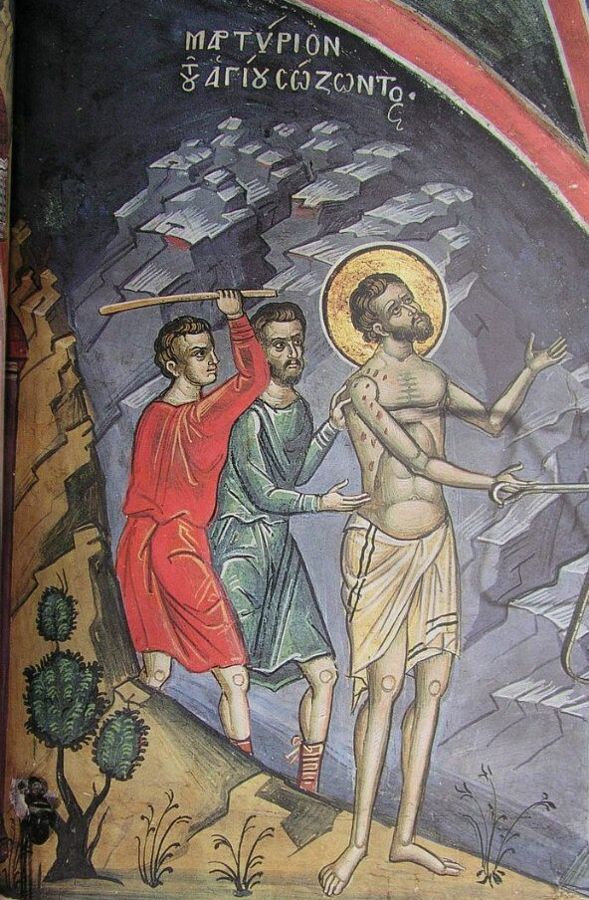
Maximian asked, “Where do you come from?” Sozon replied, “From the village of Midarze.” Maximian then asked, “What brought you here?” Sozon answered, “I am a shepherd boy, and I wander from place to place with my flock.”
Maximian continued, “What made you commit this act of audacity?” Sozon said, “I wanted to show that I am a Christian and that I think you are impious. That is why I cut off the hand of the idol.” Maximian responded, “Come now, worship the gods, and we will overlook this first act of audacity.”
Sozon replied, “What god, that one-handed fellow? I would be ashamed to honor such a god who cannot defend himself against my crook.”
Maximian turned to the executioners and said, “Torture him.” Then Sozon prayed, “Lord Jesus, help Your servant.” Maximian said, “There is still time. Do what I tell you, and you will be spared from torture.”
Sozon replied, “Fool! Do you not see that I did this to prove myself a Christian? I do not fear your torments, and I despise that filthy idol.”
Maximian ordered nails to be driven into Sozon's shoes and that the boy should walk around the arena. Sozon did so, and blood spurted from his torn feet, reddening his skin above his ankles. As he passed Maximian's tribunal, he pointed to his feet and said, “By my hope! You are not as well-shod as I am in crimson.” Maximian responded, “Why, fellow, you bear it bravely.” Sozon answered, “I feel nothing.” Then the magistrate said, “Play your pipe, and by the gods, I will spare you.”
Sozon replied, “I have played many pretty songs for my sheep, but now I will not play for you; I will sing to God.” Maximian ordered, “Burn him to death and silence his accursed tongue.”
Then the martyr walked joyfully to the pile of wood smeared with tar. A fire was set to it, and the flames rushed up around him and consumed him. As evening came, a heavy thunderstorm arose, roaring over the city. The hail and rain drove the guards from the court to seek shelter. Taking advantage of the storm and darkness, the Christians came at night and carried off the scorched bones of the martyr.
Read the original 1870s text
Baring-Gould’s sources: The Greek Menaea and Menologies. Inserted by Baronins in the Roman Martyrology. Authorities: — The Greek Acts, later, but containing, apparently in them the genuine notarial Acts.] When Maximian was governor of Cilicia there was a shepherd boy, named originally Tarasius, who took in baptism the name of Sozon. This boy loved God with all his heart, and sought to advance His kingdom and glory by every means that lay in his feeble power. Now one day, when his heart was full of what he heard, how that Christian men and women were being haled before judgment seats, and delivered over to be tormented, and how they warred a good warfare, and finished their course, and bound about their brows the wreaths of unfading flowers, he lay down under a great oak beside a murmuring spring that bubbled out of a rock, and fell asleep. Then he dreamt that the Lord Jesus stood before him, and said, “ Sozon, lay aside thy bow and the three arrows that are in thy quiver, and come and follow me to death.” Then the lad jumped up and hid his weapons under the rock, and with only his shepherd’s crook in his hand he went straight into the city of Pompeiopolis, and entering a temple, he struck a golden idol there with his crook and broke off the right hand. Then he further broke the hand, and divided the bits among the poor. Now when the sacrilege was discovered there was great commotion, and many innocent persons were arrested on suspicion. When Sozon saw this he went boldly into the court, and without a pallor on his fresh cheek, or his limbs trembling, he stood forward before the governor, Maximian, and said, “ Let these go free, I knocked the hand off the image; and I have given the gold fingers of that infamous idol to the poor.” Then Maximian said, “ What is thy name ?” Sozon. “ If thou desirest my name by which I am most commonly known, I am called Tarasius, as named by my parents; but I was called Sozon when made a Christian.”
Maximian [Diocletian’s co-emperor in the West, 286–305]. “ Whence come you ?” Sozon. “ From the village of Midarze.” Maximian. “ What brought you hither ?” Sozon. “I am a shepherd boy, I wander from place to place with my flock.”
Maximian. “ And what induced you to commit this act of audacity ?” Sozon. “ I wished to show that I was a Christian, and that I thought you impious. That is why I struck off the hand of the idol/' Maximian. “ Come now, adore the gods, and we will look over this first audacity.”
Sozon. “What god, that one-handed fellow? I should be ashamed to venerate such a god as that, who cannot help himself against my crook.”
Maximian, turning to the executioners, said, “ Rack his limbs.” Then Sozon said, “Lord Jesus I help thy servant.” Maximian. “ There is yet time. Do what I bid you, and you shall be spared torture.”
Sozon. “ Fool ! do you not see that I did this deed to prove myself a Christian ? I fear not your torments, and I despise that filthy idol.”
Maximian ordered nails to be driven into his shoes, and that the boy should be made to walk round the arena. Sozon did so, and the blood spirted from his torn feet, so that his skin was reddened above his ankles. As he passed the tribunal of Maximian, he pointed to his feet and said, “ By my hope ! you are not as gaily booted as I am in crimson.” “ Why, fellow/' said Maximian, “ you bear it bravely.” “ I feel nothing/' answered the shepherd lad. “ Then tune your pipe,” said the magistrate, “ and by the gods I will spare you.”
“ Of old I have piped many a pretty song to my sheep/’ said the boy, “ now I will not pipe to you, but sing to God.” “ Burn him to death/' said Maximian, “ and silence his accursed tongue.”
Then the martyr walked gladly to the pile of wood smeared with tar, a fire was set to it, and the flame rushed up around him, and consumed him. Now as evening came on, a heavy thunderstorm arose, and roared over the city, and the hail and rain drove the keepers from the court under cover, and taking advantage of the storm and darkness the Christians came by night and carried off the scorched bones of the martyr.