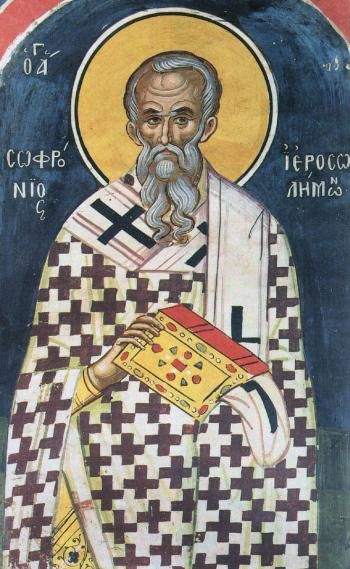
This Saint’s Story
With his friend John Moschus he travelled widely through the East and also went to Rome. He probably became a monk in Egypt about 580 and later settled in Palestine. He is commonly identified with Sophronius the rhetorician, called the Sophist. Baring-Gould, the text on this page, says that when Chosroes of Persia took Jerusalem he fled for a time to his friend St John the Almsgiver, Patriarch of Alexandria, who supported him until he could return—an episode that fits the Persian sack of 614, years before his patriarchate.
From 633 until his death he was the principal opponent of Monothelitism (the claim that Christ had only a divine will, not also a human one). In 634, conspicuous for learning and piety, he became Patriarch of Jerusalem. He held a synod there against the Monothelites and, according to Baring-Gould, sent a synodal letter on the question to Pope John IV. He gathered some six hundred testimonies of the Fathers for the two wills of Christ; that large work has perished. Among his surviving writings are a Life of John the Almoner, written with Moschus and only partly preserved; lives of Sts Cyrus and John; probably a Life of St Mary of Egypt; ten homilies rich in dogma and oratory; and many anacreontic odes that place him among Greek ecclesiastical poets.
During his reign he sorrowfully watched the Arab conquest of Palestine and the capture of Jerusalem, which the Catholic Encyclopedia treats as the great trial of his patriarchate. He died at Jerusalem, probably on 11 March 638. Greek calendars and the Roman Martyrology (the Church's official list of saints for each day) keep his memory. He is Sophronius of Jerusalem, the patriarch and writer, not to be confused with other ecclesiastical writers of the same name in the Greek East.
