St. Severinus of Noricum

Our source is Eugippius, a monk who knew him and wrote his life in 511. He called her out into the midst of the people, and asked her why she, a noble woman and free-born, had made herself a slave to avarice, which is idolatry.

Read the essentials →
Feast January 8 · Priest, Apostle

St. Severinus of Noricum

Current feast

January 8
Secondary source · Wikipedia infobox

Traditional feast

January 8
1914 / pre-1969 calendar, per Baring-Gould (1914)

Represents

Priest
Apostle

Feast days

Feast: January 8

This Saint’s Story

In our own words · little is known

Severinus appeared in Noricum, on the Danube in present-day Austria, soon after Attila's death in 453. He refused to say where he came from, though his Latin suggested an African or Italian background.

While Roman rule collapsed, he organized the frontier towns. He set up food relief, ransomed captives, warned towns of raids, and negotiated with Rugian and Alamannic chiefs. He predicted the rise of Odoacer, who later ruled Italy. He died at Favianis on January 8, 482. His monks later carried his body to Italy when the Romans evacuated the province.

What he represents

How he teaches us to live

Drawn from themes in the original account

Pray a little every day. Prayer is part of this story.

Give to people in need. The account records care for the poor.

Make time for silence. Time alone in prayer is part of this story.

The full story

Baring-Gould’s account retold in modern English

Read the full story · 3,526 words · about 15 min

In the middle of the fifth century, the province of Noricum (now known as Austria) was a major route for invading barbarians. It was the center of chaos, where Huns, Allemanni, Rugii, and many other wild tribes fought among themselves and surrounded the starving and besieged towns of what had once been a happy and fertile province. Each tribe was trying to overpower the others and march southward, over their corpses, to plunder what little remained of the already looted wealth of Italy and Rome. The differences in race, language, and customs between the conquered and their conquerors were made even more painful by their differing beliefs. The conquering Germans and Huns were either Arians or pagans. The conquered people, who called themselves Romans because they spoke Latin and lived under Roman law, were orthodox Catholics. The usual miseries of invasion were often compounded by the additional suffering of religious persecution.

It was around the year 455-460. Attila, the great King of the Huns, who called himself—and who was—"the Scourge of God," had just died. His empire had fallen apart. The entire center of Europe was in a state of anarchy and war, and the unfortunate Romans along the Danube were in a state of extreme fear, not knowing which new invader would come to destroy their crops right up to the gates of their walled towns, which were their only defense. At that moment, a man of God appeared among them, coming from the East.

He would not reveal who he was. His speech indicated that he was an African Roman—a fellow countryman of Saint Augustine—likely from the area around Carthage. He had certainly once gone to a desert in the East, eager to learn "the more perfect life." He said his name was Severinus, a name that suggested high status, as did his manners and education. However, he would not disclose anything more about himself. "If you think I am a runaway slave," he said with a smile, "prepare money to redeem me when my master demands me back." He believed that they would need him, that God had sent him to that land to help its suffering people. He could not have come to the vicinity of Vienna at that moment for any other reason than to do good, unless he had come to trade in slaves.

He first settled in a town called Casturis, according to his biographer. He stayed with the warden of the church and lived a quiet hermit life. Meanwhile, the German tribes were roaming around the town. One day, Severinus went into the church and began to warn the priests, clergy, and all the people that destruction was coming, which they could only avoid through prayer, fasting, and acts of mercy. They mocked him, trusting in their strong Roman walls, which the invaders—wild horsemen who had no siege engines—could not scale or break down. Severinus immediately left the town, prophesying, as it was said, the exact day and hour of its downfall. He went to the next town, which was then heavily guarded by a barbarian force, and repeated his warning there. While the people were listening to him, an old man came to the gate and told them that Casturis had already been sacked, just as the man of God had predicted. He entered the church, fell at the feet of S. Severinus, and said that he had been saved by Severinus's merits from being destroyed along with his fellow townsmen.

Then the people of the town listened to the man of God and devoted themselves to fasting, almsgiving, and prayer for three whole days.

On the third day, when the evening sacrifice was completed, a sudden earthquake occurred. The barbarians, seized with panic and likely hating and fearing—like all those wild tribes—the confinement of four stone walls, instead of the free, open life of the tent and stockade, forced the Romans to open their gates. They rushed out into the night and, in their madness, killed each other.

In those days, a famine struck the people of Vienna. As their only remedy, they decided to send for the man of God from the nearby town. He went and preached to them about repentance and giving to the poor. It seemed that the wealthy had hoarded their supplies of grain, leaving the poor to starve. At least, Saint Severinus discovered (it was believed through divine revelation) that a widow named Procula was among those hoarding grain. He called her out in front of the people and asked her why, as a noble and free-born woman, she had made herself a slave to greed, which is a form of idolatry. He told her that if she would not give her grain to Christ's poor, she should throw it into the Danube River to feed the fish, as she would gain nothing from it. Procula felt ashamed and willingly distributed her hoarded grain to the poor. Shortly after that, to everyone's astonishment, ships came down the Danube loaded with all kinds of merchandise. These ships had been trapped in thick ice near Passau for many days, but the prayers of God's servant had opened the ice gates and allowed them to float down the river earlier than usual.

Then, wild German horsemen surrounded the city walls and captured as many people and cattle as they could find. Severinus, like an old Hebrew prophet, did not hesitate to suggest that they should strike hard when necessary. Mamertinus, the tribune (an officer in command), told him that he had very few soldiers, and those were poorly armed, so he was afraid to confront the enemy. Severinus replied that they should take weapons from the barbarians themselves; the Lord would fight for them, and they should remain silent. He added that if they captured any enemies, they should bring them safely to him. At the second milestone from the city, they encountered the plunderers, who fled immediately, leaving their weapons behind. Thus, the prophecy of the man of God was fulfilled. The Romans returned the captives to him unharmed. He released their bonds, provided them with food and drink, and let them go. However, he instructed them to tell their comrades that if they ever approached that area again, divine retribution would come upon them, for the God of the Christians fought from heaven in His servant's cause.

So the barbarians trembled and left. The fear of Saint Severinus fell upon all the Goths, who were heretic Arians, and on the Rugii, who lived on the north bank of the Danube during those troubled times. Meanwhile, Saint Severinus left Vienna and built himself a cell at a place called "At the Vineyards." However, a benevolent impulse—what his biographer calls a divine revelation—prompted him to return and build a cell on a hill near Vienna, around which other cells soon appeared, occupied by his disciples. "There," his biographer says, "he longed to escape the crowds of men who used to come to him and to draw closer to God in continual prayer. But the more he longed for solitude, the more often he was warned by revelations not to deny his presence to the suffering people." He fasted constantly and went barefoot even in the harsh winter, which, the story goes, was so severe around Vienna at that time that wagons crossed the Danube on solid ice. Yet, instead of becoming arrogant due to his own virtues, he set an example of humility for everyone and tearfully urged them to pray for him, so that the gifts the Saviour had given him would not lead to his condemnation.

Saint Severinus seems to have gained immense influence over the wild Rugii. Their king, Flaccitheus, would share his sorrows with him and tell him how the princes of the Goths would surely kill him. When he had asked for permission to travel to Italy, Saint Severinus would not let him go. However, Saint Severinus prophesied that the Goths would not harm him. He only had one warning to heed: "Let it not trouble him to seek peace even for the least of men."

The friendship that began between the barbarian king and the educated Saint continued with his son Feva. However, his "deadly and noxious wife," Gisa, who seems to have been a fierce Arian, always, according to his biographer, held him back from showing mercy. One story about Gisa's misdeeds is so representative of the customs of the time and the style of the original biography that I will include it in full.

The King Feletheus (who is also known as Feva), the son of the previously mentioned Flaccitheus, began, at the start of his reign, to frequently visit the holy man, following his father's devotion. His deadly and harmful wife, named Gisa, always prevented him from seeking the remedies of mercy. Among the many evils she committed, she even attempted to have certain Catholics re-baptized. However, when her husband refused to agree, due to his respect for Saint Severinus, she quickly abandoned her sacrilegious plan. Nevertheless, she imposed harsh conditions on the Romans and ordered some of them to be exiled to the Danube River.

One day, while she was in the village near Vienna, she ordered some of them to be sent across the Danube and condemned to the most menial tasks of slavery. The man of God sent a message to her, asking that they be released. But she, filled with rage, commanded that the harshest response be sent back. "I pray you," she said, "servant of God, hiding there in your cell, allow us to decide what we want regarding our own slaves." Upon hearing this, the man of God replied, "I trust in my Lord Jesus Christ that she will be compelled by necessity to fulfill what she has disregarded in her wicked will."

Immediately, a swift rebuke followed, bringing low the prideful woman. She had confined certain barbarian goldsmiths in close custody so they could make royal ornaments. On the very day the queen had disrespected the servant of God, the son of the king, named Frederick, who was still a young boy, had entered their presence in a playful manner. The goldsmiths held a sword to the child's chest, declaring that if anyone attempted to enter without swearing an oath of protection, that person would die. They threatened to kill the king's child first and then themselves, as they had lost all hope of survival after being imprisoned for so long.

When Gisa heard this, the cruel and impious queen, tearing her garments in grief, cried out, "O servant of God, Severinus, are the injuries I inflicted upon you being avenged in this way? Have you, through your earnest prayers, brought this punishment upon my own flesh and blood?" Then, running around in deep remorse and miserable lamentation, she admitted that she was suffering the consequences of her contempt for the servant of God. She immediately sent knights to seek forgiveness and ordered the release of the Romans, whose prayers she had previously disregarded. The goldsmiths, having received a promise of safety, released the child and were likewise set free.

The most reverend Severinus, when he heard this, gave endless thanks to the Creator. He sometimes delays the prayers of those who ask for help so that as faith, hope, and charity grow while lesser things are sought, He may grant greater things. Ultimately, the mercy of the Omnipotent Savior worked in such a way that it brought a free woman, who was excessively cruel, into slavery. She was forced to restore freedom to those who were enslaved. After this miraculous event, the queen hurried with her husband to the servant of God. She showed him her son, who, she admitted, had been saved from the brink of death by his prayers. She promised that she would never go against his commands.

This period of Severinus' life includes the famous story of his meeting with Odoacer, the first barbarian king of Italy, and brother of the great Onulf or Wolf. Onulf was the founder of the Guelph family, Counts of Altorf, and direct ancestors of Victoria, Queen of England. Their father was Ædecon, who had once been a secretary for Attila and was the chief of the small tribe of Turklings. Although they were German, they had remained loyal to Attila's sons and faced ruin at the great battle of Netad, which marked the collapse of the Hunnic Empire. After that, Odoacer and his brother traveled over the Alps to seek their fortunes in Italy. They intended to serve, like many young German adventurers, with the Romans. They arrived at S. Severinus' cell and entered, likely as heathens, to ask for a blessing from the holy man. Odoacer had to stoop down and remain bent over because of his enormous size. The Saint recognized that he was no ordinary young man and said, "Go to Italy, even though you are dressed in ragged sheepskins: you will soon give greater gifts to your friends."

So Odoacer went to Italy, deposed the last of the Cæsars, a weak boy named Romulus Augustulus, and found himself, to his own surprise and that of the entire world, as the first German king of Italy. When he reached the peak of his power, he remembered Severinus' prophecy and sent for him, offering to grant him any request he desired. However, all that the Saint asked for was that Odoacer forgive some Romans whom he had banished. Meanwhile, S. Severinus foresaw that Odoacer's kingdom would not last, as he seemed to have foreseen many things. When certain German knights were boasting before him about Odoacer's power and glory, he stated that it would last about thirteen, or at most fourteen years. The prophecy, as everyone said at that time, came true exactly.

There is no need to follow the details of Saint Severinus's work over twenty-five years of constant self-sacrifice—and, as far as this world was concerned, constant disaster. Eugippius's chapters are little more than a list of towns that were sacked one after another, from Passau to Vienna, until the miserable survivors of the war seemed to have gathered under Saint Severinus's protection in the latter city. We also find stories of famine, locust swarms, and small victories over the barbarians, which do not prevent overall defeat. Yet through it all, Saint Severinus worked tirelessly like a true man of God, making peace with the invading leaders, redeeming captives, securing supplies of clothing for the cities that were still standing for the refugees, and persuading farmers, seemingly across large areas, to give even in times of scarcity a tenth of their produce to the poor;—a truly noble effort.

Eugippius recounts many wonders in his life of Saint Severinus. According to the story, the reader learns how a man who had secretly performed a pagan sacrifice was discovered by Saint Severinus because, while the candles of the rest of the congregation were miraculously lit from heaven, his candle alone would not light. He records how the Danube River dared not rise above the mark of the cross that Saint Severinus had carved on the posts of a wooden chapel; how a poor man, who went out to drive the locusts away from his small patch of corn instead of staying in church all day to pray, found the next morning that only his crop had been eaten, while all the surrounding fields remained untouched. He also recounts the well-known story, which has a certain eeriness about it, of how Saint Severinus kept vigil all night by the coffin of the dead priest Silvinus. Before dawn, he commanded him, in the name of God, to speak to his brethren; and how the dead man opened his eyes, and Severinus asked him whether he wished to return to life. He answered with a complaint, "Do not keep me here any longer; nor deny me the eternal rest that I have already found," and so, closing his eyes once more, he remained still forever.

At last, the noble life came to an end. For two years, Severinus had predicted that his death was near; and he also foretold that the people for whom he had devoted himself would go forth in safety, like Israel out of Egypt, and find refuge in another Roman province, leaving behind such utter desolation that the barbarians, in their search for the hidden treasures of the civilization they had destroyed, would dig up the very graves of the dead. However, when the Lord chose to deliver them, they must carry his bones with them, just as the children of Israel carried the bones of Joseph.

Then Severinus sent for Feva, the Rugian king, and Gisa, his cruel wife. When he had warned them that they must give an account to God for the people entrusted to their care, he stretched his hand out to the king's chest. "Gisa," he asked, "do you love the soul within that breast more, or gold and silver?" She answered that she loved her husband above all. "Then cease," he said, "to oppress the innocent, lest their suffering leads to your downfall."

Severinus' prediction was strangely fulfilled. Feva had handed over the city of Vienna to his brother Frederick—"poor and impious," says Eugippius. Severinus, who knew him well, sent for Frederick and warned him that he himself was going to the Lord. He told Frederick that if, after his death, he dared to take anything from the poor and the captive, God's wrath would fall upon him. In vain, the barbarian pretended to be innocent; Severinus sent him away with further warnings.

"Then on the nones of January, he was slightly struck with pain in his side. When that pain continued for three days, at midnight he called the brethren to come to him." He renewed his discussion about the coming emigration and again requested that his bones not be left behind. After bidding everyone to come near and kiss him, and after receiving the most Holy Sacrament, he forbade them to weep for him and commanded them to sing a psalm. They hesitated, weeping. He himself began the psalm, "Praise the Lord in His saints, and let all that has breath praise the Lord," and then he went to rest in the Lord.

No sooner had he died than Frederick seized the garments kept in the monastery for the use of the poor. He even commanded his men to carry off the vessels of the altar. Then a scene typical of that time followed. The steward sent to do the deed hesitated at the crime of sacrilege. A knight named Anicianus went in his place and took the vessels of the altar. However, his conscience was too strong for him. Trembling and delirium overcame him, and he fled to a lonely island, where he became a hermit. Frederick, unrepentant, took everything from the monastery, leaving only the bare walls, "which he could not carry over the Danube." But vengeance also fell upon him. Within a month, he was slain by his own nephew.

Then Odoacer attacked the Rugii and captured Feva and Gisa, bringing them to Rome. After that, the long-promised emigration occurred. Odoacer, whether out of mere policy (as he was trying to establish a half-Roman kingdom in Italy) or out of love for S. Severinus himself, sent his brother Onulf to bring the miserable remnant of the Danubian provincials into Italy. They were to be distributed among the devastated and depopulated farms of Italy. Along with them went the corpse of S. Severinus, which remained undecayed despite having been dead for six years, and it gave off an extraordinary fragrance, although (according to Eugippius) no embalmer's hand had touched it. The body was laid in a coffin that had long been prepared for it, placed on a wagon, and transported over the Alps into Italy, performing (according to Eugippius) the usual miracles along the way, until it found a resting place near Naples, in that very villa of Lucullus at Misenum, where Odoacer had sent the last Emperor of Rome to live out his ignoble life in helpless luxury.

So ends this tragic story. There can be no doubt about its truth. M. Ozanam has aptly described that deathbed scene between the saint and the barbarian king and queen: "The history of invasions has many a pathetic scene, but I know none more instructive than the dying agony of that old Roman expiring between two barbarians, less touched by the ruin of the empire than by the peril of their souls." But even more instructive, and more tragic as well, is the strange coincidence that the wonder-working corpse of the starved and barefooted hermit should rest beside the last Emperor of Rome. It symbolizes a new era. The kings of this world have been judged and cast out. The empire of the flesh is destined to perish, while the empire of the spirit will conquer from now on forevermore.

Relics are in the church of S. Severino at Naples.

He is the patron (but not the sole patron) of Austria, Vienna, and Bavaria.

Footnotes

  1. The town of Casturis was sacked as predicted by S. Severinus.
  2. Procula was a widow who hoarded grain during a famine.
  3. Mamertinus was an officer in command of the soldiers.
  4. Gisa attempted to have certain Catholics re-baptized.
  5. The goldsmiths threatened to kill the king's child first.
  6. Gisa confessed her contempt for the servant of God.
  7. Ædecon was a secretary for Attila, the ruler of the Huns.
  8. Eugippius was a biographer of Saint Severinus.
  9. Eugippius: a Christian writer and biographer of Severinus.
  10. Eugippius was a biographer of S. Severinus.

Baring-Gould’s own footnotes, in modern English.

Read the original 1870s text

Baring-Gould’s sources: Roman Martyrology and those of Germany. The life of S. Severinus was written by his disciple, Eugippius, in the year 511, as he states in a letter to Paschatius, the deacon. The following life is extracted from Mr. Kingsley's "Hermits," [34] with certain necessary modifications. What has been once well done, the author is unwilling to do again, and do in an inferior manner.

In the middle of the fifth century the province of Noricum (Austria, as we should now call it), was the very highway of invading barbarians, the centre of the human Maelstrom, in which Huns [nomadic invaders from Central Asia, led in the 5th century by Attila], Allemanni, Rugii, and a dozen wild tribes more, wrestled up and down, and round the starving and beleaguered towns of what had once been a happy and fertile province, each tribe striving to trample the other under foot, and to march southward, over their corpses, to plunder what was still left of the already plundered wealth of Italy and Rome. The difference of race, of tongue, and of manners, between the conquered and their conquerors, was made more painful by difference in creed. The conquering Germans and Huns were either Arians [followers of Arius, who taught that the Son is a created being, not fully God] or heathens. The conquered race (though probably of very mixed blood), who called themselves Romans, because they spoke Latin, and lived under the Roman law, were orthodox Catholics; and the miseries of religious persecution were too often added to the usual miseries of invasion.

It was about the year 455-60. Attila, the great King of the Huns, who called himself—and who was—"the Scourge of God" was just dead. His empire had broken up. The whole centre of Europe was in a state of anarchy and war; and the hapless Romans along the Danube were in the last extremity of terror, not knowing by what fresh invader their crops would be swept off up to the very gates of the walled towers, which were their only defence; when there appeared among them, coming out of the East, a man of God.

Who he was he would not tell. His speech showed him to be an African Roman—a fellow-countryman of S. Augustine—probably from the neighbourhood of Carthage. He had certainly at one time gone to some desert in the East, zealous to learn "the more perfect life." Severinus, he said, was his name; a name which indicated high rank, as did the manners and the scholarship of him who bore it. But more than his name he would not tell. "If you take me for a runaway slave," he said, smiling, "get ready money to redeem me with when my master demands me back." For he believed that they would have need of him; that God had sent him into that land that he might be of use to its wretched people. And certainly he could have come into the neighbourhood of Vienna, at that moment, for no other purpose than to do good, unless he came to deal in slaves.

He settled first at a town, called by his biographer Casturis; and, lodging with the warden of the church, lived quietly the hermit life. Meanwhile the German tribes were prowling round the town; and Severinus, going one day into the church, began to warn the priests and clergy, and all the people, that a destruction was coming on them which they could only avert by prayer, and fasting, and the works of mercy. They laughed him to scorn, confiding in their lofty Roman walls, which the invaders—wild horsemen, who had no military engines—were unable either to scale or batter down. Severinus left the town at once, prophesying, it was said, the very day and hour of its fall. He went on to the next town, which was then closely garrisoned by a barbarian force, and repeated his warning there: but while the people were listening to him, there came an old man to the gate, and told them how Casturis had been already sacked, as the man of God had foretold; and going into the church, threw himself at the feet of S. Severinus, and said that he had been saved by his merits from being destroyed with his fellow-townsmen.

Then the dwellers in the town hearkened to the man of God, and gave themselves up to fasting, and almsgiving, and prayer for three whole days.

And on the third day, when the solemnity of the evening sacrifice was fulfilled, a sudden earthquake happened, and the barbarians, seized with panic fear, and probably hating and dreading—like all those wild tribes—confinement between four stone walls, instead of the free open life of the tent and the stockade, forced the Romans to open their gates to them, rushed out into the night, and, in their madness, slew each other.

In those days a famine fell upon the people of Vienna; and they, as their sole remedy, thought good to send for the man of God from the neighbouring town. He went, and preached to them, too, repentance and almsgiving. The rich, it seems, had hidden up their stores of corn, and left the poor to starve. At least S. Severinus discovered (by divine revelation, it was supposed), that a widow named Procula had done as much. He called her out into the midst of the people, and asked her why she, a noble woman and free-born, had made herself a slave to avarice, which is idolatry. If she would not give her corn to Christ's poor, let her throw it into the Danube to feed the fish, for any gain from it she would not have. Procula was abashed, and served out her hoards thereupon willingly to the poor; and a little while afterwards, to the astonishment of all, vessels came down the Danube laden with every kind of merchandize. They had been frozen up for many days near Passau, in the thick ice of the river Enns: but the prayers of God's servant had opened the ice-gates, and let them down the stream before the usual time.

Then the wild German horsemen swept around the walls, and carried off human beings and cattle, as many as they could find. Severinus, like some old Hebrew prophet, did not shrink from advising hard blows, where hard blows could avail. Mamertinus, the tribune, or officer in command, told him that he had so few soldiers, and those so ill-armed, that he dare not face the enemy. Severinus answered that they should get weapons from the barbarians themselves; the Lord would fight for them, and they should hold their peace: only if they took any captives they should bring them safe to him. At the second milestone from the city they came upon the plunderers, who fled at once, leaving their arms behind. Thus was the prophecy of the man of God fulfilled. The Romans brought the captives back to him unharmed. He loosed their bonds, gave them food and drink, and let them go. But they were to tell their comrades that, if ever they came near that spot again, celestial vengeance would fall on them, for the God of the Christians fought from heaven in his servants cause.

So the barbarians trembled, and went away. And the fear of S. Severinus fell on all the Goths [Germanic peoples who invaded the Roman Empire, many of them Arian Christians], heretic Arians though they were; and on the Rugii, who held the north bank of the Danube in those evil days. S. Severinus, meanwhile, went out of Vienna, and built himself a cell at a place called "At the Vineyards." But some benevolent impulse—divine revelation his biographer calls it—prompted him to return, and build himself a cell on a hill close to Vienna, round which other cells soon grew up, tenanted by his disciples. "There," says his biographer, "he longed to escape the crowds of men who were wont to come to him, and cling closer to God in continual prayer: but the more he longed to dwell in solitude, the more often he was warned by revelations not to deny his presence to the afflicted people." He fasted continually; he went barefoot even in the midst of winter, which was so severe, the story continues, in those days around Vienna, that waggons crossed the Danube on the solid ice: and yet, instead of being puffed-up by his own virtues, he set an example of humility to all, and bade them with tears to pray for him, that the Saviour's gifts to him might not heap condemnation on his head.

Over the wild Rugii S. Severinus seems to have acquired unbounded influence. Their king, Flaccitheus, used to pour out his sorrows to him, and tell him how the princes of the Goths would surely slay him; for when he had asked leave of him to pass on into Italy, he would not let him go. But S. Severinus prophesied to him that the Goths would do him no harm. Only one warning he must take: "Let it not grieve him to ask peace even for the least of men."

The friendship which had thus begun between the barbarian king and the cultivated Saint was carried on by his son Feva: but his "deadly and noxious wife," Gisa, who appears to have been a fierce Arian, always, says his biographer, kept him back from clemency. One story of Gisa's misdeeds is so characteristic both of the manners of the time and of the style in which the original biography is written, that I shall take leave to insert it at length.

"The King Feletheus (who is also Feva), the son of the afore-mentioned Flaccitheus, following his father's devotion, began, at the commencement of his reign, often to visit the holy man. His deadly and noxious wife, named Gisa, always kept him back from the remedies of clemency. For she, among the other plague-spots of her iniquity, even tried to have certain Catholics re-baptized: but when her husband did not consent, on account of his reverence for S. Severinus, she gave up immediately her sacrilegious intention, burdening the Romans, nevertheless, with hard conditions, and commanding some of them to be exiled to the Danube. For when one day, she, having come to the village next to Vienna, had ordered some of them to be sent over the Danube, and condemned to the most menial offices of slavery, the man of God sent to her, and begged that they might be let go. But she, blazing up in a flame of fury, ordered the harshest of answers to be returned. 'I pray thee,' she said, 'servant of God, hiding there within thy cell, allow us to settle what we choose about our own slaves.' But the man of God hearing this, 'I trust,' he said, 'in my Lord Jesus Christ, that she will be forced by necessity to fulfil that which in her wicked will she has despised.' And forthwith a swift rebuke followed, and brought low the soul of the arrogant woman. For she had confined in close custody certain barbarian goldsmiths, that they might make regal ornaments. To them the son of the aforesaid king, Frederick by name, still a little boy, had gone in, in childish levity, on the very day on which the queen had despised the servant of God. The goldsmiths put a sword to the child's breast, saying, that if any one attempted to enter, without giving them an oath that they should be protected, he should die; and that they would slay the king's child first, and themselves afterwards, seeing that they had no hope of life left, being worn out with long prison. When she heard that, the cruel and impious queen, rending her garments for grief, cried out, 'O servant of God, Severinus, are the injuries which I did thee thus avenged? Hast thou obtained, by the earnest prayer thou hast poured out, this punishment for my contempt, that thou shouldst avenge it on my own flesh and blood?' Then, running up and down with manifold contrition and miserable lamentation, she confessed that for the act of contempt which she had committed against the servant of God she was struck by the vengeance of the present blow; and forthwith she sent knights to ask for forgiveness, and sent across the river the Romans, his prayers for whom she had despised. The goldsmiths, having received immediately a promise of safety, and giving up the child, were in like manner let go.

"The most reverend Severinus, when he heard this, gave boundless thanks to the Creator, who sometimes puts off the prayers of suppliants for this end, that as faith, hope, and charity grow, while lesser things are sought, He may concede greater things. Lastly, this did the mercy of the Omnipotent Saviour work, that while it brought to slavery a woman free, but cruel over much, she was forced to restore to liberty those who were enslaved. This having been marvellously gained, the queen hastened with her husband to the servant of God, and showed him her son, who, she confessed, had been freed from the verge of death by his prayers, and promised that she would never go against his commands."

To this period of Severinus' life belongs the famous story of his interview with Odoacer, the first barbarian king of Italy, and brother of the great Onulf or Wolf, who was the founder of the family of the Guelphs, Counts of Altorf, and the direct ancestors of Victoria, Queen of England. Their father was Ædecon, secretary at one time of Attila, and chief of the little tribe of Turklings, who, though German, had clung faithfully to Attila's sons, and came to ruin at the great battle of Netad, when the empire of the Huns broke up at once and for ever. Then Odoacer and his brother started over the Alps to seek their fortunes in Italy, and take service, after the fashion of young German adventurers, with the Romans; and they came to S. Severinus' cell, and went in, heathens as they probably were, to ask a blessing of the holy man; and Odoacer had to stoop and to stand stooping, so huge he was. The Saint saw that he was no common lad, and said, "Go to Italy, clothed though thou be in ragged sheepskins: thou shalt soon give greater gifts to thy friends." So Odoacer went up into Italy, deposed the last of the Cæsars, a paltry boy, Romulus Augustulus by name, and found himself, to his own astonishment, and that of all the world, the first German king of Italy; and, when he was at the height of his power, he remembered the prophecy of Severinus, and sent to him, offering him any boon he chose to ask. But all that the Saint asked was, that he should forgive some Romans whom he had banished. S. Severinus meanwhile foresaw that Odoacer's kingdom would not last, as he seems to have foreseen many things. For when certain German knights were boasting before him of the power and glory of Odoacer, he said that it would last some thirteen, or at most fourteen years; and the prophecy (so all men said in those days) came exactly true.

There is no need to follow the details of S. Severinus's labours through some five-and-twenty years of perpetual self-sacrifice—and, as far as this world was concerned, perpetual disaster. Eugippius's chapters are little save a catalogue of towns sacked one after the other, from Passau to Vienna, till the miserable survivors of the war seemed to have concentrated themselves under S. Severinus's guardianship in the latter city. We find, too, tales of famine, of locust-swarms, of little victories over the barbarians, which do not arrest wholesale defeat: but we find, through all, S. Severinus labouring like a true man of God, conciliating the invading chiefs, redeeming captives, procuring for the cities which were still standing supplies of clothes for the fugitives, persuading the husbandmen, seemingly through large districts, to give even in time of dearth a tithe of their produce to the poor;—a tale of noble work indeed.

Eugippius relates many wonders in his life of S. Severinus. The reader finds how the man who had secretly celebrated a heathen sacrifice was discovered by S. Severinus, because, while the tapers of the rest of the congregation were lighted miraculously from heaven, his taper alone would not light. He records how the Danube dared not rise above the mark of the cross which S. Severinus had cut upon the posts of a timber chapel; how a poor man, going out to drive the locusts off his little patch of corn instead of staying in the church all day to pray, found the next morning that his crop alone had been eaten, while all the fields around remained untouched. Also he records the well-known story, which has a certain awfulness about it, how S. Severinus watched all night by the bier of the dead priest Silvinus, and ere the morning dawned bade him, in the name of God, speak to his brethren; and how the dead man opened his eyes, and Severinus asked him whether he wished to return to life, and he answered complainingly, "Keep me no longer here; nor cheat me of that perpetual rest which I had already found," and so, closing his eyes once more, was still for ever.

At last the noble life wore itself out. For two years Severinus had foretold that his end was near; and foretold, too, that the people for whom he had spent himself should go forth in safety, as Israel out of Egypt, and find a refuge in some other Roman province, leaving behind them so utter a solitude, that the barbarians, in their search for the hidden treasures of the civilization which they had exterminated, should dig up the very graves of the dead. Only, when the Lord willed to deliver them, they must carry away his bones with them, as the children of Israel carried the bones of Joseph.

Then Severinus sent for Feva, the Rugian king and Gisa, his cruel wife; and when he had warned them how they must render an account to God for the people committed to their charge, he stretched his hand out to the bosom of the king. "Gisa," he asked, "dost thou love most the soul within that breast, or gold and silver?" She answered that she loved her husband above all. "Cease then," he said, "to oppress the innocent: lest their affliction be the ruin of your power."

Severinus' presage was strangely fulfilled. Feva had handed over the city of Vienna to his brother Frederick—"poor and impious," says Eugippius. Severinus, who knew him well, sent for him, and warned him that he himself was going to the Lord; and that if, after his death, Frederick dared touch aught of the substance of the poor and the captive, the wrath of God would fall on him. In vain the barbarian pretended indignant innocence; Severinus sent him away with fresh warnings.

"Then on the nones of January he was smitten slightly with a pain in the side. And when that had continued for three days, at midnight he bade the brethren come to him." He renewed his talk about the coming emigration, and entreated again that his bones might not be left behind; and having bidden all in turn come near and kiss him, and having received the most Holy Sacrament, he forbade them to weep for him, and commanded them to sing a psalm. They hesitated, weeping. He himself gave out the psalm, "Praise the Lord in His saints, and let all that hath breath praise the Lord;" and so went to rest in the Lord.

No sooner was he dead than Frederick seized on the garments kept in the monastery for the use of the poor, and even commanded his men to carry off the vessels of the altar. Then followed a scene characteristic of the time. The steward sent to do the deed shrank from the crime of sacrilege. A knight, Anicianus by name, went in his stead, and took the vessels of the altar. But his conscience was too strong for him. Trembling and delirium fell on him, and he fled away to a lonely island, and became a hermit there. Frederick, impenitent, swept away all in the monastery, leaving nought but the bare walls, "which he could not carry over the Danube." But on him, too, vengeance fell. Within a month he was slain by his own nephew. Then Odoacer attacked the Rugii, and carried off Feva and Gisa captive to Rome. And then the long-promised emigration came. Odoacer, whether from mere policy (for he was trying to establish a half-Roman kingdom in Italy,) or for love of S. Severinus himself, sent his brother Onulf to fetch away into Italy the miserable remnant of the Danubian provincials, to be distributed among the wasted and unpeopled farms of Italy. And with them went forth the corpse of S. Severinus, undecayed, though he had been six years dead, and giving forth exceeding fragrance, though (says Eugippius) no embalmer's hand had touched it. In a coffin, which had been long prepared for it, it was laid on a waggon, and went over the Alps into Italy, working (according to Eugippius) the usual miracles on the way, till it found a resting-place near Naples, in that very villa of Lucullus at Misenum, to which Odoacer had sent the last Emperor of Rome to dream his ignoble life away in helpless luxury.

So ends this tragic story. Of its truth there can be no doubt. M. Ozanam has well said of that death-bed scene between the saint and the barbarian king and queen—"The history of invasions has many a pathetic scene: but I know none more instructive than the dying agony of that old Roman expiring between two barbarians, and less touched with the ruin of the empire, than with the peril of their souls." [35] But even more instructive, and more tragic also, is the strange coincidence that the wonder-working corpse of the starved and bare-footed hermit should rest beside the last Emperor of Rome. It is the symbol of a new era. The kings of this world have been judged and cast out. The empire of the flesh is to perish, and the empire of the spirit to conquer thenceforth for evermore.

Relics, in the church of S. Severino at Naples.

Patron (but not sole Patron) of Austria, Vienna, Bavaria.
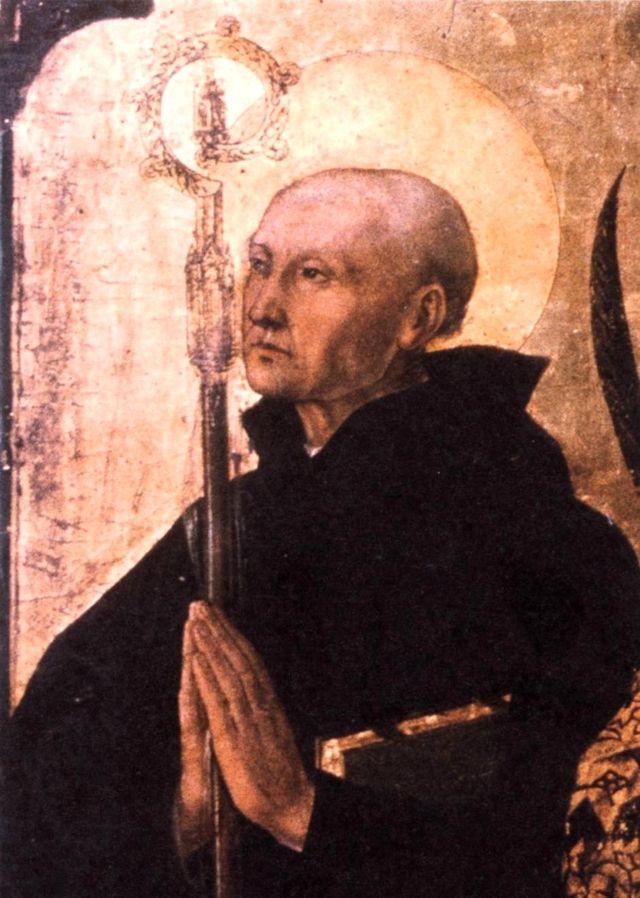
Patron saint of

  • Austria and Bavaria
    He was the apostle of Roman Noricum.

Help us add to this saint's story

Everything is read by a person before anything appears. Facts are checked against trusted sources first.

Facts are welcome; a source link helps (optional).With your permission we may share it on this page.

Nine days · Free

Pray the novena
with us.

One short email a day for nine days. The day's prayer, a line from St. Severinus of Noricum's story, and a nudge to keep going.

Also on January 8
L

St. Lucian at Beauvais

January 8 · Bishop, Martyr
P

St. Patiens

January 8 · Bishop
A

St. Atticus of…

January 8 · Patriarch
← All 1970 saints in the library
Sources & notes

Feast-day sources

Story sources

Sources

Credits

Image: Severin von Noricum (um 1470).jpg · Meister von San Severino · Public domain, via Wikimedia Commons

Image: Meister von San Severino, Wikimedia Commons (Public domain)

Retold in plain modern English from Baring-Gould’s public-domain text, sentence by sentence, keeping the same facts and order. Short explanations in parentheses are ours.

From Sabine Baring-Gould, The Lives of the Saints, new and revised edition (Edinburgh: John Grant, 1914; first edition 1872). Public domain in the United States. Reproduced unedited, except for short bracketed notes in grey that we added to explain names and terms (“S.” is the old abbreviation for Saint). Some history and judgments reflect 19th-century scholarship.