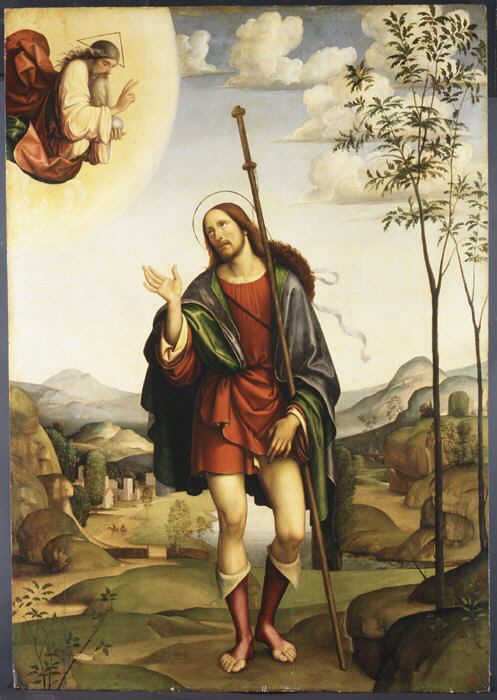
In or around 1350, a scruffy-looking man, without any means to support himself or able to provide a satisfactory explanation of who he was, was picked up by the authorities of Montpellier and thrown into a filthy cell in the common jail. There, partly due to neglect, he died. When the body was removed for burial, to everyone's surprise and dismay, it was discovered that the supposed vagabond was Roch, a nephew of the governor of Montpellier. He had inherited a large fortune from his parents a few years earlier, which he had left in the care of his uncle while he went on a pilgrimage to Rome. No one had heard from him for some time. In the lifeless face, washed for burial, his familiar features were recognizable. Likely, a scrap of paper with the name Roch on it, a passport, or something similar helped confirm his identity.
It is clear that if these events are accepted as true, this is all that is known about Roch. There is no way to know the details of his life between leaving home and his death. Therefore, we can confidently attribute all the stories of his travels to popular imagination. It was said that he had gone to Italy, that Italy had been struck by a plague that ravaged the entire peninsula, and that there was a scar on the thigh of the deceased man indicating he had been afflicted by the disease. A scrap of paper was found among his belongings after his death, which helped identify him—these were the elements from which the legend of Roch’s pilgrimage was created.
It was claimed that wherever he traveled, he miraculously drove away the plague by making the sign of the cross. He healed thousands and tens of thousands of people suffering from the plague until he himself fell ill. During his illness, a dog brought him bread from a count’s table every day to meet his needs. The count, following the dog, discovered Roch lying in a wretched hovel, recovering from his illness. The count provided him with necessities, and he eventually got better. An angel had struck him on the thigh, and from that touch, a plague boil had formed and burst. Roch visited Rome, where he was warmly received by the Pope. He made the sign of the cross on the forehead of a cardinal, leaving such a deep impression that no amount of rubbing or scrubbing could remove it. Afterward, Roch returned to Montpellier, where he was arrested as a spy and thrown into prison.
Feeling himself dying in prison, he prayed that all who would invoke him and rely on his merits would be delivered from the plague. An angel from heaven appeared in the prison and wrote on a tablet, “Those suffering from the plague, who seek the protection of Roch, shall be healed.” A bit of the spine of Saint Roch is displayed at Saint Jacques in Antwerp, and other relics are in the hospital of Saint Julian in the same city. In 1478, the body of Saint Roch was stolen from Montpellier and taken to Venice, where a church was built to house it.
However, the city of Arles also claims to possess the relics of the Saint. The shrine containing them was melted down during the Revolution, but the body itself was preserved. The relics are currently under the care of both civil and ecclesiastical authorities, each of which has a key to the reliquary, so it cannot be opened without the agreement of both. “The body is almost intact.” The same is true for the one in Venice. Countless other pieces are scattered throughout Christendom.
Saint Roch is depicted as a pilgrim, with his left leg exposed, showing a wound to which he points. Sometimes an angel is at his side, touching his thigh. The angel usually holds a tablet that reads, “You will be a patron in the plague.” Additionally, there is often a dog beside him carrying a loaf in its mouth.
A prose in honor of Saint Roch goes as follows: “Rochus ends his life there, Whom God allows to give A tablet through an angel, Which was written divinely, In letters of gold, and dictated By the hand of God of the stars.”
In Toulouse, Utrecht, Milan, and other places, it runs: “The name of Roch is written below, Which was said by God, That those who honor him, The plague's wound may be driven away: And health may be restored To those who remember him.”
Footnotes
- Those suffering from the plague, who seek the protection of Roch, shall be healed.
- A prose in honor of Saint Roch goes as follows: “Rochus ends his life there, Whom God allows to give A tablet through an angel, Which was written divinely, In letters of gold, and dictated By the hand of God of the stars.”
- In Toulouse, Utrecht, Milan, and other places, it runs: “The name of Roch is written below, Which was said by God, That those who honor him, The plague's wound may be driven away: And health may be restored To those who remember him.”
Baring-Gould’s own footnotes, in modern English.
Read the original 1870s text
Baring-Gould’s sources: Martyrologists of the 15th cent. Modern Roman Martyrology. Authorities A life by Franciscus Diedus, a Venetian, governor of Brixen, written in 1478. This is the earliest life of S. Roch. He says in his prologue: — “ Although we have found nothing trustworthy about Roch in ancient writers or in sacred codices, we have collected much from barbarous fragments in Latin or in the vulgar tongue, lest the race, travels, life and death of this holy man should remain in obscurity." In a word his life was founded on popular legends of the same authority as the chap-books of a later age. Another life from a MS. at Belfast is published by the Bollandists. These lives are thoroughly apocryphal.] It is difficult to say to how much of the romance of S. Roch the historian should apply his sponge. That S. Roch was a native of Montpellier, that he rambled into Italy at a time when the plague was raging there, probably in 1348, and that he nursed the sick and dying at Aquapendente, at Rome and Piacenza, till he was attacked by the plague himself, when he was saved from dying by a hound which led its master to Roch, lying in a solitary place apparently dying; that he returned to Montpellier, where he was taken up as a spy, and thrown into gaol, where he died — is the utmost that can be admitted as possibly fact in the legend of S. Roch. This is absolutely all that Papebrock the Bollandist was disposed to consider as trustworthy in the story. But even this is questionable.
In or about 1350, a squalid-looking man, without means of subsistence, or able to give a satisfactory account of himself, was taken up by the authorities of Montpellier, and cast into a dirty cell of the common gaol. There, partly from neglect, he died. On the removal of the body for burial, to the surprise and dismay of every one, it was discovered that the reputed vagabond was Roch, a nephew of the governor of Montpellier, who, having been bequeathed by his parents a
rich possession a few years before, had left it in the care of his uncle, and had gone on pilgrimage to Rome. Nothing had been heard of him for some while. In the dead face, washed for burial, the familiar features were retraced. Probably a scrap of paper with the name of Roch on it, a passport, or something of that sort, served to complete the identification.
It is evident that, if these events are allowed to have occurred, it is all that could be known of Roch. By no possibility could the details of his life between his leaving home and his death become known- Consequently we may safely put down all the history of his rambles to popular invention. That he had gone to Italy; that Italy had been attacked by plague which had raged throughout the peninsula, and that there was a scar on the thigh of the dead man which showed he had been assailed by the disorder; that a scrap of paper had been found among his effects when dead, which served to identify him — these were the materials out of which the fable of Roch’s pilgrimage was woven.
It was said that wherever he had gone he had miraculously expelled the plague by the sign of the cross. He had healed the plague-stricken by thousands and tens of thousands, till he was himself attacked, when a dog brought him bread from a count’s table every day to supply his necessities. The count, following the dog, found Roch lying in a miserable hovel, convalescent. He supplied him with necessaries, and he recovered. An angel had struck him on the thigh, and from the touch the plague-boil had risen and burst. Roch visited Rome, was well received by the Pope, signed the cross on the brow of a cardinal, and left it so deeply impressed thereon that no rubbing or scrubbing would get it off again. Then Roch returned to Montpellier, where he was arrested as a spy, and thrown into
prison. Feeling himself dying, he prayed that all who should invoke him and rely on his merits, should be delivered from the plague, and an angel from heaven appeared in the prison, and wrote on a tablet, “ Those labouring from 1 the plague, who fly to the patronage of Roch, shall be healed.”1 A bit of the spine of S. Roch is shown at S. Jacques, in Antwerp; other relics [the bodily remains of a saint, or objects they used, kept with honor] in the hospital of S. Julian in the same city. In 1478 the body of S. Roch was stolen from Montpellier, and taken to Venice, where a church was erected to receive it.
But the city of Arles also pretends to possess the relics of the Saint. The shrine containing it was melted up at the Revolution, but the body itself was preserved. The relics are at present under the charge of the civil and ecclesiastical authorities, each of which possess a key to the reliquary, so that it cannot be opened without the concurrence of both. “ The body is almost entire.” So is that at Venice. Innumerable other portions are dispersed through Christendom.
S. Roch is represented as a pilgrim, with his left leg exposed, in which is a wound to which he points. Sometimes an angel is at his side touching his thigh. The angel generally bears a tablet on which is written, “ Eris in pesto patronus.” Also, frequently, by his side a dog bearing a loaf in his mouth.
1 A prose in honour of S. Roch in the thus: — u Rochus ibi vitam finit Cui Deus dare sinit Tabulam per angelum Quse divina scribebatur Scriptis auri, et dictatus Manu Dei siderum.
of Toulouse, Utrecht, Milan, &c., runs Nomen Rochi infra scriptum Quod a Deo fuit dictum Ut qui eum decorant, Pestis ulcus depellatur: Sanitasque his reddatur Qui eum commemorant.”