Saint Amandus preached in the area around Toulouse when he was exiled for criticizing King Dagobert for his immoral behavior. He stayed in the house of Ernold. At that time, Gascony was ruled by Aribert, who died shortly after and left his lands to his brother Dagobert. This led to increased interactions between the Franks and the Gascons.
Adalbald, a noble Frank, was sent to Gascony on a mission from the king. While there, he saw and fell in love with Rictrudis, and he married her with her parents' consent. She then followed him north to Flanders, to Ostrevaen, where he owned large estates. Together, they had four children: Saint Maurontus (May 5), Blessed Clotsendis (June 30), Saint Eusebia (March 16), and Blessed Adalsendis (December 24). It is easy to imagine that this family of saints was united and happy. An ancient writer describes their life: “They assisted the poor, and softened their labors and fatigue; they were ever ready to relieve the hungry and the thirsty, to find clothes for the naked, and to give shelter to the traveler. Sometimes Rictrudis and her husband could be seen going out surrounded by their little children, who played their innocent games around them. It was with their children that Adalbald and Rictrudis entered the houses of the sick and needy to bring comfort and help. Their hands were ready to prepare the dead for burial, and often their words brought repentance and peace to hearts hardened by crime or filled with hatred.”
However, this blessed life of mutual love and good deeds was too bright to last long without suffering. Adalbald had to travel to Gascony, where he was murdered in Périgord, as has been previously mentioned. Upon receiving news of his death, Rictrudis turned to the only source of comfort she knew and decided to dedicate the rest of her life to the service of God. Yet, with the true wisdom of selfless piety, she postponed taking the veil until her son Maurontus was old enough to be admitted into the king's court. After she sent him off and confirmed that he was living a good, pure, and modest life, beloved by all,
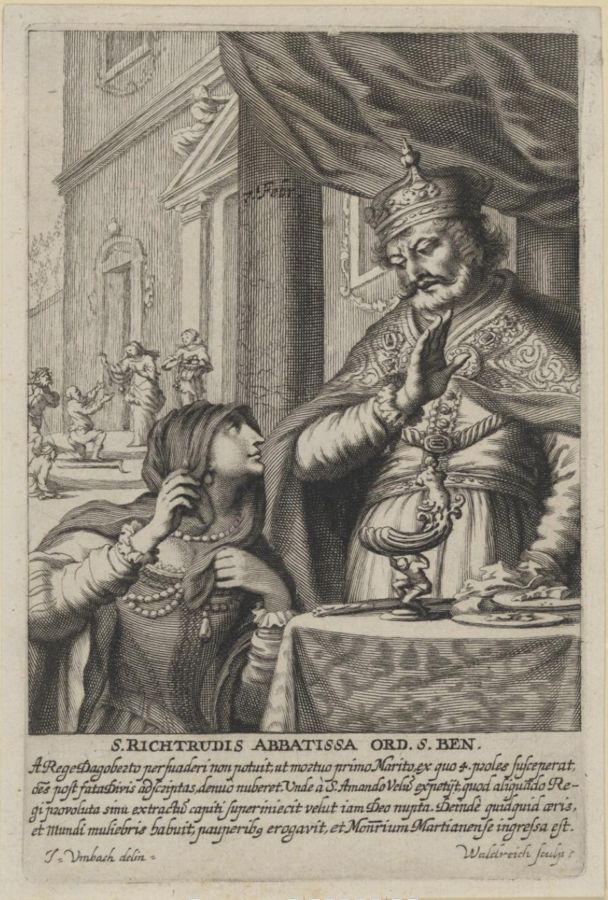
The ties that connected her to the world naturally fell away, and she prepared to go to Marchiennes when she was surprised and distressed by a message from the king asking her to marry one of his nobles. At that time, the requests of a monarch were equivalent to commands, and Rictrudis, feeling alarmed, sought out Saint Amandus and convinced him to advocate for her with the king. Not many days later, King Clovis II was in the area. Rictrudis invited him to her castle and prepared a magnificent feast for him and his attendants. During the banquet, Rictrudis rose from her seat, knelt before the king, and asked for his permission to fulfill her duty and desire. Clovis, thinking she meant to present the grace cup, replied affirmatively.
“Sire!” said Rictrudis, suddenly producing a black veil and placing it over her head, “to this, duty and inclination call me.”
The king erupted in anger, stood up from the table, and left, followed by his attendants. Saint Amandus then hurried after the king and effectively pleaded the cause of the saint, so much so that Clovis gave his consent and removed all opposition to her retirement into the cloister.
She then took the veil at Marchiennes, bringing with her her daughters Clotsendis and Adalsendis, who were still young. Her eldest daughter, Eusebia, was with Saint Gertrude, her grandmother, at Hamage. She was soon called to sacrifice her child Adalsendis to God, as Adalsendis fell ill and died on Christmas Day. For three days, the mother held back her tears. But on the Feast of the Holy Innocents, when she heard the Gospel read, which includes the prophecy of Rachel weeping for her children and refusing to be comforted, her tears burst forth, and her sobs shook her body. When the service ended and the nuns were heading to the refectory, Rictrudis turned to them weeping and said, “Go, dear sisters, without me; I must be like Rachel this day at least.”
Not many years later, she learned that her son Maurontus, who had lived a pure and God-fearing life in the court of the Frank king, intended to retire from the world. She was filled with alarm, knowing the offense this would cause to the king and his relatives, and she feared for him, worried that his calling might not be genuine. She sought the opinion of Saint Amandus, who calmed her fears by explaining how well her son had behaved at court. Maurontus came to Marchiennes and told his mother how sincere his intentions were. Then, in the abbey church before her eyes, the young noble removed his armor and received the tonsure from the hands of Saint Amandus. He then retired to Breuil (Merville), where he built a monastery on his own estate.
Rictrudis died at the age of seventy-six and left the management of the abbey of Marchiennes to her daughter Clotsendis.
The relics of Rictrudis were kept at Marchiennes in a magnificent shrine. This shrine was sent to Paris during the Revolution in 1793 to be melted down for coins. A workman saved the bones and hid them. When peace was restored, he gave them to the Archbishop of Paris, and they were kept in the palace. However, during the sack on July 24, 1830, the relics were scattered.
Footnotes
- Ostrevaen is also known as Austrebant, a part of Flanders bordered by the Schelde, the Scharpe, and the Somme.
- Maurontus lived a pure and God-fearing life in the court of the Frank king.
- The sack refers to a violent event where property was looted or destroyed.
Baring-Gould’s own footnotes, in modern English.
Read the original 1870s text
Baring-Gould’s sources: Gallican, Belgian, and Benedictine Martyrologies. Authority: — A life compiled from earlier notices by Hucbald, monk of Elnone, in 907.] S. Rictrudis was born in Gascony, of Christian parents named Ernold and Lichia. “Gentle and modest in her conduct, with the innocence of her soul as a seal on her brow, full of charity and thought for others, the young Rictrudis grew up in favour with the Lord, and in the first dawn of life shone like a pure star of righteousness and discretion."
S. Amandus preached in the neighbourhood of Toulouse, when driven into exile for reproaching King Dagobert for his incontinency, and he lodged in the house of Ernold. Gascony was then governed by Aribert, who died shortly afterwards and left his territories to his brother Dagobert, and intercourse between the Franks [the Germanic people who ruled Gaul and gave France its name] and the Gascons became more common. Adalbald, a noble Frank, visiting 1 Parts of this life are from Canon Bright’s “ Church History.** lyi Gascony on some mission from the sovereign, saw and loved Rictrudis, and married her with the consent of her parents. She then followed him to the north, into Flanders to Ostrevaen,1 where he had large possessions. She bore him four children, S. Maurontus (May 5 th), B. Clotsendis (June 30th), S. Eusebia (March 16th), and B. Adalsendis (Dec. 24th). It may be well imagined that this household of saints was an united and happy one. The ancient writer thus describes it: — “They assisted the poor, and softened their labours and fatigue; they were ever ready to relieve the hungry and the thirsty, to find clothes for the naked, and to give shelter to the traveller. Sometimes Rictrudis and her husband might be seen going out surrounded by their little children, who played their innocent games about them, and it was with their children that Adalbald and Rictrudis entered the houses of the sick and needy to bring consolation and assistance. Their hands were ready to shroud the dead, and often did their words bring repentance and peace to hearts that had been hardened by crime, or ulcerated by hatred.” But this blessed life of mutual love and good works was too bright to remain long without the cross making it with pain. Adalbald was obliged to make a journey into Gascony, and was murdered in Périgord, as has been already related (Vol. II., p. 41). On receiving news of his death, Rictrudis turned to the sole source of consolation, and resolved to dedicate the rest of her days to the undivided service of God. But with the true prudence of unselfish piety, she deferred taking the veil till her son Maurontus was of a sufficient age to be admitted into the court of the king. When she had sent him forth, and had ascertained that he was living uprightly, purely, and modestly, beloved by all, 1 Or Austrebant, the portion of Flanders inclosed by the Schelde, the Scharpe and the Somme.
the ties that attached her to the world parted of their own accord, and she prepared to retire to Marchiennes, when she was surprised and pained by a message from the king requesting her to marry one of his nobles. The requests of a monarch were at that time equivalent to commands, and Rictrudis in alarm sought S. Amandus, and persuaded him to plead her cause with the king. Not many days after, the king, Clovis II., was in the neighbourhood. Rictrudis invited him to her castle, and prepared for him and his attendants a magnificent repast. During the banquet Rictrudis rose from her place, and bending her knee before the king, asked his permission to fulfil her duty and desire. Clovis, supposing she meant that she was wishing to bring round and offer the grace cup, replied in the affirmative.
“Sire!” said Rictrudis, suddenly producing a black veil, and throwing it over her head, “to this, duty and inclination call me.”
The king burst into an explosion of anger, started from the table, and went forth followed by his attendants. S. Amandus then hastened after the king, and pleaded the cause of the saint so effectually that Clovis gave his consent and withdrew all opposition to her retirement into the cloister.
She then assumed the veil at Marchiennes, taking with her her daughters Clotsendis and Adalsendis, who were still young. Her eldest daughter, Eusebia, was with S. Gertrude, her grandmother, at Hamage. She was speedily called to sacrifice her child Adalsendis to God, for she fell sick and died on Christmas Day. For three days the mother restrained her tears. But on the Feast of the Holy Innocents, when she heard the Gospel read, in which that prophecy is rehearsed which tells of Rachel weeping for her children, and would not be comforted, her.S'. Rictrudis.
tears burst forth, and her sobs convulsed her frame. When the service was concluded, and the nuns were going to the refectory, Rictrudis turned to them weeping and said, “Go, dear sisters, without me, I must be like Rachel this day at least/' Not many years after, she heard that her son Maurontus, who had lived innocent and God-fearing in the court of the Frank king, proposed retiring from the world. She was full of alarm, knowing the offence this would give to the king and to his relatives, and fearing for himself lest his vocation should not be sincere. She asked the opinion of S. Amandus, and he calmed her apprehensions by telling her how her son had conducted himself at court. Maurontus came to Marchiennes and told his mother how sincere was his purpose, and then, in the abbey church before his mother's eyes, the young noble stripped off his armour, and received the tonsure [shaving part of the head as a sign of entering the clergy or monastic life] from the hands of S. Amandus. He then retired to Breuil (Merville) where he built a monastery on his own estate.
S. Rictrudis died at the age of seventy-six, and left the government of the abbey of Marchiennes to her daughter Clotsendis.
The relics [the bodily remains of a saint, or objects they used, kept with honor] of S. Rictrudis were preserved at Marchiennes in a magnificent shrine which was sent to Paris during the Revolution, in 1793, to be coined. A workman saved the bones and hid them, and gave them on the restoration of tranquillity to the Archbishop of Paris, and they were preserved in the palace. But in the sack of July 24th, 1830, they were dispersed.