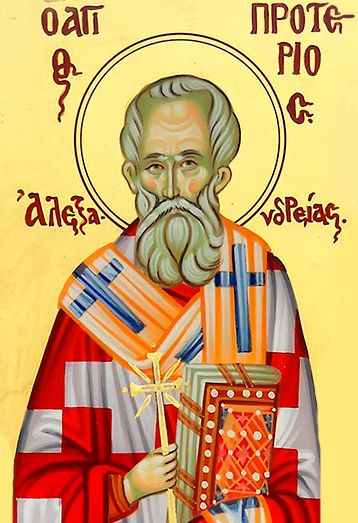
St. Proterius of Alexandria

Proterius was ordained priest by St Cyril of Alexandria.

Read the essentials →
Feast February 28 · Martyr, Patriarch

St. Proterius of Alexandria

Current feast

February 28
Secondary source · Wikipedia infobox

Traditional feast

February 28
1914 / pre-1969 calendar, per Baring-Gould (1897)

Represents

Martyr
Patriarch

Feast days

Feast: February 28

This Saint’s Story

Adapted in modern English from Alban Butler's Lives of the Saints · Baring-Gould original below

He opposed Cyril's successor Dioscorus when Dioscorus took up the errors of Eutyches, even though Dioscorus had tried to win him over by making him archpriest.

When the Council of Chalcedon (the 451 worldwide council that taught Christ is one person in two natures, divine and human) deposed Dioscorus, Proterius was elected patriarch in his place. Alexandria was split, and a faction led by Timothy Elurus and Peter Mongus, both of whom he had excommunicated, kept him in constant danger.

At last the schismatics broke into the baptistery where he had taken refuge and stabbed him on Good Friday. They dragged his body through the city, cut it to pieces and burned it. The bishops of Thrace soon afterwards wrote to the Emperor Leo that they counted him among the martyrs.

Struggles & surrender

His struggles

  • A divided city ·
    Butler: Alexandria was split after Chalcedon, and Proterius lived in constant danger from the faction of Timothy Elurus and Peter Mongus until they killed him.

Short entry · the summary here is 174 words; Baring-Gould’s fuller original text and its sources are below. We have not filled any gap with invented detail.

What he represents

How he teaches us to live

Drawn from themes in the original account

Celebrate this saint’s feast day. Remember him on February 28 with a short prayer, and ask for his help.

The full story

Baring-Gould’s account retold in modern English

Read the full story · 174 words · about 1 min

Proterius was the leader of the orthodox party in Alexandria when the patriarch Dioscorus adopted Eutychian views. That unprincipled and arrogant prelate, knowing how much Proterius was respected, made him the archpriest of his diocese. However, as Dioscorus's heretical opinions became more obvious, Proterius took strong action to oppose him. Following the condemnation and deposition of Dioscorus by the Council of Chalcedon in 452, Proterius was ordained to replace him. This caused a split in the Church of Alexandria, with the Catholics supporting Proterius and the Eutychians siding with Dioscorus. The Eutychians were led by two clergy members, Timothy Ailurus and Mongus, who had been excommunicated for heresy. During a riot that broke out, Ailurus, having received consecration from two bishops of their faction, ascended the episcopal throne and declared himself the sole patriarch of Alexandria. Proterius fled for safety to the baptistery of the Church of Saint Quirinus, but the heretics broke in and stabbed him to death. They then dragged his body through the streets, hacked it into pieces, and burned it.

Read the original 1870s text

Baring-Gould’s sources: Greek Menæa on this day. Baronius and others have expressed surprise that the name of S. Proterius is inserted in no Western Martyrologies. Authority:—Evagrius, lib. iii. 13; Theophanes, the letters of Anatolius, Patr. of Constantinople, &c.

S. Proterius was the head of the orthodox party at Alexandria, when the patriarch [the title of the bishops of the great ancient sees: Rome, Constantinople, Alexandria, Antioch, Jerusalem] Dioscorus adopted Eutychian [followers of Eutyches, who said Christ had only a divine nature; condemned at Chalcedon in 451] views. That unprincipled and haughty prelate, knowing the esteem in which Proterius was held, made him arch-priest of his diocese; but as his heretical opinions became more evident, Proterius took decided steps to oppose him, and on the condemnation and deposition of Dioscorus by the Council of Chalcedon, in 452, he was ordained in his room. This led to a schism in the Church of Alexandria, the Catholics acknowledging Proterius, and the Eutychians holding with Dioscorus. The Eutychians were headed by two ecclesiastics, Timothy Ailurus, and Mongus, who had been excommunicated for heresy. In a tumult that broke out, Ailurus, having obtained consecration from two bishops of their faction, mounted the episcopal throne, and proclaimed himself sole patriarch of Alexandria. Proterius fled for safety to the baptistery of the Church of S. Quirinus, but the heretics broke in and stabbed him to death; then dragged his body through the streets, hacked it to pieces, and burnt it.

Help us add to this saint's story

Everything is read by a person before anything appears. Facts are checked against trusted sources first.

Facts are welcome; a source link helps (optional).With your permission we may share it on this page.

Nine days · Free

Pray the novena
with us.

One short email a day for nine days. The day's prayer, a line from St. Proterius of…'s story, and a nudge to keep going.

Also on February 28
N

Sts. Nymphas and Eubulus

February 28 · Feast
M

Sts. Martyrs in the…

February 28 · Feast
← All 1970 saints in the library
Sources & notes

Feast-day sources

Story sources

Sources

Credits

Image: Proterius of Alexandria.png · Wikimedia Commons · CC0, via Wikimedia Commons

Image: Wikimedia Commons, Wikimedia Commons (CC0)

Retold in plain modern English from Baring-Gould’s public-domain text, sentence by sentence, keeping the same facts and order. Short explanations in parentheses are ours.

From Sabine Baring-Gould, The Lives of the Saints, new edition in 16 vols. (London: John C. Nimmo, 1897), digitized text from Project Gutenberg. Public domain in the United States. Reproduced unedited, except for short bracketed notes in grey that we added to explain names and terms (“S.” is the old abbreviation for Saint). Some history and judgments reflect 19th-century scholarship.