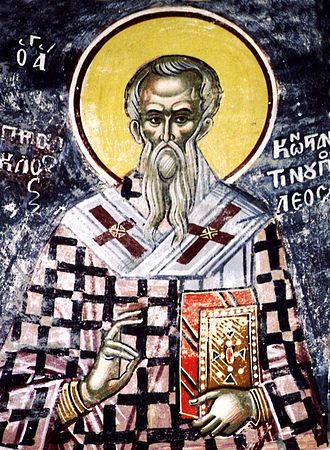
Five days after his elevation, he set fire to the church of the Arians. The Novatians, and then the Quartodecimans, experienced his persecuting zeal; great multitudes of the latter were massacred by the people, whom he incited with his harsh denunciations. At his request, the emperor closed the churches of the Macedonians because they had assassinated Antony, Bishop of Germa, who had cruelly persecuted them.
Nestorius had brought with him from Antioch a priest named Anastasius, for whom he claimed the highest esteem. He consulted Anastasius on important matters and relied on his theological assertions to form his own opinions. Nestorius was, as Socrates tells us, not a learned man. In fact, he was disgracefully ignorant. Although he was an easy speaker and had a knack for highlighting key points in theology and presenting them in a popular way, he came to despise the hard work of studying the ancient expositors and became vainly confident in his own abilities.
One day, while Anastasius was preaching in the great church at Constantinople, he said, "Let no one call Mary Theotokos (Mother of God); for Mary was just a woman, and it is impossible that God should be born of a woman." These words caused a great stir, as it seemed Anastasius was denying the divinity of Christ by disputing Mary's right to this title. Seeing that people were agitated, Nestorius took the side of his favorite and defended a doctrine he had probably never carefully considered before.
Socrates completely clears him of any intention to deny Our Lord’s divinity, but believes that he was swept away by his natural eloquence and his lack of theological training. Proclus, who preached on the next festival in honor of the Blessed Virgin before Nestorius, chose the Incarnation as his theme. After speaking of S. Mary in glowing terms, describing her as the spiritual Paradise of the Second Adam, the bush that burned but was not consumed, the cloud that bore the Cherubic throne, and the fleece filled with heavenly dew, he moved on to the practical implications of the Catholic doctrine.
“If the Word had not dwelt in the womb, flesh would never have sat down on the holy throne. It was necessary that either the sentence of death should be carried out on all, since all have sinned, or that a price should be paid in exchange that could fully claim their release. Man could not save himself, for he was burdened by the debt of sin. An angel could not redeem humanity, for he lacked the ransom that was needed. Only one course remained: that the sinless God should die for sinners. It was God who, out of His compassion, became Man. We do not proclaim a man who has been deified, but we confess a God who is incarnate. The same one was in the Father's bosom and in the Virgin's womb; in a Mother's arms, and on the wings of the wind. He was adored by angels while He sat at meals with tax collectors. The servant struck Him, and creation trembled. He was laid in the tomb, and He spread out the Heavens like a curtain.
O the mystery! I see the miracles, and I proclaim the Godhead. I see the sufferings, and I do not deny the manhood. He who ransomed us, O Jews, is not merely a man. Nor, O Manichaeans, is He merely God without human nature. If Christ is one, and God the Word is one, then there is not a Trinity, but a Quaternity, O heretic!” Amid the applause that followed this sermon, Nestorius rose from his patriarchal throne and passionately expressed his view on the matter. He accepted the phrase “One Son” in the obviously unrealistic sense that the Word was joined to the Son of Mary. However, he argued that to refer to God as Virgin-born would promote the idea of Him being an inferior deity and would provide grounds for the objection from the pagans, “I cannot worship a God who was born and died.”
He emphasized the omnipotence, glory, and all the transcendent attributes of God the Creator and God the Redeemer. “And can this God have a mother?” he asked. “The pagan idea of a God born of a mortal mother is directly contradicted by S. Paul, who states that the Lord was without father and without mother. Could a creature bear the Uncreated? Could the Word, which was with the Father before the worlds, become a newborn infant? The human nature alone was born of the Virgin; that which is of the flesh is flesh. The Manhood was the instrument of the Divine purposes, the outward and visible garment of the Invisible. God was indeed incarnate, but God did not die; His death was merely the shedding of the mortal body, which He had taken on for a time.”
It is clear that his mind was confused, and he did not clearly understand either what he was opposing or where he was being led. As Socrates says, he objected to the term "Theotokos" (Mother of God), although he did not oppose the doctrine it represented. In another sermon, he argued that since the Baptist was filled with the Spirit from the womb, yet Elizabeth was not called the Spirit’s mother, neither could Mary be called the mother of God. Here, his confusion of ideas led him to make distinctly heretical statements. His theory, as he presented it, made Christ not the Incarnate God, but merely the greatest of saints.
In later sermons, he argued that He who is called God could not be man’s high priest; that He who "held the circle of the earth" could not be wrapped in grave-clothes; and that the Sustainer of all things could not rise from the dead.
It was evident that Nestorius denied the true unity of Christ’s Person. We do not need to follow the history of this heresy any further than its impact on the life of Proclus.
The Council of Ephesus met in 431 to condemn Nestorius. He was removed from his position after his bitter parting exclamation in the synod, "I cannot call Him God who was two or three months old. I am free of your blood; from now on, I will not come among you again." Once again, there was a vacancy in the see of Constantinople, and rival parties contended for Proclus or Philip. Proclus would likely have been elected, had it not been argued that ecclesiastical canons forbade the transfer of a bishop from one see to another. Although Proclus had never exercised authority in Cyzicus, the objection was considered serious, and a man named Maximian was elevated to the patriarchal see.
Maximian governed the Church of Byzantium peacefully for two years and five months before he died on April 12, 434. By this time, the invalidity of the objection raised against Proclus had been widely acknowledged, and he was elevated with general consent to the bishopric of Constantinople.
“In moral excellence,” says Socrates, “he had few equals; for having been trained by Atticus, he was a zealous imitator of all that prelate’s virtues. His patience, however, greatly exceeded that of his master, who occasionally exercised severities upon heretics; for Proclus was gentle towards everybody, being convinced that kindness is far more effective than violence in advancing the cause of truth. Resolving, therefore, to vex and harass no heretics whatever, he restored in his person to the Church that mild and benignant dignity of character which had so often before been unhappily violated. In this respect, he followed the example of the Emperor Theodosius; for as that emperor had determined never to exercise his imperial authority against criminals, so had Proclus likewise purposed not to disquiet those who entertained other sentiments than his own on divine matters. For these reasons, the emperor had the highest esteem for Proclus. Indeed, he himself was a pattern to all true prelates and never approved of those who attempted to persecute others.”
Proclus must have been of a rarely lovable and beautiful character, a striking contrast, through his humility and tenderness to those in error, with the proud and persecuting Nestorius.
The Nestorians, forbidden to circulate the works of the deposed patriarch, caused those of Theodore of Mopsuestia to be widely dispersed. They were translated into Syriac by Ibas, a priest of Edessa, and into Persian by Maris, Bishop of Ardaschir. Barsumas, metropolitan of Nisibis, eagerly embraced the views of Nestorius and won the confidence of the Persian king by his hostility to “the faith of the Romans,” becoming the great propagator of Nestorianism in the East. Rabbulas, Bishop of Edessa, and Acacius of Melitene, in Armenia, seeing the spread of Nestorianism, wrote to the bishops of Armenia, warning them not to admit the books of Theodore of Mopsuestia and Diodorus of Tarsus, as tainted with heresy. The bishops of Cilicia were indignant at this condemnation of books by a luminary of the Cilician Church, a man whose memory they revered, and who had died in full communion with the Church. They wrote to protest that Rabbulas and Acacius acted with precipitation and out of a spirit of rivalry and caviling. The prelates of Armenia, eager to slight the Cilicians, sent two priests to Proclus with the books of Theodore and urged him to pass a condemnation on them and on Theodore by name. This called forth from Proclus the celebrated doctrinal epistle which has since been called the “Tome of S. Proclus.”
Addressing himself to the bishops, priests, and abbots of Armenia, the patriarch of Constantinople condemned certain false views which Theodore had given utterance to, but without naming him, using his characteristic reticence for the sake of charity and in the hopes of allaying the irritation; seeing, no doubt, that private and provincial jealousies stimulated the opposed parties quite as much as zeal for orthodoxy.
Proclus then clearly stated the Catholic faith regarding the One Person and Two Natures. He affirmed that there is “one Incarnate Person” (not nature) “of God the Word.” He denied any conversion of the Godhead into flesh. He noted that Christ never had a human personality separate from the Divine Personality. He pointed to the growth in wisdom and stature, the weariness by the well, and the sleep in the ship as evidence of true Manhood, which was necessary for our salvation. He urged the Armenians to let “no man spoil them through philosophy and vain deceit,” and to remain firm in the faith of Nicaea, as taught by Basil, Gregory, “and others like-minded, whose names were in the book of life.” He attached some Nestorian passages to his letter that he believed deserved condemnation. He sent both documents initially to John of Antioch, asking him to accept and endorse his statements, and to persuade Ibas, who had now succeeded Rabbulas at Edessa, to do the same. Proclus, who valued both peace and truth, had done his best to avoid offending the Cilician bishops, who were protective of the honor of Theodore and Diodorus, while also stating the true doctrine and identifying where the error lay.
However, the jealousy of the Armenians was not appeased by this. They sought not so much the establishment of the truth as the humiliation of the Cilicians. The bearers of Proclus's response secretly inserted the name of Theodore as the author of the censured passages. When the bishops of the patriarchate of Antioch received this distorted document, they fully accepted Proclus's doctrine but refused to condemn a deceased prelate based on questionable expressions that were quoted out of context and could be interpreted in a way that aligned with the language of respected fathers. They argued even more strongly that they could not anathematize someone like Theodore, who had done valuable work against Apollinarianism and whose memory was widely honored. Proclus assured them in a letter that he did not wish for a condemnation of Theodore by name; rather, he hoped they would condemn the propositions without naming the author. Saint Cyril of Alexandria also believed it was undesirable to demand the former, but he thought it was necessary to insist on the latter due to the rise of Nestorianism. However, the Eastern bishops would not condemn Theodore’s propositions for fear of appearing to place the writer under a ban.
Proclus, who had been pressured by the unscrupulous Armenians to take action against his better judgment, allowed the matter to drop. Theodosius expressed his desire that the memory of the deceased should be preserved from censure.
But the unfortunate conflict over a dead man’s reputation did not end there; it was stirred up repeatedly until Theodore of Mopsuestia was finally condemned at the Council of Constantinople in 553, more than a century after the death of the gentle Proclus.
His kind nature soon led him to make a mistake. A bishop named Athanasius arrived in Constantinople and complained that his rebellious clergy had expelled him from his diocese of Perrha in the patriarchate of Antioch. He was a convincing man and presented his case so favorably that Proclus was misled, believed the man was unjustly treated, and wrote to Domnus of Antioch on his behalf, asking him to punish those who had slandered Athanasius and had removed his name from the diptychs (a list of names of those to be remembered in prayer). Domnus convened a synod at Antioch, and the assembled bishops, having the facts of the case before them, reached a very different conclusion from Proclus regarding the merits of the case. The bishops unanimously condemned Athanasius for having appealed beyond his own proper metropolitan, where his case could have been properly examined.
It turned out that he had, in writing, resigned his position; that when summoned by his metropolitan, he had been disobedient; and that his clergy had not expelled him, but he had abandoned them. A monk named Sabinian was appointed in place of Athanasius. However, with the help of the Ephesian Latrocinium (a council that was considered illegitimate) and Dioscorus of Alexandria, Athanasius reclaimed his see in 449 and was reinstated. Sabinian appealed to the Council of Chalcedon in 451, and the council decided that Sabinian should remain provisionally in the position of bishop of Perrha until the Archbishop of Antioch had investigated the charges against Athanasius. If the charges were true, he was to remain deposed and be handed over to the civil courts, but if false, he was to be reinstated in Perrha.
In 439, according to Socrates, Proclus the bishop undertook an action for which there was no precedent among the ancient bishops. Firmus, Bishop of Caesarea in Cappadocia, had died, and the people of that place came to Constantinople to consult Proclus about appointing someone to succeed him. While Proclus was considering whom he should prefer for that see, it so happened that all the senators came to the church to visit him on a Saturday, among whom was Thalasius, the governor of Illyricum. Although it was rumored that the emperor was about to assign him to govern the eastern regions, Proclus laid hands on him and ordained him bishop of Caesarea, instead of him being appointed as prefect. This shows how flourishing the state of the Church was at that time.
The appointment was Proclus.
not a happy one, for Thalasius eventually sided with Dioscorus and supported Eutychianism. Theophanes Isaacius, who died in 817, wrote about three hundred and fifty years after the death of Proclus. He relates a legend about Proclus, which can be taken for what it is worth. Of course, no historian from that time mentions it.
During the time that Proclus was patriarch, an earthquake shook both the east and west, causing great loss of life. The people of Constantinople, alarmed by the falling buildings, fled the city and, along with the emperor and patriarch, took refuge outside. There, they offered prayers and litanies. In the midst of their supplications, a violent shock was felt, and the force of the shock lifted a boy into the air, high above the heads of the people, and indeed, beyond their sight. He fell shortly after, uninjured, and assured the people that he had been lifted into heaven, where he heard angels chanting the Trisagion (a hymn of praise to God), and was told to teach them on earth to do the same. Proclus, upon hearing this, immediately ordered that the Thrice-Holy should be sung. After that, the earthquake ceased. The boy did not recover from the shock of his fall from such a height, but died and was buried in the church of Irene.
S. Proclus had the proud honor of translating the remains of S. John Chrysostom from their obscure resting place in Cumana to Constantinople. On January 27, 438, the solemn transfer to his ancient home was carried out at the request and by the advice of Proclus. The Bosphorus was ablaze with light; the whole city seemed to pour forth all its inhabitants. The emperor, who had been Chrysostom’s godson, leaned close to the coffin and begged the departed soul to forgive Arcadius and Eudoxia, who had banished and mistreated him.
Until that memorable day, a small remnant of Joannites had kept away from all the bishops of Constantinople, whether Catholic or heterodox; they now, as if satisfied with the reparation made to the saint, recognized Proclus as their pastor.
It is touching to see the venerable Proclus, whenever he appears in history, working for peace and healing divisions. It makes us regret that no ancient biography of the saint exists. He died in July, 446. "Blessed are the peacemakers, for they shall be called the Children of God.”
Footnotes
- Theotokos means "Mother of God" in Greek.
- The Cherubic throne refers to a heavenly seat of honor associated with angels.
- The term Quaternity refers to a belief in four divine persons instead of three in the Trinity.
- Socrates: a Christian theologian and philosopher from the early church.
- Theotokos: a title for Mary meaning "Mother of God."
- Theodore of Mopsuestia was a theologian whose works were controversial.
- Diodorus of Tarsus was an early Christian theologian associated with Nestorianism.
- The Tome of S. Proclus is a significant doctrinal letter by Proclus.
- Proclus was a prominent bishop and theologian in the early Church.
- Ibas succeeded Rabbulas as bishop of Edessa.
- Apollinarianism was a heretical belief regarding the nature of Christ.
- Saint Cyril of Alexandria was an influential Church leader and theologian.
- Domnus convened a synod at Antioch.
- Athanasius reclaimed his see in 449.
- Proclus laid hands on him and ordained him bishop of Caesarea.
- Trisagion: a hymn of praise to God.
Baring-Gould’s own footnotes, in modern English.
Read the original 1870s text
Baring-Gould’s sources: Roman Martyrology. Same day Constantinopolitan Kalendar and Menology of Basil. Other Menologies on Nov. 20; same day Russian Kalendar. Authorities: — Scattered notices in Socrates, and his own writings.] S. Proclus, perhaps a native of Constantinople, was ordained deacon and then priest in that city. He was a devoted disciple of the great and glorious Chrysostom, according to George of Alexandria (7th century), the biographer of S. John Chrysostom, who tells a strange story of the saint: That a noble, who was out of favour at court, sought opportunity in the evening to consult the great prelate. S. Proclus received him, and went to the door of the chamber of S. John Chrysostom, but, hearing voices within, he peeped through a crack, and saw the saint in close converse with a stately and grave stranger. He therefore went back to the noble, and bade him wait till the visitor departed. But the conversation lasted all night, till the hour of matins, when Chrysostom came forth, and Proclus learned that his companion had been S. Paul, explaining to him difficult passages in his writings. This story, told in the 7th century, is perhaps so far to be trusted as recording the fact that Proclus was at one time intimate with Chrysostom. S. Proclus was ordained by Atticus of Constantinople, and acted as his secretary. On the death of Atticus, the name of Proclus was mentioned as his successor, but Sisinnius was the more popular candidate, and was raised to the throne of New Rome in 426. Sisinnius consecrated Proclus to the see of Cyzicus in 427, on the death of Eleusius, claiming a right over this suffragan see which the people of Cyzicus were unwilling to admit; for they proceeded forthwith to the election of a bishop, and chose Dalmatius, an ascetic. As he was rejected by the see to which he had been consecrated, Proclus was obliged to remain at Constantinople, where he devoted himself to preaching. Sisinnius survived his appointment to the bishopric of Constantinople scarce two years; and on his death the ecclesiastics of the city manifested such rivalry, some wishing to elect Proclus, others Philip, an ecclesiastical historian, that the emperors resolved to appoint a stranger to the important throne. They therefore called to the patriarchal see a man destined to acquire fame as a heresiarch. This man was Nestorius, a native of Cilicia, fluent of speech, with musical voice, but with a harsh, unforgiving temper. No sooner was he ordained than he made the appeal to the emperor, “ Give me, my prince, the earth purged of heretics, and I will give you Heaven as a reward. Assist me in destroying heretics, and I will assist you in conquering the Persians.”
Five days after his elevation he set fire to the church of the Arians [followers of Arius, who taught that the Son is a created being, not fully God]. The Novatians, and then the Quartodecimans felt his persecuting zeal; great multitudes of the latter massacred by the people, whom he stirred up by his intemperate denunciations. The emperor, at his request, closed the churches of the Macedonians, because they had assassinated Antony, Bishop of Germa, who had cruelly persecuted them.
Nestorius [Nestorius (d. c. 451), whose teaching split Christ into two persons; condemned at Ephesus in 431] had brought with him from Antioch a priest named Anastasius, for whom he professed the highest esteem, and whom he consulted on matters of moment, and on whose theological assertions he relied for the formation of his own opinions. Nestorius was, as Socrates tells us, not a man of learning. In fact he was disgracefully ignorant. Being a facile speaker, and having a certain aptitude for catching salient points in theology, and putting them in a popular light, he was led to 44 despise the drudgery of careful study of the ancient expositors, and puffed himself up with a vain confidence in his own powers.”
Anastasius was preaching one day in the great church at Constantinople when he used the words, 44 Let no one call Mary Thcotocos (Mother of God); for Mary was but a woman, and it is impossible that God should be born of a woman.” These words created a great sensation, for Anastasius seemed to be denying the Godhead of Christ, when he disputed the right of Mary to this title. Nestorius finding minds in a ferment, took the side of his favourite, and defended a doctrine he had probably never before carefully thought over.
Socrates entirely acquits him of any wish to deny Our Lord’s divinity, but thinks that he was carried away by his natural fluency, and his want of theological training. Proclus, who preached on the next festival in honour of the Blessed Virgin, before Nestorius, took the Incarnation as his theme. After speaking of S. Mary in glowing language, as the spiritual Paradise of the Second Adam, the bush burning and unconsumed, the cloud that bore 44 the Cherubic * throned,” the fleece filled with heavenly dew, he passed on to the practical bearings of the Catholic doctrine. “ If the Word had not dwelt in the womb, flesh had never sat down on the holy throne. It was necessary, either that the doom of death should be executed on all, for all have sinned, or that such a price should be paid in exchange as could fully claim their release. Man could not save, for he was under the pressure of the debt of sin. An angel could not redeem humanity, for he had lacked such a ransom as was needed. One only course remained, that the sinless God should die for sinners.... It was God who out of His compassion became Man. We do not proclaim a man deified, but we confess a God incarnate. The self-same was in the Father's bosom and in the Virgin's womb; in a Mother's arms, and on the wings of the wind. He was adored by angels while He sat at meat with publicans.... The servant buffeted Him, and creation shuddered.... He was laid in the tomb, and He spread out the Heavens as a curtain. O the mystery ! I see the miracles, and I proclaim the Godhead. I see the sufferings, and I deny not the manhood. He who ransomed us, O Jews 1 is not mere man. Nor, O Manichaeans! is He mere God destitute of human nature. If Christ is one, and God the Word is one, then there is now not a Trinity, but a Quatemity, O heretic ! " Amid the applause which hailed this sermon Nestorius rose from his patriarchal throne, and stated with vehemence his view of the matter. He admitted the phrase, “One Son,*' in the sense, obviously unreal, that the Word was joined to the Son of Mary; but he urged that to speak of God as Virgin-bom would encourage the notion of His being an inferior deity, and give reason to the objection of the heathen, “ I cannot adore a God who was born and died.” He dwelt on the omnipotence, the glory, and all the transcendent attributes of God the Creator, and of God the Redeemer. “ And can this God have a mother? ” he asked. “ The heathen notion of a God bora of a mortal mother is directly confuted by S. Paul, who declares that the Lord was without father and without mother. Could a creature bear the Uncreated ? Could the Word, which was with the Father before the worlds, become a new-born infant ? The human nature alone was bora of the Virgin; that which is of the flesh is flesh. The Manhood was the instrument of the Divine purposes, the outward and visible vesture of the Invisible. God was incarnate, indeed, but God died not; His death was but the casting off the weeds of mortality, which He had assumed for a time.”
It is evident that his mind was confused, and he did not clearly see either what he was combating, or whither he was being drawn. As Socrates says, he objected to the expression, “ Theotocos,” though he did not object to the doctrine it involved. In another sermon he argued, that as the Baptist was filled with the Spirit from the womb, yet Elizabeth was not called the Spirit’s mother, so neither could Mary be called the mother of God. Here his confusion of ideas had led him to distinctly heretical statements. For his theory as thus formulated, made of Christ not Incarnate God, but the chiefest of saints.
In subsequent sermons he contended that He who is called God could not be man’s high priest; that He who “ held the circle of the earth ” could not be wrapped in grave-clothes, and that the Sustainer of all things could not rise from the dead.
Nestorius, it was plain, denied the real unity of Christ’s Person. We need not follow the history of this heresy further than as it affects the life of S. Proclus.
The Council of Ephesus met in 431 to condemn Nestorius. He was deposed from his see, after ills bitter parting exclamation in the synod, “ I cannot term Him God who was two or three months old. I am clear of your blood, henceforth I come no more among you.** Again there was a vacancy in the see of Constantinople [a bishop’s “see” is his diocese, named from his seat (Latin sedes)], and once more rival parties contended for Proclus or Philip. Proclus would probably have been elected, had it not been represented that ecclesiastical canons forbade the translation [the solemn moving of a saint’s relics to a new shrine] of a bishop from one see to another. True Proclus had never exercised jurisdiction in Cyzicus, but the objection was felt to be serious, and one named Maximian [Diocletian’s co-emperor in the West, 286–305] was elevated to the throne of the patriarchal see.
Maximian having peacefully governed the Church of Byzantium for two years and five months, died on the 1 2th April, 434. By this time the unreality of the objection raised against Proclus had been generally admitted, and he was raised with general consent to the bishopric of Constantinople.
“ In moral excellence,” says Socrates, “ he had few equals; for having been trained by Atticus, he was a zealous imitator of all that prelate’s virtues. His patience, however, greatly exceeded that of his master, who occasionally exercised severities upon heretics; for Proclus was gentle towards everybody, being convinced that kindness is far more effective than violence in advancing the cause of truth. Resolving, therefore, to vex and harass no heretics whatever, he restored in his person to the Church that mild and benignant dignity of character which had so often before been unhappily violated. In this respect he followed the example of the Emperor Theodosius [name of Roman emperors; Theodosius I (379–395) made Christianity the state religion]; for as that emperor had determined never to exercise his imperial authority against criminals, so had Proclus likewise purposed not to disquiet those who entertained other sentiments than his own on divine matters. For these reasons the emperor had the highest esteem tor Proclus. indeed, he himself was pattern to all true prelates, and never approved of those who attempted to persecute others.”
Proclus must have been of rarely lovable and beautiful character, a striking contrast, through his humility and tenderness to those in error, with the proud and persecuting Nestorius.
The Nestorians, forbidden to circulate the works of the deposed patriarch [the title of the bishops of the great ancient sees: Rome, Constantinople, Alexandria, Antioch, Jerusalem], caused those of Theodore of Mopsuestia to be widely dispersed. They were translated into Syriac by Ibas, a priest of Edessa, and into Persian by Maris, Bishop of Ardaschir. Barsumas, metropolitan [the archbishop who heads a group of dioceses] of Nisibis, eagerly embraced the views of Nestorius, and won the confidence of the Persian king by his hostility to “ the faith of the Romans,” and became the great propagator of Nestorianism in the East. Rabbulas, Bishop of Edessa, and Acacius of Melitene, in Armenia, seeing the spread of Nestorianism, wrote to the bishops of Armenia, warning them not to admit the books of Theodore of Mopsuestia and Diodorus of Tarsus, as tainted with heresy. The bishops of Cilicia were indignant at this condemnation of books by a luminary of the Cilician Church, a man whose memory they revered, and who had died in full communion of the Church. They wrote to protest that Rabbulas and Acacius acted with precipitation, and out of a spirit of rivalry and cavilling. The prelates of Armenia, eager to slight the Cilicians, sent two priests to Proclus with the books of Theodore* and urged him to pass a condemnation on them and on Theodore by name. This called forth from Proclus the celebrated doctrinal epistle which has since been called the “ Tome of S. Proclus.”
Addressing himself to the bishops, priests, and abbots of Armenia, the patriarch of Constantinople condemned certain false views which Theodore had given utterance to, but without naming him, using his characteristic reticence for the sake of charity, and in the hopes of allaying the irritation; seeing, no doubt, that private and provincial jealousies stimulated the opposed parties quite as much as zeal for orthodoxy.
Proclus then stated in clear terms the Catholic faith as to the One Person and Two Natures. He affirmed “ one Incarnate Person” (not nature) “of God the Word;” denied any conversion of the Godhead into flesh; observed that Christ never had a human personality apart from the Divine Personality; adduced the growth in wisdom and stature, the weariness by the well, the sleep in the ship, as proving the true Manhood, which was needful for the work of our salvation. He urged the Armenians to let “no man spoil them through philosophy and vain deceit,” and to stand fast in the faith of Nicaea, as taught by Basil, Gregory, “and others like-minded, whose names were in the book of life.” He appended to his letter some Nestorian passages which he deemed worthy of condemnation; and he sent both papers in the first instance to John of Antioch, desiring him to accept and subscribe his statements, and to induce Ibas, who had now succeeded Rabbulas at Edessa, to do likewise. Proclus, a lover equally of peace and of truth, had done his utmost to avoid wounding the susceptibilities of the Cilician bishops, jealous of the honour of Theodore and Diodorus, and at the.same time to state the true doctrine, and point out where error lay.
But the jealousy of the Armenians was not satisfied with this. They sought not so much the establishment of the truth as the humiliation of the Cilicians, and the bearers of the answer of Proclus surreptitiously inserted the name of Theodore as the author of the censured passages. The bishops of the patriarchate of Antioch, on receiving this garbled Tome, while they fully accepted the doctrine of Proclus, declined to condemn a deceased prelate on acS. Proclus.
count of questionable expressions, quoted, they said, apart from the context, and capable of a sense which would harmonize them with the language of eminent fathers. Still less, they urged, could they anathematize such a man as Theodore, who had done good service against Apollinarianism, and whose memory was so widely honoured. Proclus assured them in a letter that he had not wished for a condemnation of Theodore by name; but that he hoped they would condemn the propositions without naming the author. S. Cyril of Alexandria had thought likewise that it was undesirable to demand the former, but that, seeing the progress made by Nestorianism, it was necessary to insist on the latter. But the Easterns would not condemn Theodore’s propositions for fear of seeming to put the writer under ban.
Proclus, who had been moved by the unscrupulous Armenians to take action in the matter against his better judgment, allowed the matter to drop, and Theodosius signified his wish that the memory of the dead should be preserved from censure.
But the miserable strife over a dead man’s good name did not end thus; it was stirred again and again, till Theodore of Mopsuestia was finally anathematized in the Council of Constantinople in 553, more than a century after the death of the gentle Proclus.
His kindly nature led him shortly after into committing a mistake. A bishop named Athanasius arrived at Constantinople, and complained that his rebellious clergy had ejected him from his diocese of Perrha in the patriarchate of Antioch. He was a plausible man, and stated his case so favourably that Proclus was deceived, thought the man unjustly treated, and wrote to Domnus of Antioch in his favour, requesting him to punish those who had calumniated Athanasius, and had erased his name from the diptychs. VOL. xii. 17 Domnus convened a synod at Antioch, and the assembled bishops, having the facts of the case before them, came to a very different conclusion on the merits of the case from Proclus; the bishops unanimously condemned Athanasius for having appealed beyond his own proper metropolitan, where his case could be inquired into. It turned out that he had himself, in writing, resigned his see; that, when summoned by his metropolitan, he had been contumacious; and that his clergy had not ejected him, but he had deserted them. A monk named Sabinian was placed in the room of Athanasius; but the latter, by help of the Ephesian Latrocinium and Dioscorus of Alexandria, in 449 re-claimed his see, and was re-instituted. Sabinian appealed to the Council of Chalcedon in 451, and the council decided that Sabinian should remain provisionally dn the throne of Perrha, till the Archbishop of Antioch had examined into the charges against Athanasius. If they were true, he was to remain deposed, and be delivered over to the civil tribunals, but if false, he was to be reinstated at Perrha. In 439, according to Socrates, “Proclus the bishop undertook the performance of an act, for which there was no precedent among the ancient prelates. Firmus, Bishop of Caesarea, in Cappadocia [a region of central Turkey], being dead, the inhabitants of that place came to Constantinople to consult Proclus about the appointment of some one to succeed him. While Proclus was considering whom he should prefer to that see, it so happened that all the senators came to the church to visit him on the Saturday; among whom was Thalasius, the governor of Illyricum. But although it was rumoured that the emperor was about to entrust him with the government of the eastern parts, Proclus laid hands on him and ordained him bishop of Caesarea, instead of his being constituted prefectorian prefect; so flourishing was the state of the Church at thi9 time.” The appointment was S. Proclus.
not a happy one, for Thalasius eventually took side with Dioscorus, and favoured Eutychianism [followers of Eutyches, who said Christ had only a divine nature; condemned at Chalcedon in 451]. Theophanes Isaacius, who died in 817, and therefore wrote some three hundred and fifty years after the death of Proclus, relates a legend of Proclus, which may be taken for what it is worth. Of course no historian of the time mentions it.
During the time that Proclus was patriarch an earthquake shook the east and west alike, and great loss of life ensued. The inhabitants of Constantinople, alarmed at the falling houses, deserted the town, and with the emperor and patriarch, took refuge outside the city. There they offered up prayers and litanies. In the midst of their supplications a violent shock made itself felt, and the force of the shock jerked a boy up into the air, high over the heads of the people, and indeed, beyond their sight. He fell shortly after, uninjured, and assured the people that he had been jerked into heaven, where he had heard angels chanting the Trisagion, and was bidden teach them on earth to do the same. Proclus, hearing this, ordered at once that the Thrice-Holy should be sung. Thereupon the earthquake ceased. The boy did not recover the shock of his fall from such an elevation, but died, and was buried in the church of Irene.
S. Proclus had the proud honour of translating the remains of S. John Chrysostom from their obscure restingplace in Cumana to Constantinople. On January 27, 438, the solemn transfer to his ancient home was performed at the desire and by the advice of Proclus. The Bosphorus was in a blaze of light; the whole city seemed to pour forth all its inhabitants, the emperor, who had been Chrysostom’s godson, put his face close to the coffin, and besought the departed soul to forgive Arcadius and Eudoxia, who had banished and ill-treated him.
Until that memorable day, a small remnant of Joannites had kept aloof from all the bishops of Constantinople, whether Catholic or heterodox; they now, as if satisfied with the reparation made to the saint, recognized Proclus as their pastor.
It is touching to see the venerable Proclus, whenever he appears on the surface of history, labouring for peace, to heal divisions, and it makes us regret that no ancient biography of the saint exists. He died in July, 446. " Blessed are the peacemakers, for they shall be called the Children of God.”