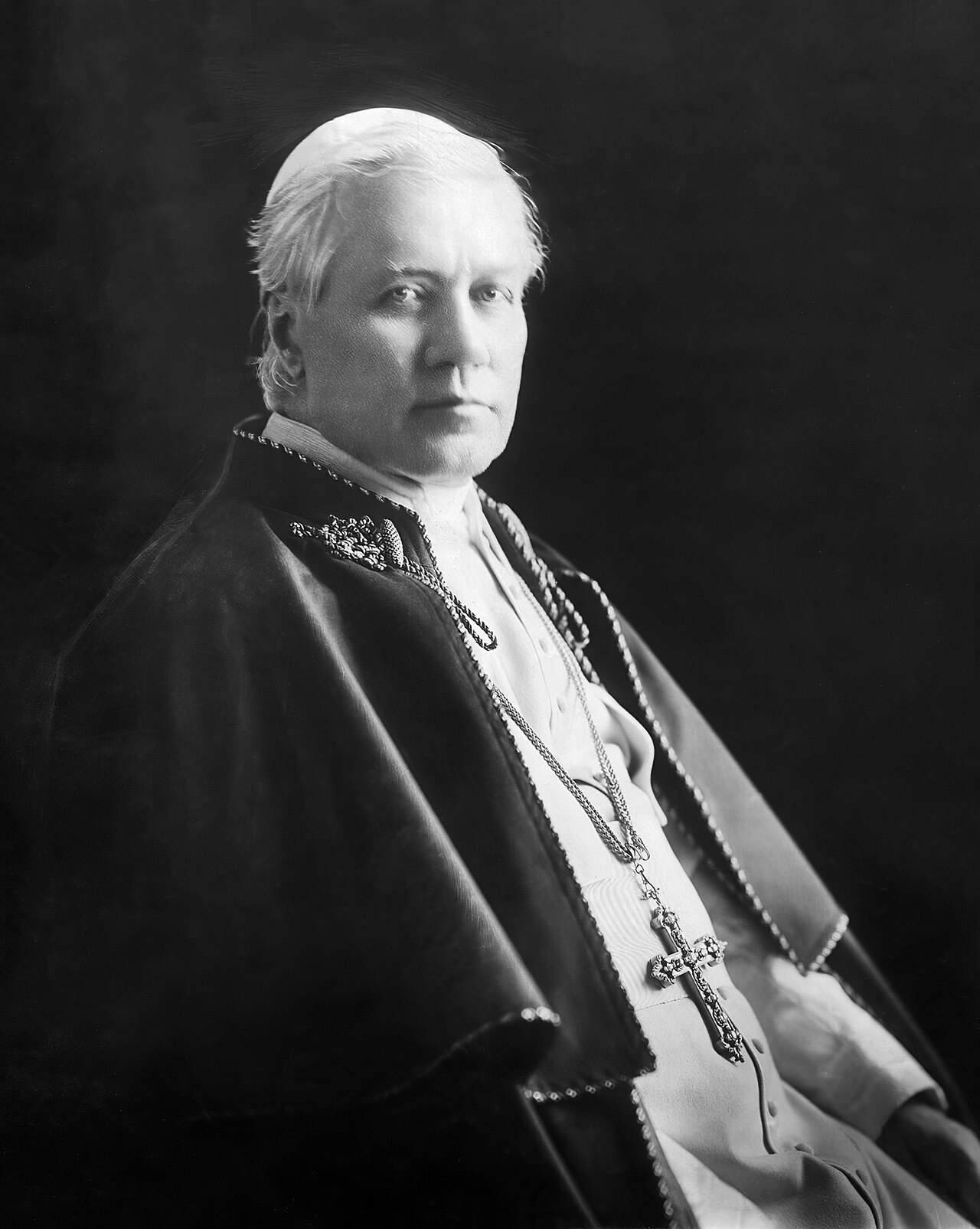
This Saint’s Story
Giuseppe Melchiorre Sarto was born on June 2, 1835, in Riese, a small village in the Austrian Empire. He was the second of ten children in a family that valued education despite their financial struggles. Giuseppe walked several kilometers daily to attend school, demonstrating his dedication to learning. He excelled academically and served as an altar boy, which deepened his faith from a young age. After receiving the tonsure in 1850, he secured a place at the seminary in Padua, where he distinguished himself in his studies.
Ordained a priest in 1858, Sarto began his ministry in Tombolo, where he took on many responsibilities due to the illness of the parish priest. His reputation for holiness grew as he dedicated himself to pastoral care, particularly during a cholera outbreak. In 1867, he became the archpriest of Salzano, where he improved the local church and worked to enhance the hospital, often using his own resources. His commitment to education led him to establish a night school for adults, and he worked tirelessly to provide religious instruction to the youth.
In 1884, Sarto was appointed Bishop of Mantua, where he focused on the formation of clergy and the promotion of Thomistic theology. He was known for his pastoral zeal and dedication to the spiritual growth of his diocese. In 1893, he was created a cardinal and became the Patriarch of Venice. His time in Venice was marked by a commitment to social works and a strong emphasis on obedience to the Pope, which he communicated in his pastoral letters.
On August 4, 1903, Sarto was elected Pope, taking the name Pius X. His papacy was characterized by a desire to renew the Church, encapsulated in his guiding principle, which emphasized the need for renewal in Christ. He implemented significant liturgical reforms, encouraged frequent reception of Holy Communion, and lowered the age for First Communion. He also began the development of a new Code of Canon Law, which was a major advancement in Church governance.
Pius X faced challenges during his papacy, particularly in addressing modernist interpretations of Catholic doctrine. He condemned modernism as a synthesis of heresies and worked to protect the integrity of the faith. His final months were overshadowed by the onset of World War I, and he died on August 20, 1914. Following his death, he was widely venerated for his piety and holiness, leading to his beatification in 1951 and canonization in 1954 by Pope Pius XII.
