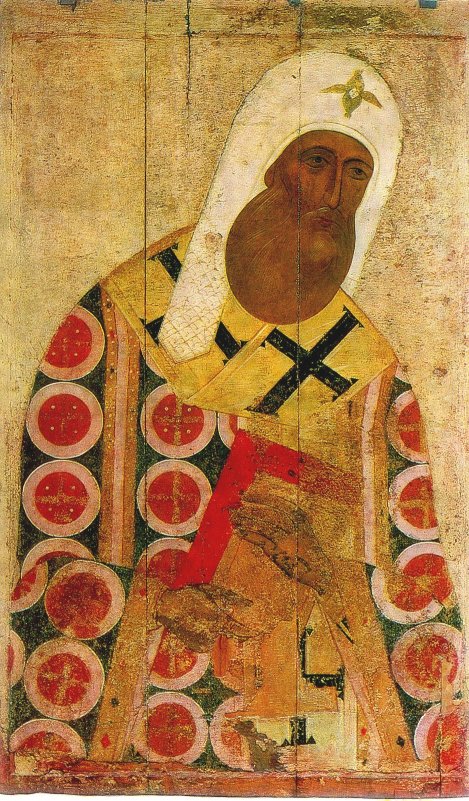
…the Church. But it seems to me that it is all about myself. Throw me overboard; I am a nobody, if only it will produce a calm.” He would have laid down the insignia of his position as metropolitan. However, the complete emptiness of the accusation was proven, as well as the malice that had led to its creation, and the holy prelate was triumphantly acquitted. The Bishop of Tver was filled with embarrassment. Peter looked at him, his face red, with downcast eyes and a sullen brow, and tried to encourage him. “Peace be with you, my son! This was not your doing, but that of the one who, from the beginning, has been the great Accuser. As for you, be more cautious in the future, and as for the past, God will forgive you!”
Moved by the advice of Prince Ivan I of Moscow, the holy metropolitan moved his see from Vladimir to Moscow in the year 1325. He is said to have persuaded that prince to lay the foundations of the stone Cathedral of the Assumption there. “If you will comfort my old age,” he said, “if you will build here a temple worthy of the Mother of God, then you shall be glorious above all other princes, and your descendants shall become great. My bones shall rest in this city, prelates shall rejoice to dwell in it, and the hands of its princes shall be on the necks of our enemies.” At the same time, Ivan also founded in his new capital the church of Saviour “in the Wood,” which is thought to be the oldest sacred building still standing today in Moscow, and the Cathedral of the Archangel, where his body now rests.
The heart of Moscow is the Kremlin, and the heart of the Kremlin is the Patriarchal Cathedral, known as the Church of the Assumption or Repose of the Virgin. In size, it would be considered a chapel rather than a cathedral in the West. However, it is filled with memories, crowded with worshippers, and overflowing with tombs and images, from the floor to the dome, so its small size is overlooked because of its rich contents.
On the platform of the nave, from Ivan the Terrible to the present day, the Czars have been crowned. Along its altar screen are displayed the most sacred images of Russia. One was painted by Metropolitan Peter; another was sent by the Greek Emperor Manuel; and another was brought by Vladimir from Kherson. High in the dome is the chapel, where, at the pinnacle of the Russian Church, the Russian Primates were elected.
In the depths of the throne, behind the altar, is the sacred image that commemorates the original rock of Kieff, from which the see of Moscow was established. The walls are lined with the graves of the Primates of the Church; at the four corners, as in all Eastern buildings, lie those who are most highly revered. The tomb of Saint Peter is located between the two chapels on the north side of the Bema or Sanctuary.
Footnotes
- Ivan I of Moscow was a prince who ruled in the early 14th century.
- The Cathedral of the Assumption is a significant church in Moscow.
- The church of Saviour “in the Wood” is an ancient church in Moscow.
- Stanley's Eastern Church, Lect. &. S. Genes.
Baring-Gould’s own footnotes, in modern English.
Read the original 1870s text
Baring-Gould’s sources: Russian Kalendar. Authority:— A life in Mouravieffs Hist, of the Church in Russia.] Peter, a Volhynian by birth, spent his early youth in religion, and was hegumen of a small monastery at Ratno, which he had founded in his native district. The fame of his virtues having reached Yury, King of the South-west of Russia and of the province of Lithuania, he sent Peter to Constantinople to be consecrated Metropolitan of Kieff by the patriarch Athanasius. Finding Kieff deserted, under the intolerable sway of the Mongols, Peter removed to Vladimir, which he made the seat of his metropolitanate, and whence he travelled throughout the country, ordaining bishops and priests, and reconciling princes who were at variance. At Bransk his efforts at allaying discord led to such resentment that had he not fled for refuge and sanctuary to the cathedral he would have been killed. Soon after his elevation, Antony, Bishop of Tver, son of the Prince of Lithuania, moved with jealousy at the advancement to such an important see of a humble hegumen, stirred up opposition, and lodged a slanderous charge against him. A synod met at Periaslavla-Zalessky, attended by numerous princes and clergy, and presided over by the Bishop of Rostoff. The venerable Peter rose up meekly, and said, “ My brethren, a great storm has arisen against August 24.3 >S. Peter.
…the Church, But it seems to me that it is all about myself. Throw me overboard, I am a nobody, if only it will produce a calm,” and he would have laid down the insignia of his metropolitanate. But the utter hollowness of the accusation having been proved, as well as the spite which had instigated its formulation, the holy prelate was triumphantly acquitted. The Bishop of Tver was covered with confusion. Peter looked at him, red, with downcast eyes, and sullen brow, and attempted to cheer him. “ Peace be with thee, my son ! This was no deed of thine, but his who, from the beginning, has been the great Accuser. As for thee, be more prudent for the future, and as for the past, God will forgive it thee ! ”
Moved by the advice of Prince Ivan I. of Moscow, the holy metropolitan [the archbishop who heads a group of dioceses] moved his see from Vladimir to Moscow, a.d. 1325. He is said to have persuaded that prince to lay therein the foundations of the stone Cathedral of the Assumption. “ If thou wilt comfort my old age,” said he, “ if thou wilt build here a temple worthy of the Mother of God, then thou shalt be glorious above all other princes) and thy posterity shall become great. My bones shall rest in this city, prelates shall rejoice to dwell in it, and the hands of its princes shall be on the necks of our enemies.” At the same time Ivan also founded in his new capital the church of S. Saviour “in the Wood,” thought to be the oldest sacred edifice standing at the present day in Moscow, and the Cathedral of the Archangel, where his body now reposes.
“The heart of Moscow is the Kremlin, and the heart of the Kremlin is the Patriarchal Cathedral, the Church of the Assumption or Repose of the Virgin. It is, in dimensions, what in the west would be called a chapel rather than a cathedral. But it is so fraught with recollections, so teemhig with worshippers, so bursting with tombs and pictures, from the pavement up to the cupola, that its smallness of space is forgotten in the fulness of its contents. On the platform of the nave, from Ivan the Terrible downwards to this day, the Czars have been crowned. Along its altarscreen are deposited the most sacred pictures of Russia. That, painted by the Metropolitan Peter; this, sent by the Greek Emperor Manuel; that, brought by Vladimir from Kherson. High in the cupola is the chapel, where, as at the summit of the Russian Church, the Russian Primates were elected. In the depth of the throne, behind the altar, is the sacred picture which commemorates the original rock of Kieff, whence the see of Moscow [a bishop’s “see” is his diocese, named from his seat (Latin sedes)] was hewn. Round the walls are buried the Primates of the Church; at the four comers, here, as in all Oriental buildings, the place of honour, lie those most highly venerated.” 1 The tomb of S. Peter is between the two chapels on the north side of the Bema or Sanctuary.
1 Stanley's Eastern Church, Lect. &. S. Genes.