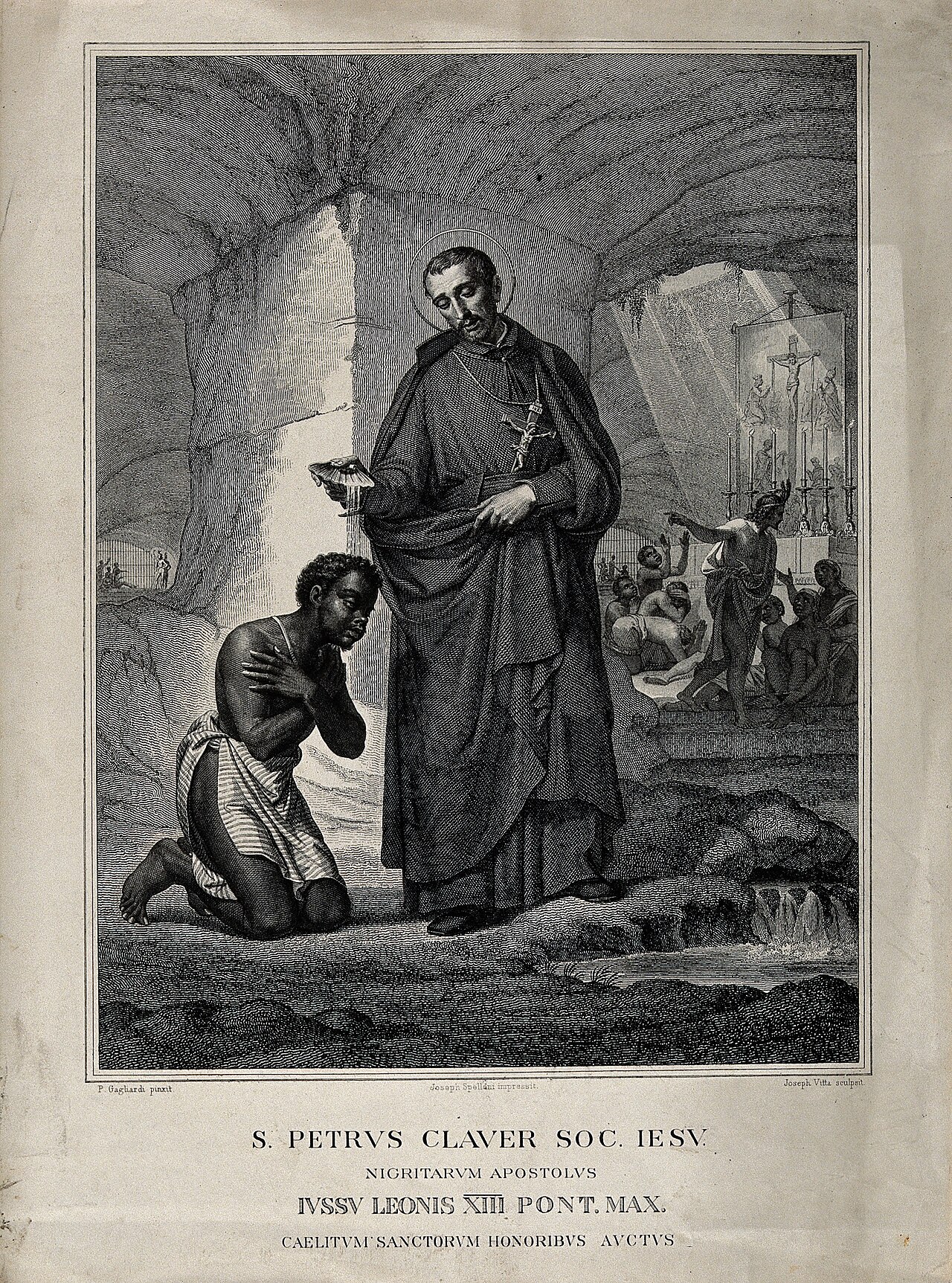
The son of a Catalonian farmer, was born at Verdu, in 1581; he died 8 September, 1654. He obtained his first degrees at the University of Barcelona. At the age of twenty he entered the Jesuit novitiate at Tarragona. While he was studying philosophy at Majorca in 1605, Alphonsus Rodriguez, the saintly door-keeper of the college, learned from God the future mission of his young associate, and thenceforth never ceased exhorting him to set out to evangelize the Spanish possessions in America. Peter obeyed, and in 1610 landed at Cartagena, where for forty-four years he was the Apostle of the negro slaves. Early in the seventeenth century the masters of Central and South America afforded the spectacle of one of those social crimes which are entered upon so lightly. They needed labourers to cultivate the soil which they had conquered and to exploit the gold mines. The natives being physically incapable of enduring the labours of the mines, it was determined to replace them with negroes brought from Africa. The coasts of Guinea, the Congo, and Angola became the market for slave dealers, to whom native petty kings sold their subjects and their prisoners. By its position in the Caribbean Sea, Cartagena became the chief slave-mart of the New World. A thousand slaves landed there each month. They were bought for two, and sold for 200 écus. Though half the cargo might die, the trade remained profitable. Neither the repeated censures of the pope, nor those of Catholic moralists could prevail against this cupidity. The missionaries could not suppress slavery, but only alleviate it, and no one worked more heroically than Peter Claver.
Trained in the school of Père Alfonso de Sandoval, a wonderful missionary, Peter declared himself the slave of the negroes forever=1F, and thenceforth his life was one that confounds egotism by its superhuman charity. Although timid and lacking in self- confidence, he became a daring and ingenious organizer. Every month when the arrival of the negroes was signalled, Claver went out to meet them on the pilot's boat, carrying food and delicacies. The negroes, cooped up in the hold, arrived crazed and brutalized by suffering and fear. Claver went to each, cared for him, and showed him kindness, and made him understand that henceforth he was his defender and father. He thus won their good will. To instruct so many speaking different dialects, Claver assembled at Cartagena a group of interpreters of various nationalities, of whom he made catechists. While the slaves were penned up at Cartagena waiting to be purchased and dispersed, Claver instructed and baptized them in the Faith. On Sundays during Lent [the forty days of fasting before Easter] he assembled them, inquired concerning their needs, and defended them against their oppressors. This work caused Claver severe trials, and the slave merchants were not his only enemies. The Apostle was accused of indiscreet zeal, and of having profaned the Sacraments by giving them to creatures who scarcely possessed a soul. Fashionable women of Cartagena refused to enter the churches where Father Claver assembled his negroes. The saint's superiors were often influenced by the many criticisms which reached them. Nevertheless, Claver continued his heroic career, accepting all humiliations and adding rigorous penances to his works of charity. Lacking the support of men, the strength of God was given him. He became the prophet and miracle worker of New Granada, the oracle of Cartagena, and all were convinced that often God would not have spared the city save for him. During his life he baptized and instructed in the Faith more than 300,000 negroes. He was beatified 16 July, 1850, Pius IX, and canonized 15 January, 1888, by Leo XIII. His feast is celebrated on the ninth of September. On 7 July, 1896, he was proclaimed the special patron of all the Catholic missions among the negroes. Alphonsus Rodriguez was canonized on the same day as Peter Claver.
Lives of the saints by DE ANDRADA (Madrid, 1657), DOMINGUES, DE LARA, SUAREZ, FERNANDEZ, FLUERIAN; SOMMERVOGEL, Bibl. de la Comp. de Jesus (Brussels, 1890—-); WASER (Paderborn, 1852); SOLA (Barcelona, 1888); HOVER (Dulmen, 1888); an excellent article by LEHMKUHL in Stimmen aus Maria-Laach, XXIV, 380 sqq.