St. Paulinus of Nola

Pontius Meropius Anicius Paulinus was born at Bordeaux about 354 and died on 22 June 431.

Read the essentials →
Feast June 22 · Bishop

St. Paulinus of Nola

Current feast

June 22
Verified · General Roman Calendar

Traditional feast

June 22
1914 / pre-1969 calendar, per Baring-Gould (1897)

Represents

Bishop

Feast days

Feast: June 22

This Saint’s Story

He came of a distinguished Aquitanian family and was educated by the poet Ausonius. He became governor of Campania, but soon found that public life could not give him the happiness he sought. Between about 380 and 390 he lived chiefly in his native land. He married Therasia, a Spanish Christian; to her, to Bishop Delphinus of Bordeaux and the priest Amandus, and to St. Martin of Tours—who, the Catholic Encyclopedia says, had cured him of a disease of the eye—he owed his conversion. Delphinus baptized Paulinus and his brother together.

When their only child died eight days after birth, and when Paulinus was threatened with a charge of having murdered his brother, he and Therasia resolved to withdraw from the world. They went to Spain about 390. At Christmas 394 or 395 the people of Barcelona obliged him to be ordained, though he had not yet received the other orders. Having a special devotion to St. Felix of Nola, he settled there with Therasia in 395, distributed most of his wealth to the poor, and lived a rigorous monastic life while building a hospice and a great basilica beside Felix's tomb, connected to the older mortuary chapel by a gallery and richly adorned with marble, lamps, paintings, and inscriptions.

About 409 he was chosen Bishop of Nola and served for some twenty years. Forty-nine letters survive, including correspondence with St. Augustine and Sulpicius Severus, together with thirty-three poems; after 395 he composed an annual hymn for the feast of St. Felix. The Catholic Encyclopedia says his writings breathe a charming, ideal personality, freed from earthly attachments, though Augustine thought him exaggerated in his veneration of saints and relics. He was regarded as a saint in his own lifetime. His body, after several translations, was restored to the cathedral of Nola under Pius X in 1908. His feast is 22 June.

Struggles & surrender

His struggles

  • Loss and accusation ·
    Paulinus and Therasia lost their only child eight days after birth, and Paulinus was threatened with a charge of murdering his own brother. Together these griefs led the couple to withdraw from the world.

Short entry · the summary here is 184 words; Baring-Gould’s fuller original text and its sources are below. We have not filled any gap with invented detail.

What he represents

How he teaches us to live

Drawn from themes in the original account

Celebrate this saint’s feast day. Remember him on June 22 with a short prayer, and ask for his help.

The full story

Baring-Gould’s account retold in modern English

Read the full story · 180 words · about 1 min

The poems of Saint Paulinus contain one of the earliest descriptions of Christian painting, found in the church of Saint Felix at Nola. In the colonnades of that church, scenes from the Old Testament were painted. Among these were the Crossing of the Red Sea, Joshua and the Ark, and Ruth and her sister-in-law, with one deserting and the other following Naomi in loyal fidelity. The poet suggests that this represents humanity—part deserting and part adhering to the true faith.

Saint Gregory the Great tells a story about a Paulinus, bishop of Nola, which has been included in the Breviary as the lesson for the festival of this Saint Paulinus. However, there were three bishops of Nola with the same name, and the story told by Saint Gregory actually belongs to Paulinus III. The story goes that the Vandals devastated Italy and plundered Nola, taking half the inhabitants captive. Paulinus offered himself as a slave in place of a widow’s son. The Vandal invasion did not occur until long after the death of Saint Paulinus, the subject of this notice.

Footnotes

  1. The Vandal incursion did not take place until long after the death of Saint Paulinus.

Baring-Gould’s own footnotes, in modern English.

Read the original 1870s text

Baring-Gould’s sources: Roman and almost all Latin Martyrologies. Authority: — Mention in the letters of S. Paulinus himself, and of his master Ausonius, mention by Sulpicius Severus, S. Ambrose, S. Augustine, S. Jerome, Pope S. Anastasius and S. Eucherius. Also an account of his death in an epistle of U rani us, priest o» Nola, at the time.] S. Paulinus, the son of Pontius Paulinus, pretorian prefect in Gaul, was born about the year 353, at Bordeaux, or Embrau, four leagues from Bordeaux. The family was noble, of consular and patrician rank, and was a branch of the illustrious Anician family. Paulinus studied with the poet Ausonius, and under his tuition became accomplished as an orator and a poet. He married Tharasia, a Spanish lady of great virtue. The prudence and rank of Paulinus led the emperor Valentinian the Elder to appoint him to be prefect of Rome. Public and private business kept him for fifteen years incessantly occupied, and led him to visit Spain and Gaul repeatedly. On one of his journeys he met S. Ambrose of Milan, who conceived a great respect for Janeaa.).S. PaullflUS. 305 him. His wife bore him one son, after many years of sterility, but the child died almost directly, to the great grief of his father, whose ambition it was to have a son to inherit his name and fortune. On a visit to Nola where he had possessions, Paulinus was struck with certain miracles he saw performed at the tomb of S. Felix, and resolved to devote himself to a Christian life. As yet he was not baptized, and it was not till fifteen years after, at the age of thirty-eight, that he received the washing of regeneration from the hands of Delphinus, bishop of Bordeaux. He then retired into Spain to Barcelona, where his wife had lands, and there the clergy and people forced him to receive priests’ orders from the hands of Lampius, the bishop. He remained four years in Spain, sold his possessions there and distributed the proceeds among the poor, and then went to Milan, where he was warmly received by S. Ambrose, who retained him at Milan for a while. After the death of S. Ambrose, Paulinus went to Rome, where he met with an icy reception from the clergy and pope, Siricius, perhaps from his having been in friendly relation with S. Jerome, whom the clergy of Rome detested, and who had been a candidate for the papal throne in opposition to Siricius. Finding his presence occasioned bickerings and annoyance in Rome, Paulinus withdrew to Nola with his wife Tharasia, and there both retired into separate cells and lived as hermits. This proceeding caused universal surprise, and some indignation. Many of his friends remonstrated, among the number was Ausonius, at his burying his splendid talents in an obscure country town, and withdrawing his abilities from the direction of public and ecclesiastical affairs. But in spite of evil report and good report, Patdinus continued to live as a recluse till, on the death VOL vi. -o of their bishop, the people of Nola elected him to be their chief pastor. He governed his see with prudence. He died on June 22nd, in the year 431; and after his death appeared in vision to John, bishop of Naples, his garments white, sprinkled over with stars, and holding a honeycomb in his hand.

The poems of S. Paulinus contain one of the earliest descriptions of Christian painting, in the church of S. Felix at Nola. In the colonnades of that church were painted scenes from the Old Testament: among them were the Passage of the Red Sea, Joshua and the Ark, Ruth and her sister-in-law, one deserting, the other following Naomi in fond fidelity; an emblem, the poet suggests, of mankind — part deserting, part adhering to the true faith.

S. Gregory the Great relates a story of a Paulinus, bishop of Nola, which has found its way into the Breviary as the lesson for the festival of this S. Paulinus. But there were three bishops of Nola of the same name, and the stoiy related by S. Gregory belongs to Paulinus III. It is to the effect that the Vandals devastated Italy and pillaged Nola, carrying off half the inhabitants captive. Paulinus gave himself up as slave in the place of a widow’s son. The Vandal incursion did not take place till long after the death of S. Paulinus, the subject of this notice* S. Felix.

From the Catholic Encyclopedia

1913 · 772 words

Born at Bordeaux about 354; died 22 June, 431. He sprang from a distinguished family of Aquitania and his education was entrusted to the poet Ausonius. He became governor of the Province of Campania, but he soon realized that he could not find in public life the happiness he sought. From 380 to 390 he lived almost entirely in his native land. He married a Spanish lady, a Christian named Therasia. To her, to Bishop Delphinus of Bordeaux and his successor the Presbyter Amandus, and to St. Martin of Tours, who had cured him of some disease of the eye, he owed his conversion. He and his brother were baptized at the same time by Delphinus. When Paulinus lost his only child eight days after birth, and when he was threatened with the charge of having murdered his brother, he and his wife decided to withdraw from the world, and to enter the monastic life. They went to Spain about 390.

At Christmas, 394, or 395, the inhabitants of Barcelona obliged him to be ordained, which was not canonical as he had not previously received the other orders. Having had a special devotion to St. Felix, who was buried at Nola in Campania, he laid out a fine avenue leading to the church containing Felix's tomb, and beside it he erected a hospital. He decided to settle down there with Therasia; and he distributed the largest part of his possessions among the poor. In 395 he removed to Nola, where he led a rigorous, ascetic, and monastic life, at the same time contributing generously to the Church, the aqueduct at Nola, and the construction of basilicas in Nola, Fondi, etc. The basilica at Nola counted five naves and had on each side four additions or chapels (cubicula), and an apsis arranged in a clover shape. This was connected with the old mortuary chapel of St. Felix by a gallery. The side was richly decorated with marble, silver lamps and lustres, paintings, statuary, and inscriptions. In the apsis was a mosaic which represented the Blessed Trinity, and of which in 1512 some remnants were still found.

About 409 Paulinus was chosen Bishop of Nola. For twenty years he discharged his duties in a most praiseworthy manner. His letters contain numerous biblical quotations and allusions; everything he performed in the Spirit of the Bible and expressed m Biblical language. Gennadius mentions the writings of Paulinus in his continuation of St. Jerome's "De Viris Illustribus " (xlix). The panegyric on the Emperor Theodosius [name of Roman emperors; Theodosius I (379–395) made Christianity the state religion] is unfortunately lost, as are also the Opus sacramentorum et hymnorum", the "Epistolae ad Sororem", the "Liber de Paenitentia", the "Liber de Laude Generali Omnium Martyrum", and a poetical treatment of the "De Regibus" of Suetonius which Ausonius mentions. Forty-nine letters to friends have been preserved, as those to Sulpicius Severus, St. Augustine, Delphinus, Bishop Victricius of Rouen, Desiderius, Amandus, Pammachius, etc. Thirty-three poems are also extant. After 395 he composed annually a hymn for the feast of St. Felix, in which he principally glorified the life, works, and miracles of his holy patron. Then going further back he brought in various religious and poetic motives. The epic parts are very vivid, the lyrics full of real, unaffected enthusiasm and an ardent appreciation of nature. Thirteen of these poems and fragments of the fourteenth have preserved.

Read the rest of the article

Conspicuous among his other works are the poetic epistles to Ausonius, the nuptial hymn to Julianus, which extols the dignity and sanctity of Christian marriage, and the poem of comfort to the parents of Celsus on the death of their child. Although Paulinus has great versatility and nicety, still he is not entirely free from the mannerisms and ornate culture of his period. All his writings breathe a charming, ideal personality, freed from all terrestrial attachments, ever striving upward. According to Augustine, he also had an exaggerated idea concerning the veneration of saints and relics [the bodily remains of a saint, or objects they used, kept with honor]. His letter xxxii, written to Sulpicius Severus, has received special attention because in it he describes the basilica of Nola, which he built, and gives copious accounts of the existence, construction, and purpose of Christian monuments. From Paulinus too we have information concerning St. Peter's in Rome. During his lifetime Paulinus was looked upon as saint. His body was first interred in the cathedral of Nola; later, in Benevento; then it was conveyed by Otto III to S. Bartolomeo all'Isola, in Rome, and finally in compliance with the regulation of Pius X of 18 Sept., 1908 (Acta Apostolicae Sedis, I, 245 sq.) was restored to the cathedral of Nola. His feast, 22 June, was raised to the rank of a double.
Help us add to this saint's story

Everything is read by a person before anything appears. Facts are checked against trusted sources first.

Facts are welcome; a source link helps (optional).With your permission we may share it on this page.

Nine days · Free

Pray the novena
with us.

One short email a day for nine days. The day's prayer, a line from St. Paulinus of Nola's story, and a nudge to keep going.

Also on June 22
A

St. Alban

June 22 · Martyr
T

Sts. Ten Thousand Martyrs

June 22 · Feast
St. Thomas More

St. Thomas More

June 22 · Martyr
← All 1970 saints in the library
Sources & notes

Feast-day sources

Story sources

Sources

Credits

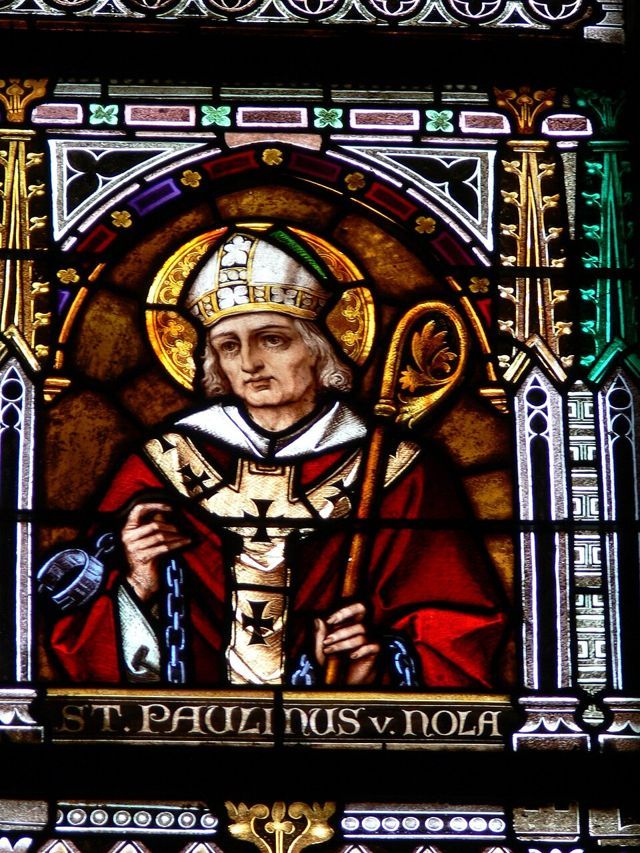
Image: Linzer Dom - Fenster - Paulinus von Nola.jpg · Wolfgang Sauber · CC BY-SA 3.0, via Wikimedia Commons

Image: Wolfgang Sauber, Wikimedia Commons (CC BY-SA 3.0)

From “Catholic Encyclopedia (1913)/St. Paulinus, Bishop of Nola,” The Catholic Encyclopedia (New York: Robert Appleton Company, 1907–1914), via Wikisource. Public domain. Matched by name and feast date; text unedited except for our bracketed notes in grey.

Retold in plain modern English from Baring-Gould’s public-domain text, sentence by sentence, keeping the same facts and order. Short explanations in parentheses are ours.

From Sabine Baring-Gould, The Lives of the Saints, new edition in 16 vols. (London: John C. Nimmo, 1897–98); text from the Internet Archive scan (OCR, lightly cleaned; errors possible). Public domain in the United States. Reproduced unedited, except for short bracketed notes in grey that we added to explain names and terms (“S.” is the old abbreviation for Saint). Some history and judgments reflect 19th-century scholarship.

Notes

Story retold in our own words from the cited sources.